
Safety compliance automation: Streamline H&S with AI
Safety compliance automation: Streamline H&S with AI
TL;DR:
- AI-driven safety compliance automation reduces manual tasks and strengthens regulatory adherence across construction and manufacturing.
- It streamlines risk assessments, incident reporting, inspections, and documentation, delivering meaningful time and cost savings.
- Human oversight remains essential to address data quality issues, validate outputs, and maintain legal compliance under UK health and safety law.
Keeping up with health and safety compliance in construction and manufacturing has never felt more demanding. Mounting paperwork, tightening regulations, and stretched teams leave many H&S officers buried in repetitive tasks rather than focusing on what genuinely matters: keeping people safe. The good news is that AI-driven automation is fundamentally changing this picture. In this guide, we explain exactly what safety compliance automation is, how its core technologies work, the real-world benefits you can expect, the limitations you must understand, and how to decide whether it is the right move for your organisation.
Table of Contents
- What is safety compliance automation?
- Key features and core technologies
- Tangible benefits for UK health and safety officers
- Risks, limitations, and common pitfalls
- Is automation right for your organisation?
- A fresh perspective: Automation is not a silver bullet—here’s what really works
- Unlock the benefits of safety compliance automation with LifeSafety.ai
- Frequently asked questions
Key Takeaways
| Point | Details |
|---|---|
| AI handles repetitive tasks | AI automates risk assessments, incident reports, and regulatory document workflows to save time and reduce errors. |
| Legal oversight is essential | AI systems always require competent human review under UK law to remain compliant. |
| Tangible ROI and risk drop | Firms see audit pass rates up to 92 percent and significant injury prevention with automation. |
| Choose proven platforms | Prioritise solutions with HSE/CDM integration, offline support, and robust audit trails. |
What is safety compliance automation?
To understand whether automation could help, we first need to clarify exactly what safety compliance automation means and what problems it solves.
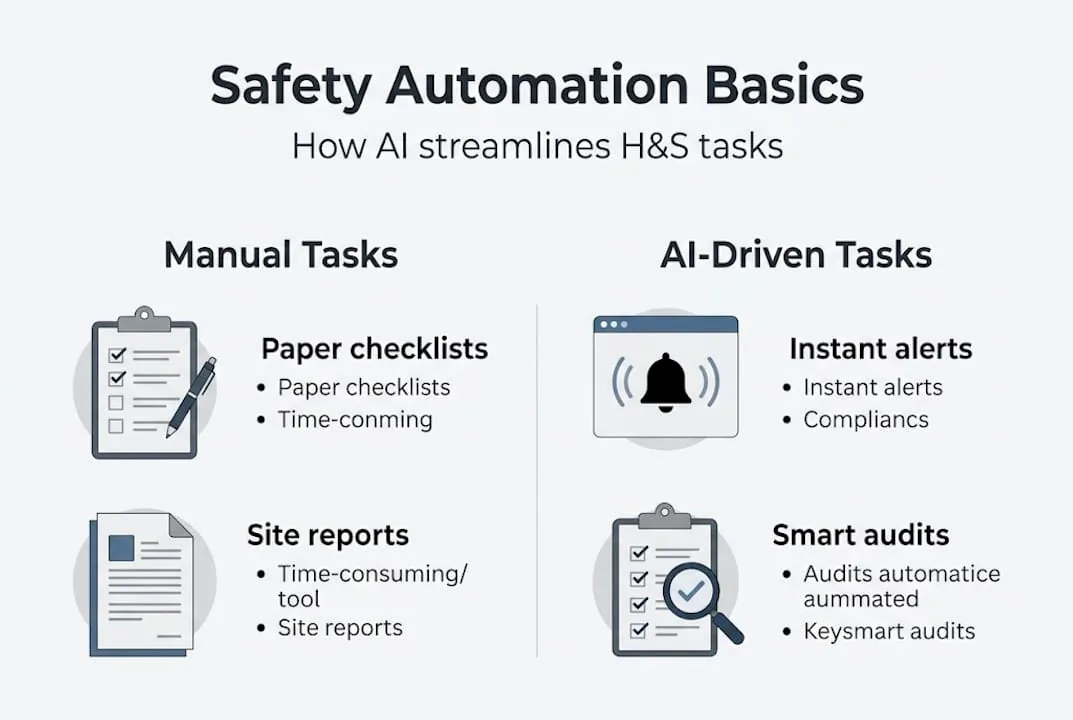
At its core, safety compliance automation uses AI and software to handle health and safety tasks such as risk assessments, incident reporting, inspections, PPE monitoring, and regulatory document generation, replacing manual processes with digital workflows, real-time monitoring, and predictive analytics. Rather than relying on spreadsheets and paper forms, automated systems capture data continuously, flag issues proactively, and generate audit-ready documentation without manual intervention.
For UK industries, this matters enormously. Regulations such as CDM 2015, COSHH, the Health and Safety at Work etc. Act 1974, and the Building Safety Act place significant documentation and reporting obligations on duty holders. Meeting these manually is time-consuming and error-prone. Automation addresses both problems directly.
Consider the difference in practice. A manual approach to a risk assessment might take an experienced officer several hours, involve multiple paper forms, and require separate sign-off workflows. An automated approach, guided by AI and safety management platforms, can generate a compliant draft in minutes, pre-populated with relevant hazards, controls, and legislative references.
“Safety compliance automation replaces reactive, paper-based processes with proactive, data-driven workflows that align with UK regulatory requirements from the outset.”
The table below illustrates the core contrast between manual and automated compliance approaches:
| Task | Manual approach | Automated approach |
|---|---|---|
| Risk assessment | 2 to 4 hours, paper-based | 20 minutes, AI-generated |
| Incident reporting | Post-event, often delayed | Real-time mobile logging |
| Inspection scheduling | Calendar reminders, ad hoc | Automated triggers and alerts |
| Audit documentation | Manual collation | Auto-generated audit trails |
Explore the full range of AI platform features to see how these capabilities translate into practical tools. You can also review RAMS automation methods for further context on document automation in construction.
Key features and core technologies
After establishing the basics, it is crucial to explore the real engines powering automation and how they map onto current legal and practical needs.
Core methodologies include AI-driven RAMS generation for CDM and HSE compliance, automated COSHH assessments, CMMS for inspection scheduling and audit trails in manufacturing, computer vision for PPE detection, and machine learning for hazard prediction and incident classification. Each of these technologies targets a specific compliance pain point.
Here is a breakdown of the key tools:
- RAMS generation: AI analyses task descriptions, identifies hazards, applies UK legislation, and produces HSE-ready method statements and risk assessments automatically.
- COSHH automation: Software maps substances to regulatory exposure limits, generates assessments, and flags substitution opportunities.
- CMMS (Computerised Maintenance Management Systems): Schedules inspections, tracks asset maintenance, and maintains full audit trails for regulatory review.
- PPE detection: Computer vision cameras monitor workers in real time, identifying missing or incorrectly worn protective equipment and triggering instant alerts.
- Machine learning hazard prediction: Analyses historical incident data to identify patterns and predict where future incidents are most likely to occur.
The comparison below shows how manual and AI-driven tools differ in practical terms:
| Feature | Manual tool | AI-driven tool |
|---|---|---|
| Hazard identification | Officer judgement | Pattern-matched + predictive |
| PPE compliance | Visual spot checks | Continuous computer vision |
| Audit trail | Paper files | Automated, timestamped logs |
| Regulatory updates | Manual review | Auto-updated rule sets |
Integration with the Building Safety Act’s Golden Thread requirement is particularly significant. Digital audit trails created automatically by these platforms satisfy the Golden Thread’s demand for accurate, accessible safety records throughout a building’s lifecycle. Learn more about PPE detection technology and how it fits within a broader compliance framework.
Pro Tip: Always ensure your chosen platform includes a human-in-the-loop override function. Automated outputs must be reviewable and approvable by a competent person to satisfy UK legal requirements and maintain robust audit trails.
Tangible benefits for UK health and safety officers
Understanding the available technology is one thing, but how does this impact your daily work and business results?
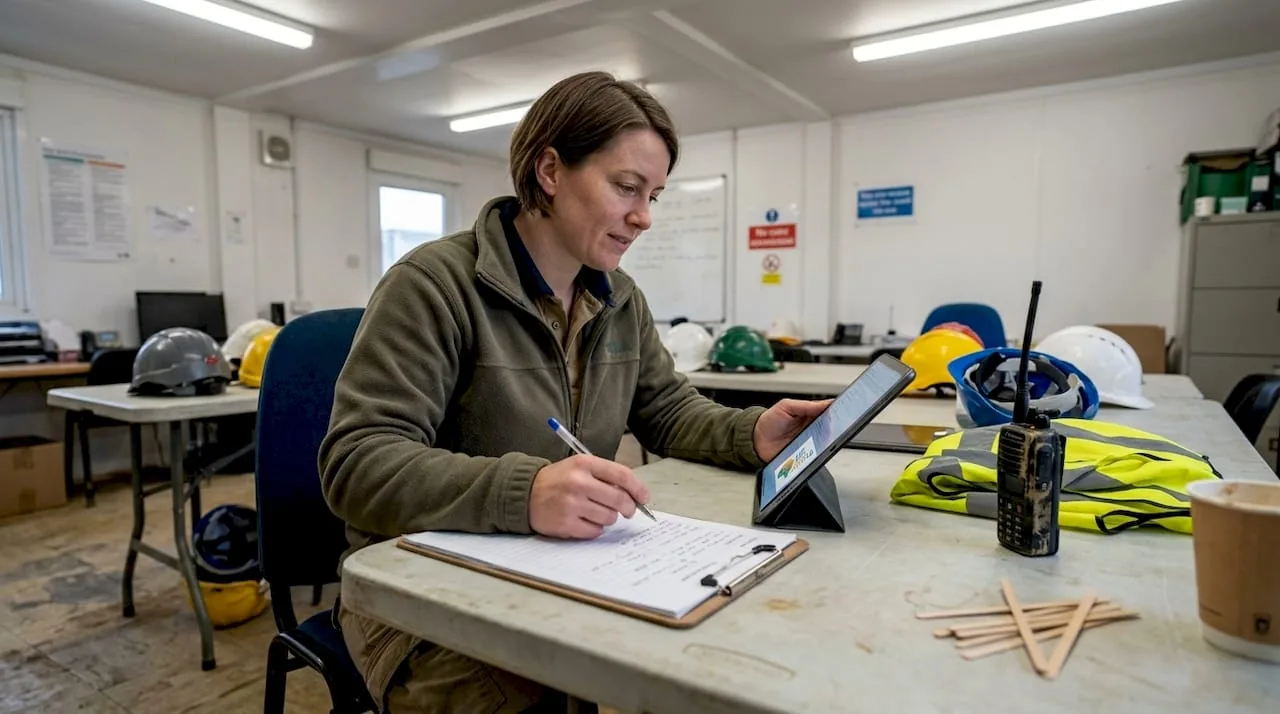
The efficiency gains are striking. Empirical benchmarks show an 85% reduction in recordkeeping time, a 97% inspection on-time rate compared to 57 to 68% manually, 87% time savings on RAMS preparation from four hours to just 20 minutes, a 92% audit pass rate, and a 50 to 70% drop in recordable injuries alongside a tenfold increase in near-miss reporting. One manufacturing case study recorded zero recordable incidents following implementation.
The financial case is equally compelling. Data indicates annual savings of approximately £47,500 per 50-person firm, driven by reduced admin time, fewer regulatory fines, and faster project approvals. Gateway 3 approvals under the Building Safety Act are completed 42% faster with automated documentation support.
Here is a numbered summary of the core benefits:
- Time savings: Dramatically reduce hours spent on risk assessments, inspections, and reporting.
- Accuracy: Eliminate human error in document generation and hazard identification.
- Audit readiness: Maintain continuously updated, audit-ready records without manual collation.
- Injury prevention: Predictive analytics and AI risk assessment reduce recordable incidents by up to 70%.
- Financial savings: Avoid regulatory fines, reduce insurance premiums, and recover admin hours.
- Near-miss culture: Easier mobile reporting tools encourage workers to log near-misses, improving your leading indicator data.
The AI PPE module is a strong example of how a single technology can deliver multiple benefits simultaneously, combining injury prevention, compliance monitoring, and real-time alerting in one system.
Pro Tip: Standardise your data entry processes before deploying automation. Clean, consistent input data is the single biggest factor in maximising ROI and ensuring your AI-generated outputs are accurate and legally defensible.
Risks, limitations, and common pitfalls
While automation offers clear advantages, it is not without critical caveats, especially in high-risk and regulated environments.
AI cannot replace competent persons under UK law. Human review is required for legal validity, and AI outputs may carry risks including poor data quality, occlusions in PPE detection, biased training data leading to inaccurate risk profiles for diverse workers, automation bias, and fragmented supply chains. These are not theoretical concerns. They are practical challenges that have caused real compliance failures.
“Automation bias, where practitioners accept AI outputs without critical review, is one of the most significant risks in high-hazard environments. The technology supports your judgement; it does not replace it.”
Common mistakes H&S officers make when adopting automation include:
- Skipping data quality checks: Feeding poorly structured or incomplete historical data into AI systems produces unreliable outputs.
- Removing human sign-off: Treating automated documents as final without competent person review creates legal exposure.
- Ignoring edge cases: AI trained on majority-group data may underperform for minority worker profiles or unusual site conditions.
- Neglecting audit trails: Failing to configure systems to retain full decision logs undermines your position in an inspection or incident investigation.
- Over-automating too quickly: Rushing full deployment without a pilot phase leads to process failures and staff resistance.
The site safety challenges faced in construction are a useful reference point for understanding where automation helps and where human expertise remains irreplaceable. For a wider view of the risks, the British Safety Council’s analysis of unreliable AI decisions in high-hazard industries is essential reading. Real-time PPE monitoring also requires careful calibration to minimise false positives that erode worker trust.
Is automation right for your organisation?
Not every business needs the same level of automation, and not every process should be automated at once. The right approach depends on your risk profile, regulatory burden, operational complexity, and internal capability to govern the technology properly.
For many UK construction contractors, principal designers, principal contractors, manufacturers, and facilities teams, the strongest starting point is not a full digital overhaul. It is a targeted deployment focused on the most repetitive, high-volume, and compliance-sensitive tasks. These often include RAMS generation, inspection scheduling, action tracking, near-miss reporting, COSHH management, and audit trail creation.
If your organisation is considering adoption, assess the following factors first:
- Regulatory pressure: Are you managing obligations under RIDDOR, CDM 2015, COSHH, the Building Safety Act, or sector-specific HSE guidance that create heavy documentation demands?
- Process volume: Do your teams produce large numbers of risk assessments, permits, inspections, maintenance checks, or incident reports each month?
- Data maturity: Is your existing safety data structured, accessible, and reliable enough to support automation?
- Operational spread: Are you managing multiple sites, subcontractors, or mobile teams where consistency is difficult to maintain manually?
- Governance capability: Do you have competent persons available to review outputs, manage exceptions, and maintain accountability?
A practical way to decide is to score your current pain points against likely automation value. If your biggest issues are delayed reporting, inconsistent documentation, missed inspections, or weak audit readiness, automation is likely to deliver immediate benefit. If your main challenge is poor leadership engagement or weak frontline culture, technology alone will not solve the problem.
| Question | If yes | What it suggests |
|---|---|---|
| Do you spend hours each week on repetitive paperwork? | High admin burden | Start with document and workflow automation |
| Do inspections or actions get missed across sites? | Control gaps | Use automated scheduling and alerts |
| Do you struggle to evidence compliance during audits? | Weak records | Prioritise audit trails and centralised records |
| Do you already have strong competent-person oversight? | Good governance | You are better placed for safe AI adoption |
In most cases, the best route is a phased implementation. Pilot one or two use cases, measure time savings and compliance improvements, then expand only when the controls, training, and review processes are working reliably.
A fresh perspective: Automation is not a silver bullet—here’s what really works
There is a temptation in safety technology discussions to frame automation as the answer to every compliance problem. That is too simplistic. In reality, the organisations that achieve the best outcomes do not just buy software. They redesign workflows, improve data discipline, clarify accountability, and strengthen the role of competent review.
What really works is a blended model:
- Automate the repetitive: Use AI for first drafts, scheduling, reminders, classification, and record collation.
- Keep expert judgement central: Ensure competent persons validate risk controls, unusual hazards, and legal interpretations.
- Build trust through transparency: Make it clear how outputs are generated, what data is used, and where human approval sits.
- Measure leading indicators: Track near-miss reporting, action close-out rates, inspection completion, and training compliance, not just injury totals.
- Review and refine: Audit the automation itself. Check for drift, bias, false positives, and process workarounds.
This perspective matters because UK compliance is not just about producing documents. It is about demonstrating that risks have been assessed by competent people, controls are suitable and sufficient, and information is available when needed for workers, regulators, and duty holders. Under RIDDOR, CDM 2015, and the Building Safety Act, accountability remains with the organisation, not the software vendor.
“The most effective safety automation programmes do not remove people from the process. They remove friction from the process so people can focus on higher-value safety decisions.”
That is why the strongest implementations are usually those that improve both compliance performance and safety culture. Workers report more near-misses because reporting is easier. Managers close actions faster because reminders are automatic. Audits become less stressful because records are already organised. And H&S teams spend more time on prevention rather than paperwork.
Unlock the benefits of safety compliance automation with LifeSafety.ai
For organisations ready to modernise compliance, LifeSafety.ai provides a practical route to safer, faster, and more defensible health and safety management. Rather than replacing your team’s expertise, the platform is designed to support it with structured workflows, AI-assisted documentation, real-time monitoring, and clear auditability.
LifeSafety.ai is particularly well suited to UK construction and manufacturing environments where teams must balance operational pace with strict legal duties. Whether you are managing site inspections, RAMS, PPE compliance, incident reporting, or Building Safety Act record requirements, the goal is the same: reduce friction while improving control.
Key areas where LifeSafety.ai can help include:
- AI-assisted risk documentation: Generate faster first drafts for risk assessments and method statements while retaining competent-person approval.
- Inspection and action management: Schedule, assign, and track inspections and corrective actions across multiple sites.
- PPE and site monitoring: Use intelligent detection tools to identify non-compliance in real time and support intervention before incidents occur.
- Audit-ready records: Maintain centralised, timestamped evidence aligned with HSE expectations and Golden Thread principles.
- Operational visibility: Surface trends in hazards, near-misses, overdue actions, and recurring compliance gaps.
If you want to explore what this looks like in practice, review the full LifeSafety.ai feature set, learn more about AI PPE detection, or see how AI safety management is evolving across the sector. The right platform should help you save time, improve consistency, and strengthen legal defensibility without weakening human accountability.
In short, the best automation strategy is one that makes compliance easier to achieve and easier to prove.
Frequently asked questions
What is safety compliance automation in simple terms?
It is the use of AI and software to automate repetitive health and safety tasks such as risk assessments, inspections, incident logging, action tracking, and compliance documentation. The aim is to reduce manual effort, improve consistency, and create stronger audit trails.
Can AI make health and safety decisions on its own?
No. Under UK law, AI should support decision-making, not replace competent persons. Duty holders remain responsible for ensuring assessments are suitable and sufficient, controls are appropriate, and legal duties are met.
How does automation help with RIDDOR and HSE compliance?
Automation helps by improving the speed and accuracy of incident capture, maintaining complete records, prompting follow-up actions, and making evidence easier to retrieve during inspections or investigations. It supports compliance, but it does not remove the need for correct legal judgement on reportability and response.
What are the biggest risks when adopting safety automation?
The main risks are poor data quality, over-reliance on AI outputs, weak human review, incomplete audit trails, and bias or inaccuracy in edge cases. These risks can be managed through governance, pilot testing, training, and clear approval workflows.
Which processes should be automated first?
Most organisations benefit from starting with high-volume, repetitive, and documentation-heavy processes such as RAMS drafting, inspection scheduling, action tracking, near-miss reporting, and audit record management. These usually deliver quick wins without removing critical human judgement.
Is automation only useful for large organisations?
No. Smaller contractors and manufacturers can also benefit, especially where limited H&S resource creates admin pressure. Even modest automation can save time, improve consistency, and reduce the risk of missed actions or incomplete records.
How do I know if a platform is suitable for UK compliance?
Look for evidence of support for UK workflows and terminology, strong audit trails, configurable approval steps, mobile and offline capability, and alignment with requirements relevant to your business such as CDM 2015, COSHH, RIDDOR, and Building Safety Act recordkeeping.
What is the best way to implement safety compliance automation?
Start with a pilot. Choose one or two use cases, clean your data, define approval responsibilities, train users, and measure outcomes such as time saved, inspection completion, action close-out, and audit readiness. Expand only when the process is stable and trusted.
Related Articles

HSE for Data Centres
Data-centre HSE is electrical plant, COSHH, permits and night-shift people risk. LifeSafety.ai puts UK compliance and live dashboards in one system.

Risk Assessment vs Method Statement (RAMS): Key Differences
A risk assessment identifies what could cause harm; a method statement sets out how the work will be done safely. Here is how they differ, what UK law actually requires, and when you need both.

Employee Incident Report form: RIDDOR-Ready Template Guide
Ensure workplace safety with our RIDDOR-ready employee incident report form. Download the template and streamline your incident reporting today!