Remote safety monitoring: boost UK compliance today
Remote safety monitoring: boost UK compliance today
Remote safety monitoring is rapidly becoming essential for UK construction and manufacturing organisations that need stronger audit evidence, faster hazard response, and more defensible compliance under HSE expectations, RIDDOR duties, CDM 2015 coordination requirements, and wider duty-of-care obligations.
TL;DR
- Remote safety monitoring has become essential for UK construction and manufacturing organisations to meet evolving regulations and improve audit evidence.
- It provides continuous, timestamped data collection that supports proactive risk management and helps protect both site-based and remote workers.
- Effective implementation depends on clear workflows, sound data governance, and a culture shift from surveillance to continuous improvement.
Remote safety monitoring has become a non-negotiable priority for UK construction and manufacturing organisations facing rising regulatory scrutiny. Manual safety checks create audit gaps that are difficult to defend before the HSE, particularly when incident timelines are disputed and paper records are incomplete. Real-time monitoring simplifies construction HSE/GDPR audits, providing the timestamped, evidence-based oversight that regulators increasingly expect. If your organisation is still relying on manual walkthroughs and periodic written reports, it is time to understand exactly what you are missing and how remote monitoring closes those critical gaps.
Table of Contents
- The urgent compliance drivers behind remote safety monitoring
- How remote monitoring transforms safety evidence and risk management
- Key technology approaches in construction and manufacturing
- Expert pitfalls, compliance risks and implementation advice
- Our take: What most compliance guides miss about remote safety monitoring
- Next steps: optimising your compliance with innovative reporting and monitoring
- Frequently asked questions
Key Takeaways
| Point | Details |
|---|---|
| Strengthen compliance evidence | Remote monitoring provides continuous, timestamped records that help prove your diligence to UK regulators. |
| Reduce audit risks | Automated monitoring closes human error gaps in safety documentation and risk management. |
| Support both on-site and remote staff | Systems enable you to meet duty of care, regardless of where your staff are located. |
| Integrate, don’t substitute | Remote monitoring should enhance—not replace—robust risk management practices. |
The urgent compliance drivers behind remote safety monitoring
UK health and safety law has never been static, and the pace of change is accelerating. The HSE is placing greater emphasis on proactive risk management and expects employers to demonstrate that they are actively monitoring workplace conditions rather than simply reacting to incidents after they occur. This shift moves organisations from a “record and report” culture toward a “detect and prevent” framework, and remote monitoring is the key enabler.
Health surveillance helps detect ill-health effects early and requires employers to use the findings to update their risk assessments and controls. This is not simply a box-ticking exercise. It means organisations must have live mechanisms to gather health and exposure data, interpret it meaningfully, and feed those insights back into active safety controls. Remote monitoring sensors, automated alerts, and continuous data logging are precisely the tools that make this feasible at scale across large construction sites or complex manufacturing facilities.
The obligations extend far beyond the physical site. In 2026, hybrid and home working is embedded in many organisations, including those in construction and manufacturing where office-based project managers, estimators, and procurement teams regularly work remotely. The HSE is clear that home workers must be protected with the same rigour as onsite staff, requiring risk assessments and appropriate controls for every employee regardless of location.
The compliance landscape for both onsite and remote workers can be complex. You may find it helpful to review the compliance differences guide to understand how UK requirements compare with international standards. When monitoring workplace risks consistently, organisations build the robust evidence base that the HSE expects to see during inspections and enforcement actions.
Key compliance drivers accelerating remote monitoring adoption include:
- Increasing HSE enforcement activity and higher penalties for failure to demonstrate proactive risk control
- CDM 2015 obligations requiring principal contractors to maintain coordinated site safety records
- RIDDOR reporting obligations that demand timely, accurate incident data and audit trails
- Growing duty of care for remote and hybrid workers across all business functions
- BS standards for occupational health and safety management calling for regular risk review cycles
“Employers must protect the health and safety of home workers as they would for office-based staff. Risk assessments and controls are required regardless of where the work is performed.” — HSE, 2026
How remote monitoring transforms safety evidence and risk management
Understanding the compliance drivers is only the beginning. The real value of remote monitoring lies in the quality and completeness of the evidence it generates. This is where manual and remote approaches diverge most dramatically, and where the business case for investing in remote monitoring becomes undeniable.
Manual audit trails rely on individuals to complete checklists, sign off inspections, and file reports accurately and on time. The reality in busy construction and manufacturing environments is that paperwork slips, inspections are rushed, and records are sometimes backdated. When an incident occurs or an HSE inspector arrives, fragmented manual records create uncertainty and expose organisations to enforcement action.
Remote monitoring creates timestamped audit trails that regulators expect, with minimal human input. Every sensor reading, camera capture, access event, and alert is recorded automatically, creating an unbroken chain of evidence that is far more difficult to challenge. This does not just protect organisations during investigations; it actively enables continuous improvement by surfacing patterns in near-miss events, equipment faults, and behavioural risks.
| Feature | Manual monitoring | Remote monitoring |
|---|---|---|
| Audit trail completeness | Partial, dependent on human input | Continuous, automated, timestamped |
| Response to hazards | Delayed, often post-incident | Real-time alerts and automated triage |
| Data retention | Paper files, risk of loss | Secure cloud storage, instant retrieval |
| HSE evidence quality | Variable, gaps possible | Consistent, regulatorily defensible |
| Scalability across sites | Resource-intensive | Scalable with minimal additional staff |
| Error rate | High (fatigue, oversight) | Very low (automated logging) |
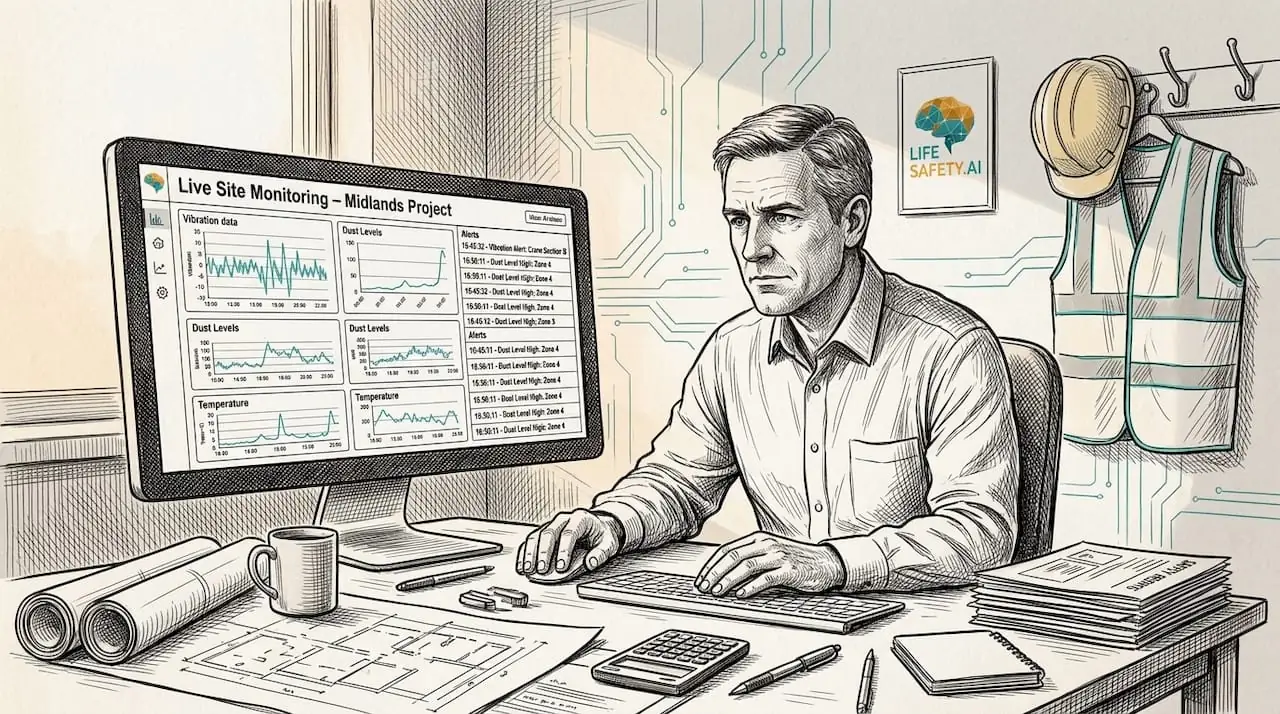
Consider a practical construction site example. A principal contractor managing a multi-phase project in the Midlands installs environmental sensors for noise, dust, and temperature alongside video analytics for PPE compliance at access points. Every morning shift begins with automated confirmation that workers entering the site are wearing appropriate head protection and hi-visibility clothing. Any anomaly triggers an immediate alert to the site safety manager’s mobile device. At month end, the platform automatically compiles a compliance report for the client and the principal designer. This is the standard remote monitoring is setting, and it aligns directly with construction site safety best practice.
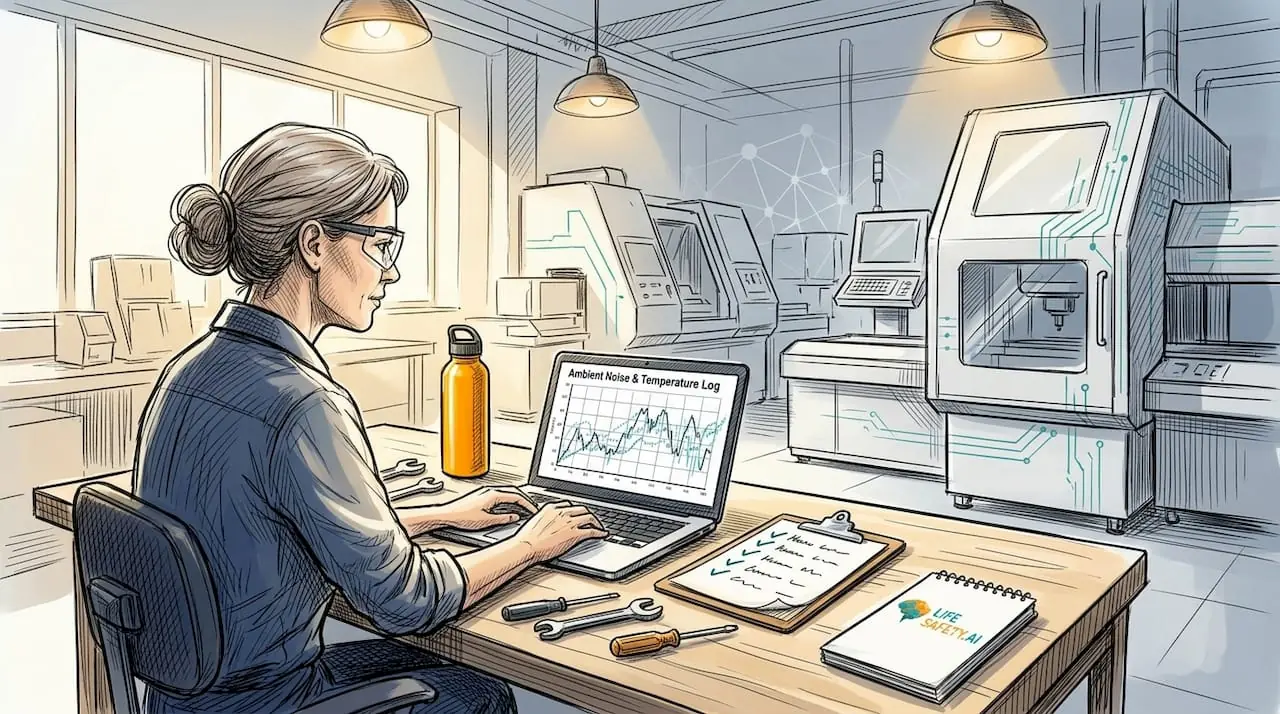
For manufacturing environments, the application is equally powerful. Continuous monitoring of machine health data, ambient air quality, and noise exposure levels feeds directly into real-time safety insights that safety managers can act on before conditions deteriorate to dangerous levels. The importance of ConSASS for compliance demonstrates how structured safety scoring frameworks, supported by real-time data, can elevate compliance performance across entire project lifecycles.
Pro Tip
When deploying remote monitoring, configure your alert thresholds based on your specific risk assessments rather than generic defaults. Site-specific thresholds generate more actionable data and reduce alert fatigue among your safety team.
Key technology approaches in construction and manufacturing
What technologies actually make remote monitoring work in practice? The answer varies by sector, site complexity, and the specific risks being managed, but several proven approaches stand out across UK construction and manufacturing.
Remote monitoring using sensors provides real-time insight into equipment condition and reduces exposure to risks by enabling predictive maintenance and early hazard detection. Sensors are now compact, affordable, and increasingly wireless, making them practical even for temporary construction sites.
| Technology | Primary application | Compliance benefit |
|---|---|---|
| Environmental sensors | Air quality, noise, temperature, gas | Exposure monitoring, COSHH compliance |
| Wearable technology | Worker location, fatigue, impact detection | Lone worker protection, incident response |
| Video analytics / CCTV | PPE detection, access control, behaviour | HSE audit evidence, CDM compliance |
| IoT machine sensors | Equipment condition, vibration, temperature | Predictive maintenance, RIDDOR prevention |
| Automated alerting systems | Threshold breach notification | Rapid response, incident prevention |
AI and wearables in construction safety are transforming how organisations detect and respond to risks before they become incidents. Wearable devices that monitor heart rate, body temperature, and movement patterns are already deployed on large UK infrastructure projects, flagging signs of heat stress or fatigue in real time. When paired with automated safety alerts, these systems create closed-loop workflows where a detected anomaly triggers an alert, a supervisor acknowledges it, and the response is logged automatically.
For manufacturing, the focus is often on machine health and worker exposure. Key remote monitoring priorities include:
- Vibration monitoring for hand-arm vibration syndrome (HAVS) compliance, particularly relevant for tool-intensive manufacturing processes
- Noise dosimetry using connected sensors that track cumulative daily exposure against HSE action levels
- Gas detection systems with automated isolation and evacuation alerts for chemical manufacturing or welding environments
- Lone worker monitoring using GPS-enabled devices for staff working in isolated plant areas during out-of-hours shifts
Our manufacturing safety checklist provides a structured framework for assessing which monitoring technologies are most relevant to your specific production environment and risk profile.
Expert pitfalls, compliance risks and implementation advice
Remote monitoring can materially improve compliance, but only when it is implemented with the same discipline applied to any other safety control. Too many organisations buy technology first and define governance later. That approach creates blind spots around accountability, privacy, escalation, and evidential quality.
One of the most common mistakes is assuming that more data automatically means better safety. In practice, unmanaged data volumes can overwhelm supervisors, bury critical alerts, and create a false sense of assurance. If alerts are not prioritised, assigned, and closed out through a documented workflow, the organisation may still struggle to prove that it acted on known risks.
Another major issue is failing to align monitoring with legal duties. For example, if a system captures evidence of unsafe access, repeated PPE non-compliance, or excessive dust exposure, that information must feed back into risk assessments, method statements, supervision plans, and where relevant, incident reporting decisions under RIDDOR. Technology that identifies hazards but does not trigger management action can increase scrutiny rather than reduce it.
Construction duty holders should also remember that under CDM 2015, coordination matters as much as detection. Principal contractors, principal designers, and subcontractors need clarity on who receives alerts, who investigates, who records corrective action, and how lessons learned are shared across the project. On higher-risk projects, this discipline also supports the wider expectations of the Building Safety Act, particularly where evidence of control, competence, and change management is important.
The strongest implementations usually include the following safeguards:
- Defined ownership for each monitoring stream, including who reviews alerts and who signs off closure
- Escalation rules that distinguish between advisory notifications, urgent interventions, and reportable incidents
- Retention policies for images, sensor logs, and access records so evidence remains available for audits and investigations
- Privacy and GDPR controls that explain lawful basis, access permissions, and proportional use of monitoring technologies
- Integration with risk assessments, permits, inspections, and corrective action systems rather than operating as a standalone dashboard
- Periodic validation to confirm sensors are calibrated, alerts are accurate, and workflows are still aligned to current site risks
A practical implementation sequence often works best:
- Identify the highest-consequence risks where delayed detection currently creates the greatest exposure.
- Select technologies that match those risks rather than deploying a broad platform without a clear use case.
- Define response workflows before go-live, including escalation, investigation, and evidence retention.
- Train supervisors and workers so the system is understood as a safety control, not simply a surveillance tool.
- Review performance monthly using trend data, false-positive rates, and close-out times to refine thresholds.
Common risk
If your organisation cannot show who received an alert, what action was taken, and when the issue was closed, the monitoring record may have limited value during an HSE inspection or post-incident review.
Our take: What most compliance guides miss about remote safety monitoring
Many compliance guides frame remote monitoring as a technology procurement exercise. That is too narrow. The real shift is organisational: remote monitoring changes how evidence is created, how quickly risk information moves, and how consistently leaders can verify that controls are working in the field.
In our view, the most important benefit is not simply better visibility. It is defensible continuity. UK regulators increasingly expect organisations to show that safety management is active, current, and responsive. Remote monitoring helps create that continuity by reducing the gaps between inspection, detection, action, and review.
This matters especially for businesses operating across multiple sites, mixed workforces, and hybrid teams. A paper-based system may still capture isolated checks, but it rarely provides a reliable, organisation-wide picture of exposure, intervention, and follow-up. Remote monitoring, when connected to reporting and corrective action workflows, gives leaders a much stronger basis for board reporting, contractor assurance, and regulator engagement.
It is also important to challenge the idea that remote monitoring replaces competent supervision. It does not. The best systems support supervisors by highlighting where attention is needed most. They help safety teams spend less time chasing paperwork and more time verifying controls, coaching behaviours, and preventing recurrence.
Organisations that gain the most value usually treat remote monitoring as part of a broader digital safety operating model that includes:
- Real-time alerts linked to accountable response workflows
- Structured reporting that turns raw data into management insight
- Corrective action tracking so hazards are not only detected but resolved
- Cross-site benchmarking to identify recurring weaknesses and leading indicators
- Evidence-ready records for HSE inspections, client audits, and internal assurance reviews
That is why the conversation should move beyond “Should we install sensors?” to “How do we build a monitoring-led compliance system that improves prevention and stands up to scrutiny?” The second question is the one that delivers lasting value.
Next steps: optimising your compliance with innovative reporting and monitoring
If your current safety assurance model still depends heavily on manual inspections, delayed reporting, and fragmented records, now is the right time to modernise. Remote monitoring does not need to be introduced everywhere at once. In most cases, the best approach is to start with the risks that are hardest to supervise consistently or the areas where evidential gaps would be most damaging during an investigation.
For construction, that may mean starting with access control, PPE verification, environmental exposure monitoring, and high-risk zone alerts. For manufacturing, it may mean prioritising machine condition, noise exposure, gas detection, and lone worker protection. In both sectors, the objective is the same: create reliable, timestamped evidence that supports prevention, intervention, and compliance.
A strong next-step plan should include:
- Review your current audit trail and identify where manual processes create uncertainty or delay.
- Map legal duties against operational risks, including HSE expectations, RIDDOR triggers, CDM 2015 coordination needs, and any Building Safety Act implications.
- Pilot one or two monitoring controls in a high-value area and measure response times, alert quality, and close-out discipline.
- Connect monitoring outputs to reporting so managers can see trends, recurring failures, and unresolved actions.
- Scale only after governance is proven, with clear ownership, training, and evidence retention in place.
LifeSafety.ai supports this approach by helping organisations turn monitoring data into practical compliance workflows. From safety alerts to structured reporting and action tracking, the goal is not just to collect more data, but to make that data useful, accountable, and inspection-ready.
If you want to strengthen your evidence base, reduce audit risk, and improve how quickly your teams respond to emerging hazards, remote safety monitoring is no longer a future-state concept. It is a practical compliance capability that UK organisations can deploy today.
Frequently asked questions
What is remote safety monitoring in a UK compliance context?
Remote safety monitoring refers to the use of connected technologies such as sensors, wearables, CCTV analytics, access systems, and automated alerts to detect hazards, record events, and support timely intervention. In the UK, its value lies in strengthening evidence for HSE inspections, supporting RIDDOR decision-making, and improving control verification under frameworks such as CDM 2015.
Does remote monitoring replace site inspections and supervisor checks?
No. Remote monitoring should enhance competent supervision, not replace it. It helps identify issues faster and creates stronger records, but organisations still need suitable risk assessments, physical inspections, worker engagement, and management oversight.
How does remote monitoring help with RIDDOR and HSE investigations?
It creates timestamped records of conditions, alerts, access events, and responses. That can help establish timelines, show what controls were in place, and demonstrate whether the organisation acted promptly when hazards were identified. This is particularly valuable when incident facts are disputed or manual records are incomplete.
What are the main technologies used in construction and manufacturing?
Common technologies include:
- Environmental sensors for dust, gas, temperature, and noise
- Wearables for fatigue, location, and lone worker protection
- Video analytics for PPE and access compliance
- Machine sensors for vibration, overheating, and predictive maintenance
- Automated alerting platforms for escalation and response tracking
Are there GDPR concerns with remote safety monitoring?
Yes. Organisations should ensure monitoring is proportionate, transparent, and supported by a lawful basis. Access to data should be controlled, retention periods should be defined, and workers should understand what is being monitored and why. Privacy governance is an essential part of any compliant rollout.
What is the best way to start?
Start with a focused pilot in a high-risk area where delayed detection currently creates exposure. Define alert thresholds, ownership, escalation, and reporting before deployment. Then review the quality of alerts, response times, and evidence capture before scaling further.
Strengthen your monitoring-led compliance approach
Remote safety monitoring works best when it is connected to practical workflows, accountable actions, and clear reporting. Explore how LifeSafety.ai can help your organisation improve hazard visibility, response discipline, and inspection-ready evidence across construction and manufacturing operations.
Related Articles

HSE for Data Centres
Data-centre HSE is electrical plant, COSHH, permits and night-shift people risk. LifeSafety.ai puts UK compliance and live dashboards in one system.
Risk Assessment vs Method Statement (RAMS): Key Differences
A risk assessment identifies what could cause harm; a method statement sets out how the work will be done safely. Here is how they differ, what UK law actually requires, and when you need both.

Employee Incident Report form: RIDDOR-Ready Template Guide
Ensure workplace safety with our RIDDOR-ready employee incident report form. Download the template and streamline your incident reporting today!