
The role of AI in hazard response: a 2026 guide
The role of AI in hazard response: a 2026 guide
Artificial intelligence is reshaping hazard response across UK construction, manufacturing, healthcare, and facilities management by improving detection, prevention, and incident coordination while supporting compliance with HSE expectations, RIDDOR reporting duties, CDM 2015 responsibilities, and the wider Building Safety Act landscape.
TL;DR
- Artificial intelligence enhances hazard response by enabling faster detection, assessment, and management of safety risks.
- Most UK organisations now use AI to identify vulnerabilities and support incident prevention across multiple industries.
- Successful deployment depends on phased rollout, explainable outputs, robust governance, and clear human oversight for safety-critical decisions.
Artificial intelligence in hazard response is defined as the application of machine learning, computer vision, and predictive analytics to detect, assess, and manage safety risks faster than human teams can act alone. The role of AI in hazard response has moved from experimental to operational across UK industries, with 77% of organisations now using AI for vulnerability identification in incident detection. That figure signals a fundamental shift: safety management is no longer reactive by default. The UK’s Health and Safety Executive (HSE) is actively developing guidance on AI in process safety, and platforms like LifeSafety are already translating that direction into daily practice for construction, manufacturing, and healthcare teams.
How does AI improve incident detection and situational awareness?
AI transforms incident detection by processing data streams that no human team could monitor continuously. Sensors, IoT devices, and computer vision systems feed real-time information into AI models that flag anomalies within seconds. The result is a situational picture that updates constantly, not just when someone files a report.
Drones illustrate the scale of this challenge well. A single drone mission can generate 350 GB of data, the equivalent of streaming 32 HD films simultaneously. Without AI to filter and prioritise that feed, responders face a data avalanche rather than a decision aid. AI-powered image analysis converts raw aerial footage into structured damage assessments, identifying collapsed structures or chemical spills within minutes of a flight.
The role of AI in incident detection also extends to cognitive load reduction. Alert triage is one of the highest-pressure tasks in any emergency operations centre, and 67% of organisations now use AI to handle it. That means fewer false positives reaching human analysts and faster escalation of genuine threats.
Key capabilities AI brings to situational awareness include:
- Continuous sensor monitoring across multiple site zones simultaneously
- Computer vision for real-time identification of unsafe conditions or PPE non-compliance
- Predictive alert prioritisation that ranks threats by severity before a human reviews them
- Aerial imagery analysis for post-event damage mapping and resource deployment
Pro Tip: Deploy AI monitoring in phases. Start with one high-risk zone, validate the alert accuracy over 30 days, then expand. This prevents alert fatigue from undermining trust in the system.
In what ways does AI contribute to incident prevention?
AI’s major impact is preventive. It turns historical and real-time data into actionable risk insights before accidents occur, rather than documenting them afterwards. This is the most significant practical shift AI delivers for health and safety professionals.
Effective prevention requires combining multiple data sources. AI analyses sensor readings, inspection feeds, training records, and past incident reports together to surface patterns that no single source would reveal. A spike in near-miss reports from a specific area, combined with maintenance logs showing overdue equipment checks, becomes a predictive signal rather than a coincidence.
The steps through which AI supports proactive risk management are:
- Ingest historical incident data to identify recurring hazard patterns by location, task type, or time of day.
- Monitor real-time inspection feeds and sensor outputs for deviations from established safe baselines.
- Apply computer vision to detect PPE non-compliance and unsafe worker behaviour on live camera feeds.
- Generate automated risk assessments that flag emerging hazards before they escalate.
- Issue early warnings to site managers with recommended corrective actions.
AI-led prevention workflow
AI-driven PPE compliance monitoring provides continuous inspection that periodic human walkthroughs cannot match. A camera system covering a construction entrance can check every worker’s helmet, high-visibility vest, and footwear in real time, logging exceptions automatically. That consistency also removes assessor bias, producing more standardised risk data across shifts and sites.
Pro Tip: Feed your AI prevention system with at least 12 months of historical incident and near-miss data before relying on its predictions. Thin training data produces unreliable forecasts.
What role does AI play during emergency response and incident management?
AI functions as a decision support system during active incidents, not as a replacement for the incident commander. Human-in-the-loop workflows ensure that AI output is combined with human context and accountability before any critical action is taken. That distinction matters enormously in high-stakes environments.
The MAESTRO AI system demonstrated what this looks like at scale. During a 72-hour replay of Typhoon Lekima in 2019, AI-enhanced emergency alerts provided eight additional lead-time hours and enabled the relocation of approximately 180,000 residents. Decision latency dropped by over 85%. Those hours represent the difference between orderly evacuation and crisis.
Within Security Incident and Event Management (SIEM) environments, AI currently covers only 21% of MITRE ATT&CK techniques without AI-driven detection engineering. With it, systems autonomously create, test, deploy, and retire detection rules based on live environmental baselines. That continuous rule lifecycle management keeps coverage current as threat profiles evolve.
AI supports incident management workflows through:
- Alert enrichment: adding context from multiple data sources before a human reviews the alert
- Threat correlation: linking related events across systems to identify coordinated or cascading failures
- Root cause analysis: surfacing probable causes from historical data within seconds of an incident trigger
- Automated workflow routing: assigning tasks to the correct team or contractor based on incident type and severity
- Dynamic reprioritisation: adjusting response queues in real time as new information arrives
| AI capability | Incident management benefit |
|---|---|
| Alert enrichment | Reduces analyst review time per alert |
| Threat correlation | Identifies cascading failures earlier |
| Root cause analysis | Accelerates post-incident investigation |
| Automated routing | Removes manual task assignment delays |
| Dynamic reprioritisation | Keeps response queues accurate as incidents evolve |
What challenges and best practices exist in integrating AI into hazard response?
Data volume is the first practical barrier. A single disaster scenario can overwhelm standard connectivity, and edge computing or prioritised cloud workflows are necessary to avoid bandwidth bottlenecks. Organisations that attempt to route all sensor data through a central server during a live incident typically experience the delays that AI was meant to eliminate.
Overreliance on black-box AI models carries its own risk. When a system cannot explain why it flagged a particular alert, responders either dismiss it or act on it blindly. Neither outcome is acceptable. Explainability and transparency are not optional features; they are prerequisites for safe AI deployment in hazard response.
The HSE is developing risk-based AI guidance for process safety and occupational health, with regulatory sandboxes and consultation on digital incident reporting planned for 2026/27. That regulatory direction favours proportionate, auditable AI systems over opaque automation.
“Bottom-up AI adoption starting with frontline managers is the most effective integration strategy. Early use of existing AI tools reduces cognitive load and improves hazard response effectiveness before any large-scale deployment is attempted.”
Best practices for AI integration in safety management include:
- Start with a pilot in one operational area before scaling across sites
- Require explainable outputs from any AI model used in safety-critical decisions
- Maintain clear human authority over all final response decisions
- Audit AI alert accuracy monthly and retrain models when false positive rates rise
- Align AI deployment with HSE guidance and relevant BS standards from the outset
For UK duty holders, this governance point is especially important. If an AI-supported process contributes to a safety decision on a construction site, in a factory, or within a higher-risk building, the organisation still retains legal responsibility for competent supervision, suitable and sufficient risk assessment, and accurate reporting where an incident becomes reportable under RIDDOR. AI can improve evidence quality and speed, but it does not transfer statutory accountability away from employers, principal contractors, accountable persons, or facilities teams.
How is AI applied across healthcare, construction, and fire safety?
Sector-specific applications show how artificial intelligence in emergency response moves from theory to measurable outcomes. Each sector faces distinct hazard profiles, and AI adapts accordingly.
In healthcare settings, AI monitors patient environments, equipment status, and staff workflows simultaneously. Anomalies in ventilation systems, temperature deviations in medication storage, or unusual movement patterns near restricted areas all trigger alerts before they become incidents. LifeSafety’s healthcare safety management tools apply this logic to compliance monitoring and risk assessment across clinical environments.
Construction sites benefit most from AI’s ability to handle dynamic, unpredictable conditions. Site hazard identification using computer vision detects unsecured loads, proximity breaches near plant machinery, and missing edge protection in real time. AI-powered safety alerts reduce the lag between a hazard appearing and a manager receiving notification. For builders managing CDM 2015 obligations, that speed directly supports principal contractor duties. Understanding construction fleet visibility is one practical area where AI-assisted monitoring adds measurable site safety value.
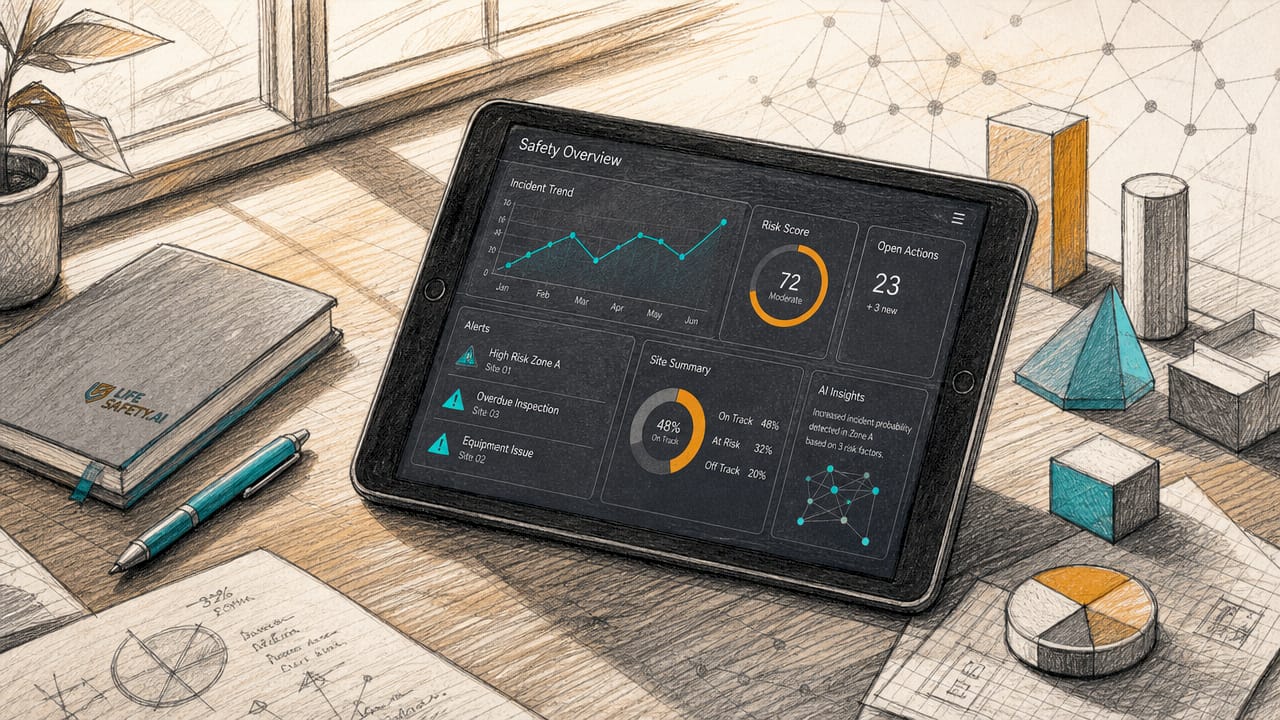
Fire safety is a third area where AI delivers clear operational gains. AI analyses sensor data from smoke detectors, heat sensors, and suppression systems together, identifying patterns that suggest a developing fire risk before any single sensor crosses its threshold. LifeSafety’s fire safety management features integrate these alerts into a unified safety dashboard, giving facilities teams a single view of risk status.
In practice, this can support stronger assurance under the Building Safety Act by improving visibility of emerging issues, documenting response actions, and helping responsible teams maintain a clearer golden thread of safety information. It is particularly useful where multiple contractors, maintenance providers, and internal stakeholders need a shared operational picture.
| Sector | Primary AI application | Key benefit |
|---|---|---|
| Healthcare | Environmental and equipment monitoring | Early detection of clinical environment hazards |
| Construction | Computer vision for site hazard detection | Real-time alerts under CDM 2015 obligations |
| Fire safety | Multi-sensor pattern analysis | Pre-threshold fire risk identification |
Pro Tip: When selecting AI tools for sector-specific hazard response, prioritise platforms that integrate with your existing incident reporting workflow. Standalone AI tools that require manual data transfer create the gaps they are supposed to close.
Key takeaways
AI in hazard response is most effective when it is deployed as a practical safety support layer rather than a fully autonomous control mechanism. The strongest results come from combining machine speed with competent human judgement, clear escalation routes, and auditable workflows.
- AI improves incident detection by monitoring sensors, cameras, and operational data continuously, helping teams identify hazards faster than manual review alone.
- Its greatest value is preventive, using historical incidents, near misses, inspections, and live feeds to identify patterns before harm occurs.
- Emergency response benefits from AI-assisted triage, alert enrichment, root cause analysis, and dynamic task routing, but final decisions should remain with accountable people.
- Explainability, governance, and monthly assurance checks are essential if AI is to support HSE expectations and stand up to scrutiny after an incident.
- Construction, healthcare, and fire safety teams can all gain measurable value where AI is integrated into existing compliance, inspection, and incident reporting processes.
- UK organisations should align deployment with RIDDOR, CDM 2015, and Building Safety Act duties, ensuring AI strengthens legal compliance rather than creating unmanaged risk.
For organisations planning next steps, the most sensible route is to begin with a defined pilot in a high-risk area, measure alert quality, involve frontline supervisors early, and connect the system to existing reporting and corrective action workflows. That approach builds trust, improves adoption, and creates a stronger evidence base for wider rollout.
Build safer, faster hazard response with LifeSafety
LifeSafety helps UK teams turn AI-supported monitoring into practical action across inspections, incident reporting, PPE compliance, fire safety, and sector-specific risk management.
- Centralise incident reporting and corrective actions
- Improve PPE and site hazard visibility across active work areas
- Support compliance evidence for HSE, RIDDOR, and contractor assurance
- Strengthen fire and building safety oversight with connected workflows
Related Articles
Incident reporting software comparison: UK guide 2026
Discover our incident reporting software comparison for UK workplaces. Explore top options like Lifesafety, SafetyCulture, and more.
Safety management solutions for construction: UK SMS guide
Discover essential safety management solutions for construction sites in the UK. Learn how a mobile-first SMS can enhance safety and compliance.

Best health and safety software for UK workplaces: 2026 guide
Discover the best health and safety software for UK workplaces in 2026. Explore top picks like Lifesafety for compliance and efficiency!