
Site hazard identification examples: a practical guide
Site hazard identification examples: a practical guide
Practical examples of how to identify hazards on site using layered methods that support stronger risk assessments, better worker engagement, and more reliable compliance with UK health and safety duties.
TL;DR
- Effective site hazard identification combines multiple techniques to capture a full range of risks.
- Frontline worker input is crucial because workers are significantly more likely to spot hazards than management alone.
- Using layered methods such as inspections, job safety analysis, near-miss reporting, and worker consultation improves safety outcomes and strengthens compliance evidence.
Site hazard identification is the systematic process of recognising, recording, and prioritising workplace conditions or behaviours that could cause injury, ill health, or damage. Getting it right is the foundation of every effective site safety assessment. Across UK health and safety practice, the standard term is hazard identification, and it sits at the heart of the risk assessment process required under the Management of Health and Safety at Work Regulations 1999.
The best site hazard identification examples share one feature: they combine multiple techniques rather than relying on a single method. That matters because different methods reveal different types of risk. Frontline workers are often far more likely to spot practical hazards than management alone, which makes worker involvement essential rather than optional. In UK terms, this also aligns with HSE expectations around consultation, supervision, and suitable and sufficient risk assessment.
1. What are the most effective site hazard identification examples of technique?
The strongest hazard identification programmes layer four or five distinct methods rather than relying on one. Each technique catches a different category of risk. Together, they create a more complete picture of site conditions than any single approach can deliver.
Routine walkthrough inspections use a standardised site safety hazard checklist to assess conditions at regular intervals. Inspectors typically review housekeeping, equipment condition, access routes, temporary works interfaces, and PPE compliance. The limitation is that inspections capture a snapshot in time and may miss hazards that only arise during specific tasks or when workers behave differently under observation.
Job Safety Analysis (JSA) breaks a task into individual steps and identifies the hazard at each stage. Good JSA quality is fundamental because it surfaces risks in phases that appear low-risk on the surface. A well-constructed JSA also feeds directly into risk assessments, permits, and method statements, making it one of the most defensible tools in a safety manager's toolkit.
Near-miss reporting captures events where harm nearly occurred but did not. These reports are early warnings of system weakness. A near miss involving a forklift clipping a racking upright, for example, signals a pedestrian segregation failure before a serious injury or a reportable event under RIDDOR occurs.
Employee consultation formalises the input of frontline workers. Under the Safety Representatives and Safety Committees Regulations 1977 and related consultation duties, workers must be consulted on health and safety matters. Structured toolbox talks, anonymous reporting channels, shift-end debriefs, and contractor coordination meetings all generate hazard intelligence that checklists often miss.
| Technique | Strength | Limitation |
|---|---|---|
| Walkthrough inspection | Covers broad site conditions quickly | Snapshot only; misses task-specific hazards |
| Job Safety Analysis | Detailed, task-level hazard mapping | Time-intensive; requires trained facilitators |
| Near-miss reporting | Early warning of systemic failures | Depends on a reporting culture being in place |
| Employee consultation | Surfaces granular, lived-experience hazards | Requires psychological safety to work well |
| Safety audits | Validates system effectiveness over time | Less effective for day-to-day hazard detection |
Pro Tip: Fix hazards on the spot during walkthrough inspections wherever it is safe to do so. Immediate correction of issues such as poor housekeeping, blocked fire routes, or missing edge protection reinforces safety culture and prevents small problems from escalating into serious incidents.
2. Construction site hazard examples: the Focus Four and beyond
The best-known high-risk construction categories are falls, struck-by incidents, electrocutions, and caught-in or between accidents. While the phrase “Focus Four” originates outside the UK, the underlying risk profile is highly relevant to British construction projects. Every site risk assessment, construction phase plan, and task-specific method statement should address these categories explicitly in line with CDM 2015, HSE guidance, and where relevant the Building Safety Act.
Common worksite hazard examples in construction include:
- Falls from height: Unguarded scaffold edges, missing toe boards, incomplete handrails, fragile roof access, or workers accessing roofs without suitable fall prevention or arrest systems. A scaffold with a missing mid-rail on the second lift is a classic example that routine inspection should catch before work begins. Proper scaffolding inspection protocols are designed precisely to prevent this.
- Struck-by incidents: Overhead lifting operations without exclusion zones, unsecured loads on flatbed vehicles, falling materials from upper levels, and plant operating near pedestrian routes. A telehandler reversing without a banksman in a busy compound is a recurring real-world example.
- Electrocution: Damaged extension leads, work near overhead power lines without a permit or isolation plan, buried service strikes during excavation, and use of unsuitable electrical equipment in wet conditions. CAT and Genny surveys before ground-breaking work are a direct response to this hazard category.
- Caught-in/between: Unguarded rotating machinery, trench collapses without shoring, workers positioned between reversing plant and fixed structures, and pinch points during lifting or temporary works installation.
- Slips and trips: Wet or muddy access routes, trailing cables across walkways, poor lighting, debris on stairs, and uneven temporary flooring. These are among the most frequently reported injuries on UK construction sites and are largely preventable through good housekeeping and route management.
- Manual handling: Carrying heavy blocks, awkward lifts in confined spaces, repetitive handling without mechanical aids, and poor storage layouts that force twisting or overreaching. CDM 2015 requires designers to eliminate or reduce foreseeable risks, including manual handling, at the design stage.
- Confined spaces: Excavations, drainage chambers, tanks, and plant rooms where atmospheric testing, permit controls, competent supervision, and a rescue plan are legally required before entry.
Each of these examples maps directly to a control measure. Identifying the hazard is only the first step; the control follows from understanding the specific risk it presents, who may be harmed, and how exposure can be prevented or reduced so far as is reasonably practicable.
3. Hazard identification examples in healthcare, manufacturing, and warehousing
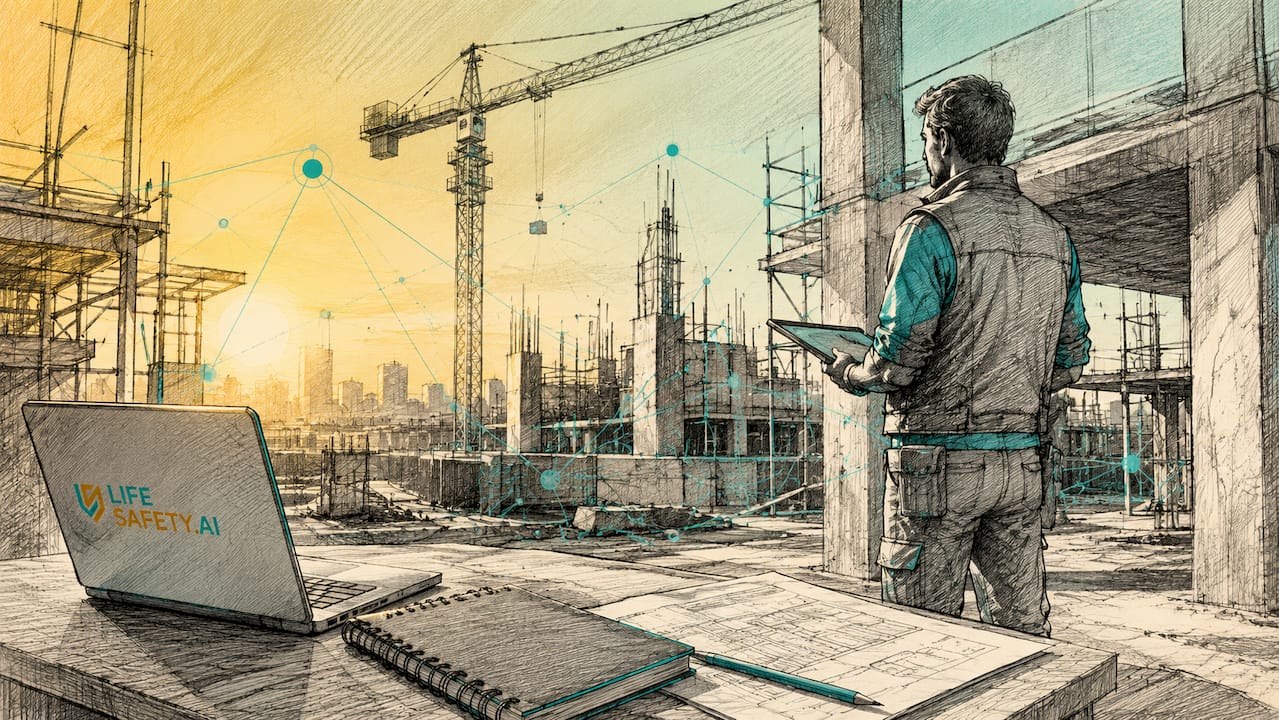
Identifying site hazards is not exclusive to construction. Healthcare, manufacturing, and warehousing each carry distinct hazard profiles that require industry-specific protocols, competent assessment, and controls tailored to the work environment.
Healthcare presents biological, ergonomic, and violence-related risks. Patient-handling injuries remain a well-established ergonomic hazard, while aggression toward staff requires formal assessment and practical controls. Hazard identification in healthcare must go beyond environmental inspection and include direct observation of patient transfers, sharps handling, lone working arrangements, and infection control interfaces.
Manufacturing hazards include:
- Chemical exposure at grinding, mixing, coating, or cleaning stations where inadequate ventilation causes respiratory symptoms or skin irritation. Improving local exhaust ventilation after workers report coughing is a clear example of hazard identification leading directly to control.
- Machine guarding failures where rotating parts, nip points, or cutting surfaces are accessible during cleaning, setup, or maintenance.
- Combustible dust accumulation in woodworking, food processing, or powder handling facilities, requiring specific assessment under DSEAR 2002.
- Substance classification and communication issues where labels, safety data sheets, and storage arrangements do not reflect current hazard information, creating downstream risk for operators and contractors.
Warehousing hazards centre on forklifts, heavy lifting, racking integrity, loading bays, and floor conditions. Colour-coded floor paths, one-way systems, and physical segregation can dramatically reduce forklift-pedestrian near misses. That single control measure begins with someone identifying the hazard of mixed pedestrian and vehicle traffic. The same logic applies to any high-risk task: identify the specific hazard first, then design the control around it.
Across all three sectors, the principle is the same. Hazard identification must be specific to the work being done, the people exposed, and the conditions under which the task actually happens. Generic paperwork rarely captures that level of detail.
4. How combining multiple methods improves safety outcomes
Inspections provide a snapshot in time. They often miss hazards that arise during specific or non-routine tasks or when workers behave differently under management observation. That is why layered, dynamic surveillance is necessary rather than optional.
Non-routine work phases such as emergency repairs, site setup, teardown, commissioning, and maintenance shutdowns often contain the highest density of unrecognised hazards. A maintenance team working outside normal shift hours, without the usual supervision structure, faces a very different risk profile from the same team on a standard day. Hazard identification plans that cover only routine operations miss these windows entirely.
Hazard identification is not a one-time paperwork exercise. It is an ongoing, integrated process where frontline worker input is actively solicited because workers hold granular workplace knowledge that static checklists consistently miss. The most effective systems treat every shift, every task change, and every new contractor as a fresh opportunity to identify what could go wrong.
The practical benefit of layering methods is that each technique catches what the others miss. A walkthrough inspection catches a damaged guard rail. A JSA for the same task reveals that the guard rail must be temporarily removed during a specific operation, creating a residual risk that needs a separate control. A near-miss report from a worker then flags that the temporary removal is happening more frequently than the JSA anticipated. No single method would have surfaced all three pieces of information.
For UK duty holders, this layered approach also creates stronger evidence of compliance. If an incident is investigated by the HSE, or if a principal contractor needs to demonstrate due diligence under CDM 2015, a system that combines inspections, consultation records, near-miss trends, and task-level analysis is far more robust than a single generic checklist.
Pro Tip: Integrate frontline worker feedback by creating a simple, mobile-friendly reporting channel. Workers who can log a hazard in under 60 seconds are far more likely to report than those who must complete a paper form at the end of a shift. Building a positive safety culture starts with making it easy to speak up.
Key takeaways
Effective hazard identification requires a layered system of inspections, JSA, near-miss reporting, and frontline worker consultation to catch the full range of risks on any worksite.
| Point | Details |
|---|---|
| Layer your techniques | Combine inspections, JSA, near-miss reporting, and worker consultation to cover all hazard types. |
| Prioritise the highest-risk categories | Falls, struck-by, electrocution, and caught-in or between hazards remain central to construction fatality prevention. |
| Include non-routine tasks | Maintenance, site setup, shutdowns, and emergency repairs carry a high density of unrecognised hazards. |
| Fix hazards immediately | Correcting issues on the spot during inspections reinforces safety culture and prevents escalation. |
| Engage frontline workers | Workers often identify hazards earlier and more accurately than management, making their input critical. |
Why I think most sites are still getting hazard identification wrong
After years working with health and safety teams across construction and manufacturing, the pattern I see most often is this: organisations treat hazard identification as an event rather than a process. A quarterly inspection gets completed, the form gets filed, and the site manager feels the job is done. It is not.
The sites with the best safety records do something different. They treat every toolbox talk as a hazard identification opportunity. They ask workers at the end of each shift what felt unsafe. They update their JSAs when tasks change, not just when an incident forces a review. That continuous loop is what separates genuinely safe sites from sites that are merely compliant on paper.
The other mistake I see consistently is poor JSA quality. A JSA that lists “use PPE” as the control for every hazard is not a JSA. It is a liability shield. A good JSA names the specific hazard at each task step and specifies the exact control, the person responsible, and the verification method. That level of detail takes time, but it is the difference between a document that protects people and one that simply protects a filing cabinet.
I also think many sites still underuse near-miss data. In too many organisations, near misses are treated as minor admin rather than as free intelligence. If a load swings unexpectedly, if a worker slips but regains balance, or if a contractor enters the wrong exclusion zone, the lesson is available before the injury happens. Ignoring that signal is one of the most expensive mistakes a business can make.
From a UK compliance perspective, this matters beyond good practice. Under the Health and Safety at Work etc. Act 1974, employers must protect workers and others affected by their undertaking. Under the Management Regulations, they must assess risk properly. Under CDM 2015, duty holders must plan, manage, monitor, and coordinate construction work. Hazard identification is the practical mechanism that makes those duties real.
If I had to reduce the whole issue to one recommendation, it would be this: make hazard identification continuous, specific, and worker-led. Use technology where it helps, especially for mobile reporting, inspection consistency, and trend analysis, but do not confuse software with safety. The value comes from the conversations, observations, and corrective actions that the system enables.
That is also where platforms such as LifeSafety.ai can add real value: not by replacing competent judgement, but by making it easier to capture hazards quickly, standardise inspections, connect findings to actions, and maintain a clear audit trail for internal review, contractor management, and regulatory scrutiny.
Practical next steps for safer sites
- Review your current hazard identification process and check whether it relies too heavily on one method.
- Introduce or improve task-level JSA for higher-risk and non-routine work.
- Create a simple reporting route for workers and contractors to log hazards and near misses in real time.
- Link identified hazards to corrective actions, responsible persons, and close-out dates.
- Use inspection and reporting trends to update RAMS, supervision plans, and site briefings.
A site that identifies hazards early is a site that prevents incidents, reduces disruption, and demonstrates stronger compliance when it matters most.
Related Articles
Incident reporting software comparison: UK guide 2026
Discover our incident reporting software comparison for UK workplaces. Explore top options like Lifesafety, SafetyCulture, and more.

Safety management solutions for construction: UK SMS guide
Discover essential safety management solutions for construction sites in the UK. Learn how a mobile-first SMS can enhance safety and compliance.

Best Health and Safety Software for UK Workplaces: A Guide
Discover the best health and safety software for UK workplaces in 2026. Explore top picks like Lifesafety for compliance and efficiency!