
Incident reporting software comparison: UK guide 2026
Incident reporting software comparison: UK guide 2026
A practical comparison of incident reporting platforms for UK organisations managing compliance under RIDDOR, CDM 2015, HSE expectations, and wider operational risk controls.
TL;DR
- Lifesafety is designed for UK workplaces, offering pre-built RIDDOR templates and AI workflows that support compliance.
- It includes offline mobile capture, fast deployment, and sector-specific modules aligned to UK regulations.
- Other platforms vary in mobile support and customisation, but few match a UK-first compliance focus for regulated environments.
For UK health and safety managers, Lifesafety is our recommended pick for regulated workplaces. It combines RIDDOR-ready templates, AI-driven investigation workflows, and sector modules built specifically for UK compliance obligations under RIDDOR, CDM 2015, and relevant BS standards. If Lifesafety does not fit your procurement constraints, the strongest runner-ups are:
- SafetyCulture (iAuditor) — best for mobile-first frontline reporting and inspection-heavy teams
- EcoOnline — best for organisations with integrated COSHH and incident tracking needs
- Intelex / Intelex EHSQ — best for large enterprises requiring deep configuration and broad integrations
- Cority — best for regulated industries with complex multi-site reporting workflows
The HSE’s incident statistics consistently show that mobile-first capture, offline access, and automated RIDDOR reporting are the features that determine whether a platform actually gets used in the field. Every vendor below is assessed against those criteria. Compare them in the table below, then use the vendor profiles and procurement checklist to build your shortlist.
Table of Contents
- Incident reporting software comparison: quick feature matrix
- How to choose incident reporting software for a UK organisation
- In-depth vendor profiles: features, UK notes, and honest cons
- What features actually matter for UK health and safety managers in 2026
- Pricing models, ballpark UK costs, and typical deployment timelines
- How we evaluated vendors for this comparison
- Key takeaways
- Why UK-first alignment changes the procurement decision
- Lifesafety gives UK health and safety teams a compliance-ready starting point
- Authoritative sources and further reading
Incident reporting software comparison: quick feature matrix
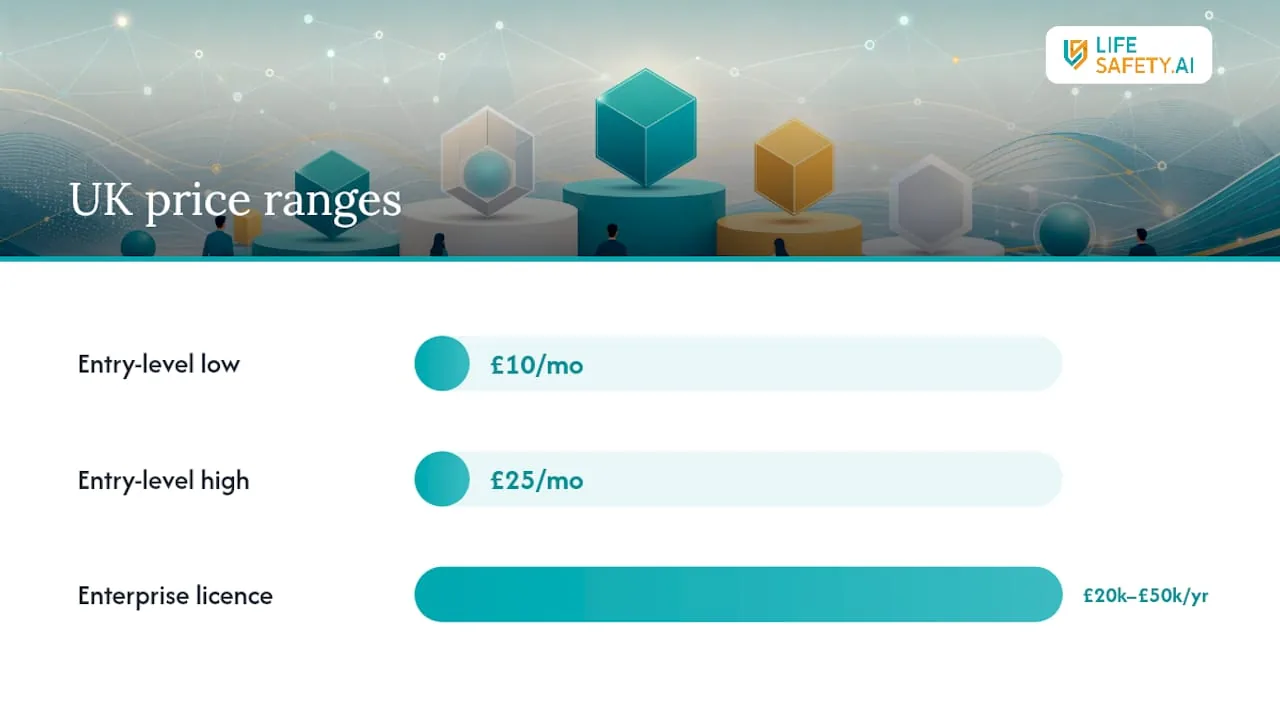
Entry-level professional plans typically start at £10–£25 per user per month, while enterprise licences frequently exceed £20,000–£50,000 annually depending on modules and user count. Use the table to rule vendors in or out quickly; verify pricing and integration lists in a live demo before committing.
| Vendor | Best for | Price model (ballpark UK cost) | Mobile & offline | RIDDOR-ready | Workflow automation | Integrations / APIs | Audit trail & export | Deployment speed |
|---|---|---|---|---|---|---|---|---|
| Lifesafety | UK regulated workplaces: RIDDOR, CDM 2015, sector modules | Subscription SaaS; 30-day free trial | Mobile app + offline sync | ✓ Pre-built RIDDOR templates | ✓ Full investigation workflows | API + HR/EHS integrations | ✓ Full audit trail, exportable | Fast; modules deploy in minutes |
| SafetyCulture (iAuditor) | Frontline inspections and mobile-first teams | Per-user/month; free tier available | ✓ Strong mobile; offline capable | Partial; template customisation required | ✓ Checklists and actions | Broad integrations | ✓ Inspection records | Fast |
| EcoOnline | COSHH + incident tracking combined | Per-user/month; modular pricing | ✓ Mobile app | Partial; configurable | ✓ Workflow tools | EHS system integrations | ✓ Compliance exports | Moderate |
| Intelex / Intelex EHSQ | Large enterprises needing deep customisation | Enterprise custom quote | ✓ Mobile | Configurable | ✓ Extensive automation | Broad enterprise APIs | ✓ Comprehensive | Longer; enterprise implementation |
| Cority | Complex regulated multi-site organisations | Enterprise custom quote | ✓ Mobile | ✓ Regulatory reporting | ✓ Advanced workflows | Enterprise integrations | ✓ Detailed audit trail | Longer; enterprise rollout |
| Notify Technology | Mobile reporting and workforce communications | Per-user/month | ✓ Mobile-first | Configurable | ✓ Notifications and tasks | API available | ✓ Reporting exports | Moderate |
| VelocityEHS | EHS analytics and combined compliance tracking | Per-user/month; modular | ✓ Mobile | Configurable | ✓ Analytics-driven workflows | EHS integrations | ✓ Analytics exports | Moderate |
| Noxus | Operations-focused incident capture | Not publicly listed | ✓ Mobile | Configurable | ✓ Operational workflows | API available | ✓ Audit records | Moderate |
| PagerDuty | IT/DevOps on-call alerting and incident response | Per-user/month; tiered | ✓ Mobile alerts | Not designed for RIDDOR | ✓ On-call automation | Extensive (Slack, Jira, etc.) | ✓ Incident logs | Fast |
| BasinCheck | Field operations with offline checklists | Not publicly listed | ✓ Offline-first | Configurable | Checklist-based | Limited | ✓ Field records | Fast |
| 1st Reporting | Detailed incident and accident recording | Per-user/month | ✓ Mobile | Configurable | ✓ Structured workflows | Moderate | ✓ Detailed records | Moderate |
| ETQ Reliance | Configurable quality and safety workflows | Enterprise custom quote | ✓ Mobile | Configurable | ✓ Quality + safety automation | Broad enterprise APIs | ✓ Quality audit trail | Longer |
| ComplianceQuest | Salesforce-native EHSQ workflows | Salesforce-based pricing | ✓ Mobile | Configurable | ✓ Salesforce-driven automation | Native Salesforce ecosystem | ✓ Salesforce audit trail | Moderate; Salesforce dependency |
Price legend: Entry-level plans start at £10–£25 per user per month. Enterprise pricing is custom and can frequently exceed £20,000–£50,000 annually depending on user count and feature scope. “Not publicly listed” means pricing is available on request only. Always verify current pricing directly with the vendor.
A 2026 market roundup highlights the wide range of specialisms and pricing approaches across these platforms, from documentation-focused tools to AI-assisted investigation suites.
How to choose incident reporting software for a UK organisation
The procurement decision comes down to seven criteria. Work through them in order, because the first two will eliminate roughly half the market immediately.
Selection criteria for UK health and safety teams
- UK regulatory fit — Does the platform reflect the way UK organisations actually report incidents, investigate root causes, and evidence compliance for HSE scrutiny?
- RIDDOR automation — Does the platform include pre-built RIDDOR templates that auto-populate from incident data and produce an export ready for HSE submission? Configurable templates are not the same thing; insist on seeing a completed RIDDOR F2508 export in the demo.
- Offline mobile capture — Can workers report incidents from construction sites, warehouses, plant rooms, and remote locations without signal loss breaking the process?
- Corrective action workflow — Can the system assign actions, escalate overdue tasks, and maintain a defensible audit trail from report to close-out?
- Data governance — Is there clear information on hosting, retention, access control, encryption, and DPA support suitable for UK procurement and GDPR expectations?
- Integration practicality — Can the platform connect to HR, training, permit-to-work, maintenance, or wider EHS systems without a major custom development project?
- Deployment speed — How quickly can the organisation move from contract signature to live reporting with real users and real workflows?
Questions to ask in vendor demos
- Show me a completed RIDDOR F2508 export generated from a test incident — can you walk me through how the form populates automatically?
- Demonstrate offline capture: submit an incident with no network connection, then reconnect and show me the sync.
- What does the corrective action workflow look like from report submission to close-out, including escalation if a deadline is missed?
- Where is our data stored, and can you provide your ISO 27001 certificate and a signed DPA today?
- Which UK organisations in our sector are current customers, and can you provide a reference contact?
Red flags to walk away from
- No offline sync, or sync that requires manual intervention
- No pre-built RIDDOR template, only a blank configurable form
- Audit trail that cannot be exported or is not tamper-evident
- Vague SLA language such as “best efforts” rather than defined response times
- Pricing that excludes integrations, SMS/telephony, or on-call features as paid add-ons revealed only at contract stage
Pro Tip: Request a 30-day pilot with real incident data before signing any annual contract. Run at least one RIDDOR-reportable scenario end-to-end during the pilot and export the completed form to verify it meets HSE requirements.
In-depth vendor profiles: features, UK notes, and honest cons
Lifesafety
Lifesafety is built from the ground up for UK regulatory compliance. The incident reporting module covers incident capture, near-miss reporting, and accident investigation within a single platform, with RIDDOR-ready templates that auto-populate from submitted incident data. Sector modules for construction, manufacturing, healthcare, and logistics mean the platform arrives pre-configured for the regulatory context most UK buyers operate in, rather than requiring months of configuration to reach compliance readiness.
The AI layer surfaces patterns across incidents, flags lapsed training linked to incident spikes, and automates routine compliance reporting. Mobile capture with offline sync is included, and the cloud architecture supports data residency within UK/EU boundaries.
- Pros: RIDDOR automation out of the box; sector-specific modules; AI-driven investigation workflows; 30-day free trial; fast deployment.
- Cons: Newer entrant compared with some enterprise incumbents; third-party review volume is still growing.
- UK note: Explicitly aligned to RIDDOR, CDM 2015, and BS standards. Construction and healthcare sector modules are production-ready.
- Demo ask: Request a live RIDDOR export, an offline capture demonstration, and a walkthrough of the corrective action escalation workflow.
SafetyCulture (iAuditor)
SafetyCulture’s mobile UX is genuinely best-in-class for frontline inspection teams. The template library is extensive, and the platform deploys quickly. RIDDOR support requires template customisation rather than arriving pre-built, which adds configuration time for UK buyers.
- Pros: Excellent mobile experience; large template library; free tier for small teams.
- Cons: RIDDOR templates are not pre-built; investigation workflows are less structured than dedicated EHS platforms.
- UK note: Widely used across UK facilities and construction, but RIDDOR automation requires manual template setup.
EcoOnline
EcoOnline’s strength is the combination of chemical safety (COSHH) and incident tracking in one platform. For organisations managing hazardous substances alongside incident reporting, this integration removes the need for a separate COSHH tool. Reviewers frequently note strong compliance module depth.
- Pros: Integrated COSHH and incident modules; strong compliance depth.
- Cons: Can feel complex for organisations that only need incident reporting without chemical safety.
- UK note: COSHH alignment makes it a strong fit for manufacturing, laboratories, and higher-risk operational environments.
Intelex / Intelex EHSQ
Intelex is a mature enterprise EHSQ platform with broad workflow capability, extensive configuration options, and a long track record in large organisations. It is often shortlisted where buyers need incident reporting as part of a much wider digital safety and quality transformation programme.
- Pros: Deep configurability; broad enterprise integrations; scalable for complex governance structures.
- Cons: Longer implementation timelines; higher total cost; may be more platform than mid-sized teams need.
- UK note: Suitable for large UK enterprises, but buyers should verify how much RIDDOR workflow is native versus configured.
Cority
Cority is well suited to regulated, multi-site organisations that need robust governance, detailed auditability, and advanced workflow control. It is commonly considered by organisations with mature EHS teams and formal reporting structures across multiple business units.
- Pros: Strong regulatory reporting capability; advanced workflows; detailed audit trail.
- Cons: Enterprise-style rollout effort; pricing and implementation can be substantial.
- UK note: A credible option for heavily regulated sectors, but buyers should test field usability with frontline teams, not just central administrators.
Notify Technology
Notify Technology focuses on mobile reporting, workforce engagement, and practical task follow-up. It is often attractive to organisations that want a modern reporting experience without moving immediately into a full enterprise EHS suite.
- Pros: Mobile-first reporting; useful notifications and task management; accessible user experience.
- Cons: Buyers should verify the depth of RIDDOR automation and export workflows in detail.
- UK note: Relevant for UK teams seeking a practical reporting tool, especially where workforce communications matter alongside incident capture.
VelocityEHS
VelocityEHS brings together incident management, analytics, and broader compliance tooling. It can be a good fit where the organisation wants stronger trend analysis and dashboarding across safety data rather than a standalone reporting form.
- Pros: Good analytics capability; modular EHS approach; mobile support.
- Cons: UK-specific reporting requirements may need configuration; modular pricing can increase cost as scope expands.
- UK note: Best assessed where analytics maturity is a priority and the team has capacity to validate local compliance workflows.
Noxus
Noxus appears more operations-focused, with incident capture and workflow support aimed at practical reporting and follow-up. It may appeal to organisations that want a simpler operational tool rather than a broad EHS transformation platform.
- Pros: Mobile support; operational workflow orientation; API availability.
- Cons: Public pricing transparency is limited; buyers should test UK compliance depth carefully.
- UK note: Worth shortlisting only after confirming RIDDOR handling, audit export quality, and data governance arrangements.
PagerDuty
PagerDuty is included here because some buyers searching for “incident reporting software” encounter it during research. However, it is fundamentally an IT and DevOps incident response platform, not a workplace safety reporting system.
- Pros: Excellent alerting and on-call automation; strong integrations with IT tooling.
- Cons: Not designed for RIDDOR, workplace accident investigation, or HSE-oriented compliance records.
- UK note: Appropriate for digital service incidents, not for construction, manufacturing, facilities, or occupational safety reporting.
BasinCheck
BasinCheck is more field-operations oriented and appears strongest where offline checklists and practical site data capture are the main requirement. It may suit teams that prioritise simple field usability over broader compliance depth.
- Pros: Offline-first capability; fast field deployment; straightforward records.
- Cons: Limited integration depth compared with larger EHS platforms; UK compliance workflows may require adaptation.
- UK note: Test carefully if your reporting process must support formal RIDDOR review and auditable investigation stages.
1st Reporting
1st Reporting focuses on structured accident and incident recording. It is likely to appeal to organisations that want more detail and process discipline than a simple form builder, without necessarily moving to a full enterprise EHS suite.
- Pros: Detailed records; structured workflows; mobile support.
- Cons: Buyers should verify integration breadth and how easily the platform supports sector-specific UK workflows.
- UK note: Potentially relevant for organisations that need disciplined reporting, but RIDDOR readiness should be demonstrated live.
ETQ Reliance
ETQ Reliance is often considered where quality and safety workflows need to sit together in a configurable enterprise platform. It is particularly relevant in manufacturing and regulated production environments.
- Pros: Strong quality and safety workflow capability; enterprise APIs; robust auditability.
- Cons: Longer implementation cycles; enterprise complexity may outweigh benefits for smaller teams.
- UK note: Stronger where quality management and safety reporting are procured together rather than separately.
ComplianceQuest
ComplianceQuest is a Salesforce-native EHSQ platform. For organisations already deeply invested in Salesforce, that can be a major advantage. For everyone else, it can introduce dependency, cost, and implementation considerations that need careful review.
- Pros: Native Salesforce ecosystem; strong automation potential; familiar governance for Salesforce-heavy organisations.
- Cons: Pricing and architecture depend on Salesforce; may be excessive if incident reporting is the primary need.
- UK note: Best suited where Salesforce is already strategic and internal teams can support platform administration.
What features actually matter for UK health and safety managers in 2026
Many software comparisons overemphasise generic workflow features and underweight the practical controls that determine whether a system stands up during an investigation, insurer query, internal audit, or HSE review. In UK environments, the following capabilities matter most.
1. RIDDOR-ready reporting, not just configurable forms
A configurable form builder is useful, but it is not the same as a RIDDOR-ready workflow. Teams need the ability to capture the right data once, classify the event correctly, and generate a defensible output for submission and record retention. This is especially important where multiple sites or contractors are involved and reporting consistency is otherwise difficult to maintain.
2. Offline-first mobile capture for real-world sites
Construction projects, plant rooms, logistics yards, and remote operational areas do not always have reliable connectivity. If workers cannot submit a report immediately, reporting rates fall and data quality deteriorates. Offline capture with automatic sync is therefore a core control, not a convenience feature.
3. Corrective action tracking with escalation
Incident reporting only creates value when it drives action. The platform should assign owners, due dates, evidence requirements, and escalation rules for overdue actions. This is particularly important in environments governed by CDM 2015, contractor management obligations, and formal internal assurance processes.
4. Audit trail integrity
A credible audit trail should show who reported the incident, who reviewed it, what changed, when actions were assigned, and how closure was evidenced. Exportability matters too. If records cannot be extracted cleanly for legal, insurance, or regulator-facing purposes, the system creates risk instead of reducing it.
5. Sector-specific workflows
A hospital trust, principal contractor, food manufacturer, and logistics operator do not investigate incidents in exactly the same way. Sector modules reduce implementation effort and improve adoption because the forms, categories, and workflows already reflect operational reality.
6. Data governance and procurement readiness
UK buyers increasingly expect clarity on hosting, encryption, access control, retention, and contractual data protection terms. This is especially relevant in public sector, healthcare, education, and higher-risk private sector procurement where governance scrutiny is high.
7. Analytics that support prevention
The best systems do more than store reports. They help teams identify recurring hazards, training gaps, contractor trends, and location-specific risk patterns. That is where AI and analytics can add real value, provided the underlying incident data is structured and reliable.
Pricing models, ballpark UK costs, and typical deployment timelines
Pricing in this market varies significantly depending on whether the product is sold as a lightweight reporting tool, a modular EHS platform, or a broader enterprise transformation suite. Buyers should assess both licence cost and implementation cost, because the latter often determines total value.
Common pricing models
- Per-user monthly pricing — common in mobile-first and mid-market tools.
- Module-based pricing — common where incident reporting sits alongside audits, COSHH, permits, or training.
- Enterprise annual licence — common in large EHSQ platforms with custom scope and negotiated support terms.
- Platform dependency pricing — relevant where the product sits on Salesforce or another wider ecosystem.
Ballpark UK cost ranges
- Small teams: often £10–£25 per user per month for core reporting capability.
- Mid-sized organisations: typically a mix of user pricing and module pricing, often moving into low five-figure annual spend.
- Enterprise deployments: commonly exceed £20,000–£50,000 annually, especially where integrations, implementation, and multiple modules are included.
Typical deployment timelines
- Fast deployment: days to a few weeks where templates are pre-built and workflows are largely standard.
- Moderate deployment: several weeks where configuration, user roles, and reporting categories need tailoring.
- Enterprise deployment: several months where integrations, governance design, and change management are substantial.
For many UK buyers, the hidden cost is not the licence itself but the internal time required to configure forms, test workflows, train users, and validate compliance outputs. That is why pre-built UK-aligned templates can materially reduce total cost of ownership.
How we evaluated vendors for this comparison
This comparison prioritises the needs of UK health and safety managers, especially those operating in construction, manufacturing, logistics, facilities, healthcare, and other regulated environments. The evaluation criteria focused on practical compliance outcomes rather than generic software feature counts.
- RIDDOR readiness — whether the platform appears to support direct, practical reporting workflows rather than requiring extensive custom build.
- Mobile and offline usability — whether frontline teams can realistically use the system in the field.
- Workflow depth — whether the platform supports investigation, corrective action, escalation, and closure.
- Auditability — whether records appear exportable, structured, and suitable for assurance purposes.
- Integration practicality — whether the platform can fit into wider HR, EHS, or operational ecosystems.
- Deployment burden — whether the likely implementation effort is proportionate to the value delivered.
- UK relevance — whether the product aligns naturally with UK compliance expectations, terminology, and sector workflows.
Where public information is limited, buyers should treat vendor claims as a starting point and validate them through live demonstrations, pilot testing, and reference checks with comparable UK organisations.
Key takeaways
- Lifesafety is the strongest fit for UK-regulated workplaces that want RIDDOR-ready reporting, fast deployment, and sector-specific workflows.
- SafetyCulture is a strong choice for mobile-first inspections, but UK buyers should expect more setup work for RIDDOR processes.
- EcoOnline stands out where COSHH and incident reporting need to sit together.
- Intelex and Cority are credible enterprise options for large, complex organisations, but implementation effort is materially higher.
- Do not confuse general incident management or IT alerting tools with workplace safety reporting systems built for HSE-facing compliance.
- The most important buying criteria remain offline capture, RIDDOR automation, audit trail quality, and corrective action control.
Why UK-first alignment changes the procurement decision
Many global EHS platforms are capable products, but capability alone does not guarantee a good fit for UK organisations. If the system requires extensive configuration before it can support RIDDOR, local terminology, contractor workflows, or sector-specific reporting categories, the buyer effectively pays twice: once for the software, and again for the implementation effort needed to make it usable.
UK-first alignment matters because it shortens time to value, reduces configuration risk, improves frontline adoption, and gives safety teams greater confidence that the records they produce will stand up to internal and external scrutiny. This is particularly relevant in sectors affected by CDM 2015, the Building Safety Act, and increasingly formal governance expectations around competence, accountability, and evidence.
Lifesafety gives UK health and safety teams a compliance-ready starting point
For organisations that want to move quickly without compromising on compliance, Lifesafety offers a practical starting point. Instead of asking teams to build incident workflows from scratch, it provides pre-built modules aligned to UK reporting and investigation needs, including RIDDOR-ready templates, mobile capture, offline sync, and AI-supported analysis.
That makes it especially relevant for construction, manufacturing, logistics, healthcare, and facilities teams that need a system frontline workers will actually use, while still giving managers the auditability and reporting structure required for governance and regulator-facing assurance.
Authoritative sources and further reading
Use the following sources to validate internal requirements, procurement criteria, and reporting obligations:
- HSE statistics overview
- HSE guidance on RIDDOR
- CDM Regulations 2015
- Building Safety Act 2022
- LifeSafety guide to employee incident report forms
- Notify Technology market roundup
- Noxus software roundup
- BasinCheck comparison resource
Final recommendation: if your organisation needs a platform that is immediately credible in a UK compliance context, start with a live demonstration of Lifesafety, then benchmark alternatives against the same RIDDOR, offline, audit trail, and corrective action criteria before making a final procurement decision.
Related Articles

Safety management solutions for construction: UK SMS guide
Discover essential safety management solutions for construction sites in the UK. Learn how a mobile-first SMS can enhance safety and compliance.

Best Health and Safety Software for UK Workplaces: A Guide
Discover the best health and safety software for UK workplaces in 2026. Explore top picks like Lifesafety for compliance and efficiency!

SafetyCulture.com alternatives for UK workplaces: 2026 guide
Discover the best safetyculture.com alternatives for UK workplaces in 2026. Explore AI-enabled platforms and tailored solutions that enhance safety.