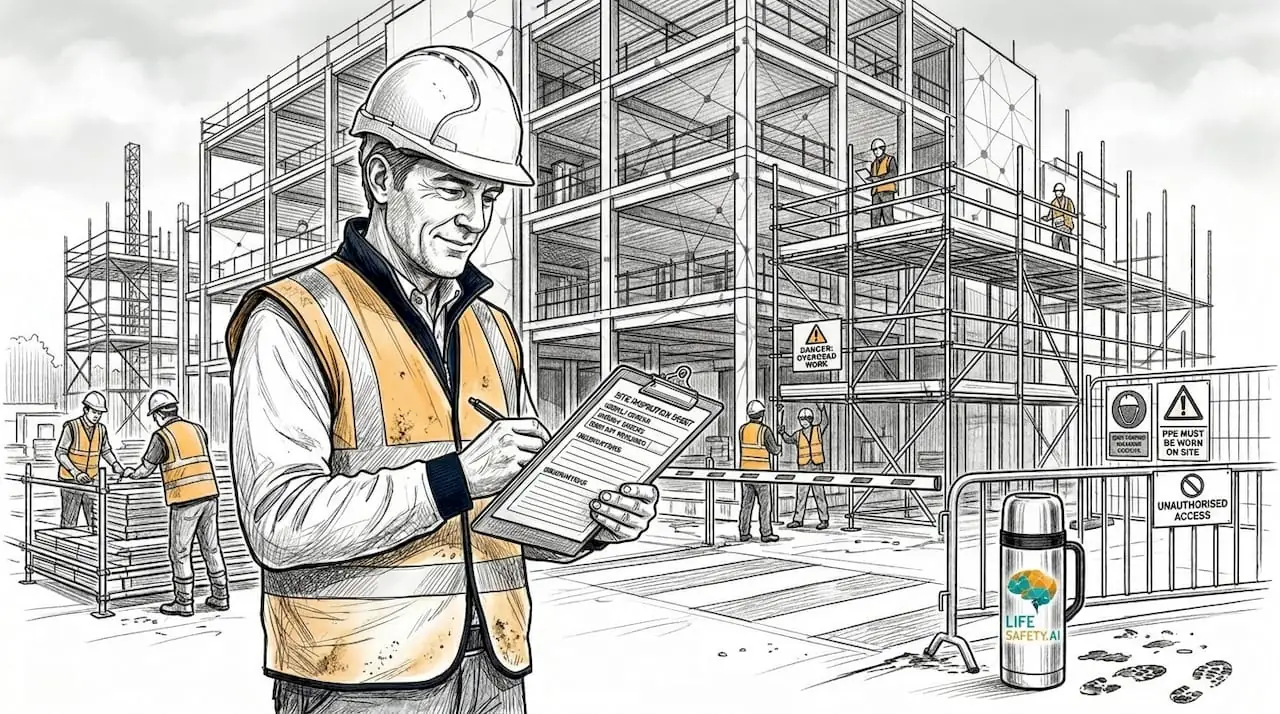
Demystifying construction site safety regulations UK
Demystifying construction site safety regulations UK
TL;DR:
- UK construction fatalities represent 28% of all work-related deaths, emphasising the importance of robust safety regulation.
- CDM 2015 assigns specific legal responsibilities to clients, designers, contractors, and workers to ensure compliance.
- Effective safety management requires ongoing documentation, competent supervision, and a strong safety culture beyond mere paperwork.
Construction kills more workers than almost any other UK industry. In 2024/25, 35 fatal injuries occurred on UK construction sites, representing 28% of all work-related fatalities nationally. Yet many construction company owners and project managers still find themselves confused by overlapping regulations, unclear duty holder responsibilities, and documentation requirements that seem to multiply with every project. Getting safety compliance right is not simply about avoiding fines. It is about protecting the people on your sites and building a business that lasts. This guide breaks down the key UK construction safety regulations, clarifies who is responsible for what, and gives you practical steps to apply compliance confidently.
Table of Contents
- Why safety regulations matter: the reality of construction risks
- Understanding CDM 2015: key duty holders and legal responsibilities
- Core documentation: what you must prepare and maintain
- Tackling the main hazards: practical compliance for everyday risks
- Going beyond legal minimums: health risks and future-proofing safety culture
- What most companies get wrong about construction site safety
- How LifeSafety.ai helps you stay compliant and proactive
- Frequently asked questions
Key Takeaways
| Point | Details |
|---|---|
| Know your duties | Understanding your role under CDM 2015 is essential for legal compliance and project safety. |
| Document everything | Accurate, up-to-date records like risk assessments and inspections are your first defence in an audit. |
| Prioritise real risks | Focus on controlling hazards that cause serious injuries and ensure actions match site realities. |
| Build safety culture | Move beyond box-ticking by investing in competence, honest reporting, and open communication. |
| Leverage digital tools | Modern compliance is more manageable and more robust with the right digital platforms. |
Why safety regulations matter: the reality of construction risks
Construction is, by its nature, a hazardous environment. The numbers confirm this without ambiguity. Construction fatalities account for more than 28% of all UK workplace deaths, with a fatality rate 4.8 times higher than the national average across all industries. These are not abstract statistics. They represent real people on real sites.
The most common causes of death and serious injury include:
- Falls from height: Scaffolding, ladders, and unprotected edges remain the leading cause of fatalities.
- Vehicle strikes: Plant machinery and site vehicles moving in close proximity to workers create constant risk.
- Falling objects: Unsecured materials and tools dropped from height cause serious injuries regularly.
- Excavation collapses: Unshored trenches and ground instability present life-threatening hazards.
- Structural failures: Premature loading or inadequate temporary works can be catastrophic.
Beyond fatalities, site health risks such as noise-induced hearing loss, hand-arm vibration syndrome, and occupational lung disease from dust affect thousands of workers each year. These conditions develop slowly, which makes them easy to overlook until the damage is done.
The financial and legal consequences of non-compliance are equally serious. Prosecution under the Health and Safety at Work etc. Act 1974 can result in unlimited fines for companies and custodial sentences for individuals. Work stoppages, reputational damage, and civil claims from injured workers add further pressure.
“The cost of getting safety wrong is never just financial. It affects your workforce, your reputation, and your ability to win future contracts.”
Regulation exists because voluntary good intentions are not enough. Consistent, enforceable standards protect workers and give businesses a clear framework to follow. Treating safety as a moral and business imperative, rather than a bureaucratic burden, is the mindset that separates high-performing companies from those that struggle. Explore our construction site safety tips for practical guidance on reducing everyday risks.
Understanding CDM 2015: key duty holders and legal responsibilities
Knowing what is at stake, the next step is understanding precisely who the law holds responsible on site. The Construction (Design and Management) Regulations 2015, known as CDM 2015, form the backbone of UK construction safety law. They apply to virtually every construction project, from a small domestic extension to a major infrastructure scheme.
CDM 2015 names clients, designers, principal contractors, and workers as duty holders, each carrying specific legal obligations. Understanding these roles is essential for compliance.
| Duty holder | Key responsibilities |
|---|---|
| Client | Appoint principal roles, ensure adequate resources and time |
| Principal designer | Plan, manage, and monitor pre-construction phase risks |
| Principal contractor | Manage construction phase, produce construction phase plan |
| Designer | Eliminate and reduce design-stage risks |
| Contractor | Comply with site rules, report hazards, protect workers |
| Worker | Follow instructions, use equipment correctly, report dangers |
For projects involving more than one contractor, clients must formally appoint both a principal designer and a principal contractor. These appointments must be made in writing before work begins.
Notification to the HSE is required when a project exceeds 30 working days with 20 or more workers simultaneously on site, or when it exceeds 500 person-days in total. This is done via the F10 notification form, available through HSE construction guidance.
Here is a clear sequence for meeting your CDM obligations:
- Identify whether the project involves more than one contractor.
- Appoint a principal designer at the earliest design stage.
- Appoint a principal contractor before construction begins.
- Confirm whether HSE notification is required and submit the F10 if so.
- Ensure all duty holders understand their responsibilities before work starts.
Pro Tip: Do not wait until the construction phase to appoint your principal designer. Early appointment means design-stage hazards are identified and eliminated before they become costly site problems. Our CDM compliance module and construction phase plan tools help you manage these obligations efficiently.
Core documentation: what you must prepare and maintain
Regulatory roles defined, the next challenge is assembling the paperwork to prove compliance. Documentation is not simply an administrative exercise. It is evidence that you have identified risks, planned controls, and monitored their effectiveness.
Required documents include risk assessments, the construction phase plan, method statements for hazardous work, inspection reports, and RIDDOR records. Each serves a distinct purpose.

| Document | Who prepares it | When required |
|---|---|---|
| Risk assessment | Employer or competent person | Before any significant work |
| Construction phase plan | Principal contractor | Before construction phase begins |
| Health and safety file | Principal designer | Handed to client on completion |
| Method statement | Contractor | For high-risk or complex tasks |
| RIDDOR report | Employer | Following reportable incident |
RIDDOR, the Reporting of Injuries, Diseases and Dangerous Occurrences Regulations 2013, requires you to report fatalities, specified injuries, over-seven-day incapacitation injuries, occupational diseases, and dangerous occurrences. Reports must be submitted to the HSE promptly, with most incidents requiring notification within ten days.
Common documentation mistakes include:
- Generic risk assessments: Copying templates without tailoring them to your specific site and tasks.
- Outdated documents: Failing to review and update assessments when conditions change.
- Incomplete inspection records: Scaffold and excavation inspections must be recorded and retained.
- Missed RIDDOR reports: Many companies under-report, often through uncertainty about what qualifies.
Pro Tip: Build a document review schedule into your project programme. Set calendar reminders to revisit risk assessments at key project milestones, not just at the start. See HSE documentation requirements for the full list of what must be kept on site. Our risk assessment process module and guidance on why safety reporting matters can help you stay consistently compliant.
Tackling the main hazards: practical compliance for everyday risks
With documentation in place, companies must translate regulations into effective on-site actions. Knowing the rules is one thing. Applying them consistently across a busy site is another challenge entirely.
Here is how to address the principal hazards identified by UK construction safety regulations:
- Falls from height: Install edge protection before work begins at height. Inspect scaffolding at least every seven days and after adverse weather. Use collective protection such as guardrails before relying on personal protective equipment.
- Vehicle and plant risks: Establish clearly marked pedestrian routes and exclusion zones around operating plant. Use banksmen when reversing vehicles near workers. Segregation is not optional; it is a legal requirement.
- Falling objects: Fit toe boards and debris netting at all elevated work areas. Secure tools and materials before lifting. Never allow work above occupied areas without adequate protection below.
- Excavations: Shore or batter all excavations deeper than 1.2 metres before workers enter. Inspect excavations at the start of every shift and after any event that may have affected stability. Records must be kept.
- Public protection: Secure site perimeters with hoarding of sufficient height. Take additional precautions near schools or care facilities where children or elderly people may be present.
“Segregation of pedestrians and vehicles is one of the simplest and most effective controls available. It costs very little and prevents a significant number of fatalities each year.”
For ground-breaking work, review excavator safety guidance from the HSE before commencing any dig. Practical compliance depends on supervisors checking controls in real time, not assuming that a signed method statement means the risk is managed.
Where projects involve occupied buildings, higher-risk residential work, or complex interfaces with the public, the need for disciplined control becomes even greater. The Building Safety Act has increased scrutiny on competence, information management, and accountability across the built environment. That means site controls must align with wider project governance, not sit in isolation.
Going beyond legal minimums: health risks and future-proofing safety culture
Legal compliance is the baseline, not the finish line. Many of the most damaging construction harms are not dramatic incidents but long-term health conditions caused by repeated exposure. Dust, noise, vibration, manual handling, and stress can all undermine worker wellbeing even on sites with apparently good accident statistics.
Forward-looking contractors go beyond minimum legal controls by embedding occupational health into everyday planning. That includes:
- Dust control: Use water suppression, on-tool extraction, and suitable respiratory protective equipment where silica dust is generated.
- Noise management: Monitor exposure, rotate tasks where appropriate, and provide hearing protection with proper supervision.
- Vibration reduction: Select lower-vibration tools, maintain equipment, and track trigger times to reduce the risk of hand-arm vibration syndrome.
- Manual handling controls: Redesign tasks, use lifting aids, and train workers to avoid preventable musculoskeletal injuries.
- Mental health support: Encourage open reporting, realistic scheduling, and supervisor awareness of fatigue and stress indicators.
A strong safety culture also depends on competence. Under CDM 2015, organisations must ensure that those appointed have the skills, knowledge, training, and experience necessary for the role. This is especially important where subcontractors are used, because legal duties cannot simply be outsourced.
Future-proofing your approach means treating safety information as live operational data. Near-miss reports, inspection findings, permit breaches, and recurring corrective actions should all be reviewed for trends. If the same issue appears repeatedly, the problem is usually systemic rather than individual.
Companies that perform well over time tend to share several cultural traits:
- Supervisors challenge unsafe behaviour consistently and fairly.
- Workers can raise concerns without fear of blame or retaliation.
- Training is refreshed when site conditions change, not only at induction.
- Leadership reviews safety performance using leading indicators, not just accident totals.
- Lessons learned are fed back into design, procurement, and planning.
In practical terms, this is where digital systems can make a measurable difference. Centralised records, mobile inspections, and real-time action tracking help businesses move from reactive compliance to proactive risk management. That is increasingly important as clients, principal designers, and regulators expect clearer evidence of control.
What most companies get wrong about construction site safety
Most compliance failures do not happen because companies have never heard of the rules. They happen because businesses misunderstand what good compliance actually looks like in practice. The most common mistake is assuming that completed paperwork equals controlled risk.
In reality, several patterns appear again and again:
- Late planning: Principal appointments, risk reviews, and site logistics are left too late, so hazards are managed reactively instead of designed out.
- Template dependence: Generic RAMS are copied from previous jobs without reflecting the actual environment, sequencing, or workforce.
- Poor supervision: Controls exist on paper but are not checked consistently by competent supervisors.
- Weak communication: Subcontractors receive documents but not meaningful briefings, toolbox talks, or updates when conditions change.
- Under-reporting: Near misses and minor incidents are ignored, which removes the chance to intervene before a serious event occurs.
Another major issue is failing to distinguish between low-level administrative non-conformities and genuinely high-risk failings. A missing signature matters, but not as much as an unprotected edge, an unsupported trench, or a plant route crossing a pedestrian walkway. Strong safety management prioritises the controls that prevent fatal and life-changing harm.
“The best-run sites are not the ones with the thickest folders. They are the ones where the controls described in those folders are visible, understood, and enforced.”
There is also a tendency to treat enforcement action as something that only follows major accidents. In fact, the HSE can intervene where there is a material breach even if no one has yet been injured. Improvement notices, prohibition notices, project delays, and client concern can all arise from visible failures in planning or control.
To avoid these traps, companies should regularly ask:
- Are our documents specific to this site and this phase of work?
- Can supervisors explain the controls without referring back to paperwork?
- Are inspections identifying the same issues repeatedly?
- Do workers feel able to stop unsafe work and report concerns?
- Are we learning from near misses before they become reportable incidents?
If the answer to any of these is no, the issue is not just compliance. It is management effectiveness. That is why the strongest organisations combine legal knowledge with operational discipline and visible leadership.
How LifeSafety.ai helps you stay compliant and proactive
Managing construction safety across multiple projects is difficult when information is fragmented across paper files, spreadsheets, email chains, and disconnected apps. LifeSafety.ai helps simplify that challenge by bringing core compliance activities into one structured system.
For UK construction teams, that means better control over the processes that matter most:
- CDM duty management: Keep appointments, responsibilities, and project records organised and accessible.
- Risk assessments and RAMS: Create, review, and update site-specific documents with clearer version control.
- Construction phase planning: Maintain live plans that reflect changing site conditions and contractor interfaces.
- Inspections and action tracking: Record findings on site, assign actions quickly, and monitor close-out.
- Incident and RIDDOR workflows: Capture events promptly and support timely reporting and investigation.
Instead of treating compliance as a static archive, LifeSafety.ai supports a more active model where information is easier to review, share, and act on. This is particularly valuable for principal contractors, health and safety managers, and directors who need visibility across several live projects.
Our platform is designed to support practical compliance with frameworks including CDM 2015, RIDDOR, and wider HSE expectations around competence, monitoring, and evidence. It also helps organisations prepare for increasing scrutiny linked to the Building Safety Act, especially where information quality and accountability are under the spotlight.
Useful resources include:
- CDM compliance module
- Construction phase plan tools
- Risk assessment workflows
- Guidance on safety reporting and compliance
If your current process depends on chasing paperwork after the fact, there is a better way. The goal is not just to pass an audit. It is to create a safer, more consistent operating model that protects workers and strengthens business resilience.
Frequently asked questions
What is the main construction safety regulation in the UK?
The main project-specific framework is CDM 2015, which sets out duties for clients, designers, contractors, and workers. It sits alongside broader legal duties under the Health and Safety at Work etc. Act 1974 and supporting regulations such as RIDDOR and the Work at Height Regulations.
When do I need to notify the HSE about a construction project?
You must submit an F10 notification where a project is expected to last longer than 30 working days with 20 or more workers on site at the same time, or where it exceeds 500 person-days of construction work in total.
Who is responsible for the construction phase plan?
The principal contractor is responsible for preparing the construction phase plan for projects involving more than one contractor. The plan must be in place before the construction phase starts.
What incidents must be reported under RIDDOR?
Reportable events include fatalities, specified injuries, over-seven-day incapacitation injuries, certain occupational diseases, and dangerous occurrences. If you are unsure, review the HSE guidance promptly rather than delaying a decision.
What are the biggest risks on most construction sites?
The most serious recurring risks include falls from height, plant and vehicle movement, falling objects, excavation collapse, and failures in temporary works or structural stability. Long-term health risks such as dust, noise, and vibration also require close control.
How does the Building Safety Act affect construction safety management?
The Building Safety Act increases expectations around competence, accountability, and information management, particularly on higher-risk buildings. For many organisations, this means stronger record-keeping, clearer duty allocation, and better evidence that safety decisions are being managed throughout the project lifecycle.
How can digital tools improve compliance?
Digital systems help teams keep records current, complete inspections faster, track corrective actions, and maintain clearer evidence for audits, investigations, and client reviews. They are especially useful where multiple contractors and projects need consistent oversight.
Final thought
Construction safety regulations in the UK can seem complex, but the core principle is straightforward: identify risk early, assign responsibility clearly, control hazards properly, and keep evidence that proves the system is working. When businesses understand their duties under CDM 2015, maintain strong documentation, and focus on real-world controls rather than box-ticking, compliance becomes far more manageable. The result is not only fewer enforcement problems, but safer sites, stronger client confidence, and a more resilient business.
Related Articles

HSE for Data Centres
Data-centre HSE is electrical plant, COSHH, permits and night-shift people risk. LifeSafety.ai puts UK compliance and live dashboards in one system.

Risk Assessment vs Method Statement (RAMS): Key Differences
A risk assessment identifies what could cause harm; a method statement sets out how the work will be done safely. Here is how they differ, what UK law actually requires, and when you need both.

Employee Incident Report form: RIDDOR-Ready Template Guide
Ensure workplace safety with our RIDDOR-ready employee incident report form. Download the template and streamline your incident reporting today!