
Why SaaS is essential for safety compliance officers
Why SaaS is essential for safety compliance officers
Paper-based safety systems are costing UK construction and manufacturing companies more than time. They’re costing lives. Whilst you’re filing incident reports by hand, proactive safety measures are identifying hazards before they become accidents. SaaS platforms deliver real-time data, automated compliance tracking, and instant regulatory reporting. For safety compliance officers managing high-risk environments, the shift from reactive paperwork to proactive digital systems isn’t just convenient. It’s essential.
Table of Contents
- How SaaS transforms safety compliance
- Benefits of SaaS for safety compliance in UK construction and manufacturing
- Real-time data: A game changer for risk management
- Why SaaS outperforms traditional methods for regulatory adherence
- Common concerns and how SaaS addresses them
- See SaaS safety compliance in action
- Frequently asked questions
Key Takeaways
| Point | Details |
|---|---|
| Proactive risk management | SaaS enables real-time data and trend analysis that prevent incidents before they occur. |
| Streamlined compliance | Automated reminders and digital audit trails take the stress out of showing compliance. |
| Seamless regulatory adherence | Features map directly to Golden Thread and BSA requirements, ensuring reliable regulatory outcomes. |
| Easy adoption for teams | User-friendly interfaces mean everyone can engage with compliance processes—no specialist IT needed. |
| Robust data security | Reputable SaaS providers ensure your safety data remains secure, compliant, and backed up. |
How SaaS transforms safety compliance
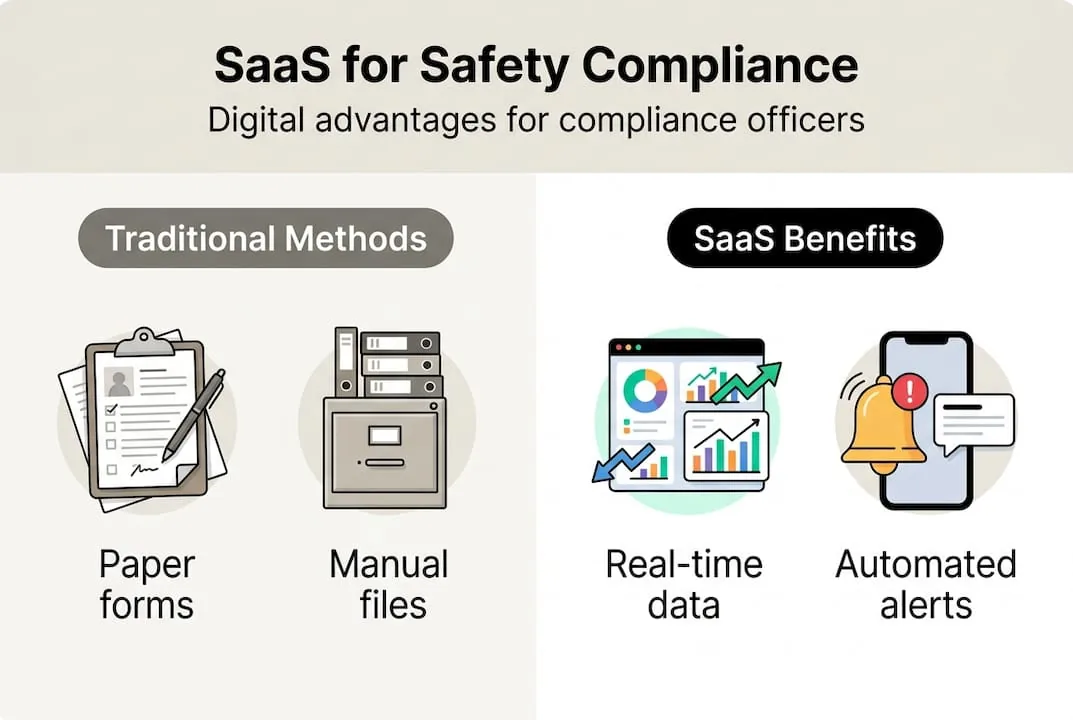
Traditional safety compliance relies on paper forms, spreadsheets, and manual filing systems. An incident occurs, someone fills out a form, the form gets filed, and weeks later you might spot a pattern. This reactive approach leaves you constantly playing catch-up with hazards.
SaaS flips this model entirely. Digital-first workflows capture safety data instantly from any device, anywhere on site. When a near-miss happens, your team logs it immediately on their mobile. The system timestamps the entry, attaches photos, and flags it for review. No paperwork gets lost. No delays in reporting.
The Building Safety Act and Golden Thread requirements demand auditable digital trails that paper systems simply cannot provide. SaaS platforms automatically create version-controlled records, track every change, and maintain complete accountability chains. When regulators request evidence, you’re sharing secure links within minutes rather than searching filing cabinets for hours.
Consider how these systems compare in daily practice:
| Feature | Paper/Legacy Systems | SaaS Platforms |
|---|---|---|
| Incident reporting speed | Hours to days | Seconds to minutes |
| Data accessibility | Office-based only | Anywhere, any device |
| Regulatory audit preparation | Weeks of manual gathering | Instant report generation |
| Trend analysis capability | Manual, time-intensive | Automated, real-time |
| Version control | Prone to errors | Automatic tracking |
| Team collaboration | Sequential, slow | Simultaneous, instant |
The administrative burden drops dramatically. Your compliance officers spend less time on paperwork and more time on actual safety improvements. Our CDM compliance module demonstrates this shift perfectly. Tasks that once consumed entire afternoons now complete in minutes.
“Digital safety management isn’t about replacing people. It’s about giving safety professionals the tools to prevent incidents rather than just document them.”
This transformation extends beyond simple digitisation. SaaS platforms integrate with your existing workflows, pulling data from multiple sources to create comprehensive safety pictures. The AI transformation in safety management shows how intelligent systems can predict risks before they materialise, fundamentally changing how we approach workplace safety.
Benefits of SaaS for safety compliance in UK construction and manufacturing
Construction sites and manufacturing facilities face unique compliance challenges. Multiple contractors, rotating shifts, complex equipment, and constantly changing environments create endless opportunities for safety gaps. SaaS platforms address these specific pain points with targeted solutions.

Automated reminders ensure nothing falls through the cracks. Your system tracks inspection schedules, certification renewals, and training requirements. When a forklift certification expires in two weeks, the relevant supervisor receives automatic notifications. When a confined space permit needs renewal, the system flags it days in advance. You’re never caught off guard by expired credentials or missed inspections.
Team adoption improves dramatically because modern SaaS tools require no specialist IT knowledge. Your site supervisors and safety officers use intuitive mobile interfaces that feel as natural as checking email. Ease of use boosts adoption across all experience levels, from seasoned safety managers to new apprentices.
Remote access transforms audit preparation and regulatory compliance. When HSE inspectors arrive unannounced, you’re pulling up complete safety records on your tablet within seconds. When head office requests quarterly safety statistics, you’re generating comprehensive reports without leaving your desk. The entire compliance history travels with you, securely accessible from any location.
Key advantages for your daily operations include:
- Instant evidence sharing with regulators and stakeholders through secure digital links
- Automatic document version control eliminating confusion over current procedures
- Seamless handover between shifts and contractors with complete activity histories
- Mobile-first design enabling on-site data capture without returning to offices
- Integration with existing business systems reducing duplicate data entry
- Real-time compliance dashboards showing your safety status at a glance
Pro Tip: Configure your SaaS platform to automatically compile regulatory submission packages. When RIDDOR reporting deadlines approach, your system can pre-populate required fields and attach supporting documentation, reducing submission time from hours to minutes.
The Golden Thread principle demands complete traceability throughout a building’s lifecycle. SaaS platforms maintain this continuity automatically, linking design decisions to construction activities to ongoing maintenance. Our construction site safety tips explore how digital tools support this comprehensive approach.
Consistent record-keeping becomes effortless. Every safety inspection follows the same digital template. Every incident report captures the same critical details. This standardisation improves data quality whilst reducing training time for new team members. The latest health and safety features demonstrate how platforms continue evolving to meet emerging compliance needs.
Real-time data: A game changer for risk management
Reactive safety management waits for incidents to reveal problems. Proactive safety management identifies patterns before accidents occur. Real-time data makes this shift possible.
When every near-miss, safety observation, and inspection result flows immediately into your central system, you’re seeing your safety landscape as it actually exists right now. Not last week’s snapshot. Not last month’s summary report. This moment’s reality.
Proactive risk management via real-time data enables you to spot emerging hazards whilst they’re still manageable. Your platform flags that three separate teams reported slippery surfaces in the same area this week. You investigate and discover a minor leak that could have caused serious falls. Problem solved before anyone gets hurt.
Trend analysis reveals patterns invisible to manual tracking. You notice incident rates spike on Friday afternoons. Investigation shows fatigue-related errors increasing as the week progresses. You adjust shift patterns and break schedules. Incident rates drop. This kind of insight requires data volume and processing power that paper systems cannot provide.
Consider the measurable impact of real-time safety data:
| Metric | Before SaaS Implementation | After 12 Months with SaaS | Improvement |
|---|---|---|---|
| Average incident reporting time | 4.2 hours | 8 minutes | 97% faster |
| Near-miss reports filed monthly | 12 | 47 | 292% increase |
| Regulatory audit preparation time | 3 weeks | 2 days | 91% reduction |
| Preventable incidents | 18 per year | 6 per year | 67% decrease |
Leadership reporting becomes straightforward and compelling. Your board wants quarterly safety updates. You’re generating visual dashboards showing incident trends, compliance rates, and risk scores. The data tells clear stories about where you’re succeeding and where you need additional resources.
Regulatory bodies increasingly expect digital evidence. When submitting RIDDOR reports or responding to HSE queries, you’re providing timestamped records, photographic evidence, and complete investigation trails. This thoroughness demonstrates your commitment to safety whilst protecting your organisation legally.
Our site diary tools exemplify how continuous data capture supports both daily operations and long-term analysis. Every site activity, weather condition, and safety briefing gets recorded automatically, creating comprehensive project histories that prove invaluable during incident investigations or legal proceedings.
Companies implementing real-time safety data platforms report incident reductions averaging 40-60% within the first year of deployment.
The competitive advantage extends beyond compliance. Clients and contractors increasingly demand proof of robust safety management. Your ability to demonstrate real-time monitoring, rapid incident response, and continuous improvement becomes a differentiator in tender processes.
Why SaaS outperforms traditional methods for regulatory adherence
Regulatory compliance isn’t optional. Miss a RIDDOR deadline, fail a CDM audit, or lose critical safety records, and you’re facing enforcement action, financial penalties, and reputational damage. SaaS platforms transform compliance from a constant worry into a managed process.
Modern safety regulations map directly to digital workflows. The Building Safety Act requires golden thread documentation. Your SaaS platform maintains this automatically through linked records and version control. CDM 2015 demands principal designer and contractor coordination. Your system provides shared workspaces where all parties access current information simultaneously.
Audit trails become comprehensive and tamper-proof. Every action within your safety management system gets logged with user details, timestamps, and change histories. When regulators question a safety decision made six months ago, you’re showing them exactly who approved it, what information they considered, and how the situation was monitored afterwards. Digital trails support regulatory requirements whilst protecting your organisation from unfounded claims.
The typical audit preparation process with SaaS follows these steps:
- Receive audit notification from regulatory body
- Access compliance dashboard showing current status across all requirements
- Generate automated evidence packages for requested areas
- Review flagged gaps or missing documentation
- Address any identified issues with documented corrective actions
- Share secure access links with auditors for remote review
- Respond to queries with instant data retrieval and supporting records
Secure record keeping eliminates the nightmare scenarios that keep compliance officers awake at night. No more wondering if critical documents got filed correctly. No more discovering that last year’s inspection records went missing during an office move. Cloud-based systems with automated backups ensure your compliance evidence remains accessible and protected indefinitely.
Pro Tip: Set up automated compliance calendars that track every regulatory deadline relevant to your operations. Your system can monitor LOLER examinations, pressure system inspections, fire risk assessment reviews, and training renewals simultaneously, sending escalating reminders as deadlines approach.
“The Building Safety Act represents the most significant change to building safety in nearly 40 years. Digital systems aren’t just helpful for compliance. They’re becoming essential.”
Our digital safety inspections and digital safety audits modules demonstrate how structured digital processes ensure nothing gets overlooked. Each inspection follows regulatory-aligned checklists, captures photographic evidence, and automatically flags non-conformances for immediate action.
The full module suite covers every aspect of safety compliance, from permit-to-work systems to contractor management. This comprehensive approach means your entire safety operation runs on one integrated platform rather than juggling multiple disconnected tools.
Common concerns and how SaaS addresses them
Transitioning from familiar paper systems to digital platforms raises legitimate questions. Safety compliance officers need assurance that new tools will actually improve rather than complicate their work.
Data security tops most concern lists, and rightly so. Your safety records contain sensitive information about incidents, individuals, and operational vulnerabilities. Reputable SaaS providers implement bank-level encryption, regular security audits, and UK GDPR compliance as standard. Data gets stored in UK-based servers with redundant backups, ensuring both security and regulatory compliance. You’re often achieving better data protection than possible with filing cabinets and local servers.
Reliability concerns centre on internet connectivity and system availability. Modern SaaS platforms offer offline modes that sync automatically when connection restores. Your team continues logging incidents and completing inspections even in areas with poor signal. Cloud infrastructure typically delivers 99.9% uptime, exceeding the reliability of most on-premise systems.
User adoption challenges decrease when platforms prioritise ease of use. Your workforce spans different ages, technical abilities, and educational backgrounds. Effective SaaS tools accommodate this diversity through intuitive interfaces, minimal training requirements, and responsive support teams.
Integration with legacy systems requires planning but rarely presents insurmountable obstacles. Most modern platforms offer APIs and standard connectors for common business systems. Your safety data can flow into HR systems, asset management databases, and financial reporting tools without manual re-entry.
Best practices for smooth SaaS implementation include:
- Start with a pilot programme in one department or site before full rollout
- Involve end users in platform selection and configuration decisions
- Migrate historical data systematically, prioritising recent and active records
- Provide hands-on training sessions rather than just documentation
- Designate internal champions who can support colleagues during transition
- Maintain parallel systems briefly during initial adoption phase
- Gather regular feedback and adjust workflows based on actual usage patterns
- Celebrate early wins to build momentum and demonstrate value
Cost considerations extend beyond subscription fees. Calculate the true expense of your current approach, including staff time on manual processes, storage costs for paper records, and the hidden price of delayed incident response. SaaS platforms typically deliver positive ROI within months through efficiency gains and incident reduction.
Our exploration of AI’s role in safety addresses concerns about technology replacing human judgement. These tools augment rather than replace your expertise, handling routine tasks so you can focus on strategic safety improvements and complex risk assessments.
See SaaS safety compliance in action
Understanding SaaS benefits theoretically differs from experiencing them in your actual operations. LifeSafety.ai provides modular solutions designed specifically for UK construction and manufacturing environments, addressing the exact compliance challenges you face daily.

Our fire safety SaaS tools streamline everything from risk assessments to evacuation planning. The incident reporting features enable your team to capture comprehensive incident details within minutes, complete with photos, witness statements, and immediate corrective actions. The risk assessment platform guides you through structured evaluation processes whilst maintaining complete audit trails.
Switching from outdated systems feels daunting, but modern platforms make migration straightforward. We provide data import tools, configuration support, and hands-on training that gets your team productive quickly. Most organisations achieve full deployment within weeks, not months. The modular approach means you can implement critical functions first, then expand as your confidence grows. Ready to transform your safety compliance from reactive paperwork to proactive protection? Explore how integrated digital solutions can elevate your safety standards whilst reducing administrative burden.
Frequently asked questions
What is SaaS in the context of safety compliance?
SaaS stands for Software as a Service, a cloud-based digital platform that streamlines health and safety management by replacing paper-based methods with real-time data capture and automated compliance tracking.
How does SaaS help meet the Building Safety Act requirements?
SaaS tools automatically create auditable digital trails and support the Golden Thread principle through version-controlled records and complete traceability, helping companies meet BSA regulations efficiently.
Is my safety data secure with SaaS?
Leading SaaS solutions offer bank-level encryption, UK GDPR compliance, and regular backups with data stored in UK-based servers, typically providing better security than paper filing systems or local servers.
Can SaaS safety platforms integrate with other business systems?
Yes, most modern SaaS safety platforms offer APIs and built-in integrations to connect seamlessly with HR systems, asset management databases, and other core business applications.
How quickly can my company switch to SaaS for safety compliance?
Implementation typically completes within weeks rather than months, with most platforms providing user training, data migration support, and phased rollout options to minimise disruption.
Recommended
Related Articles

HSE for Data Centres
Data-centre HSE is electrical plant, COSHH, permits and night-shift people risk. LifeSafety.ai puts UK compliance and live dashboards in one system.

Risk Assessment vs Method Statement (RAMS): Key Differences
A risk assessment identifies what could cause harm; a method statement sets out how the work will be done safely. Here is how they differ, what UK law actually requires, and when you need both.

Employee Incident Report form: RIDDOR-Ready Template Guide
Ensure workplace safety with our RIDDOR-ready employee incident report form. Download the template and streamline your incident reporting today!