
Why digitize safety processes: a guide for professionals
Why digitize safety processes: a guide for professionals
Digitising safety processes gives UK health and safety professionals a faster, more reliable route to compliance, stronger hazard control, and better decision-making across construction, manufacturing, and facilities environments.
TL;DR
- Digitising safety processes automates monitoring and management, leading to improved compliance and risk reduction.
- It enhances hazard detection, record accuracy, and safety culture, especially when combined with proactive risk tools.
- Common barriers include workforce resistance, integration challenges, and implementation cost, but transparency and phased rollout can reduce these risks.
Digitising safety processes means using digital technologies to automate, monitor, and manage workplace safety activities in place of paper-based or manual methods. For health and safety professionals, this shift is not a luxury. It is the most direct route to stronger compliance, faster hazard response, and measurable risk reduction. Regulations such as RIDDOR, CDM 2015, the Building Safety Act, and ISO 45001 all depend on accurate, timely records that paper systems consistently struggle to deliver. Digital safety management addresses that gap by centralising data, automating routine tasks, and giving safety teams real-time visibility across sites and operations.
What are the primary benefits of digitising safety processes?
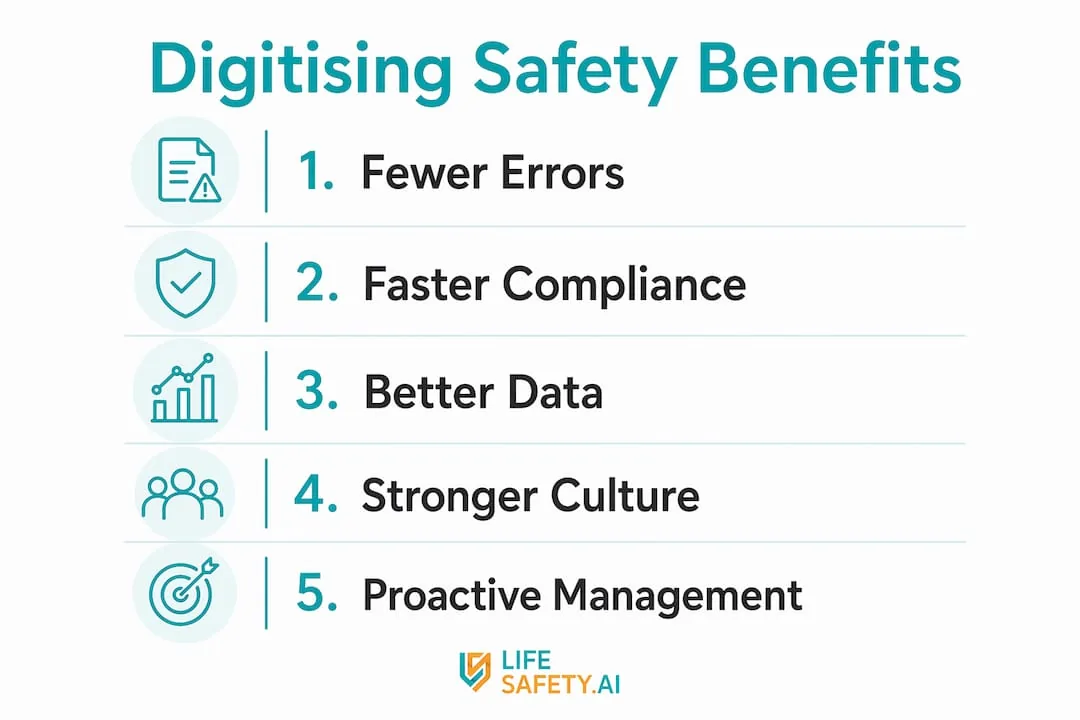
The core case for why digitise safety processes comes down to three things: fewer errors, faster compliance, and better hazard visibility. Each of these directly affects the safety outcomes your organisation is legally and ethically responsible for.
Digital tools expedite compliance reporting and improve documentation accuracy for safety audits. That matters because a missed or inaccurate record during an HSE inspection can result in enforcement action, even when the underlying safety practice was sound.
The benefits extend well beyond paperwork:
- Automated incident logging. Mobile incident reporting removes the delay between an event occurring and it being recorded. LifeSafety.ai mobile logging captures incidents at the point of occurrence, reducing transcription errors and helping teams identify RIDDOR-reportable events immediately.
- Real-time hazard identification. Digital technologies improve safety by providing context-aware information and automated hazard identification. Safety teams receive alerts before situations escalate rather than after.
- Compliance with ISO 45001 and HSE standards. Automated workflows enforce the steps required by regulatory frameworks, so nothing falls through the gaps between departments, contractors, or shifts.
- Audit readiness. Digital records are searchable, timestamped, and version-controlled. Preparing for an audit shifts from a week-long exercise to a matter of hours.
- Reduced administrative burden. Automated safety management systems have demonstrated a 33.3% reduction in occupational accidents and administrative workload. That reduction frees safety specialists to focus on prevention rather than paperwork.
Pro Tip: When evaluating digital safety platforms, check whether they support offline mobile logging. Construction and manufacturing sites often have poor connectivity, and offline capability prevents data gaps during critical moments.
The benefits of digitising safety are not confined to one sector. Construction teams use digital permit-to-work workflows to control high-risk activities under CDM 2015. Manufacturing facilities use automated inspection schedules to maintain machinery compliance and reduce unplanned downtime. Healthcare organisations use digital training records to demonstrate staff competency under regulated care requirements.
How does digitisation strengthen risk management and decision-making?
Digital safety management changes risk management from a reactive discipline into a proactive one. The difference is significant. Reactive systems record what went wrong. Proactive systems identify what is about to go wrong.

AI models trained on plant data identify risks before alarm thresholds are crossed, improving plant safety and productivity. This capability represents a fundamental shift in how safety professionals can operate. Instead of investigating incidents after the fact, teams receive early warnings and can intervene before harm occurs.
The practical steps for building a stronger risk management framework with digital tools follow a clear sequence:
- Centralise all risk assessment data. A single digital repository replaces scattered spreadsheets and paper files, giving every authorised team member access to current risk assessments from any device.
- Automate monitoring and alerts. Set threshold-based alerts for environmental conditions, equipment status, and near-miss frequency. LifeSafety.ai dashboards surface these signals in real time.
- Use historical trend analysis. Digital systems accumulate incident and near-miss data over time. Analysing that data reveals patterns, such as a particular shift, contractor package, or location generating disproportionate near-misses, that manual records would rarely surface.
- Integrate incident investigation with risk assessment. When an incident occurs, digital platforms link the investigation directly to the relevant risk assessment, making it straightforward to update controls and close the loop.
- Apply predictive maintenance scheduling. Equipment failures are a leading cause of workplace incidents. Digital condition monitoring flags maintenance needs before failure occurs, reducing both downtime and risk.
The table below shows how digital risk management compares to traditional approaches across key performance areas:
| Area | Traditional approach | Digital approach |
|---|---|---|
| Hazard detection | Post-incident review | Real-time monitoring and AI alerts |
| Risk assessment updates | Manual, infrequent | Automated triggers on incident or near-miss |
| Audit trail | Paper files, prone to loss | Timestamped digital records, always accessible |
| Decision-making | Based on memory and experience | Supported by historical data and trend analysis |
| Regulatory reporting | Manual compilation, error-prone | Automated RIDDOR and HSE reporting |
Standards such as ISA-101 and ISA-18.2 guide the design of human-machine interfaces and alarm systems to reduce risk and operator confusion. Platforms that align with these standards give safety professionals confidence that the technology itself is not introducing new hazards.
What challenges arise when implementing digital safety processes?
The importance of digital safety measures is clear, but implementation is not without friction. Understanding the obstacles in advance allows safety professionals to plan for them rather than be surprised by them.
The most common barriers are:
- Workforce privacy concerns. Privacy worries are heightened when GPS or monitoring technology is perceived as management oversight rather than a safety tool. Workers who feel surveilled rather than protected will resist adoption, sometimes actively.
- Learning curves and digital fatigue. Successful digital safety adoption depends on organisational readiness and mitigating digital fatigue among staff. Introducing multiple new systems simultaneously overwhelms teams and increases the risk of errors during the transition period.
- Integration with legacy systems. Many organisations carry decades of paper records and older software. Migrating that data and connecting legacy systems to a new platform requires planning, resource, and technical expertise.
- Cost and governance. Implementation costs are a primary limiting factor for many organisations. Without a clear governance framework, digital safety projects can stall or deliver inconsistent results across sites.
- Inconsistent adoption across teams. A digital system is only as effective as its uptake. If one team logs incidents digitally while another reverts to paper, the data picture becomes unreliable.
Mitigation starts with communication. Explain to workers precisely what data is collected, who can access it, and how it will be used. Transparency converts scepticism into cooperation. Phased rollouts, starting with one module or one site, reduce the cognitive load on teams and allow the organisation to learn before scaling.
Pro Tip: Appoint a digital safety champion on each site or team. Peer advocacy is far more effective than top-down mandates when it comes to changing daily working habits.
For UK duty holders, these implementation issues should also be viewed through a compliance lens. Under CDM 2015, clients, principal designers, and principal contractors must ensure arrangements are suitable and proportionate. A poorly governed digital rollout can create gaps in communication, training, or control verification. Likewise, under the Building Safety Act, the quality and traceability of safety information matters. If digital systems are introduced, they must improve the golden thread of information rather than fragment it.
How do digital safety processes build a stronger safety culture?
A strong safety culture is one where workers report near-misses without fear, hazards are raised before incidents occur, and safety is seen as everyone’s responsibility. Digital tools create the conditions for that culture to develop.
Safety by design, embedding safety from project conception, leads to better performance and reduces retrofitting risks. When safety is built into automated workflows from the start rather than added as an afterthought, it becomes part of how work is done rather than an additional burden. For construction professionals, this means integrating site hazard identification into the project planning phase, not just the delivery phase.
| Cultural outcome | How digital tools enable it |
|---|---|
| Near-miss reporting | Mobile reporting removes barriers; workers log events in seconds |
| Accountability | Automated task assignment and completion tracking creates clear ownership |
| Continuous improvement | Trend data surfaces recurring issues for targeted intervention |
| Safety communication | Digital dashboards share safety performance across teams in real time |
| Worker engagement | Feedback loops show workers that their reports lead to visible action |
Proactive safety processes aligned with productivity minimise downtime and reduce workarounds by creating intuitive safety measures embedded in operations. That alignment matters because safety and productivity are not in opposition. Organisations that treat them as complementary goals consistently outperform those that treat safety as a cost centre. LifeSafety.ai’s AI-driven safety insights give safety professionals the data they need to make that case internally, turning safety performance into a board-level metric rather than a compliance checkbox.
Real-time feedback is particularly powerful for engagement. When a worker submits a near-miss report and sees a corrective action assigned and closed within 48 hours, they understand that reporting makes a difference. That experience builds the reporting habit more effectively than any training session alone.
In practical terms, stronger culture also supports legal compliance. Better reporting means better evidence for RIDDOR decision-making, clearer contractor oversight, and more reliable proof that control measures are being implemented on site. In higher-risk buildings and complex projects, that visibility supports the information management expectations now associated with the Building Safety Act and the wider duty to maintain a robust safety case.
Key takeaways
Digitising safety processes is the most direct path to proactive compliance, reduced incidents, and a measurable safety culture across any industry.
| Point | Details |
|---|---|
| Compliance accuracy improves | Digital records eliminate paperwork errors and support RIDDOR and ISO 45001 reporting automatically. |
| Risk management becomes proactive | AI monitoring detects hazards before alarm thresholds are crossed, enabling early intervention. |
| Administrative burden falls | Automated systems reduce occupational accidents and free specialists for preventive work. |
| Adoption requires active management | Privacy concerns and learning curves must be addressed through transparent communication and phased rollouts. |
| Safety culture strengthens over time | Real-time feedback loops and near-miss reporting tools build the reporting habits that underpin a strong safety culture. |
Why I believe digitisation is the defining shift in health and safety
Having worked alongside health and safety professionals across construction, manufacturing, and facilities management, I believe digitisation is the defining shift because it changes the operating model of safety itself. It moves the profession away from delayed reporting, fragmented evidence, and retrospective learning, and toward live visibility, structured accountability, and earlier intervention.
In the UK context, that matters more than ever. Duty holders are expected not only to manage risk, but to demonstrate that they are managing it competently. Whether the issue is a RIDDOR reportable incident, a contractor control failure under CDM 2015, or the maintenance of accurate building safety information under the Building Safety Act, the standard of proof is rising. Paper systems and disconnected spreadsheets make that proof harder to produce and harder to trust.
Digitisation does not replace professional judgement. It strengthens it. A good safety practitioner still needs to understand hierarchy of control, behavioural risk, supervision quality, permit discipline, and the realities of work as done. What digital systems provide is a clearer signal. They show where actions are overdue, where hazards are clustering, where inspections are being missed, and where trends suggest a more serious failure could be developing.
That is why the real value is not simply efficiency, although efficiency matters. The deeper value is confidence: confidence that records are complete, confidence that actions are traceable, confidence that leaders can see emerging risk, and confidence that workers can report concerns without those concerns disappearing into a filing cabinet.
For organisations still deciding whether to modernise, my view is straightforward: start with the processes that carry the highest compliance and operational risk. Incident reporting, inspections, corrective actions, training records, and risk assessments usually offer the fastest return. Build from there. A phased approach is often more sustainable than a full-system replacement, especially where legacy processes are deeply embedded.
The organisations that will lead over the next decade are not necessarily those with the most software. They are the ones that use digital tools to make safety simpler, faster, and more visible for the people doing the work. When that happens, compliance improves, reporting improves, and prevention improves. That is why digitisation is not just a technology trend. It is a practical safety strategy.
Where to focus first
- Incident and near-miss reporting to improve response speed and RIDDOR review.
- Risk assessments and RAMS control to strengthen CDM 2015 compliance and version control.
- Corrective action tracking to ensure hazards are closed out and evidenced.
- Training and competency records to support audit readiness and contractor assurance.
- Inspection and maintenance workflows to reduce repeat failures and improve asset safety.
If your organisation is beginning this journey, the strongest starting point is usually the area where delayed information currently creates the greatest safety risk.
Related Articles

Incident reporting software comparison: UK guide 2026
Discover our incident reporting software comparison for UK workplaces. Explore top options like Lifesafety, SafetyCulture, and more.

Safety management solutions for construction: UK SMS guide
Discover essential safety management solutions for construction sites in the UK. Learn how a mobile-first SMS can enhance safety and compliance.

Best Health and Safety Software for UK Workplaces: A Guide
Discover the best health and safety software for UK workplaces in 2026. Explore top picks like Lifesafety for compliance and efficiency!