
What is RIDDOR reporting? A 2026 compliance guide
What is RIDDOR reporting? A 2026 compliance guide
A practical guide to understanding RIDDOR reporting, identifying reportable incidents, meeting HSE deadlines, and maintaining defensible records across construction, manufacturing, facilities management, and other UK workplaces.
TL;DR
- RIDDOR requires employers and site controllers to report serious work-related injuries, illnesses, and dangerous events to the HSE.
- Failure to report can lead to criminal penalties, including unlimited fines and, in serious cases, imprisonment.
- All reports must be filed within strict deadlines using the correct HSE reporting route.
- Proper record-keeping, clear duty-holder allocation, and disciplined incident management are essential for compliance and safety improvement.
RIDDOR reporting is the legal obligation for employers, self-employed persons, and premises controllers to notify the Health and Safety Executive (HSE) of significant workplace injuries, occupational diseases, and dangerous occurrences. Established under the Reporting of Injuries, Diseases and Dangerous Occurrences Regulations 2013, RIDDOR compliance is not optional. Failure to report is a criminal offence carrying unlimited fines or up to two years’ imprisonment. That penalty reflects how seriously Parliament treats workplace safety data. For health and safety professionals, understanding what triggers a report, who must file it, and when it is due is the foundation of effective incident management.
What is RIDDOR reporting and which incidents does it cover?
RIDDOR reporting covers six distinct categories of workplace event under the Reporting of Injuries, Diseases and Dangerous Occurrences Regulations 2013. Only incidents meeting one of these six triggers require a formal report to the HSE. Minor injuries, near misses below the threshold, and events such as suicide are explicitly excluded.
The six reportable categories are:
- Worker fatalities — any death resulting from a work-related accident
- Specified injuries — fractures (excluding fingers, thumbs, and toes), amputations, crush injuries causing internal organ damage, loss of sight, burns covering more than 10% of the body, and similar serious harm
- Over-seven-day injuries — incapacitation lasting more than seven consecutive days, excluding the day of the accident
- Occupational diseases — conditions such as carpal tunnel syndrome, occupational dermatitis, or hand-arm vibration syndrome, diagnosed by a registered medical practitioner
- Dangerous occurrences — near-miss events with high potential for serious harm, including scaffold collapses, explosions, and train collisions
- Non-worker injuries — injuries to members of the public or other non-workers that result in hospital treatment
Understanding common workplace hazards helps safety professionals identify which events are likely to cross the RIDDOR threshold before an incident occurs.
Pro Tip: A recordable injury and a reportable injury are not the same thing. You must log all injuries in your internal accident book, but only those meeting the six RIDDOR categories above require submission to the HSE.

Who must submit a RIDDOR report, and what are the deadlines?
The “responsible person” under Regulation 3 of RIDDOR 2013 carries the legal duty to report. The responsible person is the employer, the self-employed individual (for incidents involving their own work), or the person in control of the premises where the incident occurred. The injured worker, witnesses, and HR staff cannot discharge this duty on behalf of the responsible person.
The key duty-holders are:
- Employers — for incidents involving their employees, regardless of where the work takes place
- Self-employed persons — for incidents arising from their own work activities
- Premises controllers — for incidents involving non-workers on their site
Deadlines vary by incident type, and missing them carries the same criminal risk as failing to report altogether.
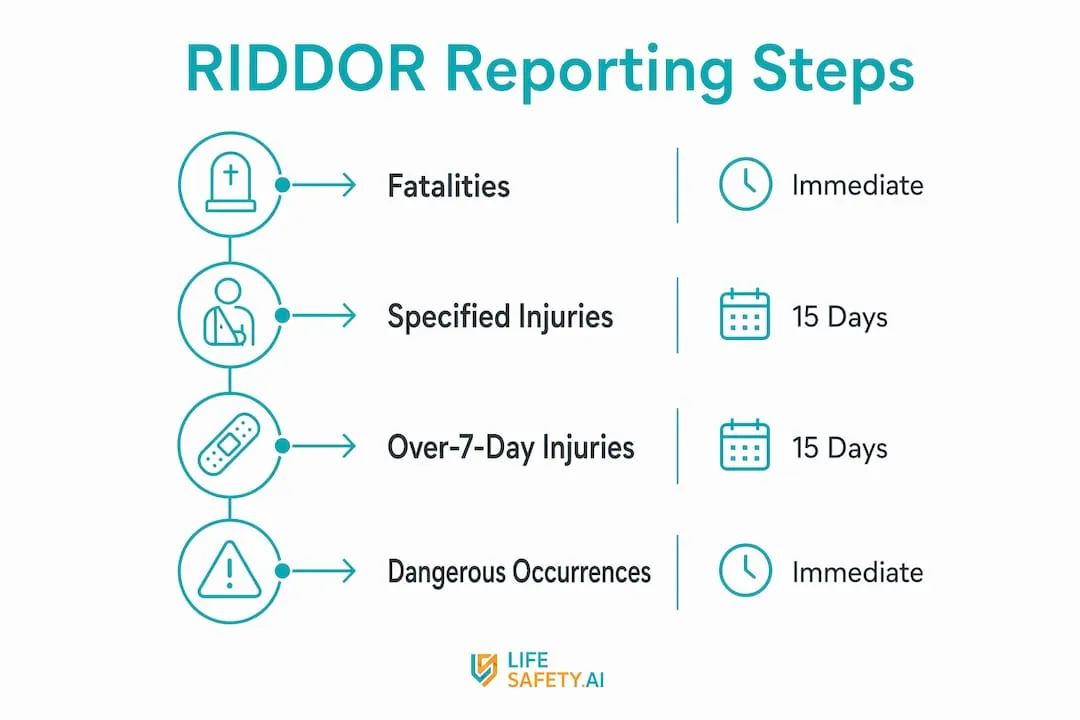
- Fatalities, specified injuries, and dangerous occurrences — notify the HSE immediately by the quickest practicable means, then submit a full written report within 10 days
- Over-seven-day injuries — submit a written report within 15 days of the accident date
- Occupational diseases — report from the date the written diagnosis is received from a medical practitioner, not from the date symptoms first appeared
Over-seven-day injury deadlines catch many organisations out because the 15-day clock starts on the day of the accident, not on the day the seventh day of incapacity is reached. That distinction matters enormously when calculating your submission window.
Pro Tip: A telephone call to the HSE opens a case record, but it does not replace the mandatory written submission. Phone notification must always be followed by a full online report within the applicable deadline.
How to make a RIDDOR report and maintain compliant records
The primary method for submitting a RIDDOR report is the HSE’s online reporting portal. Telephone reporting is available only for fatalities and specified injuries where immediate notification is required. All other categories require direct online submission.
| Incident type | Notification method | Deadline | Record retention |
|---|---|---|---|
| Fatality / specified injury | Phone, then online | Immediate + 10 days | Minimum 3 years (6 recommended) |
| Dangerous occurrence | Phone, then online | Immediate + 10 days | Minimum 3 years (6 recommended) |
| Over-seven-day injury | Online only | 15 days from accident date | Minimum 3 years (6 recommended) |
| Occupational disease | Online only | From date of diagnosis | Minimum 3 years (6 recommended) |
| Non-worker injury | Online only | 10 days | Minimum 3 years (6 recommended) |
Two errors appear repeatedly in practice. The first is using outdated PDF forms downloaded from third-party websites, which the HSE does not accept as valid submissions. The second is treating a phone call as the completed report. Even fatal incidents requiring immediate phone notification must be followed by a full written online report within 10 days to satisfy the legal requirement.
Internal records must contain the date, time, and location of the incident, the name and job role of the injured person, a description of what happened, the outcome, and the RIDDOR reference number issued by the HSE. RIDDOR records must be kept for at least three years by law. Retaining them for six years aligns with the limitation period for civil claims and gives your organisation a defensible paper trail if litigation follows.
Pro Tip: Store your RIDDOR reference numbers alongside your internal accident records from day one. Retrieving them months later during an HSE inspection or civil claim is far harder than filing them correctly at the point of submission.
Common pitfalls and best practices for managing RIDDOR compliance
RIDDOR compliance failures cluster around three areas: deadline miscalculation, incorrect identification of the responsible person, and incomplete internal records. Each is avoidable with the right processes in place.
Misunderstanding the over-seven-day injury clock is the single most common deadline error. The 15-day window opens on the day of the accident, not when the worker has been absent for seven full days. A worker injured on a Monday who remains off work through the following Wednesday has already used 10 days of the reporting window before the seven-day threshold is even confirmed.
The following best practices give safety professionals a reliable framework for RIDDOR management:
- Assign the responsible person in writing before an incident occurs. Ambiguity about who holds the duty creates delays and legal exposure.
- Track incapacitation days from the accident date, not from the first day of absence. Use a daily log to monitor each case in real time.
- Submit online reports promptly, even when a phone call has already been made. Do not wait until the final day of the deadline window.
- Audit your report content before submission. Incomplete reports can be treated as non-compliant by the HSE.
- Use RIDDOR data as a diagnostic tool, not just a legal formality. RIDDOR is designed to capture serious incidents that indicate substantive safety failures, and the data can reveal patterns in equipment failure or training gaps.
- Review your records annually to confirm retention periods are being met and that RIDDOR reference numbers are correctly filed.
Only the designated responsible person filing a RIDDOR report satisfies the legal duty. A report submitted by a well-meaning colleague, HR manager, or contractor does not discharge the obligation, regardless of how accurate or complete that report is.
For practical guidance on structuring your internal documentation, the incident report template guide from Lifesafety covers the key fields that support both RIDDOR submissions and internal investigations.
RIDDOR compliance: what the data is really telling you
RIDDOR compliance is a diagnostic safety tool that enables organisations to identify and mitigate systemic risks, rather than merely a legal formality. That framing matters. Too many safety teams treat RIDDOR as a box-ticking exercise, filing reports only when they must and moving on. The organisations that use RIDDOR data well treat each report as a signal worth investigating.
My view, having worked closely with safety professionals across construction, manufacturing, and facilities management, is that the biggest compliance failures are not about ignorance of the law. They are about process gaps. The responsible person is not clearly defined. Incapacitation days are not tracked daily. Phone calls are logged as completed reports. These are operational failures, not knowledge failures.
The other issue I see consistently is that RIDDOR data sits in isolation. Reports go to the HSE, a reference number comes back, and the file closes. The organisations with the strongest safety cultures feed that data back into their incident management processes, looking for patterns across quarters and sites. A cluster of over-seven-day injuries in one department is not bad luck. It is a signal about supervision, equipment, or workload that deserves a structured response.
RIDDOR compliance in 2026 is not more complex than it was in 2013. What has changed is the expectation that safety professionals can demonstrate not just that they reported, but that they acted on what the data showed. That is the standard the HSE and civil courts now apply.
— Harry
How Lifesafety supports your RIDDOR reporting process
Managing RIDDOR deadlines, responsible person assignments, and multi-site record-keeping manually creates unnecessary risk. Lifesafety is built specifically for UK workplaces that need to meet RIDDOR requirements without the administrative burden.

The Lifesafety incident reporting module guides users through each stage of a RIDDOR-compliant submission, from initial logging to deadline tracking and record storage. The platform flags reportable incidents automatically, assigns the correct deadline, and retains all records with the HSE reference number attached. For teams managing safety across construction, healthcare, or facilities management, Lifesafety’s construction safety management tools integrate RIDDOR reporting directly into site operations, reducing the gap between incident and submission.
This is particularly valuable in environments where RIDDOR duties intersect with wider compliance obligations under CDM 2015, the Building Safety Act, and internal contractor control procedures. A joined-up reporting process helps duty-holders demonstrate that incidents are not only reported correctly, but also escalated, investigated, and acted upon in a way that supports broader legal compliance.
FAQ
What is RIDDOR in the UK?
RIDDOR stands for the Reporting of Injuries, Diseases and Dangerous Occurrences Regulations 2013. It is the UK legislation requiring employers, self-employed persons, and premises controllers to report certain serious work-related incidents, diseases, and near-miss events to the HSE.
What incidents are reportable under RIDDOR?
Reportable incidents fall into six main categories:
- Fatalities
- Specified injuries
- Over-seven-day injuries
- Occupational diseases
- Dangerous occurrences
- Non-worker injuries requiring hospital treatment
Minor injuries and low-level near misses do not usually require RIDDOR reporting, although they should still be recorded internally.
Who is the responsible person for RIDDOR reporting?
The responsible person is usually the employer, the self-employed person, or the person in control of the premises, depending on the circumstances of the incident. The legal duty cannot be discharged simply by an employee, witness, or HR colleague unless they are acting formally on behalf of the duty-holder within an established reporting process.
How quickly must a RIDDOR report be submitted?
Deadlines depend on the type of incident:
- Fatalities, specified injuries, and dangerous occurrences — notify immediately and complete the written report within 10 days
- Over-seven-day injuries — report within 15 days of the accident date
- Occupational diseases — report once a written diagnosis is received from a registered medical practitioner
- Non-worker injuries — generally within 10 days
Can you report RIDDOR by phone?
Phone reporting is generally reserved for fatalities and specified injuries where immediate notification is required. In practice, the HSE online reporting portal is the main route for submission, and a phone call does not remove the need for the required written report.
How long should RIDDOR records be kept?
The legal minimum retention period is three years. However, many organisations retain records for six years to align with civil claims limitation periods and to support investigations, audits, and enforcement enquiries.
Is an over-seven-day injury counted from the seventh day?
No. This is one of the most common mistakes. The reporting deadline is calculated from the date of the accident, not from the point at which the seventh day of incapacity is reached. That means organisations need to track absence immediately after the incident occurs.
What happens if you fail to report under RIDDOR?
Failure to report a qualifying incident is a criminal offence. Enforcement action can include prosecution, unlimited fines, and in serious cases imprisonment. It may also weaken an organisation’s position in civil litigation and damage its standing with clients, regulators, and insurers.
Does RIDDOR apply to construction and manufacturing sites?
Yes. RIDDOR applies across UK workplaces, including construction, manufacturing, warehousing, healthcare, education, facilities management, and public-facing premises. In construction, RIDDOR often sits alongside duties under CDM 2015, while higher-risk buildings and occupied assets may also require incident learning to be considered within the wider governance expectations of the Building Safety Act.
How can software help with RIDDOR compliance?
Good safety software can help organisations identify reportable incidents faster, assign the correct duty-holder, track statutory deadlines, store evidence, and retain HSE reference numbers in one place. This reduces the risk of missed deadlines, fragmented records, and inconsistent reporting across multiple sites or contractors.
Strengthen your RIDDOR process with Lifesafety
Centralise incident reporting, deadline tracking, investigations, and compliance records in one platform designed for UK safety teams.
Related Articles

Incident reporting software comparison: UK guide 2026
Discover our incident reporting software comparison for UK workplaces. Explore top options like Lifesafety, SafetyCulture, and more.

Safety management solutions for construction: UK SMS guide
Discover essential safety management solutions for construction sites in the UK. Learn how a mobile-first SMS can enhance safety and compliance.

Best Health and Safety Software for UK Workplaces: A Guide
Discover the best health and safety software for UK workplaces in 2026. Explore top picks like Lifesafety for compliance and efficiency!