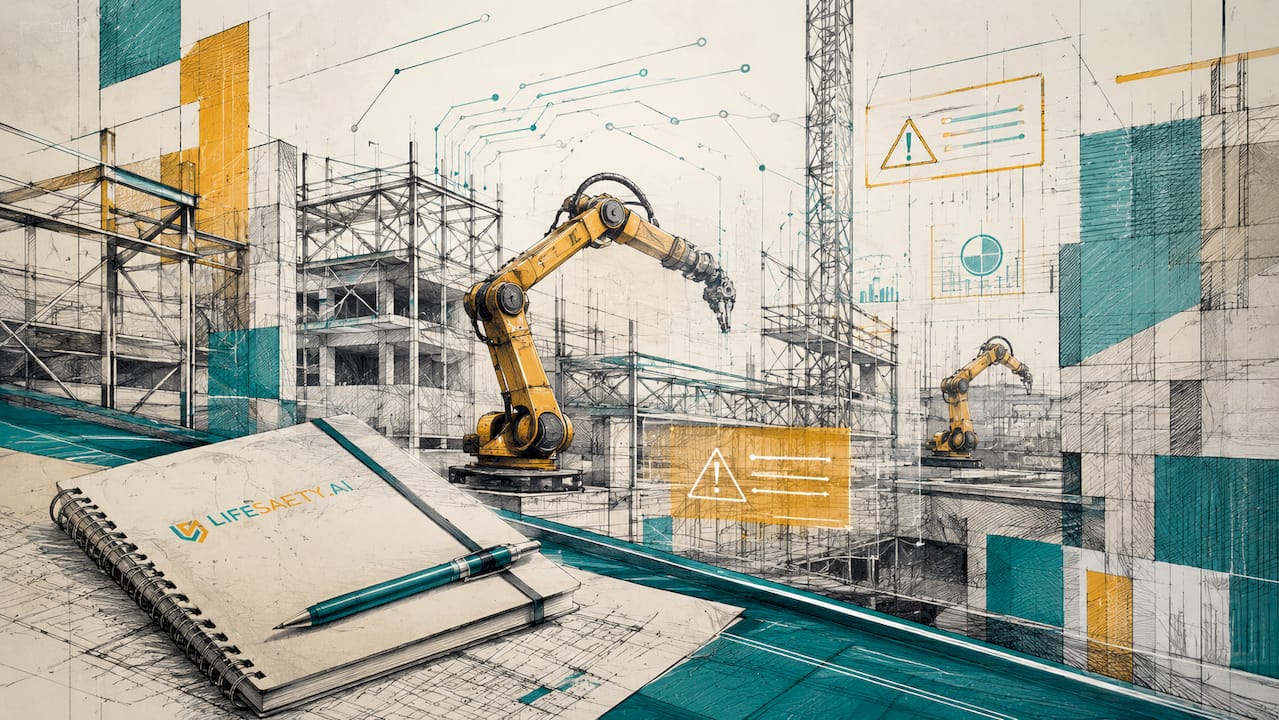
Role of automation in high-risk industries
Role of automation in high-risk industries
Automation is reshaping safety performance across construction, manufacturing, oil and gas, and other hazardous sectors. Used well, it reduces exposure to harm, strengthens compliance evidence, and supports earlier intervention. Used poorly, it introduces new mechanical, electrical, and organisational risks that must be managed under UK health and safety law.
TL;DR
- Automation reduces workplace hazards by using robots and AI to handle dangerous tasks and monitor risks.
- It improves safety compliance through continuous data collection and real-time hazard detection.
- Automation also introduces new mechanical, electrical, ergonomic, and psychosocial risks that require careful organisational management and updated risk assessments.
Automation is defined as the use of technology to perform tasks with minimal human intervention, and its role in high-risk industries is to directly reduce worker exposure to hazards while improving safety compliance. The International Federation of Robotics reports that robot adoption correlates to a 4.3% average reduction in workplace fatality and injury rates across the EU. That figure represents thousands of prevented injuries each year. AI-enabled tools, from smart wearables to AI CCTV, now provide real-time hazard alerts that act as a final layer of defence in modern safety models. For health and safety professionals managing construction, manufacturing, or oil and gas sites, understanding how automation reshapes both risk profiles and compliance obligations is no longer optional.
How does automation reduce hazards in high-risk industries?
Automation reduces hazards by removing workers from direct exposure to dangerous conditions. Industrial robots handle tasks that fall under the Dull, Dirty, Dangerous (DDD) framework, a classification used to identify work most suited for mechanisation. Welding in confined spaces, handling toxic chemicals, and working at height are all DDD tasks where robotic substitution demonstrably lowers injury rates.
The practical benefits of automation in dangerous jobs include:
- Removal from harm’s way: Robots perform high-temperature, high-pressure, or toxic-exposure tasks without fatigue or distraction.
- Consistent performance: Automated systems do not suffer from the lapses in concentration that cause many manual-task injuries.
- Real-time hazard detection: AI CCTV and smartwatches deliver haptic alerts for PPE non-compliance and proximity breaches, acting as a last line of defence.
- Continuous monitoring: Automated sensors track gas levels, temperature, and structural movement around the clock, without shift changes or human fatigue.
- Data-driven decisions: Automated systems generate incident and near-miss data that feeds directly into risk assessments and audit trails.
The AI-driven hazard detection now available through platforms like Lifesafety means that safety professionals receive alerts before incidents escalate. This shifts the safety model from reactive to genuinely preventive. AI security systems, including those discussed by BeyondSensor, show how sensor-driven monitoring enhances worker protection across hazardous sites.
Pro Tip: Map every task on your site against the DDD framework before selecting automation targets. Tasks that are simultaneously dull, dirty, and dangerous deliver the highest return on safety investment when automated first.

What new safety risks does automation introduce?
Automation does not eliminate risk. It redistributes it. Health and safety professionals must account for a new category of mechanical, electrical, and psychosocial hazards that emerge when robots enter the workplace.
OSHA Severe Injury Reports covering 2015 to 2022 recorded 77 robot-related accidents, with stationary robots causing primarily finger amputations and mobile robots causing leg and foot fractures. These are not minor incidents. They reflect a pattern of inadequate human-robot interaction planning.
The main categories of new automation risk include:
- Mechanical hazards: Collisions between mobile robots and workers, crush injuries from robotic arms, and entanglement in automated conveyor systems.
- Electrical hazards: Exposure to high-voltage systems during maintenance of automated plant.
- Ergonomic hazards: Workers adapting their posture and pace to machine rhythms, increasing musculoskeletal strain over time.
- Psychosocial hazards: Reduced task variety, loss of perceived autonomy, and diminished social interaction, all of which negatively affect safety culture if left unaddressed.
The correct response to these risks is not to slow automation adoption. The correct response is to apply the Prevention through Design principle and the Hierarchy of Controls to every human-robot interaction point. This means designing out collision risks through physical guarding and proximity sensors before relying on administrative controls or PPE.
Pro Tip: When introducing any new robotic system, run a dedicated Management of Change (MOC) process. Include frontline workers in the hazard identification stage. They will identify interaction risks that desk-based risk assessors miss.
How does automation support safety compliance and risk management?
Automation fundamentally changes how compliance is achieved and evidenced. Manual safety rounds, conducted by a single inspector at fixed intervals, leave long windows where hazards can develop undetected. Autonomous inspection systems close those windows entirely.
Heavy industrial robotics now enable continuous autonomous inspections that feed data directly into plant safety control systems. In oil and gas, this means leak detection and risk-based inspection (RBI) models receive live data rather than periodic snapshots. The result is earlier hazard detection and a stronger audit trail for regulators.
The shift from manual to automated compliance works in four stages:
- Continuous data collection: Sensors and robots gather real-time readings on pressure, temperature, gas concentration, and structural integrity.
- Automated analysis: AI systems compare live readings against defined safety thresholds and flag deviations immediately.
- Closed-loop response: Alerts trigger pre-set responses, such as shutting a valve or issuing a site evacuation signal, without waiting for human review.
- Compliance documentation: Every reading, alert, and response is logged automatically, creating an auditable record that satisfies RIDDOR, CDM 2015, and BS standards requirements.
Platforms built for automated safety inspections replace paper-based rounds with digital workflows that update in real time. This matters particularly in construction, where CDM 2015 places explicit duties on principal contractors to maintain current risk records. Automated systems make that obligation far easier to meet consistently.
The closed-loop safety model represents the most significant shift in process safety thinking in a generation. Robotics data feeds directly into plant control systems, enabling responses rather than isolated alerts. That distinction matters enormously when seconds determine whether a gas leak becomes a fatality.
UK compliance note
In UK settings, automated monitoring does not remove employer duties under the Health and Safety at Work etc. Act 1974, the Management of Health and Safety at Work Regulations 1999, CDM 2015, or reporting obligations under RIDDOR. It can, however, materially improve the quality, timeliness, and defensibility of compliance evidence when incidents, dangerous occurrences, or near misses are reviewed by HSE or internal investigators.
What organisational factors determine automation success?
Technology alone does not make a workplace safer. The interaction of human, organisational, and technical elements determines whether automation delivers its promised safety benefits or creates new failure modes.
The most common mistake health and safety professionals see is treating human error as the root cause of incidents in automated environments. When a worker overrides a safety interlock or bypasses a sensor, the question is not why the individual made that choice. The question is what organisational conditions made that choice feel reasonable. Automation that removes human agency without replacing it with meaningful oversight creates exactly those conditions.
Key organisational factors that determine automation outcomes include:
- Worker involvement: Robotisation’s safety benefits are stronger in countries where workers have meaningful representation in technology decisions, such as Germany and Austria. Involving frontline teams in automation design is not a courtesy. It is a safety control.
- Training and competence: Workers who monitor automated systems need different skills than those who performed the tasks manually. Training programmes must reflect that shift.
- Meaningful Human Control: Automation should reduce physical exposure, not eliminate human judgement. Maintaining clear human oversight of automated decisions preserves accountability and catches system errors.
- Safety culture: Automation that reduces task variety and social interaction can erode the informal safety communication that keeps sites safe. Leaders must actively replace those channels.
The automation challenges checklist developed for project managers highlights that organisational readiness, not technical capability, is the most common barrier to successful automation integration. Health and safety professionals who engage with that readiness assessment early will avoid the most costly implementation failures.
Practical implementation priorities
- Update risk assessments before commissioning automated equipment, not after first use.
- Review competence matrices for operators, maintainers, supervisors, and contractors.
- Test emergency stop, isolation, lockout/tagout, and override procedures under realistic conditions.
- Ensure design reviews consider occupied areas, pedestrian routes, and temporary works where relevant.
- Capture lessons learned in digital systems so findings feed back into future planning and permit controls.
Key takeaways
Automation reduces workplace injuries and improves compliance, but only when organisations address both the technical integration and the human factors that determine whether new systems actually perform as intended.
| Point | Details |
|---|---|
| Proven injury reduction | Robot adoption correlates to a 4.3% reduction in EU workplace fatalities and injuries. |
| New risks require new controls | Automation introduces mechanical and psychosocial hazards that demand updated risk assessments using Prevention through Design. |
| Closed-loop compliance | Connecting robotic data directly to plant safety systems enables real-time responses, not just alerts. |
| Worker involvement is a safety control | Safety benefits are strongest where frontline workers participate meaningfully in automation decisions. |
| AI tools extend the safety model | Smart wearables and AI CCTV act as a final layer of defence, detecting hazards that static systems miss. |
Why I think we are still underestimating automation’s psychosocial impact
Most conversations about automation in hazardous environments focus on the physical. Robots replace dangerous manual tasks. Injury rates fall. The business case looks compelling. I understand that framing, and the data supports it. But after working with health and safety teams across construction and manufacturing, I am convinced that the psychosocial dimension receives a fraction of the attention it deserves.
When you automate the dull, dirty, and dangerous tasks, you also automate away much of the informal social fabric of a site. Workers who previously collaborated on physically demanding tasks now monitor screens in isolation. That shift quietly erodes the trust and communication that underpin strong safety culture. The research on the DDD framework’s broader impacts confirms this pattern, yet most implementation plans I have reviewed contain no mitigation for it.
My view is that every automation project in a high-risk environment needs an explicit psychosocial risk assessment alongside the standard mechanical and electrical reviews. That assessment should ask what informal safety behaviours the automated system displaces and how those behaviours will be preserved or replaced. Platforms like Lifesafety can support that process by maintaining AI-enhanced risk assessments that capture both physical and organisational hazard profiles. The future of automation in high-risk sectors belongs to organisations that treat human factors as part of core safety engineering, not as an afterthought once the machinery is installed.
What this means in practice
- Include psychosocial hazards in formal risk assessments and review them after commissioning.
- Monitor whether automation changes communication patterns, supervision quality, or willingness to report concerns.
- Use toolbox talks, digital reporting, and supervisor check-ins to replace lost informal safety conversations.
- Assess whether role redesign has reduced autonomy or increased cognitive load for operators and maintainers.
- Ensure senior leaders treat wellbeing, engagement, and trust as measurable safety indicators, not soft extras.
Final thoughts for UK dutyholders
For UK dutyholders, the value of automation is not simply that it makes work faster. Its real value is that it can remove people from foreseeable harm, improve the reliability of inspections, and create stronger evidence that risks are being identified and controlled. That aligns directly with the expectations of HSE inspectors, principal designers, principal contractors, and accountable persons operating under modern building and industrial safety regimes.
But automation is not self-justifying. It must be selected, designed, commissioned, supervised, and reviewed with the same discipline applied to any other high-risk control measure. If a robotic system creates new collision points, weakens communication, or encourages unsafe workarounds, then the organisation has not improved safety. It has merely changed the shape of the risk.
The strongest automation programmes are therefore the ones that combine engineering control, real-time monitoring, worker involvement, and clear compliance evidence. In practical terms, that means integrating automation into risk assessments, permit systems, inspections, incident learning, and management of change from the outset.
If your organisation is planning automation in construction, manufacturing, logistics, energy, or facilities management, the right question is not whether automation is safe. The right question is whether your governance, competence, and control framework are mature enough to make it safe.
Related Articles

Workplace safety software for construction teams
Discover top-rated workplace safety software for construction. Improve incident tracking, compliance, and safety analytics with Lifesafety!

LifeguardAI.co.uk alternatives for UK safety managers: 2026
Discover top lifeguardai.co.uk alternatives for UK safety managers. Explore Lifesafety and other innovative solutions to enhance workplace safety.

Site audit recommendations: your 2026 action plan
Unlock the power of effective site audit recommendations. Follow our 2026 action plan to boost indexing, enhance content quality, and improve site speed.