LifeSafety.ai Launches Spanish Language Pack Ahead of OSHA
Product Update
LifeSafety.ai launches a Spanish language pack — ahead of OSHA and US expansion
We have rolled out a full Spanish (es-ES) language pack across LifeSafety.ai — the first step in bringing bilingual, standards-aligned safety management to the United States and the OSHA framework.
Spanish language pack OSHA-ready US delivery
Why Spanish, and why now?
Language is a safety-critical control. Across US construction, manufacturing, logistics and facilities, a significant share of the frontline workforce speaks Spanish as a first language — and safety information that is only available in English is safety information that may not be understood. Clear, native-language risk assessments, method statements, permits and toolbox talks are not a nicety; they are how you make sure a control is actually followed on site.
As we prepare to support the OSHA framework and deliver into the US market, a Spanish language pack was the natural place to start. It lets safety teams run a single platform in the language their people actually work in.
What’s in the Spanish language pack
This is a full localisation, not a surface-level translation. The Spanish pack covers:
Fully localised interface — navigation, dashboards, modules, forms, buttons and system messages in professional es-ES.
Bilingual content — teams can work in English or Spanish, switching language without losing context, so mixed workforces stay on the same page.
Localised safety modules — risk assessments, incident reporting, permits to work, inspections and training records, all in Spanish.
Consistent, native terminology — safety and compliance language translated by convention, not word-for-word, so it reads the way a Spanish-speaking safety professional expects.
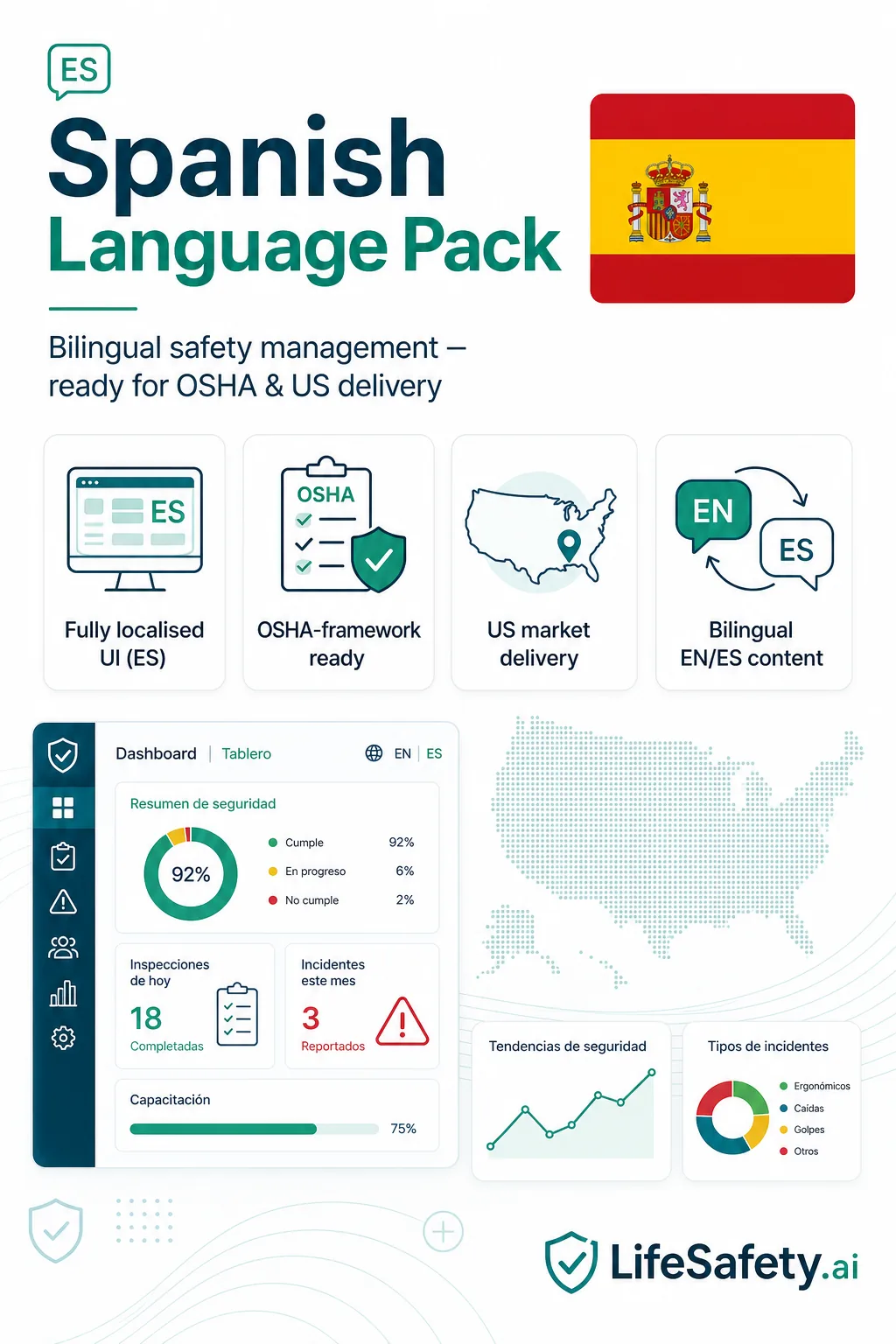
The Spanish language pack at a glance — bilingual safety management, ready for OSHA and US delivery.
Built for the OSHA framework and US delivery
LifeSafety.ai was built around recognised health-and-safety management frameworks, and the same structured approach maps cleanly onto OSHA expectations. Our upcoming US coverage brings OSHA-aligned workflows — hazard communication, incident recordkeeping, inspections and corrective actions — into the platform, now available bilingually from day one.
Delivering in Spanish and English together means a US safety manager can standardise one system across a bilingual workforce, while keeping a full, auditable record of who saw what, in which language.
Part of a wider localisation roadmap
Spanish is the first of several languages. We have already extended the platform to European Portuguese, and the underlying localisation architecture is designed so new languages plug in cleanly — same features, same data, translated where it matters. As we expand across Europe and into the US, safety teams can adopt LifeSafety.ai in the language of their workforce without compromising on functionality or compliance.
Try it in Spanish
The Spanish language pack is live now — switch languages from the header and explore the platform in es-ES. If you manage a bilingual workforce, or you are planning US operations under OSHA, get in touch and we will show you how bilingual safety management works end to end.
Related Articles
How AI-Powered PPE Detection is Reducing Workplace Injuries
Real-time camera-based monitoring is changing how organisations enforce PPE compliance on construction sites and factories.

HSE for Data Centres
Data-centre HSE is electrical plant, COSHH, permits and night-shift people risk. LifeSafety.ai puts UK compliance and live dashboards in one system.
Risk Assessment vs Method Statement (RAMS): Key Differences
A risk assessment identifies what could cause harm; a method statement sets out how the work will be done safely. Here is how they differ, what UK law actually requires, and when you need both.