
Employee training for high-risk industries: 2026 guide
Employee training for high-risk industries: 2026 guide
Employee training is the structured process of equipping workers with the skills and compliance knowledge they need to perform their roles safely and effectively. In high-risk industries such as construction, manufacturing, and healthcare, this is not optional.
TL;DR
- Employee training in high-risk industries must prioritise legal compliance and tailored skill development.
- Regular reviews, sector-specific instructors, and digital tools improve behaviour change and reduce organisational risk.
- Effective programmes depend on leadership support, practical tasks, and ongoing reinforcement.
Poorly designed workplace training programmes cost organisations far more than the investment required to build them properly. The legal exposure alone, from RIDDOR breaches to CDM 2015 non-compliance, makes structured staff development a business-critical priority. This guide gives HR managers and team leaders a clear framework for building, delivering, and sustaining training that produces real behavioural change.
What employee training must cover: required vs recommended
Not all training carries the same legal weight. Mandatory training topics include harassment prevention, workplace safety, data privacy, and anti-discrimination. Failing to deliver these exposes your organisation to regulatory penalties and civil liability. In the UK, the Health and Safety at Work etc. Act 1974 places a statutory duty on employers to provide adequate instruction and training.
Beyond legal mandates, recommended programmes significantly improve workforce effectiveness. These include structured onboarding, leadership development, communication skills, and role-specific technical training. The distinction matters because compliance training protects the organisation, while skills development drives performance.
| Category | Training type | Examples |
|---|---|---|
| Legally required | Compliance and safety | Harassment prevention, COSHH, fire safety, data privacy |
| Legally required | Role-specific mandates | Manual handling, working at height, first aid |
| Recommended | Workforce development | Leadership, communication, onboarding, conflict resolution |
| Recommended | Sector-specific skills | CDM 2015 awareness, RIDDOR reporting, risk assessment |
Prioritising compliance training first is the correct sequence. You cannot build skills on a foundation that exposes the organisation to legal risk. Once mandatory requirements are met, recommended programmes can be layered in systematically.
Pro Tip: Map your mandatory training obligations against your current completion records before designing any new programme. Gaps in legally required training are your highest-priority risk.
How to design a training programme that changes behaviour
Most training programmes fail not because the content is poor, but because the design ignores how adults actually learn. Effective training plans use 3–5 short-term goals with monthly review points to drive genuine behavioural change rather than passive content consumption. That structure forces accountability at regular intervals rather than waiting until the end of a quarter.

The 70:20:10 learning model provides a reliable framework. It holds that 70% of learning happens through on-the-job experience, 20% through social interaction and coaching, and 10% through formal instruction. Most corporate training solutions invert this ratio, front-loading formal content and neglecting the experiential and social components that actually embed skills.
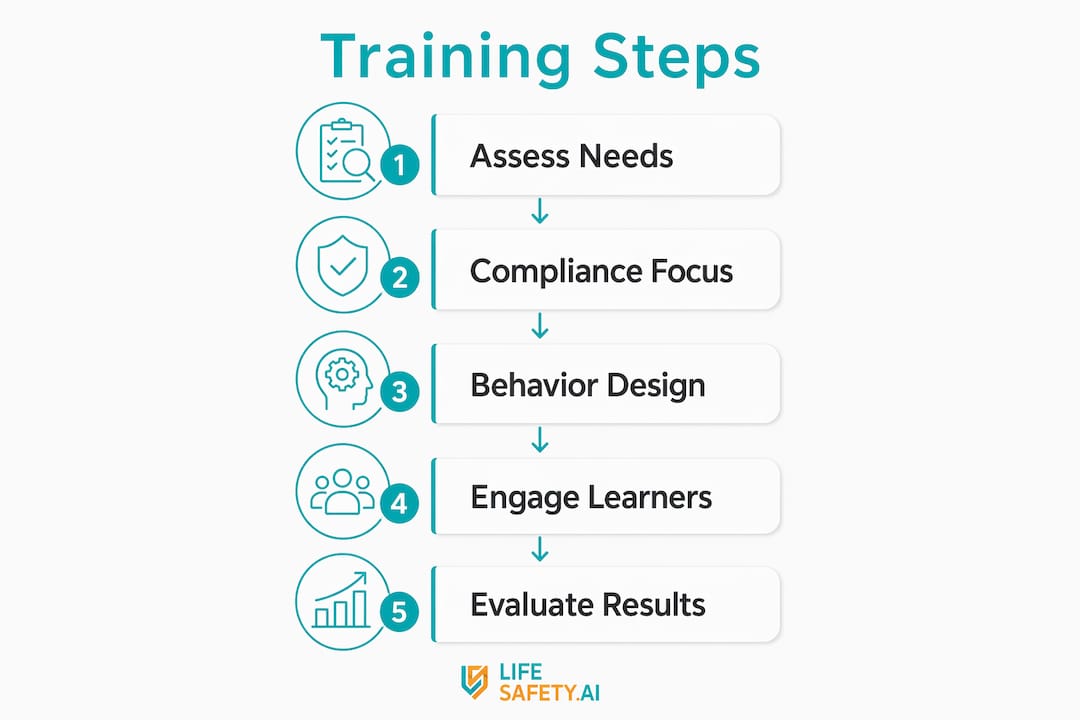
A well-designed programme follows a clear sequence:
- Define 3–5 measurable goals tied to specific job behaviours, not vague competencies.
- Audit existing knowledge gaps using line manager observations and incident data.
- Select delivery methods that match the learning type: on-the-job tasks for experiential learning, peer coaching for social learning, and structured modules for formal content.
- Build a monthly review cadence into the programme from day one.
- Assign completion tracking and document sign-off with e-signatures for compliance records.
- Adjust content based on review findings rather than running the same programme unchanged year after year.
Integrating learning into daily workflows produces far better results than scheduling a half-day session and expecting behaviour to change. A construction site supervisor who practises a risk assessment process on a live project retains far more than one who watches a video about it.
Pro Tip: Balance digital modules with in-person coaching. Digital content works well for knowledge transfer; in-person sessions work better for practising judgement and decision-making under pressure.
How to deliver training when you have no dedicated HR team
Limited HR resource does not mean limited training quality. Technology closes the gap. Training competency management platforms allow team leaders to assign courses, track completions, and store compliance records without a dedicated HR function. The administrative burden drops significantly when the system handles scheduling reminders and completion certificates automatically.
Building a training calendar aligned with business priorities is the practical starting point. Tie training delivery to project cycles, seasonal risk periods, or regulatory review dates rather than scheduling it arbitrarily.
Key delivery principles for resource-limited teams:
- Assign ownership clearly. Each training module should have a named person responsible for delivery and completion tracking.
- Use internal expertise. Senior technicians, experienced site managers, and safety officers often hold knowledge that no external course can replicate.
- Leverage peer coaching. Pairing newer staff with experienced colleagues builds skills and reinforces organisational knowledge simultaneously.
- Document everything. E-signatures on completion records protect the organisation in the event of an incident investigation or regulatory audit.
- Review vendor options carefully. Essential compliance training for a team of 20 typically costs £2,000–£4,000 per year when combining a digital platform with external compliance courses. That figure gives you a realistic budget anchor when evaluating providers.
When selecting an external vendor, prioritise those with sector-specific experience over generalist providers. A vendor who has delivered safety training in construction or manufacturing understands the regulatory context and the practical realities of the work environment.
How to tailor training for high-risk sectors and roles
Generic training does not work in high-risk environments. Specialty safety courses taught by field-experienced instructors produce measurably better compliance outcomes in sectors such as construction, maritime, and petrochemical. The reason is straightforward: instructors who have worked in the environment understand which hazards are theoretical and which are genuinely life-threatening.
For construction specifically, CDM 2015 compliance training must address the duties of principal designers, principal contractors, and duty holders. A generic health and safety course will not cover these obligations with the specificity that regulators expect. The same logic applies to healthcare, where infection control, manual handling, and safeguarding each carry distinct regulatory requirements.
Tailoring training for high-risk roles means addressing:
- Sector-specific hazards. Working at height, confined spaces, and hazardous material handling each require dedicated instruction. Effective hazmat handling training covers OSHA-aligned floor marking, segregation, and emergency response procedures.
- Frontline manager development. Leadership training for site managers and team leaders in high-risk environments must cover employment law basics, complaint handling, and incident response. Managers are frequently the greatest source of legal liability when they lack this knowledge.
- Digital leadership programmes. Structured digital leadership development for frontline managers typically runs for 8 weeks, requiring 1–2 hours per week. That time commitment is achievable without pulling managers off site for extended periods.
Pro Tip: When selecting a specialty course provider, ask specifically whether their instructors have worked in your sector. Classroom-only trainers deliver theory; field-experienced instructors deliver context.
What are the most common mistakes in employee training?
The most damaging mistake is the illusion of progress. Training plans that exist but go unused create a false sense of compliance readiness. An organisation with a 200-page training manual that nobody reads is not better prepared than one with a focused 10-module programme that every team member completes and reviews monthly.
Low engagement in digital training is a close second. Clicking through slides to reach a completion certificate is not learning. It is administration. The fix is to attach practical tasks to every digital module, so completion requires demonstrating a skill rather than simply viewing content.
Common corrective steps:
- Replace annual training events with shorter, more frequent sessions tied to specific tasks.
- Add post-training reflection exercises that require staff to apply what they have learned within 48 hours.
- Build peer collaboration into every programme. Coaching and peer collaboration drive engagement significantly higher than self-directed digital learning alone.
- Never skip management-specific training. Managers who lack knowledge of employment law and complaint-handling procedures create legal exposure that no policy document can offset.
- Review completion data monthly and follow up personally with any team member who has not completed mandatory modules.
Sustained learning builds habits. Effective training shifts from content consumption to skill application through regular reflection and adjustment. That shift requires deliberate programme design, not just good content.
Key takeaways
Effective employee training in high-risk industries requires compliance-first design, sector-specific content, and regular review cycles to produce lasting behavioural change.
| Point | Details |
|---|---|
| Compliance training comes first | Meet all legally mandated requirements before adding skills development programmes. |
| Design for behaviour, not completion | Use 3–5 measurable goals and monthly reviews to drive real skill application. |
| Sector-specific content matters | Field-experienced instructors and tailored courses produce better compliance outcomes than generic training. |
| Management training reduces legal risk | Frontline managers need employment law and complaint-handling training to limit organisational liability. |
| Technology replaces dedicated HR resource | Training platforms handle assignment, tracking, and documentation without a full HR team. |
Why I think most organisations are training backwards
After working with safety teams across construction and manufacturing, the pattern I see most often is this: organisations invest heavily in formal content and almost nothing in the follow-through. They buy a course library, assign modules, and then assume the job is done when the completion rate hits 100%.
The 70:20:10 model tells us that formal instruction accounts for only 10% of how adults actually learn. The remaining 90% comes from doing the work and talking to colleagues. Yet most training budgets allocate the inverse of that ratio. The result is high completion rates and unchanged behaviour on site.
The organisations that get this right share one characteristic: leadership commitment that goes beyond signing off a training budget. Their site managers, supervisors, and operational leaders reinforce expectations in daily briefings, challenge unsafe shortcuts, and treat competency as a live control measure rather than an annual HR exercise.
In practical terms, that means training should be linked to the realities of the job: permit-to-work systems, pre-start checks, dynamic risk assessments, incident reporting, and supervisor intervention. If a programme cannot be seen in day-to-day decisions, it is not yet working.
This matters even more under increasing scrutiny from the HSE, the Building Safety Act, and client-led assurance requirements. In higher-risk settings, competency records are no longer just internal documents. They are evidence that the organisation has taken reasonable steps to prevent harm.
My view is simple: most organisations should spend less time asking whether training has been completed and more time asking whether it has changed what people do. Completion is an administrative milestone. Behaviour change is the safety outcome.
Practical next steps for UK employers
If you are reviewing your training approach for 2026, start with a compliance gap analysis, then build a programme that combines formal learning, supervised practice, and monthly review. For construction and manufacturing employers, this should include clear links to RIDDOR reporting, CDM 2015 duties, risk assessment quality, and manager capability.
- Audit mandatory training completion against legal and contractual requirements.
- Identify high-risk roles where generic training is currently being used.
- Introduce practical verification, such as observed tasks or supervisor sign-off.
- Use digital systems to maintain auditable records and renewal reminders.
- Review training effectiveness monthly using incident trends, near misses, and manager feedback.
Where organisations need a more structured approach, platforms such as LifeSafety.ai Training & Competency and CDM compliance modules can help centralise assignments, evidence, and role-specific assurance.
Related Articles

Incident reporting software comparison: UK guide 2026
Discover our incident reporting software comparison for UK workplaces. Explore top options like Lifesafety, SafetyCulture, and more.

Safety management solutions for construction: UK SMS guide
Discover essential safety management solutions for construction sites in the UK. Learn how a mobile-first SMS can enhance safety and compliance.

Best health and safety software for UK workplaces: 2026 guide
Discover the best health and safety software for UK workplaces in 2026. Explore top picks like Lifesafety for compliance and efficiency!