
Effective safety compliance management for UK workplaces
Effective safety compliance management for UK workplaces
TL;DR:
- UK construction and manufacturing safety compliance requires ongoing management and proper documentation.
- Risk assessments, contractor management, and regular audits are essential for maintaining compliance.
- Proactive safety culture and smart digital tools help prevent costly enforcement actions and improve worker safety.
Safety compliance in UK construction and manufacturing is not a box-ticking exercise. It is a continuous, high-stakes responsibility that shapes whether workers go home safe every day. With regulatory frameworks like CDM 2015, RIDDOR, PUWER, and COSHH all demanding active management, compliance officers face mounting pressure to stay ahead of inspections, contractor risks, and incident reporting obligations. Miss a step, and the consequences range from enforcement notices to prosecution. This guide walks you through the core requirements, proven processes, and practical tools that make compliance manageable, auditable, and genuinely effective across your sites.
Table of Contents
- Understanding UK safety compliance requirements
- Step-by-step: The HSE risk assessment process
- Managing contractors and workforce competence
- Verifying compliance and handling enforcement
- Why a proactive approach beats reactive compliance
- Advanced tools for streamlined safety compliance
- Frequently asked questions
Key Takeaways
| Point | Details |
|---|---|
| Regulatory frameworks | Understand current UK regulations like CDM 2015, PUWER, and COSHH before starting compliance management. |
| Risk assessment steps | Use HSE’s five-step process to systematically identify and manage workplace hazards. |
| Contractor competence | Screen and train workers regularly to ensure competence and compliance with safety standards. |
| Audit and enforcement | Maintain thorough records and prepare for possible inspections or enforcement actions with systematic audits and reporting. |
| Proactive improvement | Adopt continuous improvement and proactive monitoring for safer, more compliant operations. |
Understanding UK safety compliance requirements
UK health and safety law is not one single rulebook. It is a layered framework of regulations, each targeting specific risks and sectors. For compliance officers in construction and manufacturing, understanding which regulations apply, and how they interact, is the foundation of everything else.
In construction, the CDM 2015 regulations govern how projects are planned, managed, and executed. They require duty holders, including clients, principal designers, and principal contractors, to coordinate safety from design through to handover. Core methodologies for managing safety compliance in UK construction include risk assessments, Construction Phase Plans, method statements, and CDM 2015 controls. These documents are not optional. They are the evidence base that inspectors examine.
Manufacturing has its own compliance focus. In manufacturing, compliance is built on health surveillance, PUWER training, and COSHH assessments. These ensure that workers are protected from machinery hazards and chemical exposures that are common on production floors.
Both sectors also need to consider wider legal duties under the Health and Safety at Work etc. Act 1974, the Management of Health and Safety at Work Regulations 1999, and where relevant the Building Safety Act for higher-risk buildings and accountable duty arrangements. In practice, compliance means translating legal duties into site controls, competent supervision, and records that stand up to scrutiny.
| Compliance task | Construction | Manufacturing |
|---|---|---|
| Risk assessments | Required for all activities | Required for all processes |
| Construction Phase Plan | Mandatory under CDM 2015 | Not applicable |
| COSHH assessments | For hazardous materials on site | Central to chemical handling |
| PUWER training records | For plant and equipment | For all machinery operators |
| Health surveillance | For specific exposures | Routine for many roles |
| Method statements | Standard for high-risk tasks | Used for complex procedures |
Key compliance documents you should maintain include:
- Risk assessments covering all significant hazards
- Construction Phase Plans for notifiable projects
- COSHH assessments for any hazardous substances
- PUWER training records for equipment operators
- Health surveillance records for exposed workers
- Inspection and audit logs for ongoing verification
For practical guidance on keeping your sites safe, our construction site safety tips resource covers common hazards and control measures. You should also review your fire safety compliance obligations, which apply across both sectors. Physical site safety measures, including building codes for railings, are also part of your overall compliance picture and should not be overlooked.
Step-by-step: The HSE risk assessment process
A risk assessment is a legal requirement for virtually every employer in the UK. More importantly, it is the practical tool that identifies where harm could occur and what you must do to prevent it. Getting this right is central to your compliance posture.
HSE’s five steps to risk assessment provide a clear, repeatable framework:
- Identify hazards on your site or in your process
- Decide who might be harmed and how, including workers, contractors, and visitors
- Evaluate risks and decide on precautions, considering existing controls and what more is needed
- Record your findings in a format that is accessible and reviewable
- Review and update the assessment whenever conditions change
This sounds straightforward, but the common mistakes are in the detail. Many compliance officers identify hazards but underestimate the range of people affected, particularly subcontractors or maintenance staff who visit infrequently. Others record findings but never revisit them, leaving outdated assessments in place after significant changes to processes or equipment.
Here is a summary of typical risk assessment outcomes and what they mean in practice:
| Risk level | Typical action required | Review frequency |
|---|---|---|
| Low | Monitor and maintain existing controls | Annually |
| Medium | Implement additional controls promptly | Every 6 months |
| High | Immediate action required, work may need to stop | After each change |
| Critical | Stop work, notify HSE if RIDDOR applies | Immediately |
Our risk assessment module supports each of these steps digitally, making it straightforward to assign actions, set review dates, and maintain an auditable trail. For a broader view of how risk assessments fit into your compliance framework, explore our comprehensive risk assessments feature set.
Pro Tip: Always involve workers in the hazard identification stage. They often know about risks that are invisible to management, particularly in manufacturing environments where processes evolve informally over time.
Managing contractors and workforce competence
Once risks are assessed, it is essential to ensure your team and contractors are fully equipped and competent. Contractor management is one of the most common areas where compliance breaks down, often because responsibility is assumed rather than verified.
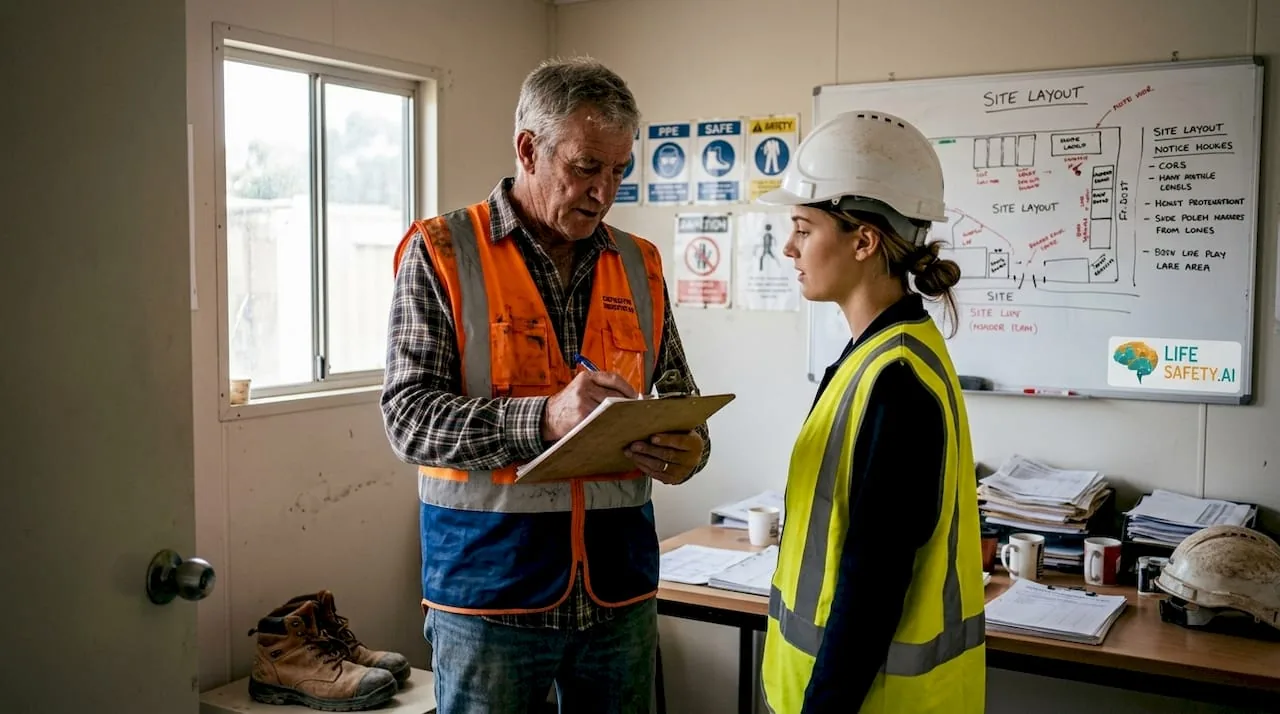
HSE’s five-step contractor management model provides a reliable structure: Plan, Choose contractor, On-site work, Check progress, and Review performance. Each stage requires documented evidence, not just verbal assurances.
Key onboarding tasks for contractors include:
- Verifying relevant qualifications and certifications
- Confirming insurance and public liability cover
- Sharing your site-specific risk assessments and rules
- Conducting a site induction and recording attendance
- Assigning a named supervisor responsible for their work
Workforce competence is equally critical. Training must be adequate, refreshed periodically, and competence should be demonstrated through a combination of experience and formal training. For specialist consultants, the Occupational Safety and Health Consultants Register is a recognised resource for verifying credentials.
“Competence is not a one-time achievement. It requires ongoing investment in training, supervision, and honest assessment of whether workers can safely perform their tasks.”
Our construction phase plan module helps you document contractor arrangements within the CDM framework, keeping everything in one auditable location. Building a strong safety culture across your workforce and supply chain is what turns individual compliance tasks into a genuinely safe working environment. Physical site protections, such as understanding the role of railings in safety, are also part of ensuring contractors work in a safe environment from day one.
Pro Tip: Use a competence matrix to track training status across your workforce. Update it after every refresher course and flag gaps before they become enforcement issues.
Verifying compliance and handling enforcement
Ensuring ongoing compliance is not the end. Auditing and enforcement response remain crucial to maintaining your safety standards and protecting your organisation.
HSE inspectors examine specific evidence when they visit. They look at your documentation, your procedures, and your compliance history. The Enforcement Management Model (EMM) guides how inspectors decide on action. They may issue improvement notices, which require you to fix identified failings within a set timeframe, or prohibition notices, which stop work immediately where there is serious risk. Prosecution follows where risk is high and compliance history is poor.
Verification tasks you should carry out regularly include:
- Internal audits against your documented procedures and risk assessments
- Site inspections with findings recorded and actioned promptly
- Document reviews to confirm risk assessments, CPPs, and training records are current
- Incident investigation to identify root causes and prevent recurrence
- Near-miss reporting to capture early warning signals before incidents occur
Enforcement in numbers: In 2024/25, HSE prosecuted 331 cases, resulting in fines totalling over £34 million. Improvement and prohibition notices numbered in the thousands. These are not rare events for non-compliant organisations.
Our safety inspections module and safety audits module make it straightforward to schedule, conduct, and record verification activities. When incidents do occur, our incident reporting module ensures you capture the right details quickly, support investigations, and maintain a clear audit trail for internal review and external scrutiny.
Where an incident meets reporting thresholds, RIDDOR obligations must be handled promptly and accurately. That means understanding reportable injuries, dangerous occurrences, occupational diseases, and specified timeframes. Delays or incomplete submissions can compound the original failure and create additional enforcement exposure.
Good enforcement readiness is not about preparing for an inspector only when one arrives. It is about maintaining records, corrective actions, and management oversight in a state that is always inspection-ready.
Why a proactive approach beats reactive compliance
Reactive compliance usually starts after something has already gone wrong: an injury, a dangerous occurrence, a complaint, or an HSE visit. By that point, the organisation is already on the back foot. Costs rise quickly through downtime, remedial work, legal advice, insurance impacts, and reputational damage.
A proactive approach is different. It treats compliance as a live management system rather than a filing exercise. Instead of waiting for incidents to reveal weaknesses, proactive organisations monitor leading indicators, review trends, and intervene early.
Examples of proactive compliance activity include:
- Reviewing near-miss data to identify recurring hazards before injuries occur
- Refreshing risk assessments after process changes, new equipment, or contractor turnover
- Running planned inspections rather than relying on ad hoc observations
- Tracking corrective actions to closure with clear ownership and deadlines
- Engaging workers in reporting, consultation, and practical control design
This approach aligns closely with HSE expectations and with recognised management system principles such as plan, do, check, act. It also supports stronger governance under the Building Safety Act, where accountable oversight, information management, and evidence of control are increasingly important.
Most importantly, proactive compliance improves real-world safety outcomes. It reduces the gap between what your procedures say and what actually happens on site or on the shop floor.
Advanced tools for streamlined safety compliance
Managing compliance manually across multiple sites, contractors, and workstreams is difficult to sustain. Paper files go missing, spreadsheets become outdated, and action tracking breaks down. Digital systems help by centralising information, standardising workflows, and making evidence easier to retrieve.
Advanced compliance tools are especially useful when you need to:
- Maintain a single source of truth for risk assessments, inspections, and training records
- Assign actions to named individuals with due dates and escalation rules
- Track contractor documentation and induction status across multiple projects
- Generate audit trails for HSE inspections, client reviews, and internal governance
- Support faster incident reporting and RIDDOR decision-making
LifeSafety.ai is designed to support these operational needs with practical, compliance-focused workflows. Teams can connect risk assessments, inspections, audits, incident reporting, and CDM documentation so that evidence is not scattered across disconnected systems.
For organisations operating in higher-risk environments, digital oversight also improves management visibility. Leaders can see overdue actions, recurring hazards, training gaps, and unresolved findings before they become enforcement issues. That is a major advantage over reactive, document-heavy approaches.
Used properly, technology does not replace competent safety management. It strengthens it by making good practice easier to repeat, easier to verify, and easier to improve.
Frequently asked questions
What is safety compliance management in UK workplaces?
Safety compliance management is the structured process of meeting legal health and safety duties through risk assessment, control implementation, training, supervision, monitoring, and record-keeping. In UK construction and manufacturing, this often includes compliance with CDM 2015, PUWER, COSHH, RIDDOR, and wider duties under the Health and Safety at Work etc. Act 1974.
How often should risk assessments be reviewed?
Risk assessments should be reviewed whenever there is reason to believe they are no longer valid, or when significant changes occur. That includes new equipment, altered processes, new substances, contractor changes, incidents, or near misses. Even where nothing obvious changes, periodic review is still good practice.
What documents should be available during an HSE inspection?
You should be able to produce current risk assessments, training and competence records, inspection logs, audit findings, incident records, contractor documentation, COSHH assessments, and where relevant Construction Phase Plans and method statements. Inspectors will also want to see evidence that issues identified have been acted upon.
When does RIDDOR reporting apply?
RIDDOR applies when certain work-related injuries, occupational diseases, dangerous occurrences, or specified incidents meet reporting thresholds. Employers and responsible persons must understand what is reportable and submit reports within the required timescales. If in doubt, review HSE guidance promptly and document your decision-making.
Why is contractor management such a common compliance failure point?
Because organisations often assume competence instead of verifying it. Common failures include poor prequalification checks, weak inductions, unclear supervision, missing documentation, and inadequate coordination between contractors and site management. Under CDM 2015, these failures can have serious legal consequences.
Can digital tools really improve compliance?
Yes, if they are implemented properly. Digital tools improve consistency, visibility, and auditability. They help teams standardise assessments, track actions, manage records, and respond faster to incidents. They are most effective when combined with competent people, clear procedures, and active leadership.
Build a stronger, audit-ready compliance system
Effective safety compliance management depends on more than paperwork. It requires clear responsibilities, current risk information, competent people, and evidence that controls are working in practice. For UK construction and manufacturing organisations, that means staying ready for HSE scrutiny while protecting workers every day.
If you want to simplify risk assessments, inspections, audits, incident reporting, and CDM documentation in one place, explore the LifeSafety.ai platform and create a more proactive, defensible compliance process.
Related Articles

HSE for Data Centres
Data-centre HSE is electrical plant, COSHH, permits and night-shift people risk. LifeSafety.ai puts UK compliance and live dashboards in one system.

Risk Assessment vs Method Statement (RAMS): Key Differences
A risk assessment identifies what could cause harm; a method statement sets out how the work will be done safely. Here is how they differ, what UK law actually requires, and when you need both.

Employee Incident Report form: RIDDOR-Ready Template Guide
Ensure workplace safety with our RIDDOR-ready employee incident report form. Download the template and streamline your incident reporting today!