
Defining high risk environments: a safety pro's guide
Defining high risk environments: a safety pro’s guide
A practical guide for safety professionals on identifying, classifying, and controlling high risk environments in line with HSE expectations, CDM 2015 duties, and wider UK compliance requirements.
TL;DR
- A high risk environment is a workplace with an elevated possibility of death or serious injury arising from hazardous conditions or activities.
- Classification depends on hazard presence, likelihood, severity, control reliability, and psychosocial factors, not just visible physical dangers.
- Effective management requires ongoing risk assessment, control verification, permit-to-work governance, and accurate records to support HSE compliance.
- For UK dutyholders, this has direct relevance to RIDDOR reporting, CDM 2015 planning, supervision, and safe systems of work.
A high risk environment is any workplace or situation where there is a significantly elevated possibility of death or serious injury arising from hazardous conditions or activities that cannot be adequately controlled through standard procedures alone. The BBC formally defines high risk work as carrying a significantly higher than normal risk of death or serious injury as a consequence of higher-risk conditions. For safety professionals, defining high risk environments is not an academic exercise. It is the foundation of every permit to work decision, every pre-job risk assessment, and every compliance obligation under UK regulations including RIDDOR and CDM 2015.
What criteria define a high risk environment?
Defining high risk environments requires more than listing obvious physical dangers. The formal classification rests on four interconnected criteria: hazard presence, likelihood of harm, severity of potential consequences, and the reliability of existing controls.

SafeWork Victoria frames the risk assessment process around two explicit questions: how likely is harm to occur, and how severe would that harm be? Both questions must be answered together. A highly probable hazard that causes only minor injury does not constitute a high risk environment. A low-probability event that could cause fatality does.
The third criterion, control reliability, is where many organisations fall short. A permit to work is required where hazardous work could lead to death or serious injury and where standard supervision and procedures are insufficient to manage that risk. This means the same physical location can shift in and out of high risk classification depending on the task being performed and the controls in place at that moment.
Psychosocial hazards form the fourth criterion. SafeWork NSW identifies unsafe, uncomfortable, or unpredictable surroundings as direct causes of anxiety, stress, and cognitive impairment. An environment that generates chronic psychological harm meets the threshold for high risk classification, even when physical injury risk appears manageable.
In UK practice, these criteria should be considered alongside the employer’s duties under the Health and Safety at Work etc. Act 1974, the Management of Health and Safety at Work Regulations 1999, and where construction is involved, the planning and coordination duties under CDM 2015. Where a serious incident, dangerous occurrence, or specified injury arises, the classification decision may also influence whether an event becomes reportable under RIDDOR.
The following steps describe how these criteria combine into a practical classification process:
- Identify all hazards present in the environment, covering both physical sources of harm and psychosocial stressors.
- Assess likelihood and severity for each hazard using structured questions: how probable is exposure, and what is the worst credible outcome?
- Evaluate control reliability by asking whether standard procedures, supervision, and PPE are genuinely sufficient or whether formal governance such as a permit to work is required.
- Apply the consequence threshold test: if failure of controls could result in death or serious injury, the environment qualifies as high risk regardless of how infrequently that failure might occur.
Pro Tip
When assessing control reliability, test your controls against a realistic worst-case scenario rather than average conditions. Controls that hold under normal operations often fail under the pressure, fatigue, or time constraints typical of high risk sites.
High risk environment examples: physical and operational contexts
High risk environments span a wide range of physical settings and operational contexts. Understanding the distinction between a generally hazardous environment and a specifically high risk task within that environment is critical for accurate risk assessment in environments.
The BBC’s formal definitions include hostile environments such as active conflict zones, riot situations, and natural disaster areas. These settings carry elevated risk by their very nature, independent of any specific task being performed. Construction sites, chemical plants, offshore platforms, and underground mines fall into the same category of inherently hazardous physical environments.
High risk activities within those environments add a second layer of classification. Tasks requiring stricter planning and supervision include:
- Working at height, including scaffolding, roofwork, and elevated platforms
- Confined space entry, where atmospheric hazards and restricted rescue access compound risk
- Hot work such as welding, cutting, and grinding near flammable materials
- Hazardous energy isolation, including electrical lockout and pressure system work
- Chemical handling and COSHH-regulated substance management
- Excavation and ground-breaking work near buried services
- Heavy lifting and crane operations
The distinction between environment and activity matters operationally. A construction site is a high risk environment. Welding on that site is a high risk activity requiring its own hot works permit and pre-job assessment. Conflating the two leads to either over-permitting routine tasks or, more dangerously, under-permitting genuinely hazardous ones.
| Classification | Definition | Example |
|---|---|---|
| High risk environment | A location with inherently elevated hazard levels | Offshore platform, chemical plant, construction site |
| High risk activity | A task that creates serious injury or fatality risk regardless of location | Confined space entry, hot work, working at height |
| Combined high risk | A high risk activity performed within a high risk environment | Welding in a petrochemical facility |
For construction-specific guidance, the construction site safety considerations published by LifeSafety provide practical context for applying these distinctions on live projects.
What frameworks help identify and manage hazardous situations?
Practical management of high risk environments follows a three-step loop: hazard identification, risk assessment, and control implementation. Each step feeds back into the others as conditions change.
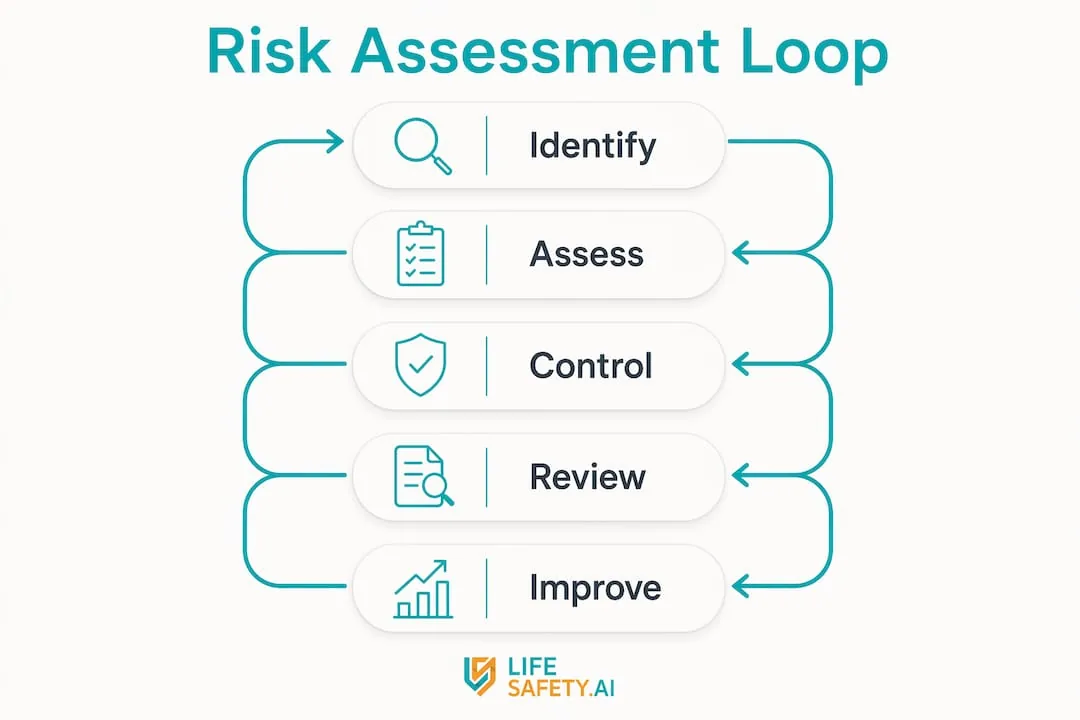
The hazard identification and risk assessment loop
Hazard identification begins with a systematic survey of the environment and the planned work. Safety professionals should document every potential source of harm, including physical, chemical, biological, and psychosocial hazards. The risk assessment then applies likelihood and severity scoring to prioritise which hazards demand immediate control action.
Control implementation follows the hierarchy of controls: elimination first, then isolation, substitution, engineering controls, administrative controls, and PPE as the final line of defence. Employers carry legal responsibility for working down this hierarchy as far as reasonably practicable before relying on administrative measures or personal protective equipment.
In practice, this loop should be evidenced through documented assessments, toolbox talks, supervision records, and periodic review. On construction projects, principal contractors and contractors must ensure that risks are planned, managed, monitored, and coordinated under CDM 2015. In occupied higher-risk buildings, the wider governance culture expected by the Building Safety Act also reinforces the need for clear accountability and auditable control measures.
Pre-job risk assessments for high risk activities
Pre-job risk assessments are systematic evaluations conducted immediately before high risk activities begin. They address task-specific hazards and changing site conditions that a general site risk assessment cannot capture. A pre-job assessment prevents the unsafe assumption that yesterday’s conditions still apply today.
These assessments are mandatory for any activity where the consequence of an uncontrolled hazard could be death or serious injury. They are also triggered by changes in personnel, equipment, weather, or adjacent work activities that alter the risk profile of a task.
- Confirm the scope of work and identify any changes since the last assessment.
- Review existing controls and verify they are in place, functional, and understood by all workers.
- Identify new or residual hazards introduced by current site conditions.
- Assign control responsibilities and confirm communication with all personnel before work begins.
Pro Tip
Use a digital pre-job checklist that workers complete on a mobile device at the point of work. This creates a timestamped record, reduces the risk of skipped steps, and feeds directly into your site’s risk assessment records for audit purposes.
Permit to work as a governance trigger
The permit to work system applies formal authorisation precisely where risks exceed what routine supervision can manage. Permit to work requirements combine consequence severity with dynamic risk assessment, making them the most reliable governance trigger for high risk activities. A confined space permit, for example, requires atmospheric testing, rescue planning, and authorised sign-off before any entry is permitted.
For UK organisations, permit systems should be integrated with competence checks, isolation procedures, emergency arrangements, and contractor control. Where an incident occurs despite these measures, the quality of the permit process will often be scrutinised during internal investigation, insurer review, or HSE enforcement activity.
| Permit Type | Trigger Condition | Key Control Requirement |
|---|---|---|
| Hot Works Permit | Ignition risk near flammable materials | Fire watch, extinguisher, area clearance |
| Confined Space Permit | Restricted entry with atmospheric hazard | Atmospheric testing, rescue plan, standby person |
| Electrical Isolation Permit | Live electrical work or energy release risk | Lockout/tagout, isolation verification |
| Excavation Permit | Ground-breaking near buried services | Service drawings, ground scan, edge protection |
How do psychosocial factors shape what constitutes high risk?
Psychosocial hazards are a defining feature of high risk environments that safety professionals frequently underweight. SafeWork NSW findings confirm that unsafe, unpredictable, or uncomfortable physical working environments directly cause anxiety, stress, sleep problems, and cognitive impairment. These are not secondary effects. They are primary safety risks that increase the probability of errors, near misses, and serious incidents.
The psychosocial hazards most commonly linked to high risk physical environments include:
- Chronic stress from sustained exposure to noise, heat, or chemical agents
- Anxiety and hypervigilance in unpredictable environments such as emergency response or conflict zones
- Cognitive impairment caused by fatigue, sensory overload, or fear of injury
- Behavioural withdrawal, where workers disengage from safety procedures due to psychological exhaustion
- Self-harm ideation and stress-related illness in environments with prolonged exposure to traumatic conditions
Psychosocial factors are critical to a complete picture of workplace safety. An organisation that manages physical hazards rigorously but ignores the psychological burden placed on workers in those environments produces an incomplete and ultimately unsafe risk assessment. Integrating psychosocial hazard management into your safety management system means including mental health indicators in incident investigations, near miss reports, and regular safety audits. It also means training supervisors to recognise behavioural signs of psychological distress before they translate into physical harm.
In UK settings, this aligns with the broader duty to protect health as well as safety. Fatigue, stress, poor communication, and cognitive overload can all undermine safe systems of work, especially in construction, manufacturing, utilities, and maintenance operations. Where psychosocial pressures contribute to an event, they should be examined as part of root cause analysis rather than treated as peripheral issues.
Key takeaways
Defining high risk environments requires assessing consequence severity, control reliability, and psychosocial hazards together, not physical danger alone.
| Point | Details |
|---|---|
| Four-criteria classification | Classify environments using hazard presence, likelihood, consequence severity, and control reliability together. |
| Environment vs activity | Separate inherently hazardous locations from high risk tasks so that permits and controls are applied proportionately. |
| Dynamic assessment | Use pre-job risk assessments and point-of-work reviews to capture changing conditions, personnel, weather, and adjacent activities. |
| Permit-to-work governance | Where routine supervision is insufficient, formal permits provide the authorisation, verification, and accountability needed for safe execution. |
| Psychosocial risk matters | Stress, fatigue, unpredictability, and cognitive overload can materially increase incident likelihood and should be built into risk assessments. |
| UK compliance relevance | Robust classification and control support compliance with HSE expectations, CDM 2015 duties, Building Safety Act governance, and RIDDOR reporting decisions. |
For safety leaders, the practical takeaway is clear: a high risk environment is not defined by appearance alone. It is defined by the credible potential for severe harm, the fragility of controls, and the real-world conditions in which people work. That means classification must be evidence-based, reviewed regularly, and linked directly to permits, supervision, competence, and emergency planning.
If your organisation is managing construction, maintenance, manufacturing, utilities, or facilities work, digital workflows can materially improve consistency. Standardised assessments, permit templates, live sign-off, and auditable records help ensure that high risk work is identified early and controlled properly before it becomes an incident.
Strengthen control of high risk work
LifeSafety helps teams manage high risk environments with structured risk assessments, digital hot works permits, confined space permits, and auditable safety records designed for UK compliance.
- Standardise pre-job checks across sites and contractors
- Verify controls before work starts, not after an incident
- Maintain clear evidence for HSE inspections and internal audits
- Improve visibility of changing site conditions and residual risk
Related Articles

Incident reporting software comparison: UK guide 2026
Discover our incident reporting software comparison for UK workplaces. Explore top options like Lifesafety, SafetyCulture, and more.

Safety management solutions for construction: UK SMS guide
Discover essential safety management solutions for construction sites in the UK. Learn how a mobile-first SMS can enhance safety and compliance.

Best Health and Safety Software for UK Workplaces: A Guide
Discover the best health and safety software for UK workplaces in 2026. Explore top picks like Lifesafety for compliance and efficiency!