
Data security in health and safety: Why it matters in 2026
Data security in health and safety: Why it matters in 2026
TL;DR:
- Data security is critical to prevent undetected equipment faults, missed hazard alerts, and physical harm in high-risk industries.
- UK regulations require strict cyber security controls, lawful data handling, and auditable governance to avoid severe fines and safety failures.
- Implementing AI-driven anomaly detection and engaging workers early improves both security resilience and operational safety outcomes.
Digital safety systems often feel secure by default. In reality, that assumption is one of the most dangerous weaknesses facing high-risk UK industries in 2026. Construction sites, manufacturing plants, and other safety-critical environments generate large volumes of sensitive operational data, from incident logs and risk assessments to maintenance records and worker health information. If a vulnerability in those systems goes unnoticed, the consequences extend far beyond reputational damage or an ICO investigation. They can include undetected equipment faults, missed hazard warnings, delayed emergency response, and direct physical harm to workers. This article explains why data security now sits at the centre of effective health and safety management, what the UK regulatory framework expects, and how AI-enabled platforms can help protect both people and organisations.
Table of Contents
- Understanding the risks: Why data security is vital in health and safety
- Regulatory landscape: Compliance and penalties for data security breaches
- Securing digital health and safety: Practical frameworks and AI-driven methods
- Challenges and opportunities: AI, privacy, and workforce acceptance
- Our perspective: What most guides miss about data security in health and safety
- Next steps: Secure your health and safety data with AI solutions
- Frequently asked questions
Key Takeaways
| Point | Details |
|---|---|
| Critical consequences | Poor data security in health and safety can lead to undetected hazards, operational disruption, and serious accidents. |
| Legal obligation | UK GDPR and health and safety law impose strict duties and potentially multi-million-pound penalties for breaches. |
| Actionable frameworks | HSE OG86 and the NCSC 10 Steps provide practical controls for securing safety-critical systems. |
| AI opportunities | AI can strengthen monitoring and anomaly detection, but it also introduces privacy, explainability, and workforce trust challenges. |
Understanding the risks: Why data security is vital in health and safety
There is a persistent belief that moving health and safety records onto a digital platform automatically makes them safer. In practice, the reverse can be true if the platform lacks robust security controls, clear governance, and regular assurance testing. Industrial Automation and Control Systems (IACS), which support machinery shutdowns, environmental monitoring, alarms, and process control, are especially exposed. According to HSE cyber security guidance, cyber incidents affecting IACS can lead to undetected faults, failures, downtime, and major accidents with health, safety, or environmental consequences.
The cyber risks affecting health and safety systems in UK construction and manufacturing commonly include:
- Ransomware attacks that lock safety teams out of incident reporting and permit-to-work systems during critical periods
- Unauthorised access to sensitive worker health records, exposure logs, or near-miss reports
- System manipulation that changes sensor thresholds or alarm settings, masking hazardous conditions
- Supply chain vulnerabilities introduced through third-party software, subcontractor access, or connected site tools
- Accidental data loss caused by misconfigured cloud storage, weak permissions, or unencrypted mobile devices
The worst-case outcome is not simply a data breach headline. It is a compromised system failing to flag a gas leak, structural movement, unsafe plant condition, or machinery malfunction. In construction and manufacturing, construction site safety depends on accurate, timely, and trusted data. If that data is corrupted, delayed, or withheld by a cyber incident, the operational consequences can be severe.
“Cyber incidents in safety-critical environments are not just IT problems. They are potential safety events with the power to injure or kill.”
Consider the scale of exposure across common risk vectors:
| Risk vector | Potential impact | Frequency in UK industry |
|---|---|---|
| Ransomware on IACS | Full site shutdown, delayed hazard response | Increasing |
| Insider data misuse | Altered records, missed compliance filings | Moderate |
| Third-party software breach | Undetected system vulnerabilities | High |
| Unencrypted mobile data | Exposed worker health records | Very high |
Digital vigilance is not optional. The safety modules your teams rely on for incident logging, inspections, and risk assessments must sit within a security architecture that is actively maintained, tested, and reviewed. In practical terms, that means cyber security should be treated as part of the safe system of work, not as a separate IT concern.
Regulatory landscape: Compliance and penalties for data security breaches
With the operational risks clear, the next question is where the UK legal framework sets the compliance bar.
Health and safety data sits within two overlapping legal regimes. The first is UK GDPR, which governs the collection, storage, use, and sharing of personal data, including worker health records, accident reports, and monitoring data. The second is health and safety law, which increasingly incorporates cyber security expectations where digital systems, automation, or AI influence safety outcomes.
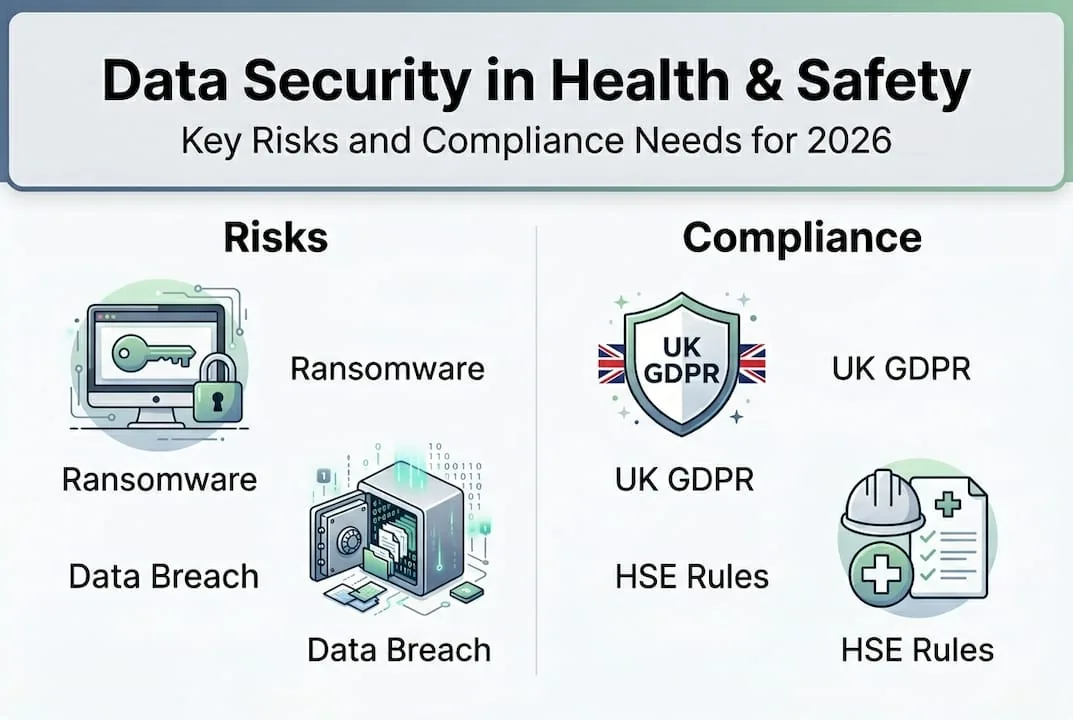
On the data protection side, the stakes are substantial. UK GDPR non-compliance risks include fines of up to £17.5 million or 4% of global annual turnover. Sector assessments also indicate that construction and manufacturing often perform poorly on privacy by design, Privacy Information Management Systems (PIMS), and data subject rights maturity. In plain terms, these sectors are both highly exposed and often underprepared.
Here is how the main regulatory frameworks compare in practice:
| Regulatory area | Key requirement | Penalty for breach |
|---|---|---|
| UK GDPR | Lawful basis, data minimisation, subject rights | Up to £17.5M or 4% global turnover |
| Health and safety law | Risk assessment, RIDDOR reporting, safe systems | Unlimited fines, prosecution |
| AI-specific guidance | Secure design, testing, supply chain accountability | Regulatory intervention |
The practical steps organisations should take to meet current expectations include:
- Conduct a formal data protection impact assessment (DPIA) for any AI system managing health and safety records or worker monitoring data.
- Ensure all incident, inspection, and near-miss data is stored with appropriate encryption, retention controls, and role-based access.
- Map data flows from site to cloud, identifying processors, subcontractors, and software vendors that handle safety-critical information.
- Register with the ICO where required, particularly if processing special category data such as health information.
- Align AI procurement and deployment with the HSE’s position that compromised AI systems can cause direct physical harm and must comply with existing health and safety law.
The HSE’s approach to AI is straightforward: there are no carve-outs simply because a system is innovative. If an AI tool operates in a safety-critical environment, it falls within the scope of health and safety legislation. That has implications not only for general duties under the Health and Safety at Work etc. Act 1974, but also for sector-specific obligations under CDM 2015, RIDDOR, and, where relevant, the Building Safety Act. Your CDM compliance module and any AI-assisted risk tools must therefore be built on secure, auditable foundations. Reviewing the full scope of AI safety management features can help identify where existing tools may be falling short.
Securing digital health and safety: Practical frameworks and AI-driven methods
Knowing what is required is only the starting point. The real challenge is turning those duties into practical controls that work on live sites and in active facilities.
Two frameworks form the backbone of good practice for securing health and safety data in the UK. The HSE’s OG86 guidance provides specific controls for IACS environments, while the National Cyber Security Centre (NCSC) 10 Steps to Cyber Security offers a broader organisational baseline. Used together, they address both operational technology risk and wider governance risk. In practice, securing IACS in line with HSE OG86 and NCSC guidance means combining access control, encryption, Building Information Modelling (BIM) safeguards, and AI-driven anomaly detection.
Organisations should focus on the following control areas:
- Role-based access control: Limit who can view, edit, approve, or export safety records based on job function and operational need
- End-to-end encryption: Protect data in transit and at rest, especially for mobile incident logging and remote site access
- Anomaly detection: Use AI to flag unusual patterns in safety data that may indicate manipulation, compromise, or system failure
- BIM integration security: Where projects use BIM, protect safety-critical data layers from unauthorised modification or deletion
- Regular penetration testing: Test systems as an attacker would, at least annually and after major changes
- Supply chain auditing: Verify that every connected third-party platform meets your security and assurance standards
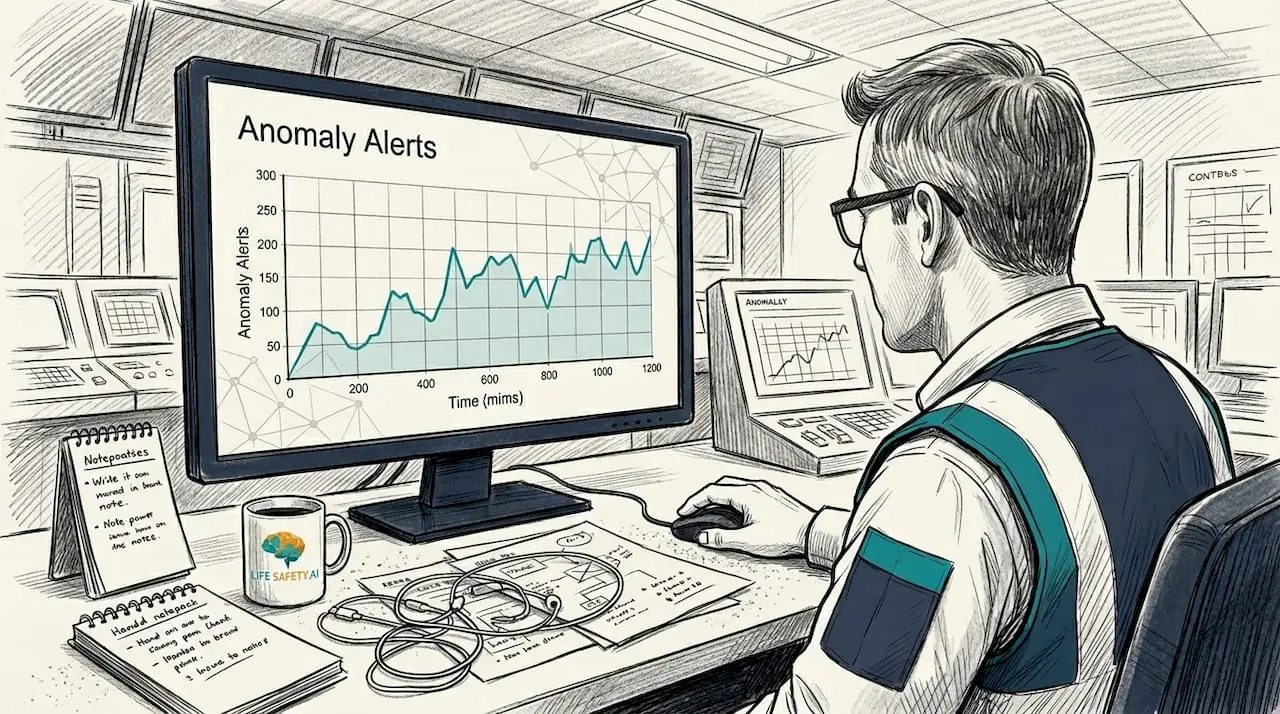
AI-driven anomaly detection is particularly valuable in high-risk environments. Rather than waiting for a reported incident, AI can identify when sensor readings deviate from established patterns, when access logs show unusual behaviour, or when reporting frequencies suddenly drop. This connects naturally to advances in PPE detection technology, where computer vision systems monitor compliance in real time and support earlier intervention.
The UK government’s Code of Practice for AI Cyber Security adds another important layer. AI solutions must follow secure design principles, rigorous supply chain checks, and continuous testing. There are no shortcuts. Staying current with AI safety management trends helps teams anticipate regulatory shifts before they become compliance failures. For a deeper view of how AI is reshaping risk processes, the work on AI in risk assessments is also worth reviewing.
Pro tip
Do not treat security testing as a one-off exercise. Schedule quarterly internal reviews, an annual independent penetration test, and always include key supply chain partners within scope.
Challenges and opportunities: AI, privacy, and workforce acceptance
Strong frameworks matter, but implementation is shaped by human factors, operational realities, and workforce trust.
AI brings real advantages to health and safety data security. Wearable sensors, connected devices, and computer vision tools are already delivering measurable results. Research published in the Buildings journal found that computer vision achieves 90% PPE detection accuracy on construction sites, enabling proactive monitoring at a scale no human team could match. These are not abstract benefits. The ability to detect unsafe conditions before they escalate is real and growing.
However, the same progress introduces significant challenges that organisations must address openly:
- Data privacy: Continuous monitoring generates large volumes of personal data, raising questions about lawful basis, consent where relevant, necessity, and proportionality
- Interpretability: Many AI models operate as black boxes, making it difficult to explain decisions to workers, unions, clients, or regulators
- Worker resistance: Surveillance-style monitoring can erode trust if introduced without consultation, transparency, and clear safeguards
- Algorithmic bias: AI trained on narrow datasets may perform poorly across different demographics, PPE types, lighting conditions, or site environments
- Over-reliance on automation: Teams may assume the system will catch everything, weakening frontline vigilance and managerial oversight
These concerns are especially relevant in UK workplaces where employers must balance innovation with fairness, consultation, and legal accountability. Under health and safety law, introducing new technology does not remove the duty to assess risk. Under UK GDPR, it does not remove the duty to process personal data lawfully and transparently. Under CDM 2015, duty holders still need clear coordination, communication, and control of risk across the project lifecycle. And where higher-risk buildings are involved, the Building Safety Act reinforces the need for reliable information management and accountable decision-making.
To improve workforce acceptance while maintaining strong security, organisations should:
- Explain what data is being collected, why it is needed, and how long it will be retained.
- Involve workers, supervisors, and where appropriate union representatives early in the design and rollout process.
- Set clear boundaries so monitoring is used for safety improvement and risk reduction, not unnecessary surveillance.
- Provide a human review process for significant AI-generated alerts or decisions.
- Test systems across varied site conditions to reduce bias and improve reliability.
When these steps are taken, AI becomes easier to position as a safety enabler rather than a control mechanism imposed on the workforce. That distinction matters. In high-risk sectors, adoption succeeds when workers believe the technology is there to protect them, not simply to monitor them.
Our perspective: What most guides miss about data security in health and safety
Many articles on data security still frame the issue as a compliance or IT governance problem first. That is too narrow for safety-critical industries. In construction, manufacturing, utilities, and facilities management, compromised data can directly undermine the controls that keep people safe. If a permit-to-work record is altered, if a maintenance alert is suppressed, or if a sensor threshold is manipulated, the result is not just poor governance. It is a degraded safe system of work.
This is the gap most guidance misses: data security is part of operational risk control. It should sit alongside physical inspections, competence management, contractor control, and incident investigation. The organisations that perform best are not those with the most policies. They are the ones that integrate cyber resilience into day-to-day safety management.
That means treating security questions as standard safety questions, such as:
- Can this system fail in a way that creates physical risk?
- Who can change safety-critical data, and how is that action logged?
- What happens if site teams lose access during an incident?
- How quickly can we detect manipulation, corruption, or unusual behaviour?
- Do our contractors and software suppliers meet the same assurance standard we expect internally?
There is also a strategic point that matters in 2026. As more organisations adopt AI for inspections, reporting, permit control, and predictive maintenance, the line between cyber security and safety assurance becomes even thinner. A weak AI supply chain, poor model governance, or inadequate testing can create hidden failure modes that traditional safety audits may miss. That is why secure-by-design procurement, evidence retention, and continuous assurance are becoming essential board-level issues.
From a LifeSafety.ai perspective, the most effective approach is to combine compliance evidence, operational visibility, and secure digital workflows in one place. Safety teams should not have to choose between usability and control. The right platform should make it easier to report incidents, manage actions, demonstrate compliance, and protect sensitive data at the same time.
Next steps: Secure your health and safety data with AI solutions
If your organisation is still treating data security as a separate IT workstream, now is the time to close that gap. In high-risk sectors, secure health and safety data management should be built into operational planning, contractor governance, and compliance assurance from the outset.
A practical next-step plan looks like this:
- Review your current systems for incident reporting, inspections, permits, and worker monitoring to identify safety-critical data dependencies.
- Prioritise high-risk weaknesses such as shared logins, poor mobile security, weak supplier controls, and missing audit trails.
- Run a DPIA and cyber risk assessment for any AI-enabled safety process, especially where personal data or automated alerts are involved.
- Strengthen governance by assigning clear ownership across safety, IT, operations, and procurement teams.
- Adopt platforms with secure-by-design controls, strong access management, and evidence-ready reporting.
For organisations looking to modernise safely, LifeSafety.ai can support a more resilient approach through connected health and safety modules, structured workflows, and AI-enabled monitoring designed for real operational environments. Whether you are managing contractor risk, inspections, CDM documentation, or incident records, the goal is the same: protect people while maintaining a defensible compliance position.
Explore the platform’s core features and sector-focused tools to assess where stronger data security can improve both safety performance and regulatory confidence. In 2026, the organisations that lead will be those that understand a simple truth: secure data is safe data, and safe data supports safer work.
Frequently asked questions
Why is data security a health and safety issue rather than just an IT issue?
Because in safety-critical environments, compromised data can directly affect physical risk. If incident records, sensor readings, maintenance alerts, or permit controls are altered or unavailable, workers may be exposed to hazards that would otherwise have been identified and controlled.
What UK laws are most relevant to health and safety data security?
The main legal areas are UK GDPR for personal data handling and wider health and safety legislation for safe systems of work. Depending on the context, this may include the Health and Safety at Work etc. Act 1974, RIDDOR, CDM 2015, and the Building Safety Act. HSE and NCSC guidance also provide important practical expectations.
Do I need a DPIA for AI-based safety monitoring?
In many cases, yes. If your AI system processes personal data, especially special category data such as health information, or involves systematic monitoring of workers, a data protection impact assessment is likely to be necessary. It is also good practice from a governance and assurance perspective.
How often should safety systems be security tested?
A sensible baseline is quarterly internal review and annual independent penetration testing, with additional testing after major system changes, integrations, or incidents. Safety-critical systems should not be left untested for long periods.
What are the biggest risks in construction and manufacturing?
Common risks include ransomware, weak mobile device security, third-party software vulnerabilities, poor access control, and manipulation of safety-critical settings or records. These sectors also face heightened exposure because of complex supply chains and distributed site operations.
How can AI improve safety data security without undermining trust?
AI can improve early detection of anomalies, unsafe trends, and unusual access behaviour. Trust improves when organisations are transparent about what is monitored, involve workers early, limit unnecessary surveillance, and ensure that important decisions still receive human oversight.
Related Articles

Workplace safety software for construction teams
Discover top-rated workplace safety software for construction. Improve incident tracking, compliance, and safety analytics with Lifesafety!

LifeguardAI.co.uk alternatives for UK safety managers: 2026
Discover top lifeguardai.co.uk alternatives for UK safety managers. Explore Lifesafety and other innovative solutions to enhance workplace safety.

Site audit recommendations: your 2026 action plan
Unlock the power of effective site audit recommendations. Follow our 2026 action plan to boost indexing, enhance content quality, and improve site speed.