
Construction training for UK safety managers: a competence guide
Construction training for UK safety managers: a competence guide
Effective construction training now means more than booking a course and filing a certificate. For UK safety managers, the priority is proving competence through Skills, Knowledge, Experience and Behaviours (SKEB), aligned to CDM 2015, HSE expectations, and the Building Safety Act 2022.
Your next practical step is simple: map critical site roles to SKEB statements this week, identify the gaps, and schedule actions into your training calendar or competence platform before the next audit, inspection, or contractor review.
- CITB SMSTS — the industry standard for site managers implementing CDM 2015 duties
- NEBOSH Health and Safety Management for Construction (UK) — management-level knowledge with an open-book assessment format
- Building Safety Act 2022 / PAS 8671 / PAS 8672 — the framework requiring competence pathways, not just certificates
Pro Tip: Set a recurring quarterly review of your SKEB role map. Regulatory expectations continue to evolve, and an out-of-date competence map can create the same audit risk as having no structured system at all.
Table of Contents
- Which construction qualifications do UK site staff actually need?
- Why SKEB frameworks replace the certificate-only approach
- How to design and deliver training that proves competence on site
- What should you require from an AI-enabled competence platform?
- A step-by-step AI-enabled workflow for capturing competence evidence
- How to choose a training provider or digital competence partner
- Key takeaways
- Why competence management, not certificate collection, improves safety outcomes
- Lifesafety makes construction competence management audit-ready
- Useful sources and further reading
Which construction qualifications do UK site staff actually need?
The four qualifications below form the recognised foundation for UK construction safety training. Each proves something different, and each sits at a different point in the workforce hierarchy. For safety managers, the key is understanding that these qualifications support competence, but do not replace the need for role-specific evidence.
| Qualification | Typical hours | Assessment format | Primary role(s) |
|---|---|---|---|
| CITB SMSTS | 5 days | Knowledge test + practical pass/fail | Site managers, project managers |
| NEBOSH Health and Safety Management for Construction (UK) | Substantial taught hours plus additional private study | 48-hour open-book scenario assessment | Safety managers, senior supervisors |
| Level 1 Award in Health and Safety in a Construction Environment | ≈21 guided learning hours | 40-question proctored MCQ | Operatives, new entrants |
| CSCS card | Varies by card type | Linked to relevant qualification or NVQ | All site workers |
CITB SMSTS is specifically designed to help site managers implement health, safety, welfare and environmental legislation, and it directly supports CDM 2015 duties. NEBOSH goes deeper: the 48-hour open-book scenario assessment tests applied judgement, not just recall. The Level 1 Award, at around 21 guided learning hours with a 40-question multiple-choice assessment, is the entry point for operatives and a common route to a CSCS Labourer card.
- SMSTS is the minimum expectation for anyone with significant site management or principal contractor responsibilities
- NEBOSH suits safety managers who need to advise on method statements, risk assessments, and control strategies
- Level 1 / CSCS is the baseline for site access across many principal contractor environments
Key figure: The NEBOSH construction qualification requires substantial taught hours plus additional private study — a significantly larger commitment than many managers assume when planning budgets, release time, and project coverage.
Why SKEB frameworks replace the certificate-only approach
Guidance from professional bodies and industry frameworks is clear: organisations must evidence that they have access to individuals with the necessary Skills, Knowledge, Experience and Behaviours, not merely that those individuals attended a course. The Building Safety Act 2022, reinforced by PAS 8671 and PAS 8672, requires competence pathways and role-linked evidence for higher-risk duties.
A practical competence framework has three core components: a SKEB statement defining what the role requires, a route to competence setting out how someone achieves it, and an implementation plan covering re-validation intervals. Together, these replace the old “does this person hold a card?” check with a structured, auditable record.
This matters in real-world enforcement. When an incident triggers an HSE investigation or a reportable event under RIDDOR, the organisation must often show not only what training was delivered, but also how competence was verified for the task, location, and level of supervision involved.
Build your role competence profiles in this order:
- Identify every site role with a CDM 2015 or Building Safety Act duty
- Define the SKEB statement for each role
- Map accredited training such as SMSTS, NEBOSH, and Level 1 to the knowledge component
- Assign re-validation intervals for each element
- Capture supervised experience and behavioural evidence through workplace records
Pro Tip: Link each SKEB evidence record to the specific task and site, not just to the worker’s general profile. Inspectors expect task-specific evidence, and a generic training record may not satisfy a targeted audit or post-incident review.
How to design and deliver training that proves competence on site
Start with a phased rollout. The first 30 days are for diagnosis: identify which roles lack SKEB profiles, which qualifications are expiring, and which workers have no documented supervised experience. Days 31–90 are for delivery: run priority SMSTS and NEBOSH cohorts, introduce toolbox talks for behavioural evidence, and begin on-site observation records. By day 180, every critical role should have a complete, auditable SKEB profile.

Delivery format matters as much as content. Classroom and e-learning sessions build the knowledge component efficiently. Supervised practice and mentoring develop skills and experience. Toolbox talks, when documented with attendance and discussion records, provide behavioural evidence that a certificate cannot.
Assessment design checklist:
- Combine accredited assessments such as the NEBOSH open-book assessment and SMSTS knowledge test with workplace observation records
- Use competency checklists tied to specific tasks, not generic role descriptions
- Require reflective logs from supervisors and workers after significant activities
- Set automated reminders for credential expiry at 60 days and 30 days before renewal
- Confirm instructor qualifications and delivery standards before booking training
On-site evidence capture checklist:
- Verify worker identity before each assessment activity using photo ID and card checks
- Capture photographic or video evidence of task completion where appropriate
- Obtain witness signatures from a qualified supervisor or assessor
- Record timestamp, location, task description, and evidence type for every entry
A pre-task safety review or job hazard analysis completed before each assessed task gives assessors a structured baseline and makes the evidence record more defensible during audit, contractor assurance reviews, or incident investigation.
What should you require from an AI-enabled competence platform?
Procurement for a digital competence platform is where many safety managers make their biggest mistake: they evaluate on interface rather than on data architecture. The features that matter for audit-readiness are less visible but far more consequential, especially where evidence may need to be produced quickly for an HSE visit, client assurance review, or internal investigation.
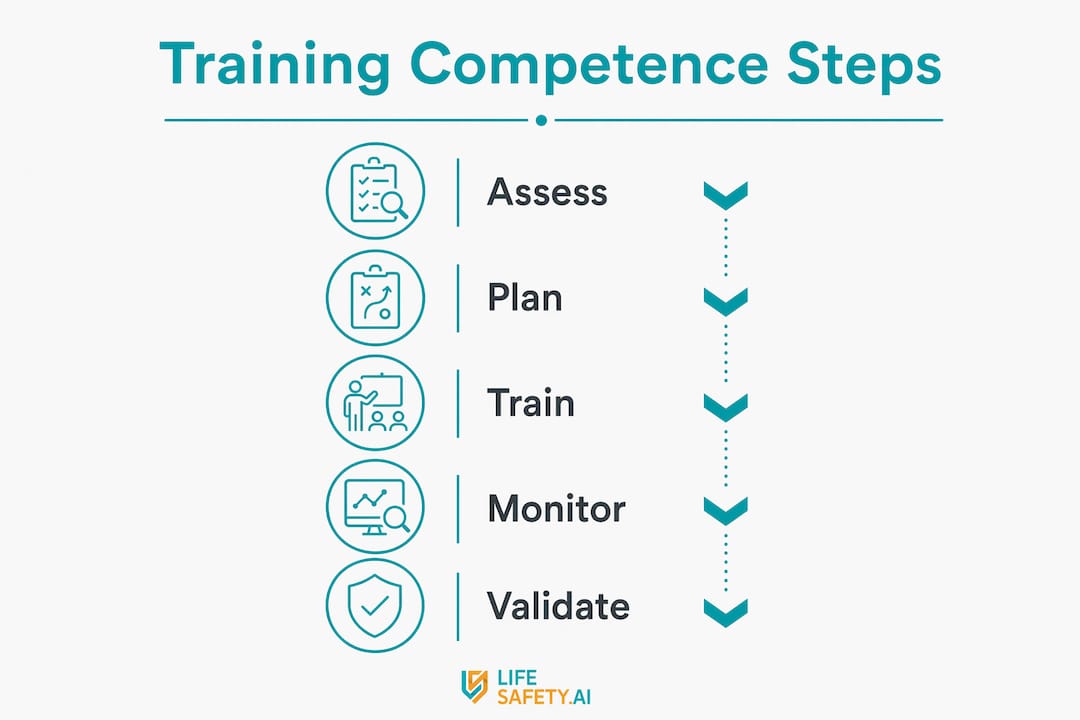
Feature checklist:
- SKEB role mapping with configurable profiles by role, project, and site
- Secure, tamper-evident audit trails with exportable audit packs
- Mobile evidence capture for photo, video, and voice notes, including offline mode
- ID and authentication controls linked to worker verification and card status
- Automated re-validation reminders with escalation workflows
- Integration APIs for HR systems, LMS platforms, and workforce records
- Role-based access controls and GDPR-compliant retention policies
AI-specific requirements to insist on:
- Automated competence gap detection against SKEB role profiles
- Natural-language evidence tagging to categorise captured records
- Anomaly detection for incomplete, inconsistent, or duplicate records
- Automated report generation formatted for regulator, auditor, or client review
Procurement red flags:
- The vendor cannot demonstrate SKEB mapping in a live demo
- There is no exportable audit pack, meaning data is effectively locked in the system
- The mobile experience is poor or there is no offline capability for live site use
- GDPR retention, deletion, and subject access processes are vague or absent
KPIs to request in your reporting dashboard:
- Percentage of roles with fully validated SKEB profiles
- Percentage of workers with active, current evidence records
- Time-to-competence for priority roles
- Number of credentials or evidence items expiring within 60 days
Pro Tip: Ask every vendor to show you a sample audit pack during the demo. If they cannot produce one in under five minutes, the platform is unlikely to support you effectively when a regulator or principal contractor requests evidence without notice.
A step-by-step AI-enabled workflow for capturing competence evidence
This workflow can be piloted on a single project within four weeks. It requires no bespoke development — only a mobile-capable platform with the features listed above and a clear governance process for supervisors, assessors, and administrators.
- Role mapping — configure SKEB profiles for the three to five highest-risk roles on the pilot project
- Task assignment — assign specific assessed tasks to workers via the platform’s mobile app
- On-site capture — worker or supervisor records photo, video, and voice-note evidence at the point of activity
- AI-assisted tagging — the platform categorises evidence against the relevant SKEB element automatically
- Supervisor sign-off — the assigned supervisor reviews and countersigns the evidence record in the app
- Automated storage — the record is appended to the worker’s role profile with timestamp and location
- Re-validation scheduling — the platform triggers reminders before evidence or credentials expire
Minimum integrations for the pilot:
- HR or identity system to verify worker identity and employment status
- Card or workforce verification to cross-reference access and qualification status
- Document storage for audit pack export and retention
Data points to capture per activity:
- Task description and referenced SKEB element
- Observer name and qualification
- Evidence type such as photo, video, or written record
- Timestamp and GPS or site location
- Supervisor sign-off status
A pre-task safety plan completed by the supervisor before each assessed activity creates a documented context record that strengthens the evidence trail. It shows that the task was planned, hazards were considered, and controls were understood before work began. That context is particularly valuable if the activity later becomes relevant to a near miss, a RIDDOR report, or a contractor performance review.
In practice, this workflow works best when supervisors are trained not only to sign off evidence, but also to challenge weak submissions. A blurred photo, missing task description, or unsigned observation note should be treated as incomplete evidence, not accepted for convenience.
How to choose a training provider or digital competence partner
Choosing a provider should be treated as a risk-control decision, not a purchasing exercise based only on price. Whether you are selecting a classroom training provider, an e-learning supplier, or a digital competence platform, the test is the same: can they help you evidence competence in a way that stands up to scrutiny?
For accredited training, confirm approval status, trainer credentials, assessment arrangements, and how completion data will be transferred into your wider competence records. For digital partners, test how easily the system can map roles, capture evidence, and produce audit-ready outputs.
Questions to ask a training provider:
- Are your courses aligned to current CITB, NEBOSH, or awarding body standards?
- What evidence do you provide beyond the certificate, such as attendance, assessment outcomes, and learning objectives?
- How do you support refresher planning and expiry tracking?
- Can you tailor examples and case studies to our project risks, contractor profile, and work activities?
Questions to ask a digital competence partner:
- Can the platform map SKEB by role, site, and project phase?
- How is evidence verified, version-controlled, and protected from unauthorised editing?
- Can supervisors capture evidence on mobile devices in low-signal environments?
- How quickly can the system generate an audit pack for a named worker, role, or incident?
- What implementation support is provided for migration, governance, and user adoption?
A strong partner should also understand the operational reality of UK construction: subcontractor turnover, temporary labour, changing site conditions, and the need to align competence records with inductions, permits, RAMS, and incident management processes.
If you are evaluating a platform such as LifeSafety.ai, look for practical features that reduce admin while improving assurance: automated reminders, structured evidence capture, role-based dashboards, and clear audit exports that support compliance conversations with clients, principal contractors, and regulators.
Key takeaways
- Certificates are necessary but not sufficient. UK construction competence now depends on evidence across skills, knowledge, experience, and behaviours.
- SMSTS, NEBOSH, Level 1, and CSCS each serve different roles and should be mapped into a wider competence framework.
- SKEB role profiles provide the structure needed for audit-ready competence management.
- Task-specific evidence is more defensible than generic training records, especially after incidents or during inspections.
- Digital platforms should be assessed on auditability, evidence controls, and workflow support, not just interface design.
- AI-enabled systems can accelerate gap detection, tagging, and reporting, but only if the underlying governance is sound.
Why competence management, not certificate collection, improves safety outcomes
Collecting certificates is administratively easy, but it does not reliably reduce risk. Competence management improves safety outcomes because it connects learning to real work, supervision, and verification. It asks whether the worker can perform the task safely under actual site conditions, not simply whether they passed a course at some point in the past.
This distinction matters across high-risk construction activities such as temporary works, lifting operations, excavation, work at height, and contractor coordination. In each case, the organisation needs confidence that the person involved understands the hazards, applies the controls, and behaves consistently with site rules and safe systems of work.
Better competence management also supports stronger leading indicators. Instead of only tracking expired certificates, safety managers can monitor incomplete observations, overdue re-validations, missing supervisor sign-offs, or roles with weak behavioural evidence. These indicators are more useful for prevention because they highlight where assurance is deteriorating before an incident occurs.
In short, competence management is not extra bureaucracy. Done properly, it is a practical control measure that strengthens planning, supervision, contractor assurance, and legal defensibility.
Lifesafety makes construction competence management audit-ready
LifeSafety.ai supports a more robust approach to construction competence by helping organisations move beyond static certificate storage. Instead of relying on disconnected spreadsheets, email trails, and shared folders, safety teams can manage competence in a structured, searchable, and auditable way.
For UK construction environments, that means being able to map roles to competence requirements, capture site evidence on mobile devices, track expiry and re-validation dates, and generate audit packs quickly when requested. This is particularly valuable where multiple contractors, temporary workers, and changing site conditions make manual record-keeping unreliable.
Typical LifeSafety.ai capabilities relevant to construction competence include:
- Role-based competence mapping aligned to SKEB principles
- Mobile-first evidence capture for observations, photos, and supervisor sign-off
- Automated reminders for expiring qualifications and scheduled re-validation
- Centralised audit records that support HSE, client, and internal reviews
- Reporting dashboards that highlight gaps before they become compliance failures
The result is a more defensible competence system: one that helps safety managers demonstrate not only who was trained, but who was competent, for what task, under which controls, and with what evidence.
Useful sources and further reading
The following sources are useful when building or reviewing a construction competence framework in the UK:
- CITB SMSTS course standard and delivery information
- NEBOSH Health and Safety Management for Construction (UK)
- Level 1 Award in Health and Safety in a Construction Environment
- RICS / ICC guidance on managing competence in the built environment
- LifeSafety.ai guide to employee training for high-risk industries
You should also review current HSE guidance on competence, contractor management, and incident reporting, alongside your own internal procedures for inductions, supervision, permits, and refresher training. Competence is strongest when it is integrated into day-to-day operations rather than managed as a separate compliance file.
Next step for safety managers
If your current process still relies on certificate folders and spreadsheets, start by selecting three high-risk roles and building a simple SKEB map for each. Then connect those roles to training, workplace evidence, re-validation dates, and supervisor sign-off. That single change will move your organisation closer to the standard expected under modern UK construction safety and building safety regulation.
Related Articles

Incident reporting software comparison: UK guide 2026
Discover our incident reporting software comparison for UK workplaces. Explore top options like Lifesafety, SafetyCulture, and more.

Safety management solutions for construction: UK SMS guide
Discover essential safety management solutions for construction sites in the UK. Learn how a mobile-first SMS can enhance safety and compliance.

Best health and safety software for UK workplaces: 2026 guide
Discover the best health and safety software for UK workplaces in 2026. Explore top picks like Lifesafety for compliance and efficiency!