
Compliance reporting for health and safety success
Compliance reporting for health and safety success
TL;DR:
- Compliance reporting involves mandatory, structured submissions to the HSE to ensure workplace safety oversight.
- Accurate and timely reports strengthen legal defence, support safety improvements, and enable proactive risk management.
- Digital tools and a safety-focused culture are essential for effective reporting and sustained site safety performance.
Many compliance officers in construction and manufacturing assume that any workplace incident automatically requires a formal report to the Health and Safety Executive (HSE). That assumption is understandable, but it is also potentially costly. Compliance reporting is a precise legal obligation, defined by specific triggers, timelines, and responsible parties. Get it wrong and you risk enforcement action, fines, or an inadequate defence when an investigation follows. This guide sets out exactly what compliance reporting means in the UK context, which reports are legally required, how to submit and retain them correctly, and the common pitfalls that catch even experienced officers off guard.
Table of Contents
- What is compliance reporting in health and safety?
- Core compliance reports and what they cover
- How compliance reports are submitted and managed
- Nuances and common pitfalls in compliance reporting
- How compliance reporting improves safety and performance
- A compliance officer’s perspective: What most guides miss
- Next steps: Streamline your compliance reporting
- Frequently asked questions
Key Takeaways
| Point | Details |
|---|---|
| Legal reports required | UK law demands formal reporting to HSE for key incidents, not just internal documentation. |
| Timely and accurate submissions | Reports must be made swiftly and with precise detail, using online HSE systems for most report types. |
| Nuances and exceptions matter | Common pitfalls include misunderstanding what is reportable and failing to amend reports when facts change. |
| Supports safety improvement | Proper reporting helps drive real workplace safety culture, trend analysis, and legislative compliance. |
What is compliance reporting in health and safety?
Compliance reporting is not simply keeping records or filling in internal accident books. It refers to mandatory, structured submissions made to a regulator, primarily the HSE, to satisfy specific legal duties. These submissions exist so that HSE can monitor workplace safety performance, investigate serious incidents, and intervene where risks are uncontrolled. It is a formal legal act, not an administrative courtesy.
In the UK’s construction and manufacturing sectors, the responsible person is typically the employer, a self-employed contractor, or the controller of the premises where the incident or activity occurs. That person carries the legal obligation to report, regardless of which subcontractor or worker was involved.
Compliance reporting for construction and manufacturing involves a defined set of mandatory submissions, including:
- RIDDOR reports for work-related fatalities, specified injuries, over-7-day incapacitation, occupational diseases, and dangerous occurrences
- F10 notifications submitted prior to the construction phase on notifiable CDM projects
- Recorded risk assessments retained and available for inspection
- Construction phase plans for relevant CDM 2015 projects
- Thorough examination reports for lifting equipment under LOLER
- Inspection reports for scaffolds, excavations, and work at height equipment
Compliance reporting is not about documenting what happened internally. It is about formally notifying the regulator so that the wider workforce, and the public, benefits from the data gathered.
Our RIDDOR reporting guide provides further detail on how these obligations interact in practice across different site types.
Core compliance reports and what they cover
Once you understand who is responsible, the next step is knowing exactly which reports are required, when they must be submitted, and what they must contain. Missing a deadline is treated as seriously as missing the report itself.
RIDDOR (Reporting of Injuries, Diseases and Dangerous Occurrences Regulations 2013) is the most frequently triggered framework. Under RIDDOR reporting rules:
- Fatalities must be reported immediately by telephone
- Specified injuries, such as fractures, amputations, or crush injuries, must be reported within 10 days
- Over-7-day incapacitation injuries must be reported within 15 days of the accident
- Occupational diseases must be reported upon receiving a written diagnosis
- Dangerous occurrences, meaning near-miss events with significant potential, must be reported without delay
F10 notifications under CDM 2015 must be submitted to HSE before work begins on any notifiable project, defined as construction work lasting more than 30 working days with more than 20 simultaneous workers, or exceeding 500 person-days.
| Report type | Trigger | Deadline | Submitted to |
|---|---|---|---|
| RIDDOR fatality | Work-related death | Immediately | HSE |
| RIDDOR specified injury | Listed injury type | Within 10 days | HSE |
| RIDDOR over-7-day | Incapacitation | Within 15 days | HSE |
| F10 notification | Notifiable CDM project | Before construction phase | HSE |
| Scaffold inspection | After erection or alteration | Before use | Site records |
| LOLER examination | Thorough examination due | Per schedule | Site records |
Common omissions include scaffold inspection records, machinery examinations, and scaffolding inspection reports for temporary works. These are frequently overlooked because they sit outside the RIDDOR framework, yet they remain legally required. For broader context on managing these obligations on site, our construction site safety tips cover several practical scenarios.
Statistic: HSE statistics show that falls from height remain the leading cause of fatal injuries in UK construction, accounting for a significant proportion of RIDDOR fatalities each year. That is why scaffold and work at height reports are non-negotiable.
How compliance reports are submitted and managed
Knowing the report types and their triggers only gets you so far. The practicalities of submitting correctly, following up, and retaining records are where many organisations lose ground.
The HSE submission process for most RIDDOR events is entirely online. Responsible persons complete the relevant form on the HSE portal, selecting the appropriate category. Fatalities are the exception: these must also be reported immediately by phone before any online submission. For F10 notifications, the CDM portal handles submissions separately.

Record retention is a legal requirement. Records must be kept for a minimum of three years from the date of the incident or submission. This applies whether records are held digitally or in paper format. Those records support several downstream activities:
| Record purpose | Practical application |
|---|---|
| Legal defence | Evidence in enforcement investigations or civil claims |
| Safety audits | Baseline data for periodic review and improvement planning |
| Data trends | Identifying recurring hazards and high-risk tasks |
| Training triggers | Highlighting gaps that require immediate intervention |
Pro Tip: Do not wait until an incident occurs to test your submission process. Run a tabletop exercise annually where your team walks through a hypothetical RIDDOR scenario end to end, from initial notification through to record storage. It will expose gaps before they matter.
Digital tools are transforming how teams manage this process. A real-time compliance dashboard enables compliance officers to track open reports, monitor deadlines, and maintain an auditable evidence trail. Integrated incident management tools reduce manual errors by prompting the responsible person through each required field at the point of reporting.
Nuances and common pitfalls in compliance reporting
Even experienced compliance officers encounter grey areas in UK health and safety law. Understanding these nuances prevents both over-reporting, which wastes resource and may dilute the quality of your data, and under-reporting, which carries legal consequences.
Five key exceptions you must know:
- Road traffic accidents: If an incident occurs on a public road and involves a moving vehicle, it is generally a matter for the police, not HSE. Private roads are different and may remain reportable under RIDDOR.
- Precautionary hospital attendance: If a worker attends hospital as a precaution but receives no treatment, the incident is not reportable under RIDDOR.
- Non-work-related illness: Personal medical conditions unrelated to workplace activity, such as an existing heart condition, are not reportable even if they result in collapse at work.
- Stress, anxiety, and PTSD: These are not reportable as physical injuries unless the condition is listed as a reportable occupational disease.
- Pupils and students: Members of the public, including students on site visits, are treated as non-workers unless they are on formal work experience, in which case different rules may apply.
A common error is reporting an injury caused by a gas leak, only to later discover gas was not the cause at all. In such cases, you should amend the original report rather than submitting a new one. HSE accepts amendments, and accuracy matters more than speed.
Pro Tip: When the reportability of an incident is genuinely ambiguous, document your reasoning in writing at the time of the decision. If HSE ever queries your judgement, a contemporaneous record of your rationale is a significant asset.
For CDM-specific reporting obligations, our CDM compliance solutions module guides teams through the notification and documentation requirements for notifiable projects.
How compliance reporting improves safety and performance
Compliance reporting is not simply a legal burden. When used intelligently, it functions as one of the most powerful tools available to a safety officer seeking genuine improvement.
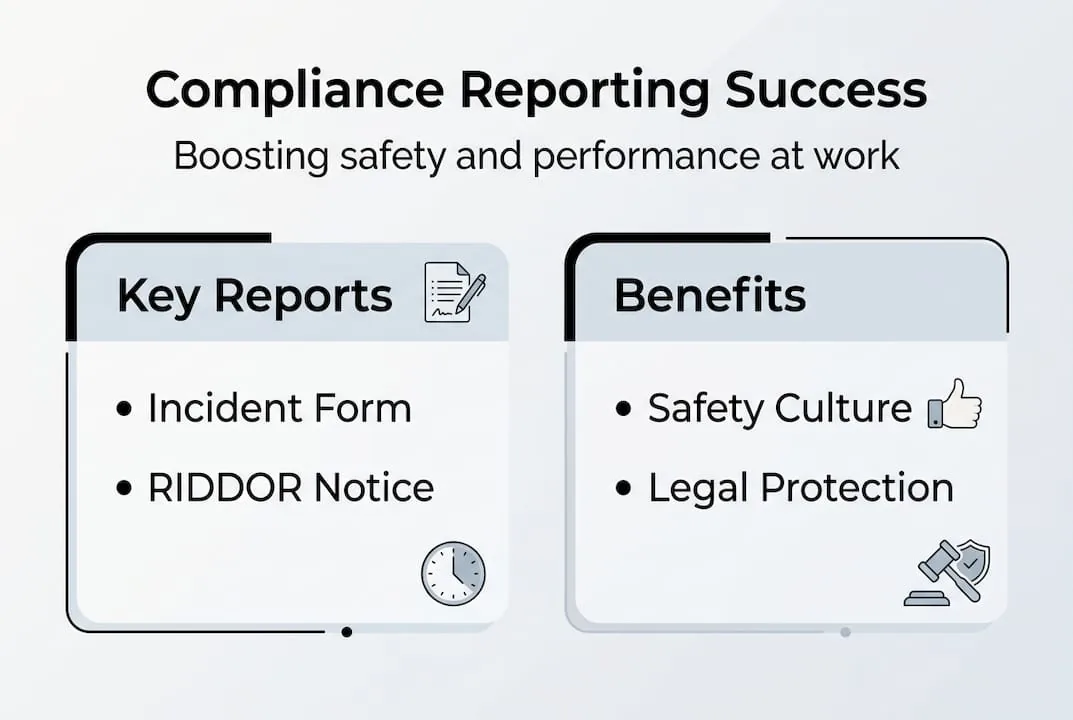
HSE uses submitted compliance data to identify trends and target inspection resources at the sectors and sites presenting the highest risk. This means organisations that report accurately contribute directly to sector-wide safety improvements, including the guidance, campaigns, and enforcement priorities that affect your industry.
At the organisational level, compliance reporting delivers several measurable benefits:
- Stronger legal defence: A complete and timely reporting record demonstrates due diligence if enforcement action or civil litigation follows an incident.
- Audit readiness: Accurate reports create a reliable baseline for internal safety audits and third-party assessments.
- Training prioritisation: Patterns in reported data reveal which tasks, teams, or locations need additional competence support.
- Better risk control: Repeated incident themes help organisations target root causes rather than treating each event in isolation.
- Improved leadership visibility: Reporting data gives directors and senior managers a clearer picture of operational risk exposure.
In higher-risk environments, this matters beyond day-to-day compliance. Under the Building Safety Act, organisations involved in design, construction, and management of higher-risk buildings face increasing expectations around evidence, accountability, and traceable decision-making. Robust reporting systems support that wider compliance culture by ensuring information is accurate, retrievable, and defensible.
There is also a cultural benefit. When workers see that incidents, near misses, and dangerous occurrences are taken seriously, investigated properly, and translated into action, trust improves. Reporting stops being viewed as a blame mechanism and starts being seen as part of a functioning safety management system.
A compliance officer’s perspective: What most guides miss
Most guidance explains what must be reported, but far fewer resources address what makes reporting systems actually work in live operational environments. In practice, the biggest failures are rarely caused by ignorance of the law alone. They are caused by fragmented responsibilities, poor escalation routes, and weak evidence capture at the point of incident.
Three realities are often overlooked:
- The first account is rarely complete. Early information is often partial, emotional, or technically inaccurate. Your process must allow for verification and amendment without discouraging prompt action.
- Subcontractor arrangements do not remove duty. On many construction sites, confusion arises over who reports what. The legal duty usually sits with the employer or person in control of the premises or activity, not simply the party who witnessed the event.
- Reporting quality depends on site culture. If supervisors fear blame, or workers think reporting creates hassle with no benefit, critical information will be delayed or lost.
That is why mature organisations treat compliance reporting as part of a broader governance framework rather than a standalone admin task. They align reporting with:
- Clear escalation protocols for supervisors, managers, and duty holders
- Standardised evidence capture including photos, witness notes, and immediate control measures
- Defined review ownership so reports are checked for legal accuracy before submission deadlines expire
- Board-level visibility for serious incidents, dangerous occurrences, and recurring trends
- Corrective action tracking so reporting leads to measurable improvement rather than static records
In construction, this approach aligns closely with CDM 2015 principles, where planning, coordination, and cooperation are central. In manufacturing, it supports stronger control under PUWER, LOLER, COSHH, and related regimes by ensuring incidents are linked back to equipment condition, supervision, training, and safe systems of work.
Practical insight: The best reporting systems do not just ask, “Is this reportable?” They also ask, “What does this event tell us about our controls, competence, and leadership?” That is where compliance starts to create operational value.
Next steps: Streamline your compliance reporting
If your current process depends on email chains, spreadsheets, and individual memory, it is vulnerable. Delays, duplicated records, and inconsistent decision-making are almost inevitable. The next step is to build a reporting process that is structured, auditable, and easy for operational teams to follow under pressure.
A practical improvement plan should include:
- Reviewing your reportability criteria against current RIDDOR, CDM 2015, and sector-specific duties
- Clarifying who owns each submission across employees, contractors, and multi-site operations
- Creating standard workflows for incident capture, legal review, submission, amendment, and retention
- Digitising records so evidence is searchable, secure, and available for audits or investigations
- Using dashboards and alerts to track deadlines, overdue actions, and recurring hazards
- Training line managers and supervisors so they understand both legal triggers and practical escalation steps
LifeSafety.ai helps organisations simplify this process with connected tools for incident reporting, compliance tracking, inspections, and document control. Whether you are managing a construction portfolio, a manufacturing facility, or a mixed-risk estate, digital workflows reduce administrative friction while improving legal confidence.
For teams looking to strengthen reporting maturity, the most effective starting point is often a simple one: map your current process from incident to closure and identify where information is delayed, lost, or misunderstood. Once those weak points are visible, improvement becomes far more achievable.
Build a more defensible reporting process
Use digital workflows to manage RIDDOR submissions, CDM notifications, inspections, and evidence trails in one place.
- Track deadlines and open actions in real time
- Standardise incident capture across sites and contractors
- Maintain audit-ready records for HSE inspections and investigations
Frequently asked questions
What is compliance reporting in health and safety?
It is the formal submission of legally required information to a regulator, usually the HSE, rather than simply recording incidents internally. Examples include RIDDOR reports, F10 notifications, and certain inspection or examination records that must be retained for review.
Does every workplace accident need to be reported to HSE?
No. Only incidents that meet specific legal thresholds are reportable. Many accidents still need to be recorded internally, but they do not all trigger an HSE submission. The key is understanding the exact RIDDOR criteria and any other sector-specific duties that apply.
Who is responsible for making a compliance report?
Usually the employer, self-employed person, or person in control of the premises or activity. On construction projects, responsibility can become blurred where multiple contractors are involved, so roles should be defined clearly in advance under CDM 2015 arrangements.
How long must compliance records be kept?
As a minimum, most RIDDOR-related records should be retained for three years from the date of the incident or report. In practice, many organisations keep records longer where there is a risk of civil claims, contractual requirements, or wider governance obligations.
Can a report be corrected after submission?
Yes. If the facts change or an error is identified, the original report should be amended rather than duplicated. Maintaining accuracy is essential, especially if the incident later becomes part of an HSE investigation or legal claim.
Why does compliance reporting matter beyond legal compliance?
Because it improves visibility of risk. Good reporting supports trend analysis, targeted training, stronger supervision, and better leadership decisions. It also helps demonstrate due diligence under wider UK safety frameworks, including expectations shaped by the Building Safety Act and modern governance standards.
Related Articles

HSE for Data Centres
Data-centre HSE is electrical plant, COSHH, permits and night-shift people risk. LifeSafety.ai puts UK compliance and live dashboards in one system.
Risk Assessment vs Method Statement (RAMS): Key Differences
A risk assessment identifies what could cause harm; a method statement sets out how the work will be done safely. Here is how they differ, what UK law actually requires, and when you need both.

Employee Incident Report form: RIDDOR-Ready Template Guide
Ensure workplace safety with our RIDDOR-ready employee incident report form. Download the template and streamline your incident reporting today!