Workplace Hazard Reporting: A Guide for Compliance Officers
Workplace hazard reporting: A practical guide for UK compliance
TL;DR:
- Many hazards go unreported beneath RIDDOR’s mandatory requirements, increasing safety risks across construction and manufacturing sites.
- A proactive safety culture emphasises near-miss reporting alongside legal incident reporting, not instead of it.
- Digital tools streamline hazard logging, investigation, escalation, and compliance evidence in high-risk industries.
Most compliance officers in manufacturing and construction know RIDDOR exists. Far fewer realise how much goes unreported beneath it. Tens of thousands of RIDDOR reports are filed each year, yet near-miss incidents and low-level hazards remain chronically under-captured across high-risk sites. The consequences are real: missed intervention points, preventable injuries, and regulatory exposure. This guide cuts through the confusion, explaining exactly what hazard reporting covers in UK law, who carries responsibility, which incidents trigger which obligations, and how to build a reporting process that genuinely protects your workforce rather than simply satisfying a legal checkbox.
Table of Contents
- Defining workplace hazard reporting in the UK
- What incidents and hazards require reporting?
- Reporting process: How incidents are identified, recorded, and escalated
- Best practices for effective hazard and near-miss reporting
- Why compliance focus must shift from minimum legal reporting to safety culture
- How LifeSafety.ai supports robust hazard reporting
- Frequently asked questions
Key Takeaways
| Point | Details |
|---|---|
| Legal and voluntary reporting | Workplace hazard reporting involves both mandatory RIDDOR submissions and internal reports for all meaningful risks. |
| Sector-specific requirements | Construction and manufacturing must track sector-related hazards such as scaffolding failures, plant movement, and machinery incidents. |
| Prompt reporting duties | Serious incidents require immediate RIDDOR action, followed by written confirmation within statutory timescales. |
| Near-miss value | Capturing and learning from near-misses is essential for effective accident prevention and continuous improvement. |
| Digital tools improve compliance | Apps and platforms streamline reporting, improve reporting rates, and help meet HSE and internal governance requirements. |
Defining workplace hazard reporting in the UK
Hazard reporting is not a single act. It is a layered system combining legal obligations with internal safety culture practices. Understanding that distinction is the starting point for any compliance officer serious about risk management.
At the legal level, the Reporting of Injuries, Diseases and Dangerous Occurrences Regulations 2013 (RIDDOR) sets out mandatory reporting duties. RIDDOR requires reporting of specific incident types to the Health and Safety Executive (HSE), covering deaths, specified injuries, over-seven-day incapacitation injuries, occupational diseases, and dangerous occurrences. This is non-negotiable. Failure to comply carries enforcement action, improvement notices, and potential prosecution.
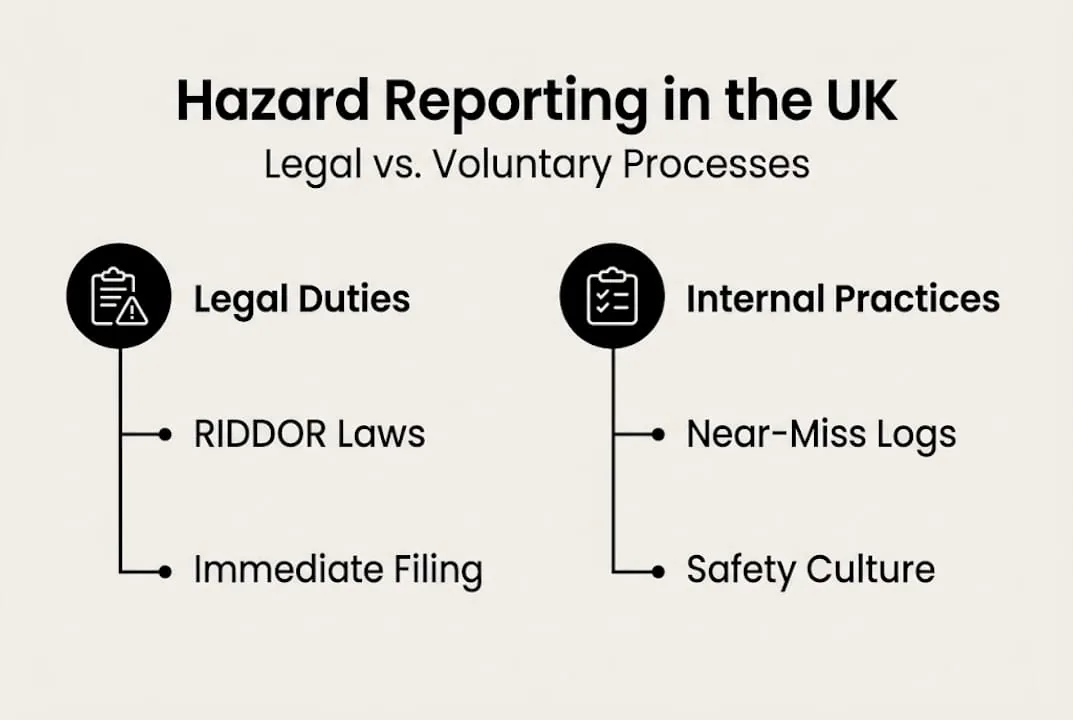
Beyond RIDDOR, there is a second, equally important layer: voluntary internal reporting. This includes near-misses, unsafe conditions, equipment defects, and behavioural risks that do not meet the RIDDOR threshold but represent genuine warning signals. These internal notifications are the heartbeat of a proactive safety culture.
Who carries responsibility?
Responsibility is distributed across several parties:
- Employers hold primary RIDDOR reporting duties for their own employees and for incidents on their premises.
- Self-employed individuals must report incidents involving themselves.
- Controllers of premises, including principal contractors under CDM 2015, report incidents involving people who are not their employees but are injured on their site.
- Workers are not legally required to submit RIDDOR reports, but they should be actively encouraged to report hazards internally through accessible channels.
Our RIDDOR reporting guide provides a more detailed breakdown of these responsibilities if you need further clarity on role-specific duties.
“A workplace where only accidents are reported is a workplace waiting for the next accident. Near-miss reporting is where prevention actually lives.”
Pro Tip: Build your internal reporting system so that it is faster and easier to log a near-miss than to ignore it. Friction is the enemy of good reporting culture.
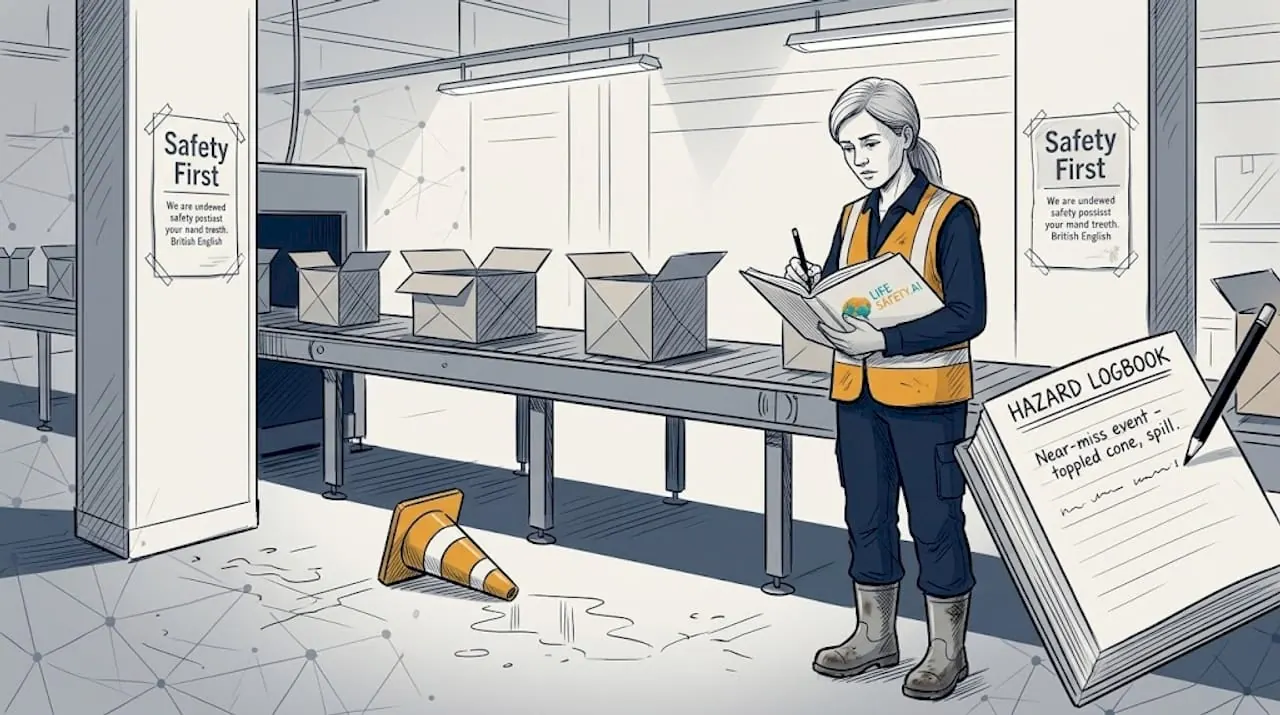
The practical value of near-miss reporting cannot be overstated. For every serious injury on a construction or manufacturing site, there are dozens of preceding near-misses that went unrecorded. Capturing those signals early is what separates reactive safety management from genuinely effective risk control.
What incidents and hazards require reporting?
Knowing the categories that trigger reporting obligations is essential for compliance officers. Getting this wrong in either direction creates problems: over-reporting wastes resource, under-reporting creates legal and safety risk.
RIDDOR-reportable incident types
The following must be reported to the HSE:
- Deaths of workers or non-workers arising from a work-related accident.
- Specified injuries to workers, including fractures excluding fingers and toes, amputations, loss of sight, crush injuries, and burns requiring hospital admission.
- Over-seven-day incapacitation injuries where a worker cannot perform their normal duties for more than seven consecutive days, excluding the day of the accident.
- Occupational diseases confirmed by a doctor, including carpal tunnel syndrome, occupational dermatitis, hand-arm vibration syndrome, and occupational asthma.
- Dangerous occurrences, meaning near-misses of a specific defined type, such as scaffold collapses, crane overturns, explosions, and structural collapses.
Reporting timelines matter. Fatalities and specified injuries must be reported immediately by telephone, then confirmed via the online form within ten days. Over-seven-day injuries must be reported within fifteen days of the accident. Occupational diseases are reported on diagnosis.
| Incident type | Reporting method | Deadline |
|---|---|---|
| Fatality or specified injury | Phone then online form | Immediately, confirmed within 10 days |
| Over-7-day incapacitation | Online form | Within 15 days of accident |
| Occupational disease | Online form | On receipt of diagnosis |
| Dangerous occurrence | Online form | As soon as practicable |
Beyond RIDDOR: what else should be reported internally?
Construction and manufacturing sites generate hazards that never reach the RIDDOR threshold but are critical to capture. These include:
- Near-misses involving moving plant or vehicles.
- Unsecured loads, defective scaffolding, or damaged PPE.
- Verbal altercations or fatigue-related errors that could escalate.
- Environmental conditions such as excessive noise or chemical exposure below reportable levels.
Our incident management essentials module is designed to capture all of these categories, not just RIDDOR-mandated incidents, giving you a complete picture of site risk.
Reporting process: How incidents are identified, recorded, and escalated
Understanding what to report is only half the challenge. The process by which hazards move from identification to formal record to regulatory submission is where most organisations struggle.
Step-by-step reporting sequence
- Hazard noticed by worker, supervisor, or safety officer on site.
- Immediate action taken to make the area safe and prevent further harm.
- Internal log created capturing who, what, where, when, and initial severity assessment.
- Supervisor or safety officer notified within the agreed escalation timeframe.
- RIDDOR threshold assessed to determine whether the incident meets a reportable category.
- RIDDOR submission made if the threshold is met, within the required timeline.
- Investigation initiated and findings recorded for future risk assessment updates.
- Follow-up review to confirm corrective actions are implemented and effective.
Pro Tip: Assign a named RIDDOR responsible person for each site or shift. Ambiguity about who submits the report is one of the most common causes of missed deadlines.
Responsibilities by role
| Role | Internal reporting | RIDDOR submission |
|---|---|---|
| Worker | Required to notify supervisor | Not responsible |
| Supervisor | Required to escalate to safety lead | Not usually responsible |
| Employer | Oversees internal system | Responsible |
| Controller of premises | Oversees site reporting | Responsible for non-employees |
| Agency or host employer | Shares duty of care | Responsibility depends on contract and control |
Employers, persons in control, and agencies each carry specific duties, and these can overlap in complex contracting arrangements common in construction. Always clarify responsibility in writing before works commence.
Record-keeping is a legal requirement, not a courtesy. All RIDDOR records must be retained for a minimum of three years. Internal hazard logs, near-miss records, and investigation reports should be stored securely and be retrievable for HSE inspection. Our near-miss reporting processes module automates record retention, removing the risk of lost or incomplete documentation.
Best practices for effective hazard and near-miss reporting
Raising reporting rates requires more than a good form. It requires a deliberate, sustained approach to culture, process, and technology.
Practical steps that make a measurable difference
- Deploy digital reporting tools that workers can access from a mobile device on site. Paper forms create friction and delay; mobile apps reduce both.
- Train supervisors regularly on what constitutes a reportable incident and how to encourage upward reporting without blame.
- Conduct visible safety audits and share findings with the workforce. Transparency builds trust and increases reporting confidence.
- Integrate near-miss data into risk assessments and method statements. Near-miss trends should directly inform your control measures.
- Provide feedback on every report submitted. Workers who never hear what happened after they raised a concern quickly stop raising concerns.
HSE recommends no-blame reporting and digital tools as foundational elements of effective incident capture. This is not aspirational guidance; it is evidence-based practice.
“The most dangerous workplace is not the one with the most hazards. It is the one where people have stopped reporting them.”
Confidentiality is a practical tool, not just a courtesy. When workers fear disciplinary consequences, reporting rates fall. Reporting a risk through a confidential channel removes that barrier and is supported by ACAS guidance on health and safety obligations.
Pro Tip: Review your near-miss trends monthly, not quarterly. By the time a pattern is obvious in a quarterly review, the opportunity for early intervention may already have passed.
For higher-risk environments, best practice also means aligning hazard reporting with wider compliance systems. In construction, that includes linking reports to CDM 2015 duties, site inductions, temporary works controls, and contractor coordination. In occupied higher-risk buildings, the Building Safety Act raises expectations around accountable information, escalation, and evidence trails. Hazard reporting should therefore feed directly into your broader governance framework rather than sit in isolation.
Why compliance focus must shift from minimum legal reporting to safety culture
Many organisations still treat hazard reporting as a narrow compliance task: report what the law requires, file the paperwork, and move on. That approach is legally risky and operationally weak.
RIDDOR is a minimum legal threshold, not a complete safety management system. If your reporting process only activates after a specified injury, dangerous occurrence, or diagnosed disease, you are learning far too late. The real value lies in identifying weak signals before they become reportable events.
That is why mature organisations focus on reporting culture as much as reporting compliance. A strong culture has several recognisable features:
- Workers understand that reporting is expected and supported.
- Managers respond quickly and visibly to concerns raised.
- Near-misses are treated as learning opportunities, not administrative burdens.
- Data is reviewed for trends, recurring causes, and control failures.
- Leadership uses reporting metrics to improve systems, not simply to monitor blame.
In practical terms, this shift matters because most serious incidents are preceded by smaller failures: a damaged guard left unreported, a reversing vehicle near-miss dismissed as routine, a scaffold defect noted verbally but never logged, or fatigue-related mistakes normalised during programme pressure. These are exactly the warning signs that a healthy reporting culture captures.
For compliance officers, the message is straightforward: if your KPI is only “number of RIDDOR reports submitted on time”, you are measuring administrative performance, not safety performance. Better indicators include:
- Near-miss reporting rate by site, contractor, or shift.
- Time to close corrective actions after a report is raised.
- Repeat hazard frequency for the same issue or location.
- Supervisor response times to internal reports.
- Evidence of learning through updated RAMS, briefings, and toolbox talks.
When reporting is embedded into daily operations, compliance improves as a by-product of better management. When it is treated as a legal afterthought, both compliance and safety suffer.
How LifeSafety.ai supports robust hazard reporting
Effective hazard reporting depends on speed, clarity, accountability, and evidence. That is exactly where digital systems outperform fragmented paper-based processes.
LifeSafety.ai helps compliance officers, principal contractors, and safety teams build a reporting process that works in the real world of UK construction and manufacturing. Instead of relying on disconnected forms, emails, and spreadsheets, teams can manage the full reporting lifecycle in one place.
Key capabilities include:
- Mobile-first hazard and near-miss capture so workers can report issues immediately from site.
- Structured incident workflows that support escalation, investigation, and corrective action tracking.
- Centralised record retention for RIDDOR evidence, internal logs, and audit-ready documentation.
- Trend analysis and dashboards to identify recurring hazards, high-risk areas, and weak controls.
- Integration with wider safety modules including incident management, inspections, and risk assessment reviews.
This matters because compliance is rarely lost on the headline event alone. It is usually lost in the gaps: the missing timestamp, the unclear ownership, the delayed escalation, the incomplete investigation, or the corrective action that was never verified. LifeSafety.ai is designed to close those gaps.
For organisations managing multiple contractors, temporary works, or occupied assets, the platform also supports stronger governance under CDM 2015 and the Building Safety Act by improving traceability and accountability across the reporting chain.
Where LifeSafety.ai adds practical value
- Improves reporting rates by reducing friction for frontline workers.
- Supports faster triage of incidents against RIDDOR thresholds.
- Creates a defensible audit trail for HSE inspection or internal review.
- Helps safety leaders turn raw reports into actionable prevention data.
If your current process depends on paper forms, inbox monitoring, and manual follow-up, it is probably doing less for safety than you think. A modern reporting system should not just store incidents. It should help prevent the next one.
Frequently asked questions
Is near-miss reporting a legal requirement under RIDDOR?
No. Most near-misses are not legally reportable under RIDDOR unless they fall within the defined category of a dangerous occurrence. However, near-miss reporting should still be required internally because it is one of the most effective ways to prevent future harm.
Who is responsible for submitting a RIDDOR report on a construction site?
Usually the employer or the person in control of the premises is responsible, depending on who employs the injured person and who controls the work area. Under complex contracting arrangements, responsibility should be clarified in writing before work starts, particularly under CDM 2015.
How long must RIDDOR records be kept?
RIDDOR records must be retained for at least three years. In practice, many organisations keep related investigation and corrective action records longer where they support wider legal, insurance, or governance requirements.
What is the difference between a hazard report and an incident report?
A hazard report usually captures an unsafe condition, unsafe act, or near-miss before harm occurs. An incident report typically records an event where harm, damage, or a defined dangerous occurrence has already taken place. Both are important and should connect within the same reporting system.
Should minor hazards really be logged?
Yes, where they indicate a genuine control weakness. A single minor issue may seem insignificant, but repeated low-level reports often reveal patterns involving housekeeping, supervision, maintenance, fatigue, or contractor management. Those patterns are exactly what compliance officers need to see early.
How can we improve reporting rates without creating a blame culture?
Make reporting simple, respond quickly, provide feedback, protect confidentiality where appropriate, and train supervisors to treat reports as learning opportunities. Workers report more when they can see that action follows reporting and that raising concerns will not be used unfairly against them.
Final thought
Workplace hazard reporting is not just about meeting the letter of RIDDOR. It is about building a system that captures weak signals early, escalates serious events correctly, and turns every report into a chance to strengthen control measures. For UK compliance officers in construction and manufacturing, that means combining legal precision with practical reporting culture. Do both well, and you reduce injuries, improve resilience, and stand on much firmer ground with the HSE.
Related Articles

Incident reporting software comparison: UK guide 2026
Discover our incident reporting software comparison for UK workplaces. Explore top options like Lifesafety, SafetyCulture, and more.

Safety management solutions for construction: UK SMS guide
Discover essential safety management solutions for construction sites in the UK. Learn how a mobile-first SMS can enhance safety and compliance.

Best Health and Safety Software for UK Workplaces: A Guide
Discover the best health and safety software for UK workplaces in 2026. Explore top picks like Lifesafety for compliance and efficiency!