Why reduce manual safety processes in 2026
Why reduce manual safety processes in 2026
Reducing manual safety processes helps organisations improve reporting speed, data consistency, hazard visibility and compliance performance while keeping competent human oversight at the centre of decision-making.
TL;DR
- Reducing manual safety processes through automation improves data consistency, speeds incident reporting, and enhances hazard visibility across sites.
- AI tools and digital workflows remove human error and administrative delays, leading to safer workplaces with measurable injury and fatality reductions.
- Human oversight remains essential for legal accountability, requiring validation of AI outputs and continuous governance to ensure safety and compliance.
Reducing manual safety processes means using technology and automation to replace paper-based workflows, repetitive administrative tasks, and human-dependent data collection with digital systems that deliver faster, more consistent safety outcomes. For health and safety professionals in construction, manufacturing, and other high-risk sectors, the case is clear: manual processes introduce delays, inconsistency, and avoidable human error at precisely the moments when accuracy matters most. AI-driven tools, automated incident reporting, and integrated safety platforms now make it practical to cut administrative burden significantly while improving compliance with RIDDOR, CDM 2015, relevant BS standards, and wider HSE expectations. This guide explains the evidence, the benefits, and the governance considerations you need to act confidently.
Why reduce manual safety processes: the operational case
The most immediate benefit of reducing manual safety processes is the elimination of administrative friction that slows safety teams down. When frontline workers must search through paper files or navigate disconnected spreadsheets to find a job hazard analysis, they either delay the task or proceed without the information. AI decision support tools address this directly by drawing on internal manuals and knowledge bases to deliver real-time guidance at the point of need.

The operational benefits extend well beyond speed. Consider what consistent, automated data capture means across multiple sites or shifts. A manual process depends on the individual completing it correctly, at the right time, with the right form. An automated process applies the same logic every time, regardless of who is on shift or how busy the site is. That consistency is the foundation of reliable safety data, and reliable data is what makes meaningful risk assessment possible.
Key operational improvements from reducing manual steps include:
- Faster incident reporting: Mobile logging tools capture near-misses and incidents in real time, reducing the gap between event and record.
- Real-time hazard visibility: Automated data capture surfaces patterns that paper-based systems miss entirely.
- Reduced administrative burden: Safety managers spend less time on data entry and more time on analysis and intervention.
- Greater consistency across sites: Automated workflows apply the same standards regardless of location or personnel.
- Improved decision-making speed: Frontline workers access relevant guidance without waiting for a supervisor or searching a filing cabinet.
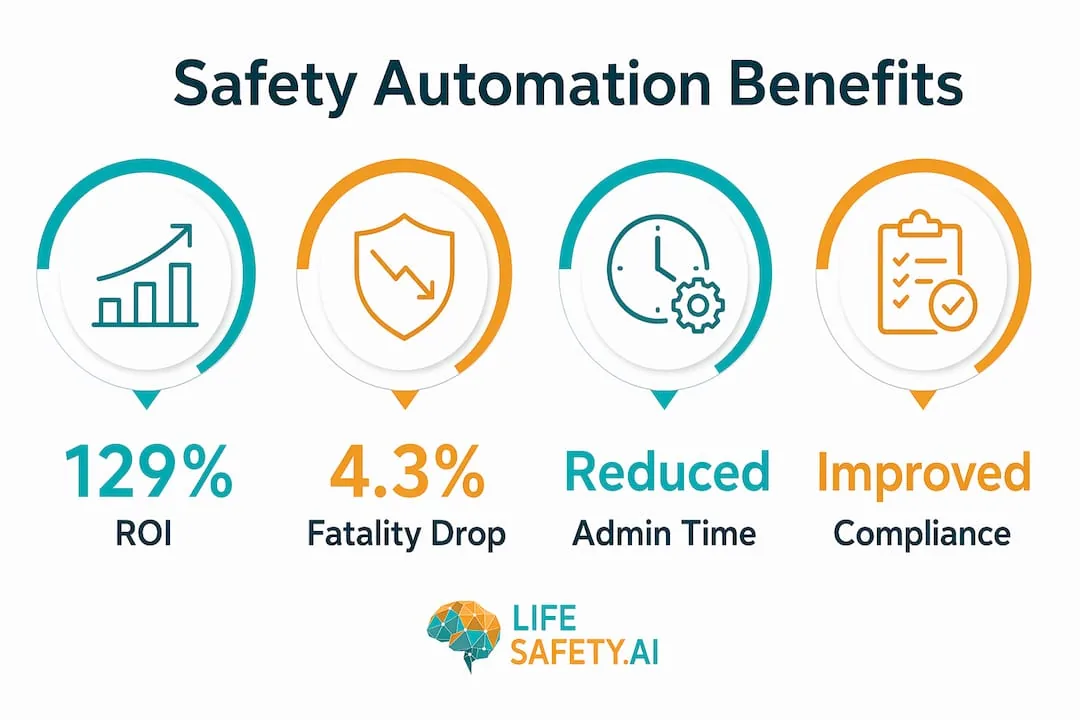
A study across 22 manufacturing sites found that applied AI using computer vision delivered a 129% ROI over three years, driven primarily by reductions in injury, fatality, and operational downtime. That figure reflects not just cost savings but a genuine improvement in how quickly hazards are detected and addressed.
Pro Tip: Start by mapping where your safety team spends the most administrative time each week. The highest-volume manual tasks, such as compiling inspection records or chasing incident reports, are your best candidates for early automation.
How does automation reduce physical risk and injury rates?
The most direct way automation improves safety is by removing workers from hazardous situations entirely. When a robot handles a repetitive press operation or a sensor monitors a confined space, the human is no longer in the exposure zone. This is not a theoretical benefit. A European study covering 2011 to 2019 found that industrial robot adoption correlates with approximately a 4.3% reduction in workplace fatalities and a 3.2% reduction in injury rates. Those figures represent real people who did not get hurt because a machine took over a dangerous task.
The mechanism matters as much as the outcome. Automation’s safety benefits stem from redesigning hazardous tasks with consistent safeguards built in, not simply from replacing a person with a machine. A poorly designed automated system can introduce new risks if safety is treated as an afterthought. Process safety must be built into automation systems from the outset, with layered safeguarding that prevents operators from needing to intervene manually during normal operation.
The table below summarises the evidence on automation’s impact on physical risk:
| Metric | Finding | Source |
|---|---|---|
| Fatality reduction | 4.3% decrease linked to industrial robot adoption | International Federation of Robotics |
| Injury rate reduction | 3.2% decrease across European workplaces (2011–2019) | International Federation of Robotics |
| ROI from AI vision systems | 129% over three years across 22 manufacturing sites | World Economic Forum |
| Primary driver of ROI | Injury, fatality, and operational downtime reductions | World Economic Forum |
Pro Tip: When specifying new automated equipment, require suppliers to demonstrate how process safety is embedded in the design. Ask specifically about layered safeguarding and what manual interventions the system still requires during normal operation.
What are the compliance and governance considerations?
Reducing manual safety processes does not reduce legal accountability. Employers retain a non-delegable duty of care regardless of whether a human or an AI system generates a risk assessment or flags a hazard. AI improves compliance speed but does not create a regulatory safe harbour, and treating automated outputs as final decisions without human review is a governance failure with real legal consequences.
The practical implication is that every AI-generated output in a safety context requires a validation step. A competent person must review, approve, and take ownership of the recommendation before it becomes a control measure. This is not a limitation of the technology. It is the correct way to use it. The most defensible approach is to augment human decision-making with AI that reduces time spent searching for safety information, not to replace the decision-maker.
Governance frameworks for reduced manual safety processes should address:
- Validation protocols: Define who reviews AI outputs and at what stage before they are acted upon.
- Audit trails: Every automated decision or recommendation must be logged with a timestamp and the identity of the approving person.
- Escalation paths: Specify what happens when an automated system flags a risk it cannot resolve. Who is notified, and within what timeframe?
- Policy alignment: Safety policies must reflect how AI tools are used, including their limitations and the circumstances in which human judgement overrides automated guidance.
- Ongoing data governance: Safety digitisation projects fail when compliance evidence is treated as a one-time upload. Continuous capture and traceability of safety data are not optional.
The risk of increased liability is real. When an AI system identifies a hazard and that hazard is not addressed, the organisation has documented evidence of a known risk it failed to control. Governance must close that loop, not leave it open. In UK terms, that means ensuring digital workflows support defensible compliance with RIDDOR reporting duties, HSE inspection expectations, CDM 2015 coordination requirements, and, where relevant, the accountability principles reinforced by the Building Safety Act.
How to implement reduced manual safety processes in your organisation
Practical implementation begins with digitising your existing safety knowledge, not replacing it. Your internal manuals, job hazard analyses, and risk assessments are the credible knowledge base that AI tools rely on to provide trustworthy guidance. If that documentation is incomplete or outdated, automation will amplify the problem rather than solve it.
Follow these steps to build a sound implementation:
- Audit your current manual processes. Identify every step where safety information is created, transferred, or stored manually. Prioritise by volume and risk.
- Digitise your knowledge base. Convert paper-based manuals, risk assessments, and method statements into structured digital formats that AI tools can interrogate. This is the foundation of AI-driven risk assessments.
- Embed AI tools at the point of work. Deploy mobile applications and decision support tools where frontline workers actually need guidance, not just in the safety manager’s office.
- Integrate safety data into your automation platforms. Safety technology yields full benefits only when centralised and embedded in existing automation systems, eliminating the media discontinuities that cause delays and errors.
- Involve your workforce in the change. Staff who understand why the change is happening and how it affects their daily tasks adopt new systems faster and use them more accurately. Resistance is almost always a communication failure.
- Establish continuous traceability. Build processes that capture safety data on an ongoing basis, not just at audit time. This protects the organisation legally and generates the data needed to improve over time.
For construction firms specifically, the operational case for digitising safety processes is particularly strong given the volume of permit workflows, CDM 2015 obligations, and multi-contractor environments that manual systems struggle to manage consistently. In practice, platforms such as LifeSafety.ai can support this transition by centralising inspections, incident records, risk assessments, corrective actions and evidence trails in one place, making it easier to demonstrate compliance during internal reviews or external scrutiny.
Key takeaways
Reducing manual safety processes delivers measurable improvements in efficiency, injury rates, and compliance quality, but only when human governance remains central to every automated workflow.
| Point | Details |
|---|---|
| Automation reduces physical risk | Robot adoption correlates with a 4.3% fall in fatalities and 3.2% fall in injury rates. |
| AI augments, not replaces, judgement | Human validation of AI outputs is legally required and operationally critical. |
| Governance must be continuous | Safety data traceability must be ongoing, not limited to audit periods. |
| Integration is non-negotiable | Safety tech delivers full value only when embedded in existing automation platforms. |
| Start with your knowledge base | Digitising internal manuals and hazard analyses is the prerequisite for effective AI deployment. |
The uncomfortable truth about safety automation
I have worked with safety professionals who expected technology to solve their compliance problems and were frustrated when it did not. The honest answer is that automation does not fix a weak safety culture. It amplifies whatever culture already exists. If your teams bypass governance steps when they are busy, an automated system will be bypassed just as readily unless you design the workflow to prevent it.
What I have found actually works is treating AI and automation as a cultural investment, not a software purchase. The organisations that see the strongest results from reducing manual safety processes are the ones where safety managers lead the integration effort, where frontline workers are involved in testing and feedback, and where governance is treated as a feature rather than a constraint. The technology is genuinely transformational when it is embedded in how people work, not bolted on as an afterthought.
The strongest programmes also recognise that digital safety is not just about efficiency. It is about creating a more reliable operating model for risk control. When incident reporting is immediate, when corrective actions are traceable, and when site teams can access current risk information without delay, organisations are better placed to prevent harm and to evidence compliance if the regulator asks questions later. That is particularly important in sectors where principal contractors, duty holders and senior leaders must show clear lines of responsibility.
In 2026, the question is no longer whether manual safety processes create avoidable friction. They do. The better question is how quickly your organisation can replace the highest-risk manual steps with controlled, auditable digital workflows that support competent decision-making. If you approach automation with strong governance, workforce engagement and a clear compliance framework, the result is not just less paperwork. It is a safer, faster and more defensible safety management system.
Move from manual safety admin to auditable digital control
LifeSafety.ai helps UK organisations digitise inspections, incident reporting, risk assessments and action tracking so safety teams can reduce admin burden without weakening governance.
- Centralised records for inspections, hazards, incidents and corrective actions
- Faster reporting workflows aligned to operational and compliance needs
- Traceable approvals to support competent review and accountability
- Better visibility across sites for contractors, managers and duty holders
Related Articles

Workplace safety software for construction teams
Discover top-rated workplace safety software for construction. Improve incident tracking, compliance, and safety analytics with Lifesafety!

LifeguardAI.co.uk alternatives for UK safety managers: 2026
Discover top lifeguardai.co.uk alternatives for UK safety managers. Explore Lifesafety and other innovative solutions to enhance workplace safety.

Site audit recommendations: your 2026 action plan
Unlock the power of effective site audit recommendations. Follow our 2026 action plan to boost indexing, enhance content quality, and improve site speed.