
What is CDM 2015? A guide for construction professionals
What is CDM 2015? A guide for construction professionals
A practical guide to the Construction (Design and Management) Regulations 2015 for clients, designers, contractors, and workers operating in Great Britain.
TL;DR
- The CDM 2015 regulations govern health and safety for all construction projects in Great Britain, regardless of size.
- They assign specific legal duties to clients, designers, principal designers, contractors, and workers so safety is integrated throughout every project stage.
- Proper compliance relies on coherent documentation, timely duty holder appointments, and a safety-oriented culture rather than paperwork alone.
The Construction (Design and Management) Regulations 2015, universally known as CDM 2015, are the primary legal framework governing health, safety, and welfare across all construction projects in Great Britain. Enforced by the Health and Safety Executive (HSE), these regulations define who is responsible for safety at every stage of a project, from initial design through to completion and handover.
CDM 2015 applies regardless of project size or value, meaning a domestic loft conversion carries the same legal weight as a major infrastructure scheme. Understanding your duties under CDM 2015 is not optional. It is a legal obligation with real consequences for clients, designers, and contractors alike.
What is CDM 2015 and who does it apply to?
CDM 2015 is defined as the set of regulations that apply to every construction project in Great Britain, with no exemptions based on project size, value, or duration. That breadth is deliberate. The HSE designed CDM 2015 to shift safety management from an afterthought into a core part of project planning.
The regulations cover new builds, refurbishments, demolitions, maintenance works, and even domestic projects where a homeowner commissions construction work.
The scope of construction work under CDM 2015 is wider than most professionals expect. It includes civil engineering, installation of mechanical and electrical systems, site preparation, and structural alterations. If your project involves any of these activities, CDM 2015 applies to you.
Who are the key duty holders under CDM 2015?
Clients, designers, principal designers, contractors, and workers each carry distinct legal duties under CDM 2015. The accountability hierarchy places the client at the top, with legal responsibility for ensuring the right appointments are made and that adequate resources are allocated to safety. That accountability does not disappear when work is delegated.
The five key duty holders and their core responsibilities are:
- Client: Appoints the principal designer and principal contractor, ensures pre-construction information is prepared, and confirms that suitable arrangements for managing the project are in place throughout.
- Principal designer: Coordinates health and safety during the pre-construction phase, manages design risk, and compiles the pre-construction information pack.
- Designer: Eliminates or reduces foreseeable risks through design decisions and communicates residual risks to the principal designer and construction team.
- Principal contractor: Prepares and manages the Construction Phase Plan, coordinates contractors on site, and consults workers on safety matters.
- Workers: Cooperate with their employer and the principal contractor, report hazards, and follow site safety rules.
One aspect that catches many professionals off guard is the domestic client rule. When a domestic client commissions construction work, their duties under CDM 2015 are transferred to the contractor by default, unless a principal designer has been appointed. This means domestic contractors carry a heavier legal burden than they often realise.
Which projects require notification to the HSE?
Not every project triggers a formal notification, but the threshold is lower than many teams assume. A project requires HSE notification when it is scheduled to last more than 30 working days with more than 20 workers on site simultaneously, or when it will exceed 500 person-days in total. Reaching either threshold makes the project notifiable, which brings additional obligations.
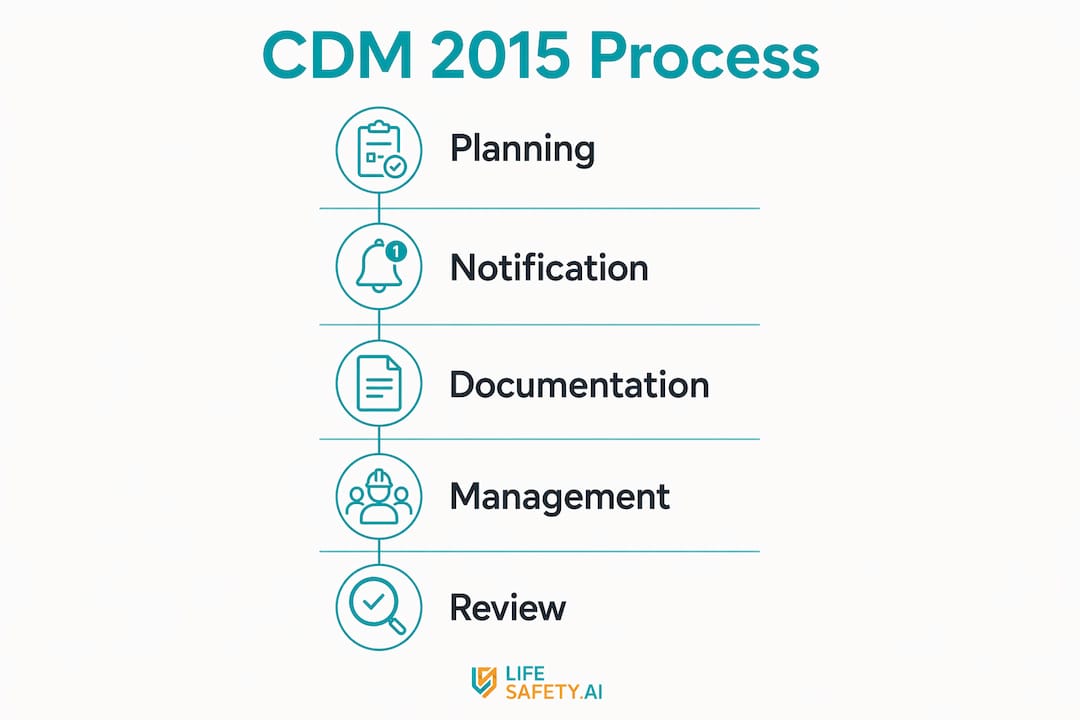
The notification process follows a clear sequence:
- Identify notifiability early. Calculate projected duration and peak worker numbers during pre-construction planning, not after work begins.
- Submit the F10 form. The client or principal designer submits the F10 notification to the HSE before the construction phase starts.
- Display the notification. A copy of the F10 must be displayed prominently on site throughout the construction phase.
- Update when details change. If project scope or duration changes materially, the notification must be revised and resubmitted.
Notifiable projects attract closer HSE scrutiny and require a principal designer and principal contractor to be formally appointed. Missing the notification deadline is a prosecutable offence, not an administrative oversight.
Notification and duty holder flow
What key documentation must be prepared under CDM 2015?
CDM 2015 documentation requirements are specific and legally binding. The core documents include pre-construction information, the Construction Phase Plan, the Health and Safety File, the F10 notification form, risk assessments, and method statements. Each document serves a distinct purpose and must be prepared at the right stage of the project.

| Document | Responsible party | When prepared |
|---|---|---|
| Pre-construction information | Client / principal designer | Before construction phase begins |
| Construction Phase Plan | Principal contractor | Before construction phase begins |
| Health and Safety File | Principal designer | Compiled throughout, handed over at completion |
| F10 notification | Client / principal designer | Before construction phase begins |
| Risk assessments | Contractors / designers | Throughout design and construction phases |
A common compliance failure is treating these documents as separate exercises. Coherence across all three core documents is critical. The pre-construction information should feed directly into the Construction Phase Plan, and both should inform the Health and Safety File as it develops. Gaps between them are exactly what HSE inspectors look for.
Pro Tip: Start compiling the Health and Safety File from day one of the construction phase. Collecting information progressively throughout the project prevents a last-minute scramble at handover and produces a far more useful document for future maintenance teams.
The Construction Phase Plan is not a static document. It must be updated as the project evolves, particularly when new contractors are appointed or when site conditions change significantly.
How does CDM 2015 affect project management and costs in practice?
CDM 2015 changes how projects are planned from the outset, not just how they are managed on site. The regulations require safety to be considered during design, which means architects and engineers must think about construction method, maintenance access, and demolition at the earliest stages. That shift adds time to pre-construction phases but reduces costly late-stage redesigns.
For smaller projects, the financial impact is measurable. CDM 2015 compliance adds approximately 10–20% to total project costs on smaller schemes due to additional planning and coordination requirements. That figure reflects the genuine resource commitment required, particularly for principal designer appointments and documentation preparation on projects that previously had no formal safety management structure.
The most common practical pitfalls health and safety professionals encounter include:
- Appointing duty holders too late, after design decisions have already been made.
- Producing a Construction Phase Plan that is generic rather than project-specific.
- Failing to brief subcontractors on the contents of the pre-construction information.
- Treating the Health and Safety File as a post-project task rather than an ongoing record.
- Overlooking the domestic client rule when working on residential projects.
The CIOB Academy notes that many professionals focus overly on documentation rather than on the behavioural changes that actually drive safer project outcomes. Paperwork that does not change how people work on site is compliance theatre, not safety management.
What are the best practices for CDM 2015 compliance?
Effective CDM 2015 compliance is proportionate to the scale and risk profile of the project. A small domestic extension does not require the same documentation depth as a multi-storey commercial development. The principle of proportionality is built into the regulations and confirmed by HSE guidance.
Pro Tip: Conduct a structured safety review at each major project transition, such as moving from design to procurement, and from procurement to construction. Structured reviews at project transitions improve risk communication far more effectively than updating a static plan.
The following practices consistently produce better compliance outcomes:
- Engage workers early. Site workers provide hazard intelligence that designers and managers routinely miss. Formal mechanisms for capturing their input, such as toolbox talks and pre-task briefings, improve risk assessments materially.
- Link your documents. Cross-reference the pre-construction information, Construction Phase Plan, and Health and Safety File so that each document builds on the last.
- Appoint early. The principal designer must be appointed before detailed design begins, not when planning permission is granted.
- Use the CDM compliance module to track duty holder appointments and documentation status in real time.
- Review risk assessments at key milestones. A risk assessment written at tender stage may be outdated by the time groundworks begin.
The goal is a living compliance workflow, not a folder of documents that nobody reads. When CDM 2015 is implemented well, it changes how teams communicate, how risks are shared, and how decisions are made under pressure on site.
Key takeaways
CDM 2015 is the legal backbone of construction safety in Great Britain, and compliance requires coordinated effort across every duty holder from client to worker throughout the full project lifecycle.
| Point | Details |
|---|---|
| Universal application | CDM 2015 applies to all construction projects in Great Britain, with no exemptions for size or value. |
| Client accountability | The client holds ultimate legal responsibility for safety appointments and documentation, even on domestic projects. |
| Notification thresholds | Projects exceeding 30 working days with over 20 simultaneous workers, or 500 person-days, must be notified to the HSE. |
| Document coherence | Pre-construction information, Construction Phase Plan, and Health and Safety File must cross-reference and build on each other. |
| Proportionate compliance | Effort and documentation depth should match the scale and risk of the project, not a one-size-fits-all template. |
Why CDM 2015 is about culture, not just compliance
Having worked across construction safety for many years, the single biggest misunderstanding I see is treating CDM 2015 as a documentation exercise. Teams spend hours producing pre-construction information packs that nobody on site ever reads. The Construction Phase Plan gets filed away after the first site meeting. The Health and Safety File is assembled in a panic the week before handover.
The regulations were designed to change behaviour, not generate paperwork. When CDM 2015 works as intended, the principal designer is challenging architects to eliminate fall risks at roof level before a single drawing is issued. The principal contractor is driving coordination between trades before conflicting activities create exposure on site. The client is asking whether enough time, budget, and competence have been built into the programme to deliver the work safely.
That is where compliance becomes culture. A compliant project is not simply one with the right forms in place. It is one where risk is discussed openly, design assumptions are tested, and workers are encouraged to raise concerns before an incident occurs. This aligns closely with wider UK safety expectations under the Health and Safety at Work etc. Act 1974, and with the broader direction of travel seen in the Building Safety Act, where accountability, competence, and evidence of control are increasingly central.
Construction professionals should also remember that CDM 2015 does not sit in isolation. Serious incidents may trigger RIDDOR reporting, enforcement action by the HSE, civil claims, programme disruption, and reputational damage. In higher-risk environments, poor coordination at design and planning stage can also create downstream building safety issues that persist long after practical completion.
In practice, the strongest projects are the ones where CDM is embedded into ordinary decision-making:
- Design reviews actively challenge how work will be built, maintained, cleaned, inspected, and eventually altered or demolished.
- Procurement decisions consider competence, supervision, and realistic sequencing rather than lowest cost alone.
- Site briefings translate risk information into clear instructions that workers can apply immediately.
- Leadership behaviours reinforce that stopping unsafe work is acceptable and expected.
- Digital records are maintained in a way that supports auditability, handover quality, and future maintenance safety.
For organisations managing multiple projects, this is where structured systems make a real difference. A platform that tracks appointments, document status, reviews, and live actions can help turn legal duties into repeatable operational controls. That is far more valuable than storing disconnected PDFs in separate folders and hoping they align when an inspector asks questions.
Ultimately, CDM 2015 is about preventing harm through better planning, better design, and better coordination. The paperwork matters because it evidences those controls, but the real test is whether the project team is making safer decisions as a result. If the answer is yes, the regulations are doing what they were intended to do.
Practical next steps for UK construction teams
- Confirm whether your project falls within the scope of CDM 2015 and whether it is notifiable to the HSE.
- Appoint the principal designer and principal contractor early enough to influence design and planning.
- Ensure pre-construction information, the Construction Phase Plan, and the Health and Safety File are linked and kept current.
- Build worker consultation into routine delivery through toolbox talks, briefings, and close-out reviews.
- Use digital compliance tools to maintain evidence for HSE inspections, RIDDOR follow-up, and internal assurance.
For teams looking to strengthen project controls, LifeSafety.ai modules can support CDM compliance tracking and Construction Phase Plan management in a format aligned to operational delivery.
Related Articles
Incident reporting software comparison: UK guide 2026
Discover our incident reporting software comparison for UK workplaces. Explore top options like Lifesafety, SafetyCulture, and more.

Safety management solutions for construction: UK SMS guide
Discover essential safety management solutions for construction sites in the UK. Learn how a mobile-first SMS can enhance safety and compliance.

Best Health and Safety Software for UK Workplaces: A Guide
Discover the best health and safety software for UK workplaces in 2026. Explore top picks like Lifesafety for compliance and efficiency!