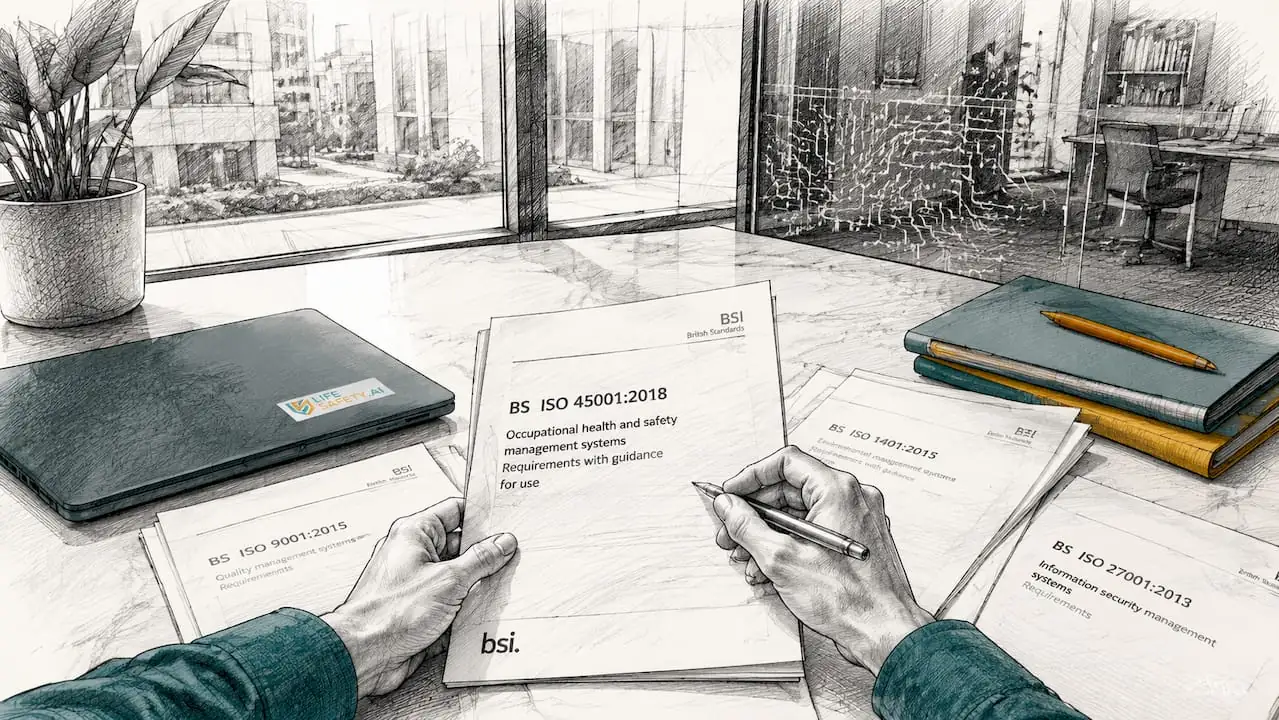
What are BS standards? A guide for safety professionals
What are BS standards? A guide for safety professionals
British Standards shape how UK organisations design, maintain, inspect, and evidence safe systems of work. For health and safety professionals, they are a practical route to demonstrating compliance with HSE expectations, CDM 2015 duties, and wider Building Safety Act accountability.
TL;DR
- British Standards are consensus documents published by the British Standards Institution to establish safety and quality requirements.
- They are voluntary in law but often become effectively mandatory through insurance terms, contracts, procurement requirements, or regulatory scrutiny.
- Proper understanding, version control, and implementation of BS standards support stronger workplace safety compliance and better decision-making.
British Standards (BS) are formal consensus documents published by the British Standards Institution (BSI) to establish unified safety, quality, and operational requirements across UK workplaces and industries. The BSI holds royal charter status as the UK’s national standards body and maintains over 27,000 active standards, publishing more than 3,100 new or revised standards each year. For health and safety professionals and compliance officers, these documents are not background reading. They are the practical benchmarks that define how workplaces design, install, and maintain safety systems. Understanding BS standards is the foundation of effective compliance management.
What are BS standards and how are they structured?
BS standards are consensus-based documents that define agreed methods, specifications, and requirements for products, services, and processes. The HSE defines standards as documents approved by recognised bodies to promote order and safety through consolidated knowledge. That definition matters because it tells you exactly what a BS standard is not: it is not a legal regulation, and it is not one organisation’s opinion. It is an agreed position reached through expert consultation.
The naming convention tells you a great deal about a standard’s origin and scope. BS standard numbering follows the format BS XXXX:YYYY, where the number identifies the subject and the year shows the version. Prefixes carry specific meaning:
- BS indicates a purely British standard developed by the BSI.
- BS EN indicates a European standard adopted into the British catalogue.
- BS ISO indicates alignment with an international standard from the International Organisation for Standardisation.
- BS EN ISO indicates a standard that is simultaneously European and international in origin.
Beyond naming, BS standards fall into seven main types. Specifications set out precise requirements a product or process must meet. Codes of practice give recommendations for accepted good practice. Guides offer general information and options. Methods describe how to carry out tests or measurements. Management system standards, such as those in the ISO 9000 family, set frameworks for organisational processes. Test method standards define how to measure performance. Finally, Publicly Available Specifications (PAS) are a separate, faster-track document type.
PAS documents deserve particular attention. PAS documents provide faster, flexible standardisation to address urgent needs and often precede a full BS standard. PAS 9980, which covers fire risk appraisals for external wall construction, is a prime example. It was developed rapidly after the Grenfell Tower fire to fill a critical gap before a formal standard could be produced. Knowing whether you are working with a PAS or a full BS standard affects how you apply it and what weight it carries in a contractual or regulatory context.

How do British Standards support workplace safety and compliance?
BS standards give safety professionals a common language. Standards act as a shorthand for safety specifications, aiding communication and consistency across supply chains and safety management systems. When a contractor, insurer, and facilities manager all reference BS 5839-1, they share an identical understanding of what fire detection design in non-domestic premises requires. Without that shared reference, every project would require lengthy negotiation over basic requirements.
The practical application of BS standards in workplace safety follows a clear logic:
- Identify the hazard category. Fire, electrical safety, manual handling, and structural integrity each have dedicated standards. Matching the hazard to the correct standard is the first step.
- Locate the relevant standard or PAS. Use the BSI Knowledge portal or the HSE’s published guidance to find the current version. Always check the year suffix to confirm you have the latest revision.
- Review the scope and normative references. Most standards reference other standards within their text. BS 5839-1, for instance, references BS EN 54 series standards for fire detection components. You need to understand the full chain.
- Apply the standard’s requirements to your site assessment. This means translating technical clauses into your risk assessment process, maintenance schedules, and design specifications.
- Document your compliance position. Record which version of the standard you applied, when you applied it, and any deviations with their justification.
Key standards that compliance officers encounter most frequently include BS 5839-1 for fire detection and alarm systems in non-domestic premises, BS 9999 for fire safety in the design and management of buildings, and BS 45001 (the British adoption of ISO 45001) for occupational health and safety management systems. For construction professionals, CDM compliance intersects with multiple BS standards covering structural safety, temporary works, fire precautions, and site management.
In practice, standards also support evidence for wider UK duties. If an incident becomes reportable under RIDDOR, or if the HSE investigates whether risks were reduced so far as is reasonably practicable, your documented use of relevant standards can materially strengthen your position. The same applies under CDM 2015, where designers, principal contractors, and dutyholders must show that foreseeable risks were identified and controlled using recognised good practice.
Pro Tip: When a BS standard references another standard in its normative section, that referenced standard becomes effectively mandatory for your compliance. Always map the full chain of normative references before finalising your compliance checklist.
What is the legal and commercial status of BS standards compliance?
BS standards are voluntary under UK law but frequently become contractually and commercially mandatory. This distinction is one of the most misunderstood aspects of the standards system, and getting it wrong carries real consequences.
The voluntary legal status means Parliament has not passed legislation requiring compliance with most BS standards directly. The Health and Safety at Work etc. Act 1974 and its associated regulations set legal duties, but they rarely name specific BS standards. Instead, they require employers to reduce risks so far as is reasonably practicable. Demonstrating compliance with the relevant BS standard is one of the most reliable ways to show you have met that test.
The commercial reality is different. Consider these common scenarios:
- Insurance requirements. Insurers routinely require compliance with BS 5839-1 as a condition of fire insurance cover for commercial premises. Non-compliance can void a policy.
- Client contracts. Public sector procurement and major construction contracts frequently specify BS standards as contractual requirements. Failure to comply constitutes a breach of contract.
- Regulatory enforcement. The HSE and local fire authorities use BS standards as benchmarks when assessing whether an employer has met their legal duty of care. Departure from a standard requires a documented justification.
- PAS 9980 revision. Key workplace safety standards in 2026 include an expected revision of PAS 9980, due in July 2026. Compliance officers working in residential or mixed-use buildings with external wall systems need to monitor this revision closely.
The Kitemark is a separate matter. The Kitemark is a voluntary certification scheme applicable only to certain BS standards, primarily in safety and quality management. Most BS standards do not require Kitemark certification. Compliance is most often self-declared, supported by documented evidence rather than third-party certification. Do not assume that the absence of a Kitemark means non-compliance, and do not assume that a Kitemark covers every clause of a standard.
This distinction is especially important in sectors affected by the Building Safety Act. Dutyholders, accountable persons, and principal accountable persons may not be legally compelled to follow every British Standard word for word, but they are expected to make competent, evidence-based decisions. In any post-incident review, inquiry, or enforcement action, the question will often be why a recognised standard was not followed, and what equivalent or better control was used instead.
How to interpret and implement BS safety standards effectively
Applying BS standards in practice requires a structured approach. The documents themselves can be dense, and misreading a normative requirement as an informative recommendation is a common and costly error.
- Access the current version. Purchase standards directly from the BSI Knowledge portal or access them through a subscribing library. Never rely on unofficial copies, which may be outdated.
- Distinguish normative from informative content. Normative clauses use the word “shall” and are mandatory within the standard’s scope. Informative annexes use “should” or “may” and represent guidance rather than requirements.
- Differentiate between a BS standard and a PAS. A PAS carries significant weight but is not a full consensus standard. Carefully differentiating PAS from full BS standards is key to selecting the right guidance for specific workplace safety assessments.
- Integrate standards into your safety management system. Reference the applicable standard in your fire risk assessment documentation, method statements, and training records. This creates a traceable compliance trail.
- Schedule annual reviews. The BSI publishes over 3,100 revised or new standards each year. Set calendar reminders to check for updates to every standard in your compliance register, particularly after major incidents in your sector prompt rapid revisions.
- Train your team on the relevant clauses. A standard only protects your organisation if the people responsible for implementation understand what it requires. Targeted training on specific clauses is more effective than distributing the full document.
For construction teams, staying current with evolving standards is especially pressing. Project update processes for UK construction teams increasingly incorporate BS standard revision tracking as a standard workflow step, reflecting how frequently relevant standards change.
In higher-risk environments, implementation should also be tied to incident learning. If a near miss, dangerous occurrence, or injury triggers internal investigation or RIDDOR reporting, review whether the applicable standard was current, correctly interpreted, and fully implemented. This closes the loop between compliance paperwork and real operational control.
Pro Tip: Create a “standards register” as a living document within your safety management system. List every BS standard and PAS relevant to your operations, the version currently applied, the date of your last review, and the date of the next scheduled check. Auditors and insurers respond very well to this level of documented diligence.
Key takeaways
BS standards are the practical backbone of UK workplace safety compliance, and understanding their structure, legal status, and application is non-negotiable for any compliance officer operating in 2026.
| Point | Details |
|---|---|
| BS standards definition | Formal consensus documents published by the BSI to set agreed safety and quality requirements. |
| Naming conventions matter | Prefixes such as BS EN and BS ISO tell you whether a standard has European or international alignment. |
| Voluntary but effectively mandatory | Standards are not law, but insurers, clients, and regulators treat key standards like BS 5839-1 as de facto requirements. |
| PAS documents are distinct | PAS documents like PAS 9980 are faster-track and carry significant weight but are not full consensus standards. |
| Documentation is your defence | A standards register with version numbers, review dates, and compliance evidence protects you during audits and enforcement action. |
Why I think most safety professionals underestimate BS standards
The most common mistake I see compliance officers make is treating BS standards as a box-ticking exercise. They identify the relevant standard, confirm their systems broadly align, and file the evidence. That approach works until something goes wrong, and then it fails badly.
The real value of BS standards is not certification. It is the thinking behind the document. Each standard represents years of expert debate about what “good enough” actually means in a specific risk context. If you only use the title page and a few headline clauses, you miss the assumptions, limitations, and linked controls that make the standard effective in the first place.
In my view, this is where many organisations expose themselves unnecessarily. They may have a fire alarm system that appears compliant, but they have not checked whether maintenance frequencies, component compatibility, false alarm management, and record-keeping all align with the current edition. They may cite a standard in a construction phase plan, but they have not translated it into site supervision, contractor briefings, or inspection routines. On paper, that looks acceptable. Under investigation, it often does not.
Safety professionals should treat BS standards as operational tools, not library references. If a standard is relevant, it should influence how you assess risk, specify controls, train staff, appoint competent contractors, and review performance. That is particularly true in sectors where the consequences of failure are severe, including construction, manufacturing, facilities management, and higher-risk residential buildings.
There is also a cultural issue. Teams sometimes assume that because standards are voluntary, they are optional in any meaningful sense. In reality, once a standard becomes embedded in insurer expectations, procurement frameworks, HSE guidance, or accepted industry practice, ignoring it is rarely a neutral decision. It becomes a decision you may later need to defend to regulators, clients, coroners, or courts.
My recommendation is simple: build standards awareness into routine compliance management. Maintain a live register. Assign ownership. Review revisions after incidents, enforcement notices, and major regulatory changes. Link standards to your risk assessments, contractor controls, and audit schedules. If you do that consistently, BS standards stop being abstract documents and start becoming what they are supposed to be: practical tools for preventing harm.
Practical next steps for UK dutyholders
If you are responsible for compliance across construction, manufacturing, estates, or mixed-use property portfolios, the most effective next step is to formalise how standards are tracked and applied. That means moving beyond ad hoc document storage and creating a repeatable process that supports audits, investigations, and day-to-day decision-making.
- Build a standards register covering all relevant BS, BS EN, BS ISO, and PAS documents.
- Map each standard to the relevant legal duty, such as HSWA, RIDDOR, CDM 2015, fire safety legislation, or the Building Safety Act.
- Assign an internal owner for each standard and define review dates.
- Record where each standard is implemented in policies, risk assessments, maintenance plans, procurement documents, and contractor controls.
- Use digital tools to maintain version control and evidence trails across sites and teams.
LifeSafety.ai can support this approach through structured compliance workflows, digital risk assessments, and module-based oversight for fire safety and CDM duties. Where standards change frequently, a centralised system reduces the risk of outdated references remaining embedded in live documentation.
Related Articles

Incident reporting software comparison: UK guide 2026
Discover our incident reporting software comparison for UK workplaces. Explore top options like Lifesafety, SafetyCulture, and more.

Safety management solutions for construction: UK SMS guide
Discover essential safety management solutions for construction sites in the UK. Learn how a mobile-first SMS can enhance safety and compliance.

Best Health and Safety Software for UK Workplaces: A Guide
Discover the best health and safety software for UK workplaces in 2026. Explore top picks like Lifesafety for compliance and efficiency!