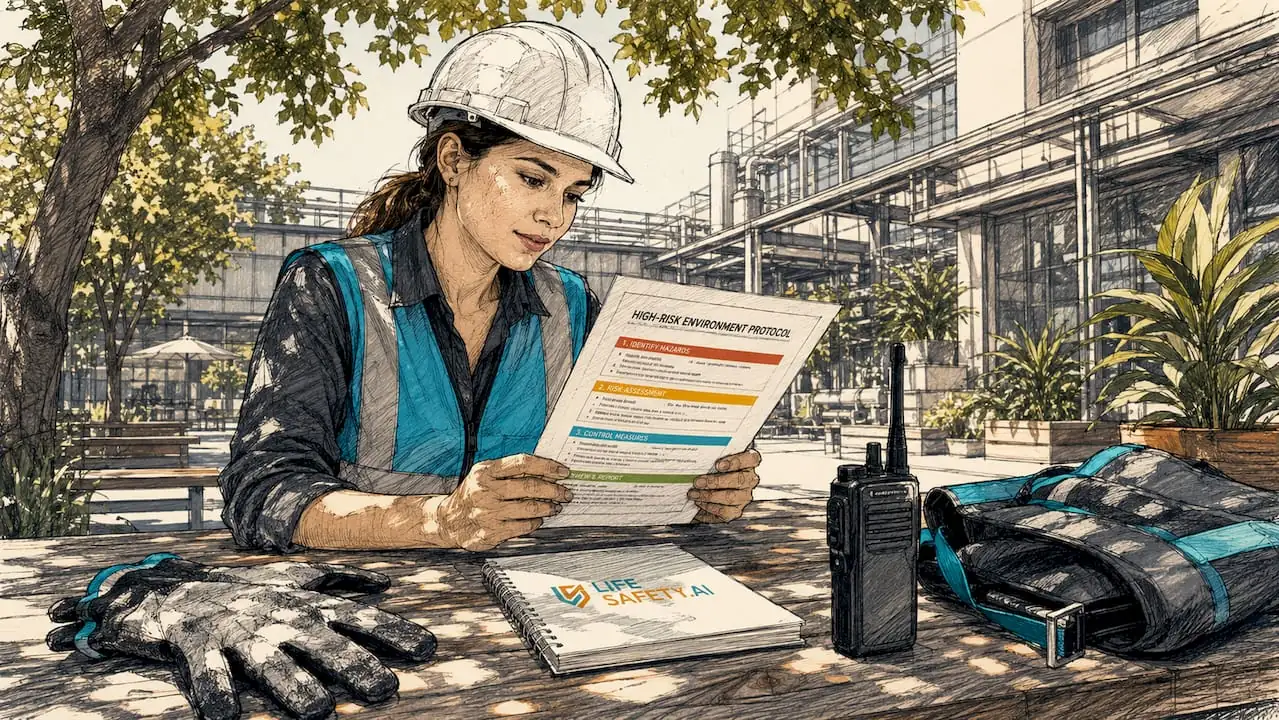
Understanding High-Risk Environment Protocols: Quick Guide
Understanding high-risk environment protocols: a practical guide
A practical overview of how structured protocols, dynamic risk assessment, communication controls, training, and evidence infrastructure help organisations manage hazardous environments and meet UK compliance expectations.
TL;DR
- High-risk environment protocols are structured procedures that ensure safety and compliance in hazardous workplaces.
- Effective arrangements combine dynamic risk assessment, clear communication, scenario-based training, and automated evidence collection.
- For UK duty holders, these controls support stronger compliance with HSE expectations, RIDDOR reporting duties, CDM 2015, and wider organisational duty of care.
High-risk environment protocols are the structured procedures and controls that health and safety professionals implement to mitigate dangers and maintain compliance in hazardous workplaces. The term sits alongside the recognised industry vocabulary of safety management systems and risk control frameworks, and understanding high-risk environment protocols means knowing how these systems translate policy into daily operational practice. Whether you manage a construction site under CDM 2015, oversee manufacturing operations subject to RIDDOR, or coordinate personnel in volatile locations, the quality of your protocols determines whether your workforce goes home safely. Generic checklists do not cut it. The most effective frameworks are intelligence-led, evidence-based, and continuously reviewed.
What are the core components of effective high-risk environment protocols?
Effective protocols share four non-negotiable components: structured risk assessment, communication systems, tailored training, and escalation procedures. Each component must connect to the others. A training programme that does not feed into an escalation workflow leaves a critical gap.
Connected protocol model
Risk assessment and dynamic threat profiling
Risk assessment is the foundation of every hazardous environment protocol. Comprehensive risk assessments account for geopolitical context, social unrest, infrastructure vulnerability, and healthcare limitations as factors that directly influence risk levels. In UK construction and manufacturing settings, the same principle applies to changing site conditions, contractor interfaces, temporary works, plant movement, confined spaces, and process hazards. Static assessments completed once a year are not sufficient for genuinely high-risk settings. Dynamic threat profiling means updating your assessment whenever the environment changes, not just when the calendar dictates.
For duty holders working under CDM 2015, this means ensuring risk information remains current throughout the project lifecycle. For employers managing reportable incidents under RIDDOR, it means identifying deteriorating conditions before they become injuries, dangerous occurrences, or occupational exposures.
Communication protocols

Clear communication standards prevent confusion during incidents. Time-based and location-based check-ins give your team a verified picture of personnel status at all times. Secure messaging channels prevent sensitive operational information from being intercepted. Effective high-risk briefings go beyond informing personnel. They explain context, link risk to task, detail step-by-step actions, and promote confident responses under pressure.
In practical workplace terms, communication protocols should define:
- Who reports to whom during normal operations and during emergencies.
- What channels are approved for urgent alerts, routine updates, and incident escalation.
- How often check-ins occur for lone workers, travelling staff, contractors, and remote teams.
- What information must be recorded to support investigation, audit, and legal defence if an incident occurs.
This is particularly important where multiple contractors, principal contractors, and client teams are operating together, as required under the coordination duties set out by CDM 2015.
Training and scenario-based drills
Hostile environment training is an essential preparedness layer involving scenario-based drills calibrated to specific threat categories, not a generic curriculum. That specificity matters enormously. A drill designed for civil unrest looks entirely different from one designed for chemical exposure or working at height. Training should cover situational awareness, de-escalation, vehicle security, and responses to kidnapping or carjacking where relevant to the deployment.
In UK industrial settings, the same logic applies to:
- Work at height rescue drills for construction and maintenance teams.
- Spill and exposure response for sites handling hazardous substances under COSHH.
- Fire and evacuation exercises for manufacturing, warehousing, and energy operations.
- Permit-to-work briefings for hot works, confined spaces, isolation, and intrusive maintenance.
Training should not be measured only by attendance. It should be measured by competence, observed behaviour, and the ability to execute the protocol correctly under pressure.
Escalation triggers and leadership notification
Every protocol needs a defined threshold at which a situation moves from operational management to leadership notification. Vague language like if things get serious is not a trigger. Triggers must be specific: a missed check-in after a defined window, a confirmed security incident within a set radius, or a change in government travel advisory. Without defined triggers, escalation happens too late or not at all.
Pro Tip: Document your escalation thresholds in writing and test them during drills. Teams that practise escalation scenarios respond faster and with greater accuracy during real incidents.
In a UK compliance context, escalation thresholds should also connect to:
- RIDDOR decision points for reportable injuries, dangerous occurrences, and occupational diseases.
- Senior management notification where there is potential for enforcement action, project shutdown, or serious reputational harm.
- Building Safety Act governance routes where higher-risk buildings or accountable persons are involved.
How do protocols differ across high-risk industries and scenarios?
Protocols for hazardous environments are not transferable wholesale between industries. The threat profile of a North Sea offshore platform differs fundamentally from that of a construction site in an urban regeneration zone or a corporate travel programme operating in a politically unstable region. Applying a single protocol template across all three creates dangerous blind spots.
Organisations frequently fail by treating all travel under a single country risk code without accounting for differing risk profiles by city or activity. The same principle applies to fixed-site operations. A manufacturing facility handling COSHH-regulated substances requires controls that a general office environment simply does not. Destination-specific intelligence and local context are not optional extras. They are the difference between a protocol that works and one that looks good on paper.
Tailoring hostile environment training based on destination risk profiles ensures focus on the specific threats relevant to each scenario rather than generic security awareness. Preparation covering kidnapping responses, civil unrest, and carjacking must be calibrated per threat evaluation, not applied uniformly.
| Industry or scenario | Primary hazard category | Key protocol focus | Review frequency |
|---|---|---|---|
| Construction (CDM 2015) | Physical injury, structural collapse | Permit to work, site induction, PPE compliance | Quarterly |
| Hazardous materials handling | Chemical exposure, fire, explosion | COSHH assessment, spill response, PPE | Quarterly |
| Corporate travel (high-risk regions) | Kidnapping, civil unrest, carjacking | Intelligence briefings, check-ins, emergency extraction | Pre-deployment and ongoing |
| Offshore and energy | Isolation, fire, equipment failure | Permit to work, emergency shutdown, evacuation drills | Quarterly |
Pro Tip: Build a protocol library organised by hazard category rather than by job title. When a new risk emerges, you can pull the relevant controls immediately rather than starting from scratch.
What role does evidence infrastructure play in protocol effectiveness?
Evidence infrastructure is the system that proves your controls are actually working, not just documented. The most successful risk programmes establish evidence infrastructure providing independently verifiable proof of controls operating as intended. This strengthens regulatory standing and may lower insurance premiums. That is a direct financial return on investment in safety management.
Automated evidence collection with cryptographic attestation transforms risk management by ensuring tamper-evident proof of compliance. Real-time dashboards, regulatory confidence, and faster audit cycles all follow from this foundation. For health and safety professionals operating under RIDDOR or CDM 2015, the ability to produce verified evidence on demand is not a luxury. It is a legal and operational necessity.
Review cycles must match the risk level of the environment. A robust review cycle should be conducted quarterly for high-risk areas and annually for low-risk areas, with clear thresholds for automatic escalation. Quarterly reviews catch emerging risks before they become incidents. Annual reviews alone leave too long a gap in genuinely hazardous settings.
| Review element | High-risk environment | Low-risk environment |
|---|---|---|
| Full risk assessment review | Quarterly | Annually |
| Control effectiveness check | Monthly | Quarterly |
| Post-incident debrief | Within 48 hours | Within 2 weeks |
| Protocol documentation update | After every significant change | Annually |
Post-event debriefs are the most neglected element of evidence infrastructure. Intelligence-led frameworks identify post-task debriefs as critical yet often neglected. Debriefs provide ground truth that updates protocols with real operational experience. Without them, protocols drift from the reality of what workers actually encounter.
In practice, a strong evidence infrastructure should capture:
- Completed inspections and audits with timestamps, responsible persons, and corrective actions.
- Training records linked to competence, not just attendance.
- Incident and near-miss data that can be trended and reviewed by leadership.
- Permit-to-work and control verification records for high-risk activities.
- Post-incident learning outputs that feed directly back into revised procedures.
How can health and safety professionals implement protocols effectively?
Practical implementation requires more than issuing a policy document. Protocols must be embedded into daily workflows, induction programmes, and leadership behaviour. The following steps reflect what works in genuinely high-risk settings.
- Conduct a baseline assessment. Map every hazard category present in your environment before writing a single procedure. Use dynamic risk assessment tools to capture real-time conditions rather than relying on a static snapshot.
- Design scenario-based induction training. Generic inductions do not prepare workers for specific hazards. Build induction content around the actual threat profile of the site or deployment. Include de-escalation, emergency response, and communication procedures as core modules, not optional extras.
- Integrate communication and escalation workflows. Assign clear ownership for each escalation trigger. Every worker must know who to contact, through which channel, and within what timeframe. Test these workflows during drills, not just during real incidents.
- Align with legal duty of care and ISO 31030. Duty of care requirements extend beyond domestic workplaces, legally obliging organisations to actively manage risks with tailored assessments and verified support. ISO 31030 provides a structured travel risk management framework covering briefings, check-ins, and emergency plans. For construction professionals, CDM 2015 sets equivalent obligations for site-based operations.
- Deploy technology to automate evidence collection. Manual record-keeping creates gaps. Platforms that automate safety audit records and incident logs reduce administrative burden and produce the verified evidence trail that regulators and insurers require. AI with real-time monitoring capabilities, such as those offered by Lifesafety, allows safety teams to detect hazards proactively rather than reactively.
- Schedule quarterly reviews for all high-risk protocols. Build the review date into the protocol document itself. Assign a named owner. A protocol without a scheduled review is a protocol that will become outdated.
To strengthen implementation further, organisations should ensure that protocol ownership is visible at every level:
- Directors and senior leaders set risk appetite, approve resources, and review performance trends.
- Managers and supervisors translate protocol requirements into daily controls and safe systems of work.
- Workers and contractors understand expectations, report deviations, and stop unsafe work where necessary.
- Safety professionals maintain the evidence base, verify effectiveness, and drive continual improvement.
This is where many organisations either succeed or fail. A protocol that exists only in a shared drive is not operational control. A protocol that shapes planning, supervision, competence, and review is.
Key takeaways
Effective high-risk environment protocols combine dynamic risk assessment, defined escalation triggers, scenario-specific training, and verified evidence infrastructure to protect workers and satisfy legal compliance obligations.
| Point | Details |
|---|---|
| Dynamic risk assessment | Update assessments whenever the environment changes, not only on a fixed annual cycle. |
| Scenario-specific training | Calibrate drills to the actual threat profile of the site or deployment, not a generic curriculum. |
| Defined escalation triggers | Write specific, testable thresholds that move incidents from operational to leadership response. |
| Evidence infrastructure | Automate evidence collection to produce tamper-evident proof of compliance for regulators and insurers. |
| Quarterly review cycles | High-risk protocols require quarterly review; annual cycles leave too large a gap in hazardous settings. |
Why I think most organisations are still getting protocols wrong
The gap between compliance paperwork and operational safety is wider than most organisations admit. I have seen sites where the risk assessment folder is immaculate and the actual site behaviour bears almost no resemblance to what is written in it. That gap is not a documentation problem. It is an implementation problem, a leadership problem, and often an evidence problem.
Too many organisations still treat protocols as static documents created for audits rather than living systems designed to control real work. They produce a polished procedure, circulate it by email, collect signatures, and assume the job is done. It is not. If supervisors are not reinforcing the controls, if workers cannot explain the escalation route, if near misses are not changing the risk picture, and if leadership only reviews safety after an incident, then the protocol is failing regardless of how professional it looks.
In the UK, this matters because regulators and investigators do not assess safety performance solely by the existence of paperwork. They look at whether arrangements were suitable, sufficient, communicated, and implemented in practice. Under HSE scrutiny, the difference between a documented control and an effective control becomes very clear very quickly.
I also think many organisations underestimate how quickly risk conditions change. A contractor change, programme delay, design variation, staffing shortage, equipment defect, or local security issue can alter the risk profile in hours. Yet some businesses still review critical protocols annually and call that robust governance. In a genuinely high-risk environment, that is too slow.
The organisations that get this right tend to do a few things consistently:
- They treat risk assessment as a live process, not a filing exercise.
- They make supervisors accountable for visible implementation on the ground.
- They use drills and debriefs to test whether the protocol actually works.
- They maintain clean evidence trails that stand up to audit, investigation, and insurer review.
- They revise protocols quickly when conditions change, rather than waiting for the next scheduled review.
My view is simple: most protocol failures do not happen because organisations lack templates. They happen because organisations fail to connect policy, people, process, and proof. Until those four elements are aligned, high-risk environment protocols will continue to look stronger on paper than they are in reality.
Final thought
High-risk environment protocols are not just administrative controls. They are the operating system for safe work in volatile, hazardous, or tightly regulated settings. When they are dynamic, specific, evidence-backed, and regularly tested, they help organisations protect people, satisfy legal duties, and make better decisions under pressure.
For teams looking to strengthen compliance performance across construction, manufacturing, facilities, and higher-risk operations, the priority should be clear: build protocols that can be understood, used, verified, and improved continuously.
Related Articles

Incident reporting software comparison: UK guide 2026
Discover our incident reporting software comparison for UK workplaces. Explore top options like Lifesafety, SafetyCulture, and more.

Safety management solutions for construction: UK SMS guide
Discover essential safety management solutions for construction sites in the UK. Learn how a mobile-first SMS can enhance safety and compliance.

Best Health and Safety Software for UK Workplaces: A Guide
Discover the best health and safety software for UK workplaces in 2026. Explore top picks like Lifesafety for compliance and efficiency!