
Training Management in High-Risk Industries: Why it Matters
The importance of training management in high-risk industries
In high-risk sectors such as construction and manufacturing, effective training management is essential for maintaining workforce competence, supporting HSE compliance, and reducing operational risk across sites, contractors, and supply chains.
TL;DR
- Effective training management ensures compliance, improves workforce safety, and reduces operational risks in high-risk industries.
- Integrating a TMS and LMS provides comprehensive control over training content, scheduling, and certification tracking to prevent audit failures.
Training management is defined as the systematic process of planning, delivering, tracking, and auditing workforce training to maintain compliance and operational readiness. In high-risk industries such as construction and manufacturing, this discipline is not optional. It is the mechanism that keeps workers competent, audits defensible, and organisations protected from regulatory penalties. Integrated platforms reduce training time by 40 to 60% compared to traditional classroom methods, while automating compliance audit trails. Platforms like LifeSafety are built precisely around this need, combining AI-driven automation with structured training record management to give decision-makers real-time visibility across their workforce.
How does effective training management improve workplace safety and compliance?
The direct relationship between training management and safety outcomes is measurable and well-documented. Audit readiness is the primary function of training management in regulated environments, and manual methods consistently cause compliance failures. When certification records are incomplete or out of date, organisations face enforcement action, operational shutdowns, and reputational damage. A structured training management approach removes that risk by maintaining a continuous, auditable trail of evidence.
Consistent competency tracking also reduces operational risk in ways that incident reporting alone cannot. When a manager can see, in real time, which operatives hold valid working-at-height certificates or confined-space permits, they can make deployment decisions with confidence. Without that visibility, the default is assumption, and assumption is where accidents begin. Standards such as ISO 45001, HSE guidance, and sector-specific legal duties under CDM 2015 require organisations to demonstrate not just that training happened, but that it was appropriate, current, and recorded correctly.
The impact on safety incident rates is significant. Organisations that implement structured training programmes report measurable reductions in near-misses and lost-time injuries, because competency gaps are identified and closed before they translate into harm. Fragmented training records and manual compliance tracking create audit risks even when individual employees are fully trained. Centralised evidence management is the foundation of genuine audit readiness, not a nice-to-have addition.
Pro Tip
Before your next audit, run a gap analysis against your current training records. Identify which roles lack documented evidence of competency, and prioritise those first. This single exercise often reveals more risk than a full safety review.
Training control flow for safer deployment decisions
A practical view of how competency evidence supports compliance, supervision, and safe work allocation.
LMS vs TMS: what is the difference and why does it matter?
Misunderstanding the distinction between a Learning Management System and a Training Management System is one of the most common and costly mistakes in regulated industries. LMS and TMS serve distinct functions, and conflating them leads directly to operational inefficiencies and compliance gaps.
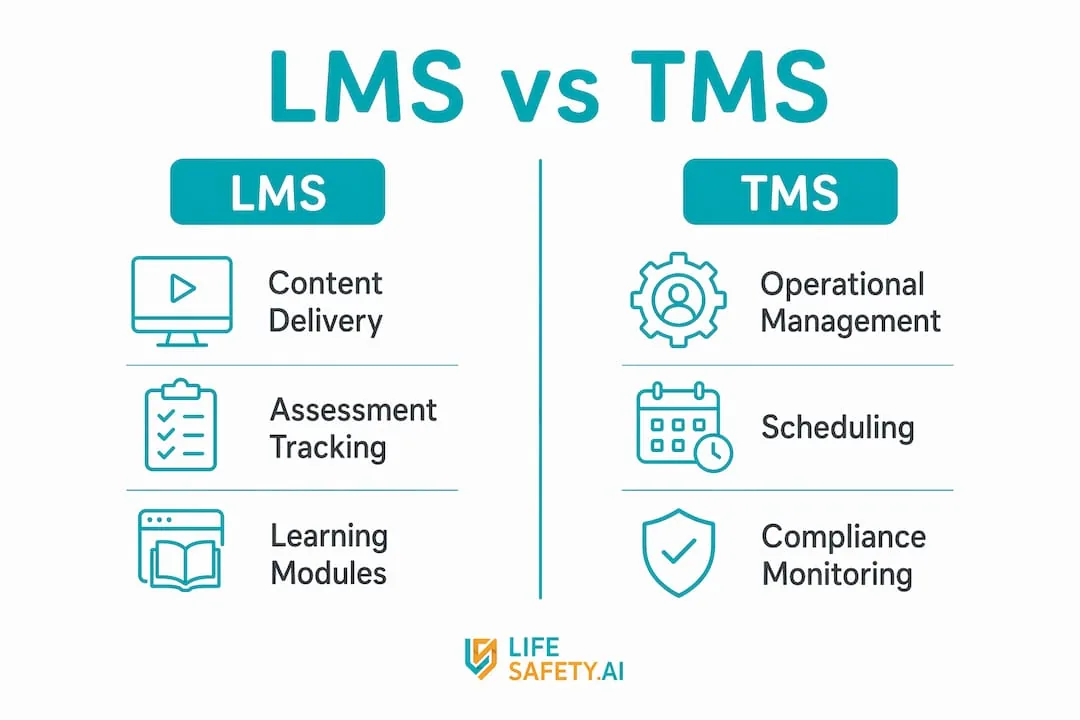
An LMS is designed to deliver and track learning content. It manages e-learning modules, assessments, and completion records. A Training Management System, by contrast, handles the operational logistics of training: scheduling sessions, managing instructor availability, tracking certification expiry dates, generating compliance reports, and maintaining version-controlled documentation. The table below illustrates the core differences.
| Feature | LMS | TMS |
|---|---|---|
| Primary function | Content delivery and completion tracking | Operational scheduling and compliance management |
| Compliance reporting | Basic completion logs | Audit-ready reports with certification expiry tracking |
| Version control | Limited | Full document version management |
| Multi-site coordination | Rarely supported | Core capability |
| Certification management | Partial | End-to-end lifecycle tracking |
Organisations that rely solely on an LMS for compliance management in high-risk environments are exposed to what practitioners call version blindness. This occurs when staff complete training on outdated procedures because the LMS has not been updated to reflect the current version of a safety document. Version control of training documents is vital to ensure staff are trained on current safety procedures, and this is a TMS function, not an LMS one.
The most effective approach integrates both systems. The LMS delivers the content; the TMS manages the operational and compliance layer. For construction and manufacturing environments operating across multiple sites and contractor pools, this integration is not a luxury. It is the only way to maintain consistent competency compliance at scale, particularly where principal contractors, dutyholders, and accountable persons need reliable evidence under the Building Safety Act and related governance expectations.
Which training management strategies best support decision-makers?
Decision-makers in high-risk industries need training management strategies that are practical, scalable, and directly tied to compliance outcomes. The following approaches reflect what works in complex operational environments.
- Centralise all training records into a single platform. Distributed spreadsheets and paper-based records are a compliance liability. A unified training records platform gives managers instant visibility into who is trained, what they are certified in, and when renewals are due.
- Automate certification renewal notifications. Manual reminders fail as workforce size grows. Scheduling complexity escalates with volume, and automation is the only reliable solution at scale. Automated alerts sent to both the worker and their line manager remove the human error from the renewal cycle.
- Use data-driven reports to identify training gaps. A competency matrix maps required competencies against actual certifications across roles and sites. This turns training management from a reactive record-keeping task into a proactive workforce planning tool.
- Consider end-to-end managed services for multi-site and supplier coordination. Hidden administrative costs and fragmented supplier management often exceed the cost of an automated training management solution in infrastructure and energy sectors. Consolidating supplier management through a single platform reduces duplication and improves accountability.
- Align training programmes with CDM 2015 and RIDDOR requirements. In UK construction and manufacturing, regulatory frameworks are specific and non-negotiable. Training records must demonstrate compliance with these standards to withstand HSE scrutiny.
Pro Tip
Document your existing training workflows before selecting any technology. Map who schedules sessions, who tracks completions, and who handles certification renewals. Technology built on top of undocumented processes replicates the chaos rather than resolving it.
Training management as an operational discipline must be treated separately from curriculum development. The content of training and the management of training are two different problems requiring two different solutions.
What measurable benefits can organisations expect from training management?
The return on investment from effective training management is quantifiable across several dimensions. The table below summarises the key metrics that decision-makers should track.

| Benefit area | Measurable impact |
|---|---|
| Training delivery efficiency | 40 to 60% reduction in training time via integrated platforms |
| Employee retention | Up to 94% retention correlation when development is consistently prioritised |
| Income per employee | 218% higher income per employee in organisations with structured training programmes |
| Cost efficiency | Up to 30% cost savings from consolidating suppliers and automating workflows |
The 94% retention figure deserves particular attention. High-risk industries face persistent recruitment challenges, and the cost of replacing a trained operative, including induction, certification, and lost productivity, is substantial. When workers see that their development is tracked, supported, and invested in, retention improves. This is not a soft benefit. It directly reduces the cost of maintaining a competent workforce.
The 218% income-per-employee figure reflects something deeper than training efficiency. It captures the compounding effect of a workforce that is consistently competent, rarely disrupted by compliance failures, and able to operate at full productivity. Organisations that treat training management as a strategic function rather than an administrative burden see this gap widen over time. The impact of training on performance is cumulative, and the organisations that recognise this earliest build the most durable operational advantage.
Cost avoidance is equally significant. Compliance penalties, audit failures, and operational shutdowns carry costs that dwarf the investment in a well-configured training management system. Preventing a single HSE enforcement notice can justify a year’s platform subscription many times over.
Key takeaways
Effective training management is the operational discipline that converts compliance obligations into measurable workforce performance and safety outcomes.
| Point | Details |
|---|---|
| Compliance depends on centralised records | Fragmented or manual records create audit risk even when training has occurred. |
| TMS and LMS serve different functions | A TMS manages compliance logistics; an LMS delivers content. Both are needed for full coverage. |
| Automation removes human error at scale | Automated renewal notifications and scheduling are non-negotiable as workforce size grows. |
| ROI is quantifiable and significant | Organisations see up to 60% faster training delivery and 218% higher income per employee. |
| Strategy precedes technology | Document existing workflows before selecting a platform to avoid replicating inefficiencies. |
Why training management is the discipline most managers underestimate
I have spoken with safety managers across construction, utilities, and manufacturing who describe their training records as “mostly up to date” or “handled by HR.” That phrase, “mostly up to date,” is where serious compliance risk lives. In my experience, the organisations that suffer the most painful audit outcomes are rarely those with poor training content. They are the ones with excellent training content and terrible training management.
The distinction matters enormously. You can have the best safety induction programme in your sector and still fail an HSE inspection because you cannot produce a complete, version-controlled record of who completed it, when, and against which version of the procedure. That is a training management failure, not a training failure.
What I find most encouraging is the shift I am seeing among forward-thinking managers. Training management is moving from a compliance checkbox to a genuine competitive advantage, because real-time workforce readiness visibility directly influences safety incident rates and operational uptime. The managers who treat their competency matrix as a live operational tool, rather than a document filed after an audit, are the ones whose sites run with fewer disruptions and greater confidence.
My honest view is that technology investment in this area pays back faster than almost any other safety management spend, but only when it is paired with disciplined governance. A platform cannot compensate for unclear ownership, inconsistent standards, or poor document control. What it can do is make those weaknesses visible early enough to fix them before they become enforcement issues, project delays, or preventable incidents.
For UK dutyholders, principal contractors, facilities managers, and manufacturing leaders, the message is straightforward: if you want stronger compliance under RIDDOR, more defensible evidence for HSE, better alignment with CDM 2015, and clearer accountability under the Building Safety Act, training management deserves board-level attention. It is not administrative overhead. It is operational control.
Strengthen workforce competence with LifeSafety.ai
LifeSafety.ai helps organisations centralise training records, monitor certification expiry, maintain competency matrices, and improve audit readiness across high-risk operations. For construction, manufacturing, and multi-site environments, this creates a clearer line between training evidence and safe deployment decisions.
- Centralised training records for employees, contractors, and suppliers
- Live competency matrix visibility across roles and sites
- Automated alerts for expiring certificates and mandatory refresher training
- Structured evidence trails to support HSE inspections, internal audits, and compliance reviews
Related Articles

Incident reporting software comparison: UK guide 2026
Discover our incident reporting software comparison for UK workplaces. Explore top options like Lifesafety, SafetyCulture, and more.

Safety management solutions for construction: UK SMS guide
Discover essential safety management solutions for construction sites in the UK. Learn how a mobile-first SMS can enhance safety and compliance.

Best Health and Safety Software for UK Workplaces: A Guide
Discover the best health and safety software for UK workplaces in 2026. Explore top picks like Lifesafety for compliance and efficiency!