
Training compliance checklist: your 2026 guide
Training compliance checklist: your 2026 guide
A practical guide for UK organisations to build, evidence, and maintain a legally robust training compliance checklist aligned to HSE expectations, RIDDOR reporting culture, CDM 2015 duties, and wider sector-specific obligations.
TL;DR
- A comprehensive training compliance checklist helps organisations demonstrate legal adherence and avoid costly regulatory gaps, especially when tailored to national, devolved, and industry-specific requirements.
- Regular audits, detailed documentation, and disciplined management of training records are essential for audit readiness and continuous compliance.
- Using automation tools such as an LMS or integrated safety platform streamlines tracking, renewal alerts, and evidence collection, strengthening overall safety and regulatory performance.
A missed training record might not feel urgent until an inspector arrives or a serious incident occurs. For health and safety professionals, a training compliance checklist is often the difference between an organisation that can demonstrate it meets its legal obligations and one that cannot. While many global frameworks reference OSHA, HIPAA, harassment prevention, FLSA, and ADA training as baseline examples, UK duty holders need to translate the same discipline into the language of Health and Safety at Work etc. Act 1974, Management of Health and Safety at Work Regulations 1999, RIDDOR, CDM 2015, sector guidance, and internal competence standards. This guide takes you through mapping requirements, building a practical checklist, executing training programmes, and maintaining the documentation that keeps you audit-ready.
Table of Contents
Key takeaways
| Point | Details |
|---|---|
| Map all applicable requirements | Identify statutory, industry, client, and location-specific mandates before building your checklist to avoid costly gaps. |
| Build a role-based checklist | Segment employees by role, site, contractor status, and risk level so every training obligation is assigned to the right person. |
| Track more than completion | Record completion dates, assessment scores, regulatory references, competence checks, and renewal deadlines to satisfy auditors. |
| Treat compliance as continuous | Regulatory updates, new starters, role changes, incidents, and corrective actions all trigger new training obligations rather than arbitrary schedules. |
| Use technology to stay audit-ready | Learning Management Systems and integrated safety platforms automate reminders, evidence capture, and reporting for HSE, client, and internal audits. |
Building your training compliance checklist
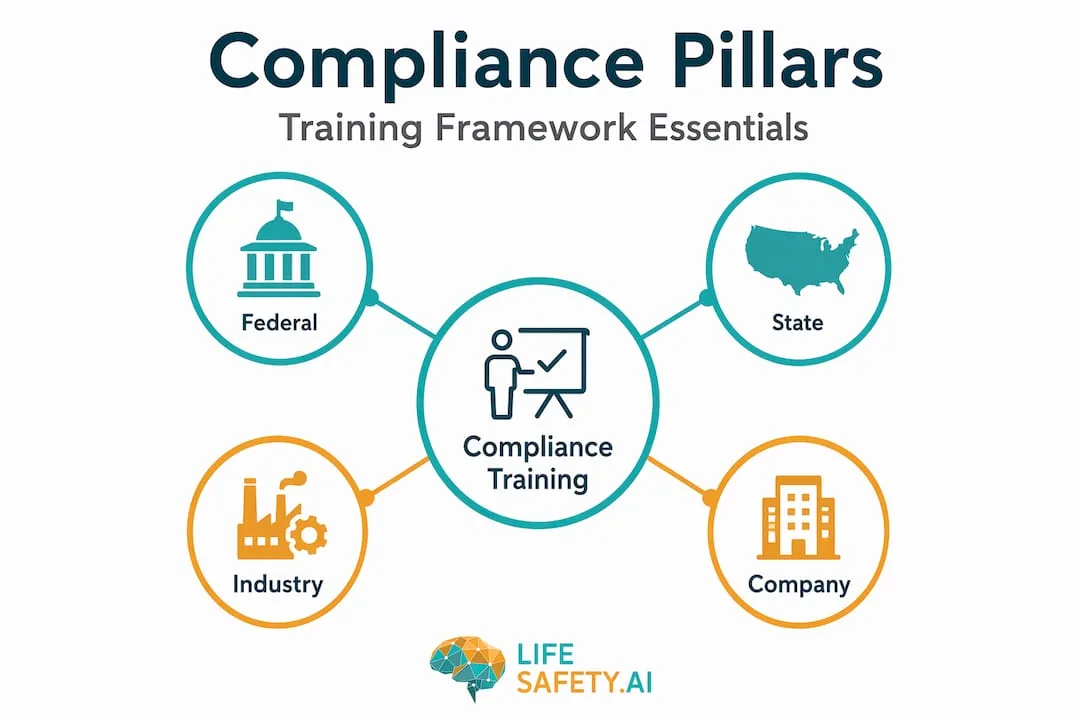
Before you write a single checklist item, you need a complete picture of what is legally required of your organisation. That means working from the top down: statutory baseline first, then devolved or regional expectations, then industry-specific requirements, and finally your own internal policies and client standards.
In the original article, the federal baseline is described through five core pillars: OSHA hazard-specific training, harassment prevention aligned with EEOC guidance, HIPAA for healthcare-adjacent roles, FLSA wage and hour awareness, and ADA accommodation training. For UK organisations, the equivalent discipline should be anchored in general health and safety duties, manual handling, DSE, fire safety, COSHH, asbestos awareness, working at height, PUWER, LOLER, first aid, safeguarding where relevant, and sector-specific competence requirements. In healthcare or data-sensitive environments, information governance and confidentiality training may sit alongside safety training in the same compliance framework. Missing onboarding windows for mandatory induction or role-specific competence checks is one of the most common causes of avoidable non-compliance.
Regional and sector-level requirements introduce meaningful complexity. In practice, organisations operating across multiple sites often build what looks like a solid checklist but miss local authority expectations, principal contractor rules, NHS trust requirements, rail standards, or client-specific permit-to-work training. These are not minor variations. They directly affect whether a worker is legally and operationally competent to carry out a task.
Industry overlays add another layer. Construction sites operating under CDM 2015 carry specific site safety training obligations on top of general health and safety law. Manufacturing environments may require machine safety, lockout or isolation procedures, forklift competence, and hazardous substance controls. Higher-risk residential and mixed-use developments may also need competence evidence aligned to the Building Safety Act and the wider dutyholder regime. When you segment your workforce by role, physical location, contractor status, and risk exposure, the training matrix that emerges is usually larger than most organisations initially expect.
Pro Tip: Before auditing your checklist against current regulations, consult your industry trade body or sector-specific guidance alongside regulator websites. Trade bodies often publish plain-English summaries of recent regulatory changes that internal stakeholders may not have flagged yet.
Preparing your checklist and audit framework
Once you know what is required, the next step is translating that into a structured, auditable document. A compliance training checklist that will stand up to scrutiny needs more than a list of course titles. It needs to capture the regulatory basis for each training item, the audience, the delivery mode, and the renewal frequency.
In UK terms, this means being able to show not only that training happened, but also why it was required, who it applied to, how competence was assessed, and what trigger determines refresher training. That level of structure is especially important where training supports safe systems of work, permit controls, contractor management, or post-incident corrective actions.
Here is a practical sequence for building the framework:
- Conduct a training programme audit. Review your existing training against statutory, sector, client, and internal policy obligations to identify gaps. Separate legally mandated training from best-practice or internal-policy training. Both matter, but they carry different consequences if missed.
- Map each requirement to a specific module. Link every obligation to a named course, a regulatory citation, and a delivery method. Vague entries like “health and safety awareness” invite audit challenges. “COSHH awareness, aligned to COSHH Regulations 2002, delivered via LMS, annual renewal” does not.
- Segment by audience. Not every employee needs the same training. Role, seniority, site, contractor status, and risk exposure all determine which checklist items apply to a given individual.
- Set completion windows and renewal dates. Some regulations set hard deadlines. Others are implied through risk assessment, competence standards, or client requirements. Build both into the checklist so renewals trigger automatically rather than only being noticed when they are overdue.
- Define quality criteria. Completion alone is rarely sufficient. Include minimum assessment scores, supervisor sign-off, toolbox talk attendance, or practical demonstration criteria where regulations or your own standards require it.
The table below illustrates how checklist components should be structured for clear audit evidence:
| Checklist field | What to record | Why it matters |
|---|---|---|
| Course title | Full name and version number | Proves the correct content was delivered |
| Regulatory citation | Specific regulation, ACOP, standard, or client rule | Confirms the legal or contractual basis for the requirement |
| Audience | Role, department, site, contractor category | Demonstrates correct targeting |
| Delivery mode | Classroom, eLearning, toolbox talk, on-the-job | Confirms approved delivery method |
| Completion date | Date per individual | Primary audit evidence |
| Renewal date | Calculated from legal or risk-based requirement | Prevents expiry gaps |
| Assessment score | Pass mark, actual score, practical sign-off | Evidence of comprehension, not just attendance |
For tool selection, a dedicated Learning Management System is worth the investment for any organisation with a growing workforce, multiple sites, or recurring refresher obligations. Platforms that log detailed actions against training attempts provide far stronger audit evidence than completion flags alone. Spreadsheets can work for smaller teams, but they break down quickly when renewal tracking, contractor records, and competence evidence begin to scale.
Pro Tip: When building your checklist, create a “regulatory trigger” column. Note whether each training item is triggered by a fixed date, a new starter, a role change, an incident, a permit requirement, or a regulatory update. This transforms a static document into a living compliance tool.
Rolling out training and driving completion
A well-built checklist for training compliance is only as good as the programme it supports. Execution is where most organisations lose ground, and the reasons are rarely technical. They are organisational. Deadlines are unclear, managers treat training as optional when workloads spike, and employees do not understand why certain courses are mandatory.
Address these problems at the point of launch. Assign training with explicit deadlines in writing, linked to the relevant legal, operational, or client requirement. When employees understand that induction, asbestos awareness, fire safety, or permit-to-work training is a legal and safety obligation rather than an administrative preference, completion rates improve. That message needs to come from line managers and supervisors, not only from HR or the learning team.
This matters particularly in construction and manufacturing, where competence is inseparable from risk control. If a worker has not completed the right training for confined spaces, work at height, lifting operations, or hazardous substances, the issue is not simply overdue learning. It is a live control failure that can contribute to incidents, enforcement action, and in serious cases a reportable event under RIDDOR.
Practical delivery considerations that directly affect completion rates include:
- Offering training in multiple formats where possible. Some employees complete eLearning on mobile devices. Others need scheduled classroom time, supervised practical sessions, or translated materials. Rigid delivery modes create unnecessary barriers.
- Building in acknowledgement steps. A simple digital sign-off confirming the employee has completed and understood the training creates an additional evidence layer.
- Setting escalation protocols for non-completion. Define what happens at 14 days before a deadline, at the deadline itself, and after it has passed. Escalation to line managers, project leads, and HR should be automatic, not ad hoc.
- Tracking engagement, not just completion. An LMS that flags employees who repeatedly fail assessments or abandon modules gives you the data to intervene before a gap becomes a compliance failure.
- Recognising and reinforcing good compliance behaviour. Compliance culture does not build itself. Staff training compliance improves measurably when employees see that their organisation takes mandatory training seriously and acknowledges those who meet their obligations.
Where training is linked to site access, permit issue, or supervisor authorisation, completion data should feed directly into operational controls. That is where integrated platforms add real value: they do not just store certificates, they help prevent untrained people from being assigned to higher-risk work.
Recordkeeping and staying audit-ready
Documentation is where compliance programmes win or lose at audit. In many enforcement cases, training may have taken place, but the records could not be produced in a credible, timely, or complete format. Auditors and investigators often interpret the absence of records as evidence of weak management control rather than simple administrative oversight. That distinction matters enormously.
In the UK context, poor recordkeeping can undermine your position during HSE inspections, client audits, insurer reviews, and internal investigations following incidents or near misses. It can also weaken your ability to demonstrate that you took reasonably practicable steps to ensure competence, supervision, and safe systems of work.

Audit-ready documentation goes beyond a completion flag in a spreadsheet. Each training record should include the employee’s name, role, and location; the course title and version; the regulatory or procedural obligation it satisfies; the completion date; the assessment result; and the next renewal date. For certifications, attach the certificate itself or a verified reference to it. For practical competence, include assessor details and sign-off evidence.
The comparison below shows the difference between a weak and strong recordkeeping approach:
| Recordkeeping element | Weak approach | Strong approach |
|---|---|---|
| Completion evidence | Name on sign-in sheet | LMS record with timestamp, score, and acknowledgement |
| Regulatory link | Course title only | Specific regulation, ACOP, or internal procedure cited in record |
| Renewal tracking | Manual calendar reminder | Automated expiry alert via LMS or safety platform |
| Audit access | Paper files requiring retrieval | Searchable digital records with instant export |
| Non-completion records | Not tracked | Escalation log with actions, restrictions, and resolution dates |
Periodic audits of your training records using your compliance training checklist are just as important as the initial audit. Schedule a formal review at least annually, and also whenever a regulation changes, when you onboard large cohorts, when contractors are mobilised, or when roles change significantly. Regulatory mandates and risk controls often require refresher training tied to specific triggers rather than simple calendar cycles. Your checklist needs to reflect that reality.
My perspective on compliance ownership
In practice, the biggest weakness in many training compliance programmes is not the checklist itself. It is unclear ownership. HR may manage the LMS, health and safety may define mandatory content, operations may control access to work, and line managers may be expected to chase completion. If nobody owns the full chain, gaps appear between assignment, completion, competence verification, and record retention.
The most resilient organisations treat training compliance as a shared control with clearly defined responsibilities. Health and safety teams define the risk-based requirements. HR or learning teams administer the programme. Line managers confirm attendance and practical application. Senior leaders review overdue risk and intervene where non-compliance affects operational safety. That model is far more effective than assuming the LMS alone will solve the problem.
For higher-risk sectors, I would go further: if a training item is linked to a critical control, then overdue status should trigger a visible operational response. That may mean restricting site access, pausing authorisation for certain tasks, or requiring supervisor sign-off before work continues. This is especially relevant where competence supports compliance with CDM 2015, lifting operations, temporary works, fire safety management, or building safety duties.
A checklist is not just an administrative tool. It is a governance mechanism. Used properly, it helps demonstrate that your organisation is taking reasonably practicable steps to ensure people are trained, informed, and competent for the risks they face.
How Lifesafety supports your compliance programme
Lifesafety.ai helps organisations move from static spreadsheets and fragmented records to a more controlled, auditable compliance workflow. For teams managing construction, manufacturing, facilities, or mixed-risk operations, the platform can support a stronger training governance model by connecting people, tasks, evidence, and review cycles.
- Role-based assignment: align training requirements to job role, site, contractor category, and risk profile.
- Evidence capture: store completion records, certificates, acknowledgements, and supporting documents in one searchable location.
- Renewal alerts: automate reminders for expiring training, certifications, and competence checks before they become operational risks.
- Audit readiness: export records quickly for HSE inspections, client audits, insurer reviews, and internal assurance checks.
- Safety integration: connect training status with wider compliance workflows such as incident management, corrective actions, inspections, and contractor control.
Where your organisation needs to demonstrate competence under RIDDOR-informed learning, CDM 2015 dutyholder arrangements, or the Building Safety Act competence agenda, having a single source of truth for training evidence is a practical advantage. It reduces administrative friction and improves confidence that the right people have the right training at the right time.
FAQ
What should a training compliance checklist include?
At minimum, include the training title, regulatory or policy basis, target audience, delivery method, completion deadline, renewal frequency, and evidence requirements. Stronger checklists also include trigger events such as new starters, role changes, incidents, and regulatory updates.
How often should training records be audited?
A formal review at least annually is a sensible baseline, but higher-risk organisations should also review records after major onboarding periods, contractor mobilisation, incident investigations, or regulatory changes. If training supports critical controls, more frequent checks may be justified.
Is completion enough to prove compliance?
No. Completion alone rarely proves competence. Auditors and investigators may expect to see assessment results, practical sign-off, version control, and evidence that the training was appropriate for the person’s role and risk exposure.
How does this relate to RIDDOR and HSE expectations?
While RIDDOR is a reporting regime rather than a training regulation, reportable incidents often trigger scrutiny of competence, supervision, and safe systems of work. Poor training records can weaken your position during an HSE investigation by making it harder to demonstrate that workers were properly informed and trained.
Do contractors need to be included in the checklist?
Yes, where contractor competence affects your operations, site safety, or legal duties. Under CDM 2015 and general health and safety law, organisations should be able to show that contractors have received the required induction, site rules, and task-specific training relevant to the work they are undertaking.
When should refresher training be triggered?
Refresher training may be triggered by a fixed interval, but it should also be triggered by role changes, new equipment, changes in process, incident findings, poor assessment results, or updated legal guidance. The best checklists capture both date-based and event-based triggers.
Related Articles

Incident reporting software comparison: UK guide 2026
Discover our incident reporting software comparison for UK workplaces. Explore top options like Lifesafety, SafetyCulture, and more.

Safety management solutions for construction: UK SMS guide
Discover essential safety management solutions for construction sites in the UK. Learn how a mobile-first SMS can enhance safety and compliance.

Best Health and Safety Software for UK Workplaces: A Guide
Discover the best health and safety software for UK workplaces in 2026. Explore top picks like Lifesafety for compliance and efficiency!