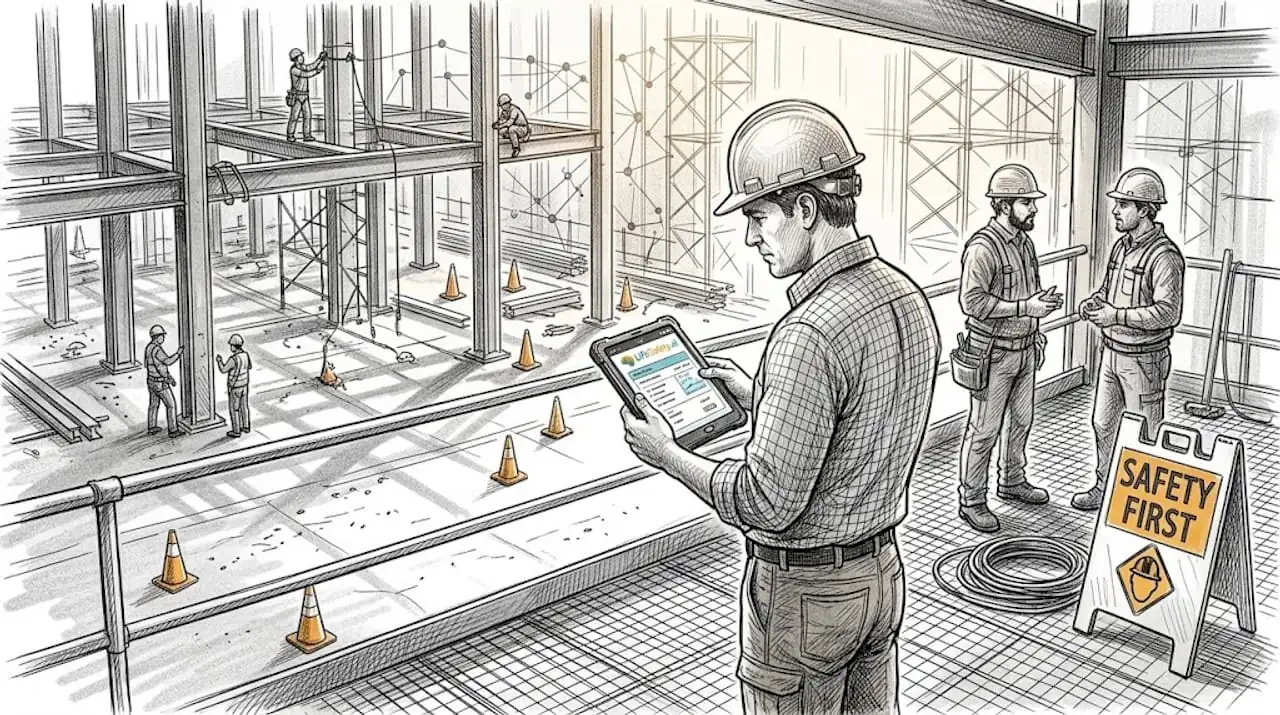
Top safety management trends and AI innovations for 2026
Top safety management trends and AI innovations for 2026
TL;DR:
- Proactive safety management is now expected by 2026, driven by AI, legislation, and a stronger focus on human factors.
- AI tools enable real-time hazard detection, predictive analytics, and automated compliance workflows, helping reduce workplace incidents significantly.
- Successful safety strategies must integrate AI capability with strong safety culture, human oversight, and robust compliance with HSE, RIDDOR, CDM 2015, and wider UK duties.
Workplace accidents are not simply bad luck. For years, many safety professionals in construction and manufacturing accepted a certain level of risk as unpredictable, something to manage after the fact rather than prevent before it occurs. That assumption is now outdated. By 2026, the combination of AI-powered safety systems, updated UK legislation, and a sharper focus on human factors means that proactive risk management is no longer aspirational; it is achievable and expected. This guide covers every major trend you need to understand, from AI integration and regulatory change to the cultural challenges that no software alone can solve.
Table of Contents
- Why safety management is evolving rapidly in 2026
- AI integration: The new backbone of proactive safety management
- Regulatory shifts: What compliance officers must know in 2026
- Risks, blind spots, and best practices in the new era
- The uncomfortable truth about AI and safety: People still matter most
- Modern solutions for safety management leaders
- Frequently asked questions
Key Takeaways
| Point | Details |
|---|---|
| AI tools now essential | AI-driven hazard detection and predictive analytics are now mainstream for UK construction and manufacturing compliance. |
| Regulations have intensified | ISO 45001 alignment and HSE oversight of AI use now require risk assessment, transparency, and human control. |
| Mental health is central | Safety management in 2026 treats psychological and human factors as core compliance priorities. |
| People remain crucial | Technology works best when paired with engaged, well-trained staff and a strong safety culture. |
Why safety management is evolving rapidly in 2026
UK construction and manufacturing have always carried significant risk. But the numbers from 2026 make a compelling case that the sector has reached a critical juncture. Construction and manufacturing lead the 2026 Workplace Risk Index with scores of 85/90 and 81/90 respectively, confirming these industries remain the most hazardous in the UK economy.
Despite advances in personal protective equipment and site management, accident rates, fatalities, and long-term health absences persist at troubling levels. The traditional approach of reactive incident reporting simply is not keeping pace. Compliance officers are under greater pressure than ever to shift from recording what went wrong to preventing it in the first place.
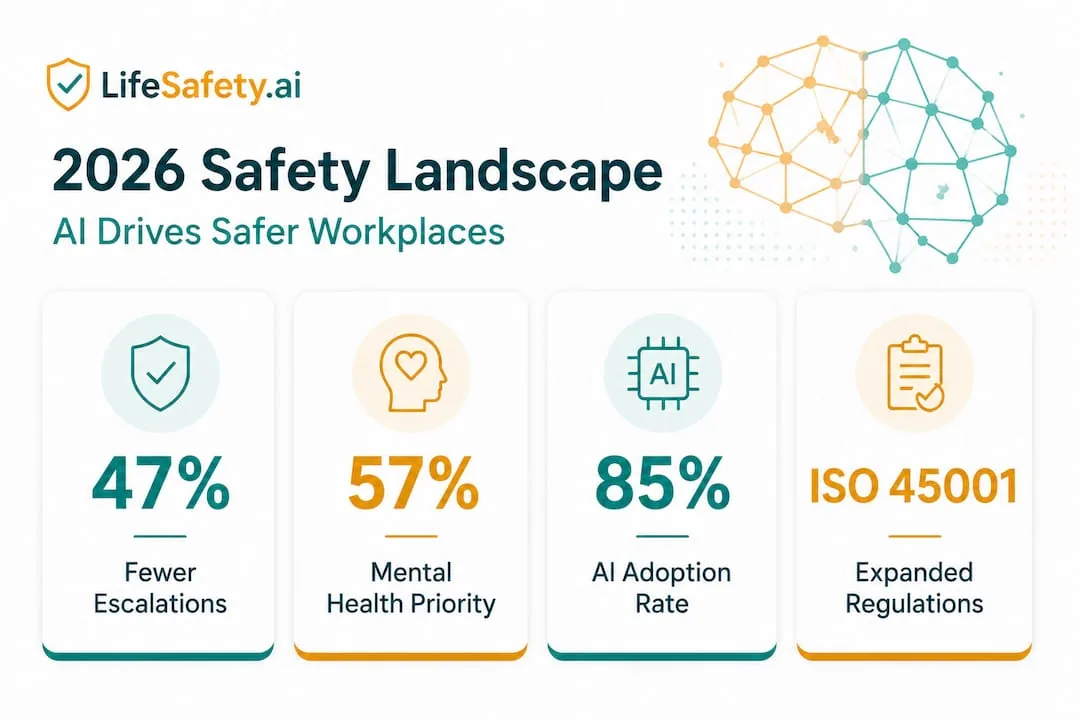
One finding stands out above the rest: 57% of UK businesses now rank mental health and wellbeing as their top safety priority, and human error remains the leading cause of workplace incidents. This means your strategy in 2026 must account for both the physical environment and the psychological state of your workforce.
The current risk landscape at a glance
| Risk factor | Construction (2026) | Manufacturing (2026) |
|---|---|---|
| Workplace Risk Index score | 85/90 | 81/90 |
| Leading incident cause | Human error | Human error |
| Emerging priority | Mental health | Psychosocial hazards |
| Regulatory focus | CDM 2015, RIDDOR | ISO 45001, HSE AI rules |
Key challenges driving the need for change include:
- Persistent gaps between incident reporting and root cause analysis
- Insufficient early warning systems for near-miss events
- Limited integration between site monitoring tools and compliance documentation
- Underestimation of stress, fatigue, and psychological risk as incident precursors
“Human error and mental health are no longer separate conversations from physical safety. In 2026, any credible safety strategy treats them as one.”
If you manage safety across construction sites, our construction site safety tips resource outlines practical measures that remain highly relevant against this backdrop.
AI integration: The new backbone of proactive safety management
The shift from reactive to predictive safety management is being driven largely by AI. By 2026, AI-powered safety systems for real-time hazard detection, predictive forecasting, and automated compliance reporting have become standard practice across UK construction and manufacturing. This is no longer emerging technology; it is operational expectation.
The practical applications are wide-ranging. Computer vision cameras monitor sites continuously, flagging unsafe behaviours such as missing PPE or workers entering restricted zones. IoT sensors embedded in machinery track vibration, temperature, and operational load to predict mechanical failure before it causes injury. Predictive analytics models review historical incident data to identify patterns that human reviewers would miss entirely.
What the evidence shows
The results from early adopters are striking. Balfour Beatty achieved a 47% reduction in safety escalations through computer vision technology, while Persimmon Homes deployed HFR AI on telehandlers to prevent near-miss incidents before they occurred. These are not marginal gains; they represent a fundamental shift in what safety performance looks like.
| Approach | Traditional management | AI-powered management |
|---|---|---|
| Hazard detection | Manual inspection, periodic | Continuous, real-time monitoring |
| Incident reporting | Post-event documentation | Automated, triggered by sensor data |
| Compliance evidence | Manual paperwork | Automated audit trails |
| Risk forecasting | Historical review | Predictive modelling |
| Mental health monitoring | Annual surveys | Ongoing data-driven indicators |
Integrating AI into your safety processes does not require a wholesale technology overhaul. A practical sequence works well for most organisations:
- Audit your current data sources. Identify what incident, near-miss, and maintenance data you already hold. AI tools are only as good as the data you feed them.
- Start with one high-risk area. Pilot AI hazard detection in the environment where you have the most incidents or the highest severity potential.
- Connect alerts to your existing workflows. Ensure that AI-generated alerts trigger actual responses through your reporting and permit systems, not just notifications that are ignored.
- Train your team on interpreting AI outputs. Staff should understand what the system flags and why, so they can respond confidently rather than override alerts without reason.
- Review outcomes monthly. Track whether AI-flagged hazards correlate with reduced incidents and near-misses. Adjust thresholds and alert parameters accordingly.
Pro Tip: When selecting AI safety tools, ask vendors specifically how their system performs in low-light conditions and during shift changeovers. These are known weak points for computer vision, and you need honest answers before deployment on a live site.
For a deeper look at how AI is reshaping day-to-day practices, our guide on AI in safety management covers practical implementation frameworks in detail. Advances in robotics in construction also offer a useful perspective on where automation is headed beyond AI software alone.
We have also documented our own development journey in the LifeSafety.ai mobile app launch, which reflects directly on these industry shifts.
Regulatory shifts: What compliance officers must know in 2026
Technology alone does not define the 2026 safety landscape. Regulation is keeping pace, and for compliance officers, understanding the new requirements is non-negotiable.
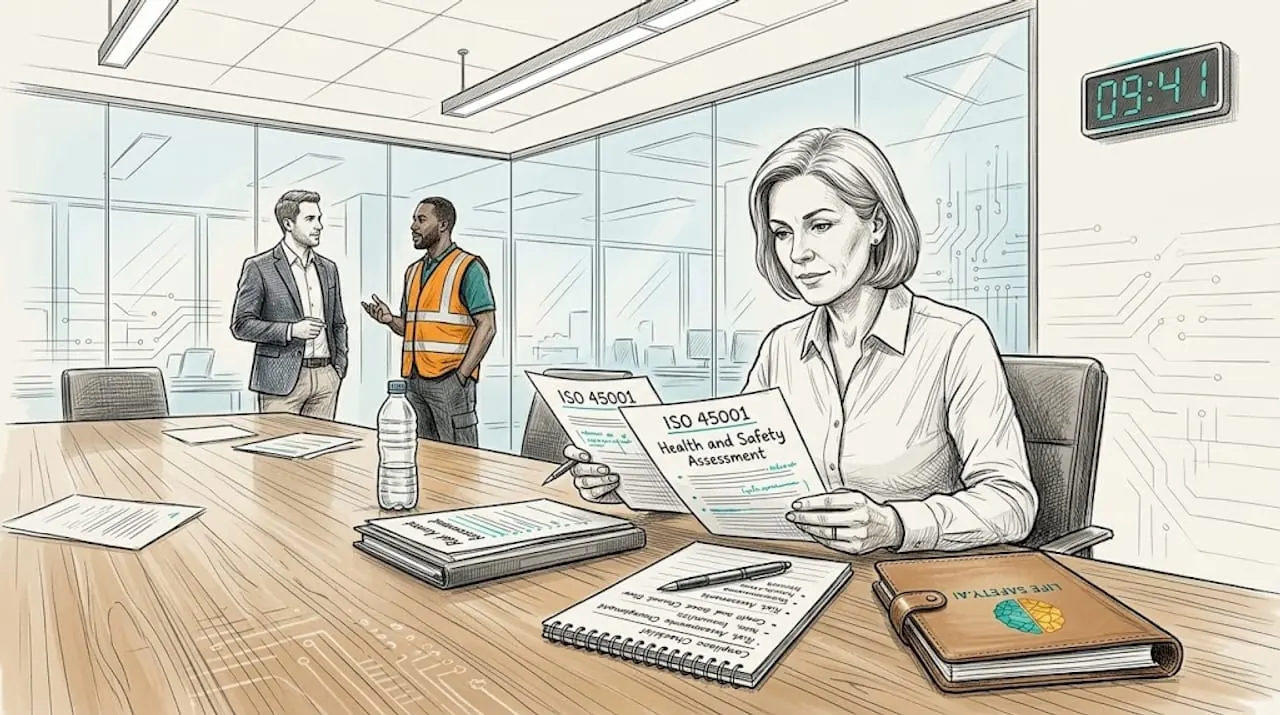
The most significant development is the expansion of ISO 45001-aligned regulations across the UK, with tightened safety legislation now placing explicit emphasis on mental health, psychosocial hazards, and human factors engineering. This is a substantial shift from previous frameworks that focused almost exclusively on physical risk. Organisations that have not conducted a gap assessment against the updated standard are exposed.
The HSE’s approach to AI in the workplace
The Health and Safety Executive has issued clear guidance on AI use in safety-critical environments. The HSE’s regulatory position emphasises that AI systems must undergo formal risk assessments, meet robust cyber security standards, and maintain human-in-the-loop oversight at all times. Critically, AI must comply with existing legislation, including the Health and Safety at Work etc. Act 1974. AI does not create a separate compliance framework; it sits within the one you already operate.
Key regulatory priorities for compliance officers in 2026:
- Gap assessments against ISO 45001 updates: Particularly around psychosocial risk identification and management plans.
- AI risk assessments: Document how each AI tool is used, what decisions it informs, and how human oversight is maintained.
- Cyber security protocols: Any connected safety system must be assessed for vulnerability. A compromised sensor network is a safety risk, not just an IT problem.
- Explainable AI: Regulators increasingly expect organisations to demonstrate that AI-generated decisions can be understood and challenged. Black-box systems are becoming a liability.
- Audit trails: Every AI-assisted decision that influences a safety outcome must be logged with sufficient detail to support investigation and legal review.
- Mental health integration: Wellbeing risk assessments must now sit alongside physical risk assessments in your safety management system.
“In 2026, explainability is not a feature request; it is a regulatory requirement. If you cannot explain why your AI flagged a hazard or recommended a control measure, you cannot defend your compliance position.”
Pro Tip: Review your current compliance documentation and identify any gaps where AI tools influence decisions but lack a formal audit trail. Addressing this now will protect you significantly when HSE inspection or incident investigation occurs.
Your compliance dashboard setup should be structured to capture AI-related decisions alongside standard incident and near-miss data. For reference on how regulatory standards vary internationally, the overview of construction codes from other jurisdictions provides useful comparative context.
For higher-risk projects, dutyholders should also consider how AI-enabled monitoring interacts with obligations under the Building Safety Act, especially where digital records, accountable persons, and evidence of control measures form part of the wider safety case.
Risks, blind spots, and best practices in the new era
With AI adoption accelerating, the risks of getting it wrong are as real as the benefits of getting it right. New tools can create a false sense of assurance if organisations assume that more data automatically means better control. It does not. Poor implementation can leave serious blind spots in place while giving leadership the impression that risk is being managed more effectively than it really is.
One of the most common failures is over-reliance on detection without equivalent investment in response. A camera may identify missing PPE, a sensor may flag overheating equipment, and a dashboard may highlight a trend in unsafe access, but none of that improves safety unless supervisors act quickly and consistently. Technology can surface risk; it cannot own the corrective action.
Another issue is data quality. If incident records are inconsistent, near-miss reporting is weak, or maintenance logs are incomplete, predictive models will produce unreliable outputs. In safety-critical environments, poor data is not just an analytics problem. It can distort priorities, misdirect resources, and weaken your legal position after an incident.
Where organisations still get caught out
- Alert fatigue: Too many low-value notifications lead supervisors to ignore genuinely serious warnings.
- Weak escalation routes: Hazards are detected, but no one is clearly accountable for closing them out.
- Bias in AI models: Systems trained on narrow or poor-quality datasets may miss site-specific risks or misclassify behaviours.
- Privacy and trust concerns: Workers may resist monitoring if the purpose, boundaries, and safeguards are not explained properly.
- Disconnected systems: AI tools that do not link to permits, inspections, training records, or corrective actions create fragmented control.
- Insufficient competence: Teams may have access to advanced dashboards but lack the training to interpret outputs correctly.
Best practice in 2026 is therefore less about buying the most advanced platform and more about building a disciplined operating model around it. The strongest organisations are doing the following:
- Define clear ownership. Every AI alert category should have a named response owner and a target response time.
- Set thresholds carefully. Tune systems to prioritise meaningful risk rather than flooding teams with minor exceptions.
- Validate outputs regularly. Compare AI findings with supervisor observations, audits, and incident outcomes to test reliability.
- Integrate with existing controls. Link alerts to permits, toolbox talks, inspections, and corrective action workflows.
- Protect worker confidence. Be transparent about what is monitored, why it is monitored, and how data is used.
- Review legal defensibility. Ensure records are suitable for HSE inspection, internal investigation, and, where necessary, RIDDOR reporting.
For construction environments in particular, these controls should align with principal contractor duties, site induction processes, and coordination requirements under CDM 2015. In manufacturing, the same principle applies to machinery safety, maintenance planning, lockout procedures, and competence management.
The biggest blind spot is assuming that detection equals control. In reality, control only exists when a hazard is identified, understood, assigned, and closed out.
If your current process still relies heavily on spreadsheets, email chains, or disconnected site apps, this is usually where risk accumulates. A centralised platform that links incidents, actions, permits, and evidence can materially improve both operational control and audit readiness.
The uncomfortable truth about AI and safety: People still matter most
For all the progress in automation, the most important variable in safety management remains human behaviour. AI can identify patterns, flag anomalies, and accelerate reporting, but it cannot replace judgement, leadership, or trust. The uncomfortable truth is that many incidents still happen not because organisations lacked data, but because people felt unable to speak up, supervisors normalised unsafe shortcuts, or fatigue and stress were left unmanaged.
This matters because 2026 safety performance is increasingly shaped by human factors. Mental health, workload, communication quality, supervision, and organisational culture all influence whether controls are followed in practice. A site with excellent technology but poor culture can still produce serious incidents. Conversely, a well-led team with strong reporting habits and visible management commitment will often outperform a more heavily automated but disengaged workforce.
What strong safety culture looks like in 2026
- Workers trust the reporting process and believe concerns will be acted on rather than ignored.
- Supervisors use AI outputs as prompts, not as substitutes for site presence and direct engagement.
- Mental health and fatigue are discussed openly as legitimate safety risks, not personal weaknesses.
- Near misses are valued as learning opportunities rather than treated as administrative burdens.
- Training is practical and continuous, helping teams understand both the technology and the underlying risk controls.
- Leadership remains visible, especially after alerts, incidents, or major changes in work activity.
There is also a competence issue. If teams do not understand how AI recommendations are generated, they may either distrust them entirely or follow them too blindly. Neither outcome is safe. The goal is informed use: competent people applying technology within a clear framework of responsibility.
That is why the best-performing organisations are combining digital tools with regular briefings, behavioural safety conversations, and stronger line management capability. They are not treating AI as a replacement for culture. They are using it to reinforce culture.
Practical reminder: If your workforce would struggle to explain what happens after an AI alert is raised, your process is not mature enough yet. The response pathway should be as clear to frontline teams as it is to compliance managers.
For organisations reviewing their broader safety maturity, this is often the point where digital transformation and leadership development need to move together. Better systems help, but better conversations still prevent harm.
Modern solutions for safety management leaders
For safety leaders in construction and manufacturing, the challenge is no longer whether to modernise. It is how to do so in a way that improves control without creating unnecessary complexity. The most effective solutions in 2026 are those that bring together incident reporting, risk assessment, permit-to-work, audit evidence, and AI-assisted oversight in one operational environment.
This is where platforms such as LifeSafety.ai are increasingly relevant. Rather than treating compliance as a separate administrative layer, modern systems embed it directly into day-to-day site activity. That means hazards can be captured on mobile, corrective actions assigned immediately, permits linked to live work controls, and evidence retained in a form suitable for inspection, investigation, and management review.
What to look for in a 2026 safety platform
- Mobile-first reporting for incidents, hazards, observations, and near misses from live sites.
- Integrated permit-to-work controls that support high-risk activities and approval workflows.
- Centralised compliance dashboards for audits, actions, trends, and evidence retention.
- AI-assisted analysis that helps prioritise risk without removing human decision-making.
- Clear audit trails suitable for HSE review, internal assurance, and RIDDOR-related investigation.
- Support for UK frameworks including CDM 2015, HSWA, ISO 45001 alignment, and Building Safety Act record expectations where relevant.
In practical terms, leaders should be asking whether their current setup helps them answer the following questions quickly:
- What are our highest-risk recurring issues across sites or shifts?
- Which actions are overdue, and who owns them?
- Can we evidence that controls were in place before work started?
- Are near misses being captured early enough to prevent escalation?
- Can we demonstrate how AI-supported decisions were reviewed by competent people?
If the answer to those questions is still buried across spreadsheets, inboxes, and disconnected apps, there is a strong case for change. Our incident reporting, permit-to-work, and compliance dashboard modules are designed specifically to help UK teams move from fragmented administration to live operational control.
The direction of travel is clear. By 2026, leading organisations are not waiting for incidents to reveal weaknesses. They are using better systems, better data, and better leadership to identify risk earlier and respond faster.
Frequently asked questions
What are the biggest safety management trends for 2026?
The biggest trends are AI-enabled hazard detection, predictive analytics, stronger focus on mental health and human factors, tighter regulatory expectations around explainability and audit trails, and wider integration of compliance processes into digital workflows. In the UK, this sits alongside continued emphasis on RIDDOR, CDM 2015, and HSE enforcement expectations.
Is AI now essential for construction and manufacturing safety?
For many organisations, AI is becoming essential in practice because it improves visibility, speed, and consistency in high-risk environments. However, it is not a substitute for competent supervision, training, and culture. The strongest results come when AI supports existing safety management rather than attempting to replace it.
How does HSE view AI in safety-critical workplaces?
HSE expects AI systems to be risk assessed, secure, explainable, and subject to human oversight. Organisations remain responsible for compliance under existing legislation, including the Health and Safety at Work etc. Act 1974. If an AI-supported process contributes to a safety failure, the presence of technology does not remove employer responsibility.
Does AI change RIDDOR reporting duties?
No. RIDDOR duties remain the same. AI may help detect incidents, identify patterns, and improve record quality, but the legal obligation to report qualifying injuries, diseases, and dangerous occurrences still rests with the responsible person or organisation.
What are the main risks of using AI in safety management?
The main risks include poor data quality, over-reliance on automated outputs, alert fatigue, weak escalation processes, cyber security vulnerabilities, and lack of explainability. There is also a cultural risk if workers see monitoring as punitive rather than protective. These issues should be addressed through governance, training, and transparent communication.
How should organisations start adopting AI safely?
Start with a focused pilot in a clearly defined high-risk area. Review your data quality, document the intended use case, assign response ownership, and ensure the tool links into existing reporting and action workflows. Build in regular review points so you can test whether the system is actually reducing risk rather than simply generating more information.
What role does mental health play in 2026 safety strategy?
Mental health is now central. Stress, fatigue, burnout, and psychosocial hazards are increasingly recognised as incident precursors, not separate wellbeing topics. A credible 2026 safety strategy should therefore include both physical and psychological risk assessment, supported by management capability and clear reporting routes.
What should safety leaders prioritise next?
Prioritise three things: better visibility of live risk, stronger evidence of control, and clearer ownership of action. Whether you use AI, mobile reporting, or integrated compliance software, the objective is the same: prevent harm earlier and demonstrate that your organisation is managing risk competently and consistently.
Final thought
Safety management in 2026 is no longer defined by how well you document incidents after they happen. It is defined by how effectively you identify weak signals, act before harm occurs, and maintain evidence that your controls are working. AI is accelerating that shift, but people, process, and compliance discipline still determine whether the technology delivers real protection.
Related Articles

Workplace safety software for construction teams
Discover top-rated workplace safety software for construction. Improve incident tracking, compliance, and safety analytics with Lifesafety!

LifeguardAI.co.uk alternatives for UK safety managers: 2026
Discover top lifeguardai.co.uk alternatives for UK safety managers. Explore Lifesafety and other innovative solutions to enhance workplace safety.

Site audit recommendations: your 2026 action plan
Unlock the power of effective site audit recommendations. Follow our 2026 action plan to boost indexing, enhance content quality, and improve site speed.