
The role of remote access in safety: HSE guide
The role of remote access in safety: HSE guide
Remote access is now a safety-critical control in industrial and construction environments. For UK duty holders, it affects operational control, traceability, incident investigation, and compliance with HSE expectations, RIDDOR reporting, CDM 2015 duties, and wider governance under the Building Safety Act.
TL;DR
- Remote access is now recognised as a safety-critical control, governing who can interact with operational technology systems.
- Implementing brokered remote access with explicit approvals and comprehensive session logging improves safety, traceability, and regulatory compliance.
- Poorly governed remote access increases the risk of safety failures, environmental harm, and failed incident investigations.
Remote access is defined as a safety-critical control point that determines whether operational technology in industrial environments remains secure, traceable, and under authorised governance. For health and safety professionals, the role of remote access in safety extends far beyond IT convenience. Regulators now assess remote access as integral to operational control, functional safety, and incident investigation. Frameworks from the NCSC and vendors like Rockwell Automation confirm that poorly governed remote access creates direct pathways to safety failures, environmental harm, and unplanned downtime in high-hazard sites.
How does remote access enhance safety in OT systems?
Secure remote access in operational technology (OT) environments works through a layered governance model, not a simple network tunnel. The standard industry term for this approach is brokered remote access, where every session passes through a controlled intermediary rather than opening a direct connection to plant assets.

The broker or jump host model is the foundation. A technician requesting access to a programmable logic controller (PLC) or engineering workstation must authenticate, receive explicit approval, and operate within a defined time window. Just-in-time approvals restrict lateral movement by ensuring no persistent access exists between sessions. This contrasts sharply with traditional IT VPN access, which grants broad network trust once a user connects.
Session logging and traceability are what make remote access genuinely useful for safety investigations. Every session must be attributable to an identity, tied to a specific asset, time-stamped, and recorded. Fragmented logs across IT, OT, and vendor tools reduce evidence reliability and impair root cause analysis after an incident. Without authoritative logs, accountability shifts away from individuals and safety investigations stall.
Key mechanisms that define a compliant brokered access model include:
- Strong multi-factor authentication tied to individual identities, not shared credentials
- Explicit session approval workflows with named requestors and business justification
- Network segmentation that prevents access from spreading beyond the approved asset
- Full session recording enabling immediate revocation when work is complete
- Centralised audit logs accessible to HSE teams and regulators without manual collation
Pro Tip: Treat session recording as a safety document, not just a security log. In a RIDDOR investigation or CDM 2015 audit, a timestamped session recording showing exactly what a remote technician did to a control system is far more defensible than a verbal account.
What risks does poorly governed remote access create?
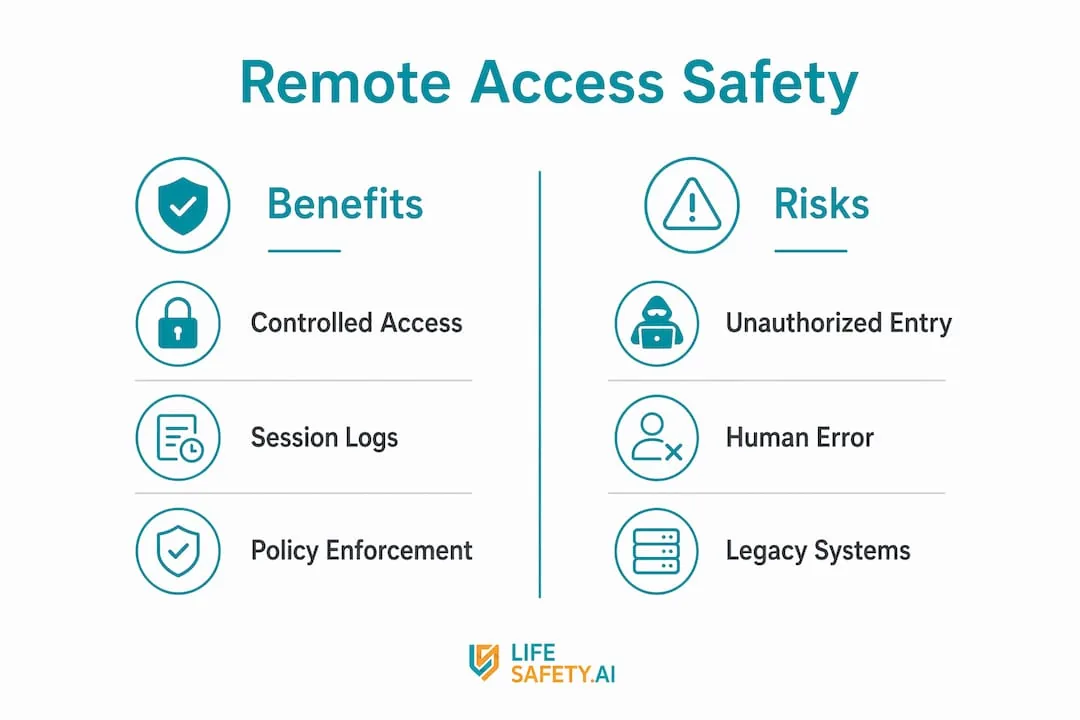
Ungoverned remote access in OT environments creates a category of risk that safety professionals rarely encounter in standard IT settings. The concept is called blast radius: the extent of damage a single compromised or misused session can cause across interconnected plant systems.
Legacy OT systems are fragile and cannot tolerate uncontrolled lateral movement. A vendor connecting to one historian server may inadvertently reach a safety instrumented system (SIS) if segmentation is absent. That single misstep can trigger unplanned shutdowns, process upsets, or worse, disable a safety function at a critical moment.
The consequences of weak governance fall into four categories:
- Safety function compromise: Uncontrolled access paths can modify controllers or SIS configurations, disabling interlocks or alarm thresholds without any change management record.
- Environmental harm: Process upsets caused by unauthorised or erroneous remote changes can lead to releases, spills, or emissions that trigger regulatory enforcement.
- Incident investigation failure: Inability to reconstruct remote sessions means investigations cannot determine whether a remote action contributed to an incident, leaving liability unresolved.
- Privilege creep: Vendor accounts accumulate access rights over time. Without periodic review, a contractor retains access to live plant systems long after their work is complete.
Human error compounds every one of these risks. Managed secure remote access reduces this by enforcing policies, reviewing activity in real time, and removing access swiftly when anomalies appear. The absence of such management is not a minor gap. It is a governance failure with direct safety consequences.
Comparing remote access governance models for OT safety
Not all remote access approaches carry the same safety profile. The table below compares three common models used in industrial environments.
| Access Model | Security Level | Traceability | Operational Friction | Safety Impact |
|---|---|---|---|---|
| Traditional VPN | Low to medium | Poor (shared credentials common) | Low | High risk of lateral movement and untraced changes |
| Brokered access with just-in-time approval | High | Full session attribution | Medium | Controlled blast radius, audit-ready logs |
| Mediated diagnostic channel (vendor-specific) | Medium | Partial (vendor-controlled logs) | Low | Limited visibility for HSE teams, compliance gaps |
The brokered model is the only approach that satisfies both operational safety and regulatory traceability requirements. NCSC 2026 guidance treats every OT connection as a risk-managed design decision, not a convenience feature. Deploying a secure tunnel without logging and monitoring is what the NCSC calls “security theatre.” It looks controlled but provides no safety assurance.
Role-based access control (RBAC) within the brokered model adds a further layer of protection. A maintenance engineer receives access only to the specific asset requiring attention, not the entire control network. Emergency access follows a separate, pre-approved pathway with heightened logging and mandatory post-incident review.
Pro Tip: Separate your routine maintenance access from your emergency access procedures in writing. Emergency access under pressure is where governance collapses. Pre-approving emergency pathways with defined escalation contacts prevents ad hoc workarounds that leave no audit trail.
Balancing security with operational uptime is the practical challenge every HSE professional faces. Overly restrictive controls that delay emergency response create their own safety risk. The answer is not to loosen controls but to design faster approval workflows for pre-vetted emergency scenarios.
Best practices for implementing safe remote access
Health and safety professionals are well placed to drive remote access governance because they understand both the regulatory requirements and the operational consequences of failure. The importance of remote access in HSE governance is that it connects cybersecurity controls directly to safety outcomes.
Practical implementation starts with session attribution before access begins. Every request should capture the identity of the requestor, the specific asset, the business justification, and the expected duration. This information feeds directly into safety audit trails and supports RIDDOR compliance when incidents occur.
The following practices form a defensible governance baseline:
- Integrate remote access logs with your safety management system. Logs sitting in a separate IT system are invisible to HSE teams during investigations. Central integration means safety professionals can query session data alongside incident records.
- Conduct quarterly access reviews. Identify dormant vendor accounts, expired contractor credentials, and privilege creep. Remove access that no longer has a business justification.
- Define and test emergency access procedures. Document who approves emergency remote access, how it is activated, and what post-incident review is required. Test the procedure annually.
- Require session recording for all OT access. Recording should be stored in a tamper-evident format accessible to HSE and compliance teams, not just IT.
- Collaborate with IT and OT teams on risk ownership. Remote access governance fails when IT owns the controls but OT and HSE teams bear the safety consequences. Joint ownership with shared accountability produces better outcomes.
Continuous monitoring of active sessions enables real-time intervention when behaviour deviates from the approved scope. This is the difference between reactive incident investigation and proactive safety management. Platforms that surface anomalies during a session allow supervisors to terminate access before a safety function is affected.
Construction and manufacturing sites face particular challenges because multiple vendors often require simultaneous access to different systems. Construction site safety protocols must account for concurrent vendor sessions, each with separate approval chains and asset scopes, to prevent one vendor’s session from inadvertently affecting another’s work area.
Key takeaways
Effective remote access governance is the single most important technical control connecting cybersecurity practice to operational safety outcomes in industrial environments.
| Point | Details |
|---|---|
| Remote access is a safety control | Regulators treat it as integral to operational control and incident investigation, not just IT security. |
| Brokered access outperforms VPN | Just-in-time approvals and full session logging reduce blast radius and support audit readiness. |
| Traceability enables accountability | Sessions must be attributable before start, observable during, and revocable after work completes. |
| Human error requires active management | Enforcing policies and monitoring sessions in real time prevents errors from reaching safety functions. |
| HSE teams must own governance jointly | Remote access controls owned solely by IT leave safety professionals without visibility during investigations. |
Why remote access governance is the safety issue most HSE teams underestimate
Having worked with health and safety teams across construction and manufacturing, I have observed a consistent pattern. Remote access governance sits in a blind spot. IT teams manage the controls, OT engineers manage the systems, and HSE professionals manage the outcomes. Nobody owns the intersection.
The regulatory direction is clear. The NCSC’s 2026 principles do not treat OT connectivity as an IT problem. They treat it as a risk-managed architecture decision with direct safety implications. Yet most HSE audits I have reviewed still treat remote access as a checkbox item rather than a substantive control requiring evidence of governance.
The uncomfortable truth is that many organisations cannot reconstruct what happened during a remote session after an incident. They have logs, but the logs are fragmented across three systems and owned by different teams. That is not compliance. That is the appearance of compliance.
What I find works in practice is bringing HSE professionals into the access approval workflow, not as gatekeepers but as informed stakeholders. When a safety manager understands which vendor is accessing which controller and why, they can challenge poor justification, verify that the work aligns with permit controls, and ensure the activity is visible within the wider safety management system.
In UK terms, this matters because post-incident scrutiny rarely stays within one discipline. A serious event may trigger internal investigation, insurer review, client scrutiny, HSE engagement, and potentially RIDDOR reporting. On higher-risk projects and occupied assets, governance expectations also sit alongside the Building Safety Act’s emphasis on accountable information, clear dutyholder roles, and demonstrable control of major risks.
For principal contractors, principal designers, facilities managers, and manufacturing duty holders, the lesson is straightforward: remote access should be governed like any other safety-critical intervention. If a person cannot enter a live plant room or restricted construction zone without authorisation, competence checks, and records, they should not be able to enter the digital equivalent without the same discipline.
The organisations that handle this well do three things consistently. They define ownership jointly across IT, OT, and HSE. They make session evidence easy to retrieve. And they rehearse emergency access before a real incident forces shortcuts. That combination is what turns remote access from a hidden vulnerability into a controlled safety function.
Practical compliance actions for UK duty holders
To align remote access governance with UK health and safety expectations, organisations should embed it into existing compliance processes rather than treating it as a standalone cyber issue.
- RIDDOR readiness: Ensure remote session records can be retrieved quickly where a dangerous occurrence, specified injury, or major process event may require formal reporting or investigation support.
- CDM 2015 coordination: Where contractors or specialists access live systems remotely, define responsibilities clearly within contractor control, planning, and coordination arrangements.
- HSE evidence management: Store approvals, recordings, and audit logs in a way that supports inspection, internal review, and root cause analysis.
- Building Safety Act governance: For higher-risk buildings and critical assets, maintain clear accountability for who approved access, what changed, and how the decision was justified.
- Competence assurance: Verify that remote users are authorised, trained, and limited to the systems relevant to their task.
If your organisation already uses digital permits, incident workflows, inspections, or audit modules, remote access evidence should sit alongside them. That is where platforms such as LifeSafety.ai can add value by connecting operational records, safety actions, and compliance evidence in one place.
Related Articles

Incident reporting software comparison: UK guide 2026
Discover our incident reporting software comparison for UK workplaces. Explore top options like Lifesafety, SafetyCulture, and more.

Safety management solutions for construction: UK SMS guide
Discover essential safety management solutions for construction sites in the UK. Learn how a mobile-first SMS can enhance safety and compliance.

Best Health and Safety Software for UK Workplaces: A Guide
Discover the best health and safety software for UK workplaces in 2026. Explore top picks like Lifesafety for compliance and efficiency!