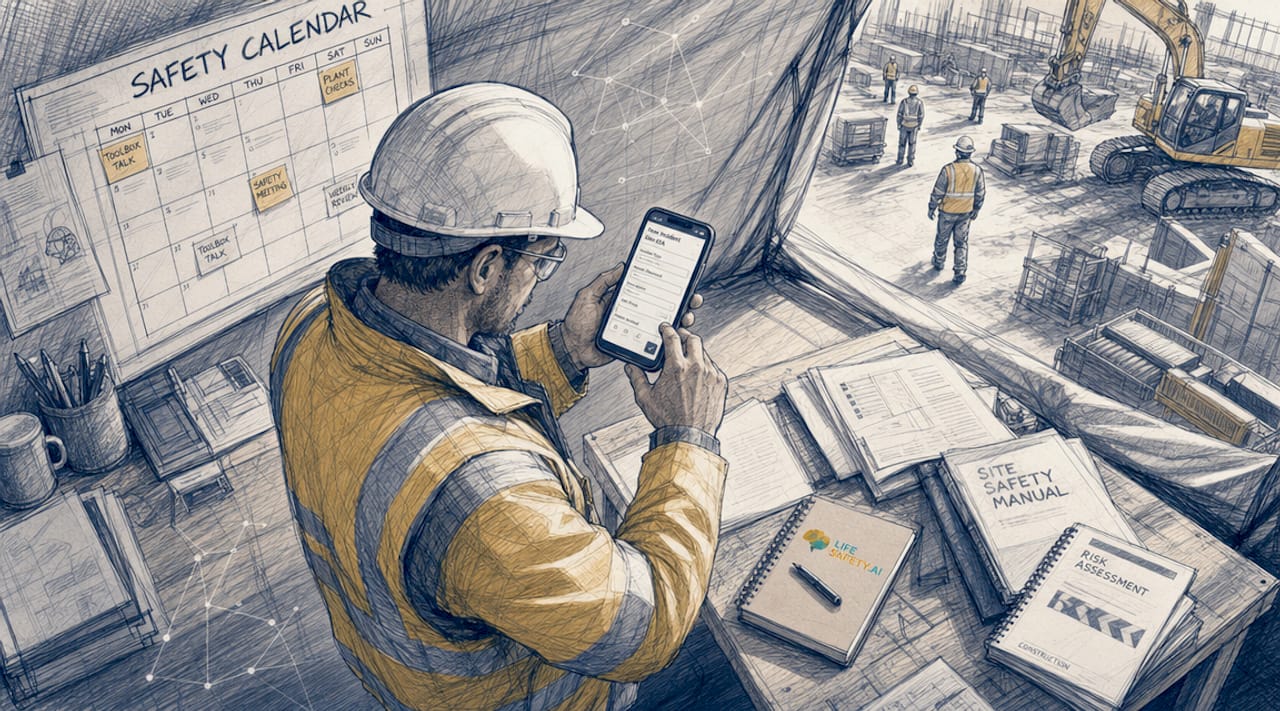
The role of mobile reporting in health and safety
The role of mobile reporting in health and safety
Mobile reporting is reshaping how UK organisations capture incidents, near misses, and compliance evidence across construction, manufacturing, and other high-risk environments.
TL;DR
- Mobile incident reporting enhances compliance by reducing reporting time and guiding workers through structured digital forms at the scene.
- It captures immediate data, improves accuracy, and creates centralised audit trails that support inspections and investigations.
- Using mobile-first tools designed for frontline environments helps organisations move from reactive reporting to a more proactive safety culture.
Mobile reporting in occupational health and safety (OHS) is defined as the use of smartphone or tablet applications to capture, submit, and manage incident data directly from the point of occurrence. For health and safety professionals working in construction, manufacturing, and other high-risk environments, this capability is no longer a convenience. It is the difference between a compliant, proactive safety culture and one that is perpetually reactive. A 2026 manufacturing study found that mobile incident reporting cut average reporting time from 47 minutes to just 8, while increasing near-miss reporting by 207.1%. Those numbers reframe what good safety management looks like.
How mobile reporting improves compliance with RIDDOR
RIDDOR (Reporting of Injuries, Diseases and Dangerous Occurrences Regulations 2013) places a legal duty on responsible persons to report specific workplace incidents to the Health and Safety Executive (HSE). The HSE’s RIDDOR online portal is the primary submission channel, generating official reference numbers as proof of compliance. Yet the HSE itself has acknowledged persistent problems with both under-reporting and over-reporting, prompting a 2026 consultation to simplify the online form interface. This tells us something important: usability directly determines compliance rates, not just intent.
Traditional paper-based reporting creates three compounding problems. Forms are completed hours after an incident, when details are already fading. They are then transcribed manually, introducing errors. Finally, they are filed locally, making audit preparation a time-consuming exercise in retrieval. Each step adds friction and reduces the reliability of the data that regulators and safety managers depend upon.
Mobile reporting addresses all three problems at once. Frontline workers submit reports from the scene using structured digital forms with required fields and conditional logic, which improves data accuracy and removes the transcription step entirely. The result is a cleaner, faster, and more defensible record.
Key compliance advantages mobile reporting delivers include:
- Time-stamped submissions that confirm when and where an incident was recorded, supporting HSE inspection expectations and internal due diligence.
- Centralised audit trails that make due diligence evidence immediately accessible during inspections, investigations, and contractor reviews.
- Guided RIDDOR classification built into the reporting workflow, reducing misclassification errors that have historically distorted reporting quality.
- Automatic reference logging that mirrors the HSE portal’s confirmation system, giving responsible persons a complete submission record.
“Simplifying online forms is vital to tackle historical under- and over-reporting, showing that usability directly affects compliance.” — HSE Media Centre, 2026
For a detailed walkthrough of digital RIDDOR submission requirements, the complete RIDDOR reporting guide from LifeSafety.ai covers the current regulatory framework in full.
What are the key operational benefits of mobile reporting?
The operational benefits of mobile reporting extend well beyond faster form completion. They reshape how safety data flows through an organisation and how quickly corrective actions are triggered. The 2026 manufacturing study referenced above is the clearest evidence available: near-miss reporting increased by 207.1% after mobile reporting was introduced, while moderate accidents fell by 55.6%. That correlation is not coincidental. More near-miss data means earlier intervention, which means fewer serious incidents.
Here is how that improvement unfolds in practice:
- On-the-spot capture. Workers photograph hazards, record GPS location, and submit reports before leaving the scene. No detail is lost to memory or delay.
- Real-time notifications. Supervisors receive instant alerts when a report is submitted, enabling same-shift corrective action rather than next-day review.
- Richer root cause analysis. Photos, location data, and structured field responses give safety managers the complete picture needed to identify systemic causes rather than attributing incidents to individual error.
- Proactive risk detection. Near-miss capture at scale creates a pattern of leading indicators that predictive safety management depends upon.
- Reduced reporting friction. The compliance benefits arise specifically from removing barriers to reporting. When submitting a report takes eight minutes instead of 47, workers actually do it.
The cultural shift this drives is significant. When reporting is easy and visibly acted upon, workers trust the system. That trust is what converts a reactive safety programme into a proactive one. Mobile reporting does not just collect data. It signals to the workforce that their observations matter.
Pro Tip: Set up automated escalation rules so that any report tagged as a high-severity near miss triggers an immediate notification to the site manager and safety lead. This closes the feedback loop that workers need to see before they will consistently report.

Mobile-first versus mobile-enabled: what is the difference?
Not all digital reporting tools carry the same operational value. The distinction between mobile-first incident reporting software and mobile-enabled desktop platforms is one that health and safety professionals must understand before selecting a solution.
| Feature | Mobile-first software | Mobile-enabled desktop platform |
|---|---|---|
| Designed for | Smartphones and tablets as primary devices | Desktop browsers, adapted for mobile |
| Offline capability | Yes, syncs when connectivity returns | Typically requires internet connection |
| Frontline usability | Intuitive, minimal training required | Often complex, designed for office users |
| Form design | Short, structured, conditional logic | Frequently mirrors desktop form length |
| Reporting speed | Immediate, from the scene | Delayed, often completed at a workstation |
Mobile-first software is built around the reality that frontline workers in construction or manufacturing are not sitting at desks. They are on scaffolding, in plant rooms, and on production floors. A reporting tool that requires a computer removes the single most important feature of mobile reporting: immediacy.
Mobile-first platforms remove the common barriers that suppress reporting. There is no need to find a computer, log into a system, or navigate a form designed for a 27-inch monitor. Structured fields with conditional logic mean workers only see questions relevant to the incident type they are reporting. This reduces manual entry errors and keeps forms short enough to complete in under ten minutes.
Pro Tip: When evaluating mobile reporting tools, test them on the actual devices your frontline workers carry. A form that looks clean on an iPhone 15 may be unusable on an older Android handset common on construction sites.
Best practices for implementing mobile reporting
Selecting the right tool is only the first step. The importance of mobile reporting is fully realised only when implementation is planned carefully and frontline workers are genuinely engaged from the outset.
Effective implementation rests on five principles:
- Involve frontline workers early. Workers who help design the reporting workflow are far more likely to use it consistently. Run pilot sessions on site and gather feedback before full rollout. Adoption resistance is almost always a symptom of poor consultation, not poor technology.
- Capture conditions first, classify later. Practitioners recommend recording immediate conditions at the scene before any classification decisions are made. Time, location, and photographs preserve incident integrity for regulatory purposes. RIDDOR classification can follow once the responsible person has reviewed the submission.
- Design workflows for near misses and minor incidents. Most organisations focus their reporting systems on RIDDOR-reportable events. This misses the majority of safety-relevant data. Near-miss and minor incident workflows should be as frictionless as possible, because these reports are the leading indicators that prevent serious harm.
- Address data security and GDPR obligations. Mobile reports frequently contain personal data, including the names of injured parties and witnesses. Confirm that your chosen platform stores data on UK-based servers, applies role-based access controls, and provides a data processing agreement compliant with UK GDPR.
- Integrate with your wider safety management system. Mobile reporting delivers its greatest value when it feeds directly into risk assessments, audit schedules, and training records. Standalone reporting apps that do not connect to your safety management system create data silos that undermine the AI-driven risk assessment capabilities now available to UK safety teams.
Pro Tip: Run a 30-day near-miss reporting challenge after launch. Set a visible target for the team, share anonymised results weekly, and recognise contributors. This builds the reporting habit faster than any training session alone.
For high-risk environments such as construction sites, mobile reporting also supports construction site safety obligations under CDM 2015, where principal contractors must maintain accurate records of incidents and near misses across multiple duty holders. In higher-risk buildings and complex projects, the same reporting discipline also strengthens evidence trails expected under the Building Safety Act, particularly where dutyholders need to demonstrate effective control, communication, and record keeping.
Key takeaways
Mobile reporting transforms health and safety compliance by removing the friction that suppresses incident reporting, producing richer data, and enabling faster corrective action across high-risk environments.
| Point | Details |
|---|---|
| Compliance through usability | Mobile reporting reduces RIDDOR misclassification and under-reporting by guiding workers through structured, on-site digital forms. |
| Near-miss data drives prevention | A 207.1% increase in near-miss reporting after mobile adoption demonstrates its role in shifting safety culture from reactive to proactive. |
| Mobile-first design matters | Software built for smartphones outperforms adapted desktop tools in frontline usability, reporting speed, and data completeness. |
| Capture first, classify later | Recording time, location, and photographs immediately preserves incident integrity before RIDDOR classification decisions are made. |
| Integration amplifies value | Mobile reporting connected to risk assessments, audits, and training records delivers far greater safety outcomes than a standalone app. |
Why mobile reporting is the most underestimated shift in safety management
I have worked alongside safety teams in manufacturing and construction who were genuinely committed to their programmes but were drowning in paperwork. The honest observation from that experience is this: the reporting system was the bottleneck, not the people. Workers knew what to report. They simply could not face the process.
What mobile reporting does, at its best, is remove the excuse not to report. And that changes everything. When a near miss is captured in eight minutes on a phone rather than 47 minutes at a desktop, the data that leadership receives is richer, faster, and more representative of actual site conditions. That data builds trust in both directions.
Workers trust that management is serious because the system is easy to use and visibly responsive. Leadership trusts the data because it is captured at the scene, time-stamped, and supported by photographs, location details, and structured fields. In practical terms, that means better investigations, stronger trend analysis, and more credible evidence if the HSE, insurers, clients, or principal contractors ask questions later.
This is why mobile reporting is still underestimated. It can appear to be a simple technology upgrade, but in reality it changes the operating rhythm of safety management. It shortens the distance between observation and action. It improves the quality of evidence available for RIDDOR decisions. It supports contractor coordination under CDM 2015. It strengthens record keeping in environments where the Building Safety Act has raised expectations around accountability and information management. And it gives safety professionals something they rarely have enough of: timely, usable data from the frontline.
The organisations that benefit most are not necessarily the ones with the biggest budgets. They are the ones that understand a simple truth: if reporting is difficult, reporting will be incomplete. If reporting is easy, structured, and mobile-first, the organisation sees more of the real risk picture. That visibility is where prevention begins.
Practical next steps for UK safety teams
- Review whether your current incident workflow can be completed fully on a mobile device at the point of work.
- Check that your process supports near-miss reporting, not only RIDDOR-reportable events.
- Confirm that submissions create a clear audit trail with timestamps, user records, and attached evidence.
- Test offline functionality for construction sites, plant rooms, and remote operational areas with poor connectivity.
- Ensure reporting outputs feed into investigations, risk assessments, training actions, and management review.
If your current process still depends on delayed desktop entry or paper forms, mobile reporting is not a minor enhancement. It is likely the most direct improvement you can make to reporting quality, compliance confidence, and preventive safety performance.
Related Articles

Workplace safety software for construction teams
Discover top-rated workplace safety software for construction. Improve incident tracking, compliance, and safety analytics with Lifesafety!

LifeguardAI.co.uk alternatives for UK safety managers: 2026
Discover top lifeguardai.co.uk alternatives for UK safety managers. Explore Lifesafety and other innovative solutions to enhance workplace safety.
Site audit recommendations: your 2026 action plan
Unlock the power of effective site audit recommendations. Follow our 2026 action plan to boost indexing, enhance content quality, and improve site speed.