
The role of data security in compliance: 2026 guide
The role of data security in compliance: 2026 guide
Data security is not separate from compliance. It is the operational proof that governance, risk management and legal duties are being met. For UK organisations working across construction, manufacturing and regulated services, robust controls support accountability under data protection law while strengthening wider assurance expectations linked to HSE governance, contractor oversight and incident management.
TL;DR
- Data security is essential for demonstrating compliance with regulations such as GDPR, HIPAA and ISO 27001 through effective, ongoing controls.
- Auditors require documented evidence linking policies, risk assessments, control implementation and review processes to verify that controls are operational and effective.
Data security is defined as the set of technical and organisational measures that protect sensitive information from unauthorised access, disclosure, alteration, or destruction. For compliance officers and data protection professionals, the role of data security in compliance is direct: without implemented controls, organisations cannot satisfy the legal obligations imposed by GDPR, HIPAA, SEC Regulation S-P, ISO 27001, or the NIS2 Directive. Compliance is not a separate discipline from security. It is the formal, auditable expression of it. Organisations that treat data protection as a governance function rather than an IT task are the ones that survive regulatory scrutiny.
In UK practice, this same principle aligns with broader assurance expectations under HSE guidance, CDM 2015, and the Building Safety Act: organisations must not only define controls, but also show that they are implemented, reviewed and effective. Whether the subject is personal data, contractor competence records, building information, or incident logs, evidence matters.
What are the key regulatory requirements for data security?
Regulatory frameworks across industries converge on a shared expectation: organisations must identify risks to personal and sensitive data, implement proportionate controls, and demonstrate ongoing effectiveness. The specific requirements differ, but the underlying logic does not.
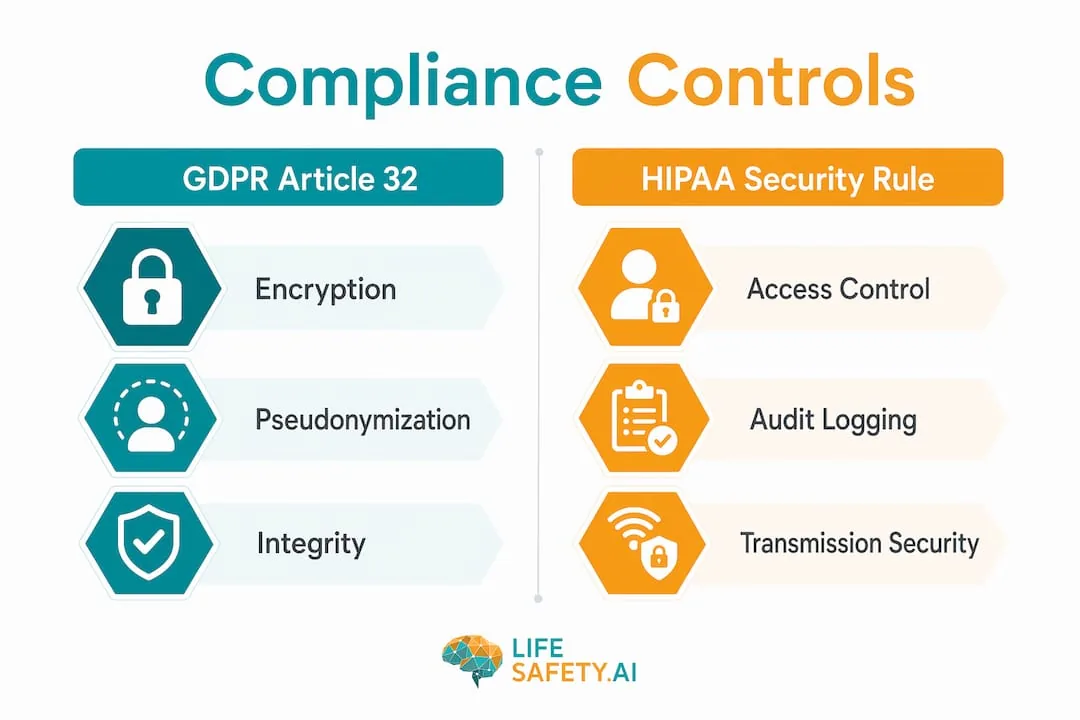
GDPR Article 32 sets the clearest technical benchmark in European data protection law. Article 32 GDPR mandates pseudonymisation, encryption, availability, resilience, and regular testing of technical and organisational measures, all calibrated to the risk context of the processing activity. This is not a static checklist. It requires organisations to reassess controls as risks evolve.
HIPAA’s Security Rule takes a similar position in US healthcare. The Office for Civil Rights (OCR) treats NIST and ISO mappings as useful inputs but not as standalone evidence of compliance. What OCR expects is a continuous governance risk management plan, one that documents how risks were identified, what controls were applied, and how their effectiveness is reviewed over time.
SEC Regulation S-P raises the bar for financial services. Amended Reg S-P requires covered entities to implement incident response programmes, notify customers within 30 days of a breach, and maintain written service provider oversight policies with breach notification clauses requiring provider notification within 72 hours. Smaller financial institutions must comply by June 2026.
The key requirements across major frameworks include:
- GDPR Article 32: Encryption, pseudonymisation, resilience, availability, and regular testing proportionate to risk
- HIPAA Security Rule: Continuous risk analysis, risk treatment plans, and documented management review
- SEC Reg S-P: Incident response programmes, 30-day customer notification, and 72-hour service provider breach notification
- ISO 27001:2022: Top management-approved information security policy, full ISMS, risk treatment plans, and audit programmes
- NIS2 Directive: Cybersecurity risk management obligations for operators of essential and important entities across the EU
Each framework uses different language, but all demand the same thing: proof that security controls exist, are proportionate, and are working.
For UK dutyholders, this mirrors familiar compliance logic in health and safety. Under RIDDOR, organisations must report certain incidents; under CDM 2015, they must plan, manage and monitor construction work; under the Building Safety Act, accountable persons and principal dutyholders must maintain reliable information and demonstrate control. In each case, regulators expect evidence of a functioning system, not a policy sitting on a shelf.
How do data security policies support audit readiness?
The information security policy is the foundational document that connects governance intent to operational practice. ISO 27001:2022 Clause 5.2 mandates a top management-approved policy that defines authority, sets security objectives, and serves as the governance anchor for all downstream controls. Auditors from every major framework treat this document as the starting point for any compliance assessment.
Audit readiness is built through a documented chain of evidence, not through the existence of a policy alone. The chain works as follows:
- Risk assessment: Identify and document threats, vulnerabilities, and the potential impact on confidentiality, integrity, and availability.
- Control selection: Map chosen controls to identified risks, referencing the applicable regulatory requirement where relevant.
- Implementation evidence: Collect logs, configuration records, training completion records, and test results that demonstrate controls are active.
- Ongoing review: Schedule and document periodic reviews of control effectiveness, updating risk assessments when the threat environment or technology changes.
- Management sign-off: Obtain and record senior leadership approval of risk treatment decisions and policy updates.
ISO 27001 certification requires a full Information Security Management System (ISMS) including risk assessment methodology, risk treatment plans, regular audit programmes, and management review. This is the gold standard for demonstrating compliance readiness across multiple regulatory frameworks simultaneously.
The most common audit failure is not the absence of controls. It is the absence of evidence that controls are working continuously. Compliance audits frequently fail because organisations cannot produce documentation linking their policy, risk assessment, control implementation, and review cycle. Policy statements alone do not satisfy regulators.
Pro Tip: Build a compliance evidence register that maps each regulatory obligation to a specific control, the evidence type that demonstrates it, and the review date. Update it quarterly. This single document transforms an audit from a stressful exercise into a structured conversation.
In UK construction and manufacturing settings, the same discipline should be applied to safety-critical information. If your organisation stores training records, permit-to-work data, contractor competence files, inspection logs, fire strategy documents, or digital building information, your audit trail should show who approved access, how records are protected, when they were reviewed, and how integrity is maintained. This supports not only data protection compliance, but also defensible governance under HSE scrutiny.
What are the essential data security measures for compliance?
Technical and organisational controls form the operational core of any compliance programme. The table below compares the most frequently required measures across major frameworks.

| Control | GDPR Article 32 | HIPAA Security Rule | SEC Reg S-P | ISO 27001 |
|---|---|---|---|---|
| Encryption | Required | Addressable (strongly expected) | Expected | Required |
| Access controls | Required | Required | Required | Required |
| Incident response plan | Required | Required | Mandatory with timelines | Required |
| Penetration testing | Required | Expected | Expected | Required |
| Third-party oversight | Required | Required | Mandatory written policies | Required |
| Breach notification | 72 hours to regulator | 60 days to affected individuals | 30 days to customers | Within ISMS scope |
Encryption, access controls, and incident response policies are the measures regulators cite most consistently when assessing compliance effectiveness. Their absence is among the most common triggers for enforcement action and financial penalties.
Beyond the table, several practices deserve particular attention:
- Penetration testing and vulnerability scanning: GDPR Article 32 mandates ongoing evaluation of technical and organisational measures. Penetration testing provides documented evidence of control effectiveness and identifies gaps before regulators do.
- Breach notification readiness: GDPR requires notification within 72 hours of becoming aware of a breach. Inadequate monitoring and logging can cause the notification clock to start earlier than organisations realise, because regulators may determine awareness occurred before the internal team acknowledged it.
- Third-party risk management: Effective service provider oversight requires written policies, contractual breach notification obligations, and regular assessments of supplier security posture. Under SEC Reg S-P and GDPR, a supplier’s breach is your compliance problem.
- Data restoration capabilities: GDPR Article 32 requires timely restoration of data availability and resilience following an incident. Organisations frequently over-invest in encryption while under-testing their recovery capabilities, which is a significant compliance gap.
In operational environments such as construction, facilities management and manufacturing, these controls also protect safety-critical records. If inspection findings, maintenance histories, asbestos information, fire door records, permit systems or contractor induction data are unavailable, altered or exposed, the issue is not only a privacy concern. It can become a live safety and legal risk. That is why data security should be integrated with wider compliance systems rather than managed in isolation.
How can organisations implement effective data security risk management?
Effective risk management is a continuous governance function, not an annual exercise. The shift from one-time assessments to ongoing risk governance is the single most important operational change compliance officers can make in 2026.
The practical implementation follows a structured cycle. Start with a baseline risk analysis that identifies all personal and sensitive data assets, maps processing activities, and documents threats and vulnerabilities. Assign likelihood and impact ratings to each risk. Select controls proportionate to the risk level and document the rationale for each decision. This rationale is what auditors want to see: not just what you did, but why.
Risk assessments must be updated when technology changes, when new processing activities begin, when a security incident occurs, or when the regulatory environment shifts. Treating a risk assessment as a document produced once and filed is the fastest route to a compliance failure. Regulators look for documented incident response plans that include defined roles, breach notification procedures, and evidence of testing. A plan that has never been exercised is treated with scepticism during enforcement proceedings.
Linking your ongoing risk assessments to specific compliance obligations creates a traceable audit trail. When a regulator asks why you chose a particular control, the answer should reference both the identified risk and the regulatory requirement it addresses.
Pro Tip: Schedule a tabletop exercise at least twice a year where your incident response team works through a simulated breach scenario. Document the exercise, record the outcomes, and update your response plan accordingly. This single activity produces compliance evidence, identifies gaps, and builds team confidence simultaneously.
The following priorities support a mature risk management posture:
- Assign ownership of each risk to a named individual, not a team or department
- Set remediation deadlines and track progress formally, not through email threads
- Review third-party risk profiles annually and after any significant supplier change
- Integrate security risk findings into board-level reporting to demonstrate governance accountability
- Maintain a log of all risk treatment decisions, including accepted risks with documented justification
For UK organisations, this approach should sit alongside existing safety governance. If your board already reviews accident trends, near misses, RIDDOR events, contractor performance and building safety actions, data security risks should be reported with the same discipline. A compromised document control system, inaccessible safety file, or weak supplier access process can undermine compliance under CDM 2015 and the Building Safety Act just as surely as it can undermine GDPR compliance.
Key takeaways
Effective data security compliance requires continuous governance, documented evidence, and proportionate controls aligned to specific regulatory obligations.
| Point | Details |
|---|---|
| Regulatory alignment | GDPR, HIPAA, SEC Reg S-P, and ISO 27001 all require proportionate, documented security controls. |
| Evidence over policy | Auditors require proof that controls are implemented and effective, not just that policies exist. |
| Continuous risk management | Risk assessments must be updated regularly to reflect evolving threats and regulatory changes. |
| Third-party oversight | Written supplier policies and contractual breach notification obligations are mandatory under multiple frameworks. |
| Incident response readiness | Documented, tested incident response plans reduce regulatory penalties and demonstrate compliance maturity. |
Why compliance officers need to rethink what “done” looks like
One of the most persistent misconceptions I encounter among compliance professionals is the belief that achieving a certification marks the end of a compliance cycle. Obtaining ISO 27001 certification or completing a NIST mapping exercise is genuinely valuable work. But it is the beginning of a compliance posture, not the conclusion of one.
The organisations that struggle most during regulatory investigations are usually not the ones that never started. They are the ones that assumed the project was finished. They completed the policy set, passed the audit, archived the evidence, and moved on. Then the environment changed. New suppliers were onboarded. Systems were reconfigured. Staff changed roles. Data volumes increased. A breach occurred. At that point, the original compliance pack no longer reflected operational reality.
This is where compliance officers need to redefine what good looks like. “Done” should mean that governance mechanisms are in place to keep controls current, evidence available, and accountability visible. It should mean that risk assessments are living documents, not annual paperwork. It should mean that senior leaders understand their role in approving risk treatment, funding remediation, and reviewing performance. It should mean that third-party oversight is active, not assumed.
In UK sectors with significant operational risk, this mindset is already familiar. No competent safety professional would claim that a completed risk assessment means a site is permanently safe. Conditions change, contractors change, equipment changes, and work methods change. The same is true for data security compliance. Controls must be monitored, tested and adapted as the organisation evolves.
The strongest compliance teams therefore work less like document custodians and more like assurance leaders. They coordinate legal, operational, IT and supplier stakeholders. They maintain evidence registers. They challenge stale assumptions. They escalate unresolved risks. They ensure that incident lessons are translated into control improvements. And they make it easier for the organisation to demonstrate compliance under pressure.
For organisations using digital compliance platforms, this is where structured workflows become especially valuable. Centralised action tracking, version-controlled policies, linked risk assessments, audit trails and review reminders reduce the chance that critical obligations are missed. In practice, this is the same principle that underpins effective safety management systems: clear ownership, timely review, and visible evidence.
Final thoughts
Data security is now a core compliance function. It is how organisations prove that they have translated legal duties into operational controls. Whether the framework is GDPR, HIPAA, SEC Reg S-P, ISO 27001 or NIS2, the expectation is consistent: identify risk, implement proportionate safeguards, test them, document them, and review them continuously.
For UK organisations, the lesson extends beyond privacy law. The same governance discipline supports stronger performance under HSE expectations, RIDDOR reporting arrangements, CDM 2015 dutyholder coordination, and the Building Safety Act. Reliable information, controlled access, tested response plans and clear accountability are not abstract compliance ideals. They are practical foundations for safe, defensible operations.
If you want compliance to stand up to audit, investigation or enforcement, focus less on whether the policy exists and more on whether the evidence trail is complete. That is the difference between nominal compliance and a system that can withstand scrutiny.
Practical next step
Review your current compliance framework and ask four questions:
- Can we show a clear link between each regulatory duty and the control that manages it?
- Do we have current evidence that the control is operating effectively?
- Is ownership assigned to a named person with review dates and actions tracked?
- Would this evidence stand up to regulator, client or insurer scrutiny today?
If the answer is no to any of these, the priority is not more policy writing. It is stronger governance, better evidence management and a more disciplined review cycle. Platforms such as LifeSafety.ai can help teams connect risk assessments, actions, audits and compliance records in one place, making it easier to maintain both data security assurance and wider operational compliance.
Related Articles

Incident reporting software comparison: UK guide 2026
Discover our incident reporting software comparison for UK workplaces. Explore top options like Lifesafety, SafetyCulture, and more.

Safety management solutions for construction: UK SMS guide
Discover essential safety management solutions for construction sites in the UK. Learn how a mobile-first SMS can enhance safety and compliance.

Best Health and Safety Software for UK Workplaces: A Guide
Discover the best health and safety software for UK workplaces in 2026. Explore top picks like Lifesafety for compliance and efficiency!