
The role of automation in risk assessments: 2026 guide
Risk Assessments • Automation • UK Compliance
The role of automation in risk assessments: 2026 guide
Automation is reshaping how organisations identify hazards, evaluate controls, and maintain defensible records under UK health and safety law. This guide explains where AI, robotic process automation, and digital workflows add value, where governance is essential, and how safety teams can adopt automation without weakening professional judgement.
TL;DR
- Automation in risk assessments employs AI, RPA, and digital workflows to replace manual data processes, enabling faster and more consistent evaluations.
- It improves accuracy through governed workflows, standardised templates, and continuous monitoring, helping organisations move beyond periodic reviews.
- For UK dutyholders, automation can strengthen compliance evidence under RIDDOR, CDM 2015, the Health and Safety at Work etc. Act 1974, and the Building Safety Act when records remain traceable and auditable.
- Effective implementation depends on governance, integration, data quality, and competent human oversight so AI-driven outputs remain reliable and legally defensible.
Automation in risk assessments is defined as the use of AI, robotic process automation (RPA), and digital workflow tools to replace manual data gathering, analysis, and reporting tasks throughout the risk evaluation lifecycle. The industry term for this practice is automated risk assessment, and it sits at the heart of modern health and safety management. Tools such as Arendt’s SARA and Zania’s AI agents are already compressing processes that once took weeks into a single working day. With 98% of risk professionals reporting that AI tools have improved risk identification, monitoring, and mitigation, the role of automation in risk assessments is no longer a future consideration. It is the present standard.
How does automation improve efficiency and accuracy in risk assessments?
Automated risk assessment processes deliver two measurable gains: speed and consistency. Where a traditional annual review might consume several weeks of co-ordinated effort across departments, Arendt’s SARA tool compresses that entire process into a single day. That is not a marginal improvement. It fundamentally changes how frequently organisations can afford to reassess risk.
Accuracy improves because automation removes the variability introduced by human fatigue, inconsistent templates, and siloed data. Governed workflows enforce the same logic every time, regardless of who initiates the assessment. A construction site manager in Manchester and a safety officer in Birmingham will produce outputs built on identical criteria when the process is automated, which makes audit trails far more defensible under CDM 2015 and RIDDOR requirements.
The benefits of automation in risk evaluations extend beyond speed and consistency to continuous monitoring. Rather than relying on point-in-time snapshots, platforms like Zania use AI agents for continuous monitoring that autonomously follow up, reassess, and update risk posture in real time. For health and safety professionals managing dynamic site conditions, this shift from periodic to live risk intelligence is significant.
In practice, this means organisations can update assessments when site conditions change, when new equipment is introduced, or when incident trends suggest controls are no longer effective. That is particularly relevant in construction, manufacturing, logistics, and higher-risk occupied buildings where the pace of operational change can quickly outstrip manual review cycles.
Key efficiency gains from automated risk assessment processes include:
- Compressed timelines. Annual assessments reduced from weeks to hours, freeing safety teams for site-level work.
- Reduced human error. Governed templates and automated data ingestion eliminate transcription mistakes and missed controls.
- Consistent outputs. Every assessment follows the same logic, producing comparable, auditable records across sites and teams.
- Real-time alerts. Automated triggers flag new hazards as conditions change, rather than waiting for the next scheduled review.
Pro Tip: Never remove human sign-off from the final risk acceptance stage. Automation handles volume and pattern recognition, but a qualified safety professional must retain authority over the final risk decision, particularly for high-consequence hazards.
What are the key automation technologies transforming risk assessments?
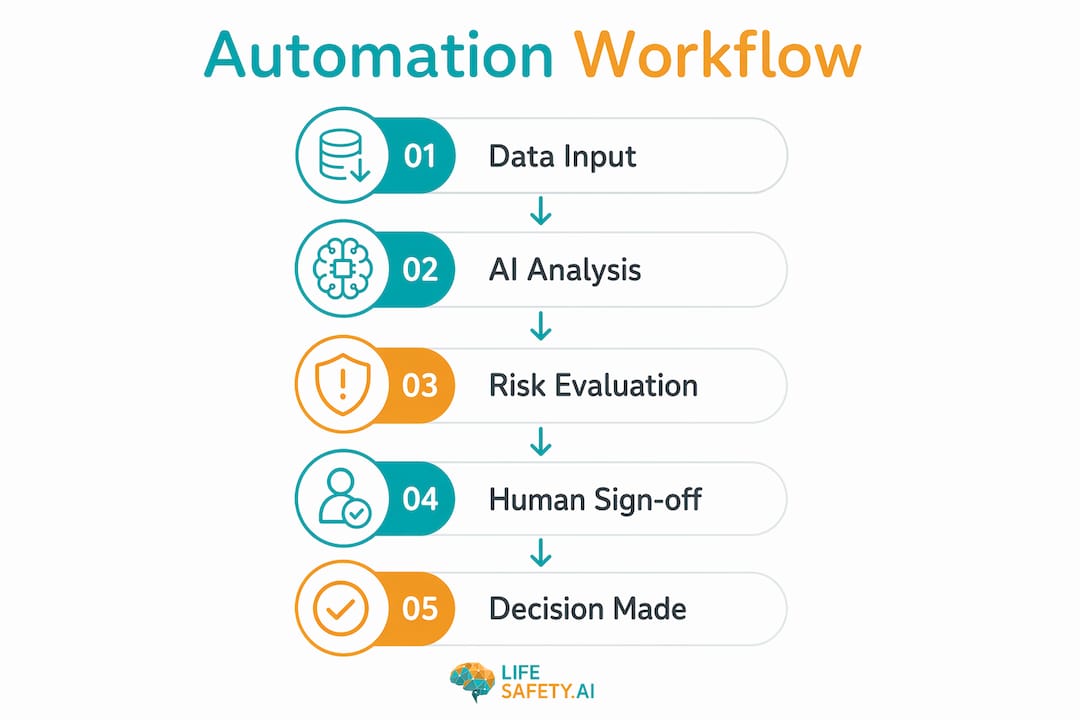
Three technology categories are reshaping how automation improves risk analysis: agentic AI, generative AI, and robotic process automation. Each serves a distinct function, and understanding the difference helps safety managers choose the right tool for the right task.

Agentic AI operates autonomously across multi-step workflows. It can ingest data from multiple sources, complete questionnaires, flag anomalies, and trigger reassessments without human prompting at each stage. Zania’s platform exemplifies this approach, using AI agents that shift assessments to continuous monitoring with dynamic data ingestion rather than static, scheduled reviews.
Generative AI produces structured outputs such as risk narratives, control recommendations, and compliance summaries from unstructured inputs. Its primary risk is hallucination, where the model generates plausible but incorrect content. Structured AI governance reduces hallucination rates from 14.2% to 3.1%, which is the difference between a reliable audit trail and a liability. Embedding generative AI within governed workflows, rather than using it as a standalone prompt tool, is what makes it trustworthy.
Robotic process automation (RPA) handles repetitive, rule-based tasks: populating forms, transferring data between systems, and generating scheduled reports. RPA does not reason or learn, but it executes defined processes with perfect consistency, making it ideal for COSHH assessment data entry or fire risk documentation updates.
A fourth category, AI-assisted questionnaires, is increasingly important in contractor management and supplier assurance. These tools standardise data collection, reduce assessor variation, and improve comparability across portfolios. For principal contractors and accountable persons, that consistency can materially improve evidence quality during internal audits or HSE scrutiny.
| Technology | Primary function | Key benefit | Main risk |
|---|---|---|---|
| Agentic AI | Autonomous multi-step workflows | Continuous, real-time risk monitoring | Requires strong governance to remain auditable |
| Generative AI | Structured output from unstructured data | Fast narrative and control generation | Hallucination without governed workflows |
| Robotic process automation | Rule-based task execution | Perfect consistency on repetitive tasks | Cannot adapt to novel or ambiguous inputs |
| AI-assisted questionnaires | Automated data collection | Standardised inputs across all assessors | Dependent on data quality and template design |
Pro Tip: Embedding AI into your existing workflows, rather than running it as a separate prompt-based tool, is what Moody’s describes as the prompt-to-process approach. This integration is what separates proactive, real-time risk management from ad hoc outputs that are difficult to trace or defend.
What challenges and governance are essential when implementing automation?
Governance is not optional when deploying automation tools for risk assessment. It is the mechanism that makes automated outputs legally defensible, auditable, and reliable. Without it, automation introduces new categories of risk rather than reducing existing ones.
The most significant technical risk is AI hallucination. Generative AI models can produce confident, well-formatted outputs that are factually wrong. In a health and safety context, an incorrect control measure or a missed hazard category is not an abstract problem. It is a potential enforcement failure under the Health and Safety at Work etc. Act 1974. Structured governance frameworks, aligned with standards such as the NIST AI Risk Management Framework, reduce this risk materially.
There are also operational risks. Poorly integrated systems can duplicate records, break version control, or create uncertainty over which assessment is current. Weak access controls can expose sensitive incident data. In regulated environments, these failures can undermine confidence in the entire safety management system.
Critical governance considerations for health and safety teams include:
- Workflow embedding over prompt-based use. Prompt-based AI without workflow integration produces inconsistent, untraceable outputs. AI must be embedded into defined processes with version control and audit logging.
- Continuous supervisory overlays. Static validation at the point of output is insufficient. Effective governance requires ongoing monitoring of model performance and drift over time.
- Human-in-the-loop for high-stakes decisions. Augmented intelligence frameworks clarify that humans retain control for exceptions and final risk acceptance. AI handles volume; professionals handle judgement.
- Data governance and infrastructure readiness. Clear data governance is foundational for AI-enabled risk programmes. Incomplete, inconsistent, or poorly structured data produces unreliable automated outputs regardless of the tool used.
- Traceability and audit trails. Every automated decision must be traceable to its source data and logic. This is non-negotiable for CDM 2015 compliance and HSE inspections.
For UK organisations, governance should also reflect the practical expectations of regulators and clients. That means retaining evidence of who approved the assessment, what data sources were used, when the assessment changed, and how exceptions were escalated. In higher-risk buildings and complex construction projects, these controls support stronger assurance under the Building Safety Act and related dutyholder responsibilities.
How does automation impact health and safety roles and workflows?
Automation does not reduce headcount in health and safety teams. It changes what those teams do. Research from CapTech confirms that automation shifts skill requirements toward data science, AI model tuning, and governance rather than eliminating roles. For safety professionals, this means the job becomes more strategic and more technically demanding at the same time.
The practical workflow shift looks like this. A safety manager who previously spent two days compiling a COSHH assessment from site records, supplier data sheets, and exposure monitoring logs can now review an AI-generated draft in under an hour. The time saved is not absorbed by administration. It is redirected toward site inspections, contractor briefings, and the kind of contextual judgement that no automated system can replicate.
That shift matters because the highest-value work in health and safety has never been form filling. It is intervention quality, workforce engagement, contractor control, and the ability to spot weak signals before they become incidents. Automation can remove friction from the paperwork layer, but it cannot replace competence, leadership, or accountability.
Transitioning effectively to automated workflows requires a structured approach:
- Audit your current processes. Identify which assessment tasks are repetitive, data-heavy, and rule-based. These are the highest-value targets for automation.
- Invest in data quality first. Automated tools are only as reliable as the data they ingest. Standardise your input formats before deploying AI.
- Build AI literacy within your team. Safety professionals do not need to become data scientists, but they do need to understand how to interrogate AI outputs and recognise when a result requires human review.
- Define governance roles clearly. Assign ownership of model performance, audit trail maintenance, and exception handling before go-live.
- Treat automation as augmentation. Future risk teams require cross-domain expertise that combines data and AI skills with deep domain knowledge. The professionals who thrive will be those who use automation to sharpen their strategic contribution, not those who resist it.
Platforms such as LifeSafety.ai can support this transition by centralising assessments, standardising templates, and maintaining a clearer compliance record across fire safety, contractor management, and operational risk workflows. Used properly, that creates more time for competent persons to focus on prevention rather than administration.
What practical results does automation deliver in real risk assessments?
The evidence for automation’s impact on risk management is concrete and measurable. Arendt’s SARA solution demonstrates that annual assessments compressed to one day are achievable at scale, not just in controlled pilots. For organisations running multiple sites under CDM 2015, that time saving translates directly into reduced consultant costs and faster compliance sign-off.
Zania’s third-party risk management platform illustrates a different benefit: consistency and auditability across large supplier networks. By automating questionnaire distribution, response analysis, and risk tier updates, Zania produces records that are comparable across hundreds of assessments. Manual processes cannot achieve that level of standardisation, and inconsistency is precisely what HSE inspectors and internal auditors look for.
The scale of adoption reinforces these outcomes. AI adoption in risk management is projected to rise from 14% to 70% by 2029, with 81% of executives already reporting efficiency gains. That trajectory reflects genuine operational returns, not technology enthusiasm.
| Use case | Tool or approach | Measured outcome |
|---|---|---|
| Annual risk assessment compression | Arendt SARA | Weeks reduced to one day |
| Third-party risk consistency | Zania AI agents | Standardised, auditable outputs at scale |
| AI adoption and efficiency gains | Accenture / KPMG data | 81% of executives report efficiency improvements |
| Professional satisfaction with AI tools | KPMG survey | 98% report improved risk identification and mitigation |
For fire safety and COSHH assessments specifically, platforms like LifeSafety.ai integrate automated workflows with real-time compliance updates, helping assessments reflect current regulatory requirements without relying on manual intervention alone. This is especially useful where organisations need to maintain consistency across multiple premises, contractors, or operational teams.
You can also explore how AI is transforming risk assessments in practical terms, including how digital systems support faster reviews, stronger evidence trails, and more responsive control management.
The most important point is that automation delivers value when it improves the quality of decisions, not just the speed of administration. Faster assessments are useful. Faster, more accurate, and more defensible assessments are what actually improve safety outcomes.
Final takeaway
The role of automation in risk assessments is no longer limited to back-office efficiency. It now affects how hazards are identified, how controls are reviewed, how evidence is retained, and how quickly organisations can respond to change. For UK dutyholders, the opportunity is significant: better consistency, stronger auditability, and more time for competent professionals to focus on prevention.
But automation is only beneficial when it is implemented with discipline. That means good data, governed workflows, clear accountability, and human oversight at the point of risk acceptance. Used in that way, automation strengthens compliance with HSE expectations, supports more robust records under RIDDOR and CDM 2015, and helps organisations build a more proactive safety culture.
If you are reviewing your current assessment process, the practical next step is simple: identify the repetitive tasks that consume time without adding judgement, automate those first, and keep competent people firmly in control of the decisions that matter most.
Related Articles

Incident reporting software comparison: UK guide 2026
Discover our incident reporting software comparison for UK workplaces. Explore top options like Lifesafety, SafetyCulture, and more.

Safety management solutions for construction: UK SMS guide
Discover essential safety management solutions for construction sites in the UK. Learn how a mobile-first SMS can enhance safety and compliance.

Best health and safety software for UK workplaces: 2026 guide
Discover the best health and safety software for UK workplaces in 2026. Explore top picks like Lifesafety for compliance and efficiency!