
Risk management strategies for construction: 2026 guide
Risk management strategies for construction: 2026 guide
TL;DR:
- Effective construction risk management requires task-specific assessments, dynamic trigger-based registers, and clear ownership at all levels.
- Strong leadership and real-time technology integration are essential to prevent risks from escalating into delays, injuries, enforcement action, or contractual disputes.
- Static risk registers and poor enforcement often lead to failure, emphasising the need for continuous protocols and a proactive safety culture aligned with HSE expectations, CDM 2015, and where relevant the Building Safety Act.
Construction projects are high-stakes environments where a single unaddressed risk can cascade into delays, injuries, and legal disputes costing millions. Over 70% of construction projects run late, and poor risk planning is a leading cause. Effective risk management strategies for construction are no longer optional. They are the professional standard separating firms that deliver on time and on budget from those that continually fire-fight. This guide covers ten practical strategies that address the full spectrum of construction project risks, from site safety and supply chain volatility to contract structures and leadership accountability.
Table of Contents
- Key takeaways
- How to evaluate risk management strategies for construction
- 1. Conduct thorough, task-specific risk assessments
- 2. Build a live, trigger-based risk register
- 3. Assign clear ownership across all risk categories
- 4. Shift to multi-hub supply chain models
- 5. Use prefabrication and modular methods strategically
- 6. Implement targeted site safety controls for leading hazards
- 7. Integrate CDM 2015 compliance into risk planning
- 8. Use contracts to transfer risk intelligently
- 9. Strengthen leadership depth across project roles
- 10. Leverage technology for real-time risk monitoring
- My honest take on where most risk strategies fall short
- How Lifesafety supports proactive construction risk management
- FAQ
Key takeaways
| Point | Details |
|---|---|
| Dynamic risk registers matter | Linked trigger points prevent risks from escalating before your next scheduled review. |
| Ownership drives outcomes | Each risk must have a single accountable owner with real authority to act. |
| Procurement is ongoing | Treating supply chain management as a live function reduces schedule and cost volatility significantly. |
| Leadership enforces culture | Weak leadership allows risk to spread unchecked across every project phase. |
| Technology closes the gap | AI-driven tools convert static checklists into real-time, responsive safety management processes. |
How to evaluate risk management strategies for construction
Before applying any strategy, you need a framework to judge whether it will actually work for your project and organisation. Not every approach suits every site.
The most reliable criteria for construction risk assessment include five factors:
- Identification accuracy: Does the method capture all relevant hazards, including those specific to the task, phase, and location?
- Ownership clarity: Is there a named individual with real authority to act on each risk, not just to document it?
- Trigger responsiveness: Does the strategy respond to live project signals rather than waiting for a scheduled review?
- Phase integration: Is risk analysis built into procurement, design, mobilisation, and handover rather than bolted on at the start?
- Scalability: Can the approach function on a two-person groundworks package as well as a multi-contractor infrastructure scheme?
Leadership is the binding factor across all five. Deficient structured application is the primary barrier to effective risk management, not a shortage of tools or templates. A firm with strong leadership enforcing continuous protocols will consistently outperform one with sophisticated software but fragmented accountability.
Pro Tip: Audit your current risk register for trigger points. If it cannot answer “what site event would force us to review this risk today?”, it is a static document rather than a live management tool.
1. Conduct thorough, task-specific risk assessments
Generic risk assessments written once at project inception are one of the most common and most costly failures in construction safety management. A risk assessment written for excavation work on one site is not fit for purpose on another with different ground conditions, utilities, and access constraints.
Task-specific and site-specific assessments dramatically improve both relevance and regulatory compliance. A well-structured risk assessment should capture the hazard description, risk category, likelihood rating, potential impact, control measures, response plan, current status, and a named owner. That last field matters more than most teams realise.
The process of conducting these assessments works best when structured as follows:
- Identify all foreseeable hazards at task level before work begins.
- Rate each hazard for likelihood and severity to produce a risk score.
- Define control measures and assign a single named owner for each risk.
- Link each risk entry to a trigger point that mandates review, such as a weather threshold or a missed delivery date.
- Update assessments after incidents, near misses, or significant scope changes.
Risk registers must include trigger points linked to real project signals so that review happens when it is needed, not when it happens to be scheduled. This transforms a register from a compliance document into a genuine management tool.
Pro Tip: Assign risk ownership across roles including project managers, site superintendents, procurement leads, and safety officers. Each owner should have the authority and the resources to act, not just to flag.
2. Build a live, trigger-based risk register
A risk register without dynamic review points is a liability dressed up as a control. Active trigger points ensure timely re-evaluation before risks escalate into incidents or delays.
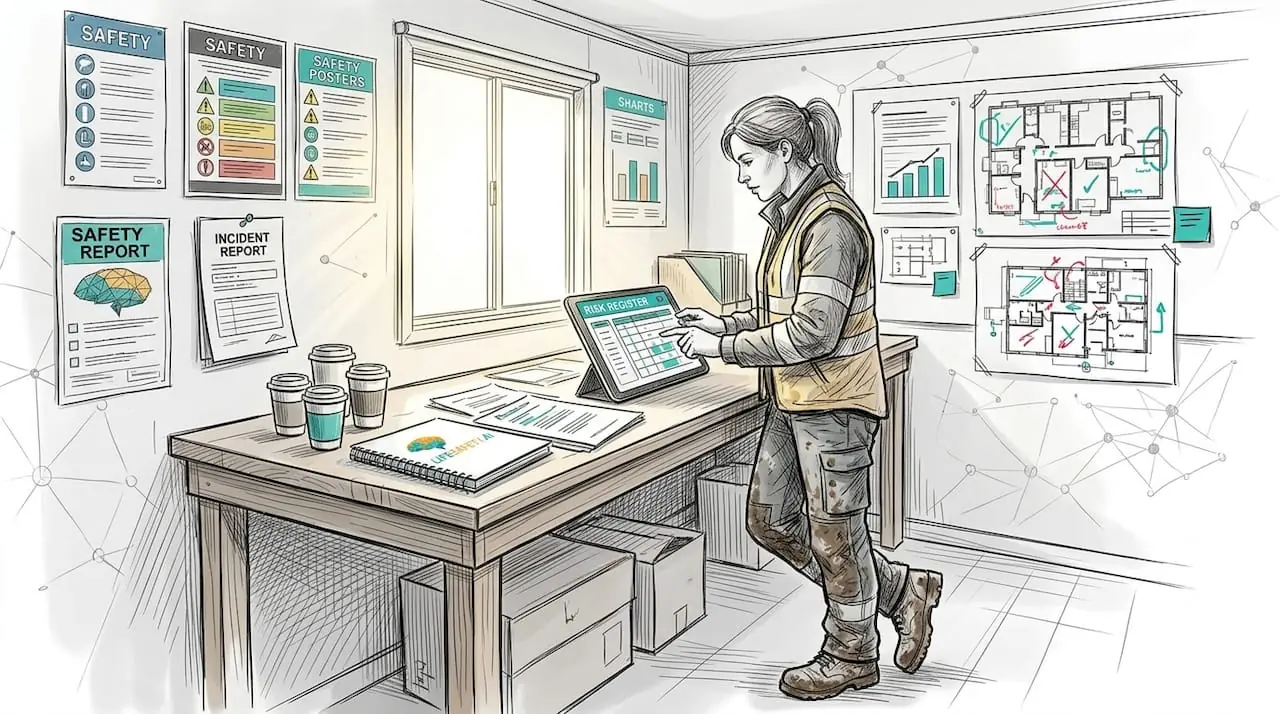
Triggers should be tied to specific, observable project events. A missed submittal deadline triggers a schedule risk review. A rainfall threshold triggers a review of earthworks stability controls. A supplier price movement beyond a defined percentage triggers a procurement and budget risk review.
This approach keeps risk analysis proportionate to what is actually happening on the project rather than to an arbitrary calendar interval. Teams that practise trigger-based reviews catch problems weeks earlier than those relying on monthly risk meetings.
3. Assign clear ownership across all risk categories
A practical risk management plan assigns specific owners for each risk with the authority to act, not just to report. This distinction separates firms with effective risk cultures from those with impressive documentation and poor outcomes.
Ownership should span the full project hierarchy. Project managers own programme and commercial risks. Site superintendents own physical site and safety risks. Procurement leads own supply chain and material risks. Executives own strategic, reputational, and insurance-related risks. When every risk has a named owner with the authority and the budget to respond, escalation paths are clear and response times shrink.
For UK projects, this ownership model should also align with statutory duty holders. Under CDM 2015, clients, principal designers, principal contractors, designers, and contractors each have defined responsibilities. Risk ownership should therefore complement, not conflict with, legal duties. If a risk concerns design co-ordination, temporary works interfaces, or residual hazards, the accountable owner must be positioned to influence those decisions in practice.
4. Shift to multi-hub supply chain models
Single-source supplier dependency is one of the most underestimated construction project risks. When a sole supplier faces a production disruption, port delay, or pricing shock, the entire project schedule is exposed.
Leading construction firms adopt multi-hub supply models and treat procurement as a continuous management activity alongside financials and field reporting. The practical benefits are significant:
- Concentration risk reduction: Spreading procurement across multiple qualified suppliers means no single disruption grounds the project.
- Price stability: Competing supplier relationships provide leverage during volatile commodity periods.
- Lead time resilience: Regional and national sourcing options reduce exposure to logistics disruptions.
- Early procurement integration: Bringing procurement into the pre-construction phase rather than treating it as a downstream task.
The table below illustrates how reactive and proactive supply chain approaches compare across key risk dimensions.
| Risk dimension | Reactive approach | Proactive multi-hub approach |
|---|---|---|
| Supplier base | Single source per trade | Multiple qualified suppliers per category |
| Market monitoring | Ad hoc, triggered by crisis | Continuous, with defined price thresholds |
| Procurement timing | Post-contract award | Integrated from pre-construction phase |
| Schedule impact | High when disruption occurs | Managed through alternative sourcing |
| Cost predictability | Volatile | Significantly more stable |
Pro Tip: Treat procurement as a live input into your weekly project review, alongside programme and cost. Early warnings on material lead times are only useful if they trigger action before the window closes.
5. Use prefabrication and modular methods strategically
Prefabrication and modular construction offer genuine schedule certainty benefits, particularly for repetitive structural and services elements. Manufacturing in controlled environments reduces exposure to weather delays, site access constraints, and trades sequencing conflicts.
That said, modular construction introduces new risks in cyber security, ergonomic handling, and transport logistics that traditional insurance policies often do not cover. Engaging your insurance broker and CDM co-ordinator early in the design phase closes these gaps before they become contractual disputes. The schedule benefits of modular approaches are real, but only when the unique risk profile is mapped and managed from the outset.
On UK projects, modular strategies should also be reviewed against lifting plans, transport route constraints, fire performance requirements, and the golden thread expectations that increasingly shape higher-risk building information management. Off-site manufacture can reduce site exposure, but it does not remove the need for robust design risk management and installation controls.
6. Implement targeted site safety controls for leading hazards
The construction site safety agenda is well understood in principle and persistently underdelivered in practice. The leading causes of serious injury and fatality on UK construction sites remain falls from height, contact with moving plant, collapse of excavations, and exposure to hazardous substances. Addressing them demands targeted controls, not generic safe systems of work.
Technology and AI-driven tools transform risk management from static checklists to dynamic, real-time processes that enable faster action when conditions change. Effective strategies for construction safety in this area include:
- Linking risk assessments directly to method statements (RAMS) so controls are communicated to operatives before work begins.
- Using digital permit-to-work systems to manage high-risk activities including hot works, confined space entry, and live service isolation.
- Deploying mobile incident logging so near misses are captured in real time rather than going unrecorded.
- Conducting routine safety audits with defined frequencies for different risk levels.
Near-miss tracking deserves particular attention. Organisations that systematically capture and investigate near misses build a much stronger leading-indicator picture than those relying only on injury statistics. By the time an incident becomes reportable under RIDDOR, the control system has already failed. The better approach is to identify weak signals early, investigate root causes, and update controls before harm occurs.
For the highest-risk activities, targeted controls should include:
- Work at height: hierarchy of control, edge protection, inspected access equipment, rescue planning, and supervision of short-duration tasks that are often underestimated.
- Plant and vehicle movement: segregated routes, banksman arrangements, exclusion zones, visibility controls, and competency checks for operators.
- Excavations: service detection, temporary works design, inspection regimes, spoil placement controls, and weather-triggered reviews.
- Hazardous substances: COSHH assessment, ventilation, exposure monitoring where required, and substitution of harmful materials where reasonably practicable.
Compliance note: Where an incident meets reporting thresholds, ensure prompt assessment against RIDDOR requirements and maintain clear records for internal investigation, insurer notification, and client reporting.
7. Integrate CDM 2015 compliance into risk planning
Construction risk management in the UK cannot be separated from CDM 2015. Too many organisations still treat compliance as a parallel paperwork exercise rather than the legal framework that should shape how risk is identified, designed out, communicated, and controlled.
Effective integration means embedding CDM duties into the project lifecycle from concept through handover. That includes ensuring the client makes suitable arrangements, the principal designer plans and manages design risk, and the principal contractor co-ordinates site controls and contractor interfaces. Risk planning should not sit in a silo from these duties.
In practical terms, this means:
- Reviewing design decisions for opportunities to eliminate hazards at source before relying on procedural controls.
- Maintaining a clear flow of pre-construction information so contractors understand site constraints, residual risks, and existing hazards.
- Ensuring the construction phase plan reflects actual site conditions, sequencing, and interfaces rather than generic templates.
- Capturing residual risks and key safety information for the health and safety file at the right time, not as an afterthought at project close.
Where projects fall within the scope of the Building Safety Act, the standard rises further. Duty holders need stronger evidence trails, better information management, and clearer accountability for design and construction decisions affecting building safety. A mature risk strategy therefore supports both day-to-day site safety and the longer-term integrity of the asset.
8. Use contracts to transfer risk intelligently
Contracts are a risk management tool, but only when used intelligently. Poorly drafted clauses do not remove risk; they simply move disputes downstream. The aim is not to push every exposure onto the weakest party. It is to allocate risk to the organisation best able to control it, insure it, or price it accurately.
In construction, this usually means distinguishing between risks that are controllable by the contractor, those that sit with the client, and those that should be shared or expressly managed through contingency. Ground conditions, design completeness, inflation, delay damages, and interface risk all need careful treatment.
Good contractual risk transfer should include:
- Clear definitions: ambiguous drafting creates claims, not certainty.
- Notice provisions: teams must know when and how to notify delay, change, or compensation events.
- Insurance alignment: contractual obligations should match actual policy cover and exclusions.
- Supply chain flow-down: key obligations must be reflected in subcontracts where the operational risk sits lower in the chain.
- Realistic allocation: transferring uncontrollable risk often results in inflated pricing or later dispute.
Commercial teams should work closely with project delivery and safety leads. A contract may allocate responsibility for temporary works, design co-ordination, or access arrangements, but if the site team does not understand those obligations, the paper protection is of limited value.
9. Strengthen leadership depth across project roles
Most risk systems do not fail because the organisation lacks forms, software, or policy statements. They fail because leadership depth is weak. When supervisors are inconsistent, managers avoid difficult decisions, or directors only engage after an incident, risk spreads quickly across programme, quality, and safety.
Strong leadership depth means more than having one capable project lead. It means resilience across the full chain of command so that standards hold under pressure, during absences, and when the programme tightens. This is especially important on complex projects with multiple subcontractors and changing site conditions.
Leadership behaviours that improve risk outcomes include:
- Visible site engagement: leaders regularly test whether controls are working in practice, not just on paper.
- Decisive escalation: unresolved issues are raised early rather than normalised.
- Consistent standards: the same expectations apply across all trades and all shifts.
- Learning culture: incidents, near misses, and audit findings lead to action rather than blame avoidance.
- Competence development: supervisors and managers are trained to understand both operational and legal risk.
In the UK context, leadership also means understanding when a matter has regulatory significance. A serious near miss involving structural instability, service strike, or lifting failure may require immediate stand-down, formal investigation, and review of whether wider duty-holder arrangements remain adequate.
10. Leverage technology for real-time risk monitoring
Technology is most valuable when it closes the gap between identifying a risk and acting on it. In many organisations, that gap is still too wide. Paper forms, delayed reporting, and disconnected spreadsheets mean the project team often learns about a control failure after the opportunity to prevent escalation has passed.
Real-time monitoring tools improve this by connecting field observations, inspections, permits, incidents, and corrective actions in one workflow. Instead of waiting for a weekly meeting, teams can respond as soon as a threshold is crossed or a pattern emerges.
High-value use cases include:
- Digital inspections and audits with automatic action tracking and overdue alerts.
- Mobile incident and near-miss reporting that captures evidence at the point of occurrence.
- Permit-to-work controls linked to live site conditions and authorisation workflows.
- Risk register automation that prompts review when trigger events occur.
- Dashboard reporting for directors, project managers, and safety teams to spot trends early.
Used properly, AI can help identify recurring themes, prioritise corrective actions, and surface weak signals that would otherwise be buried in narrative reports. The key is governance. Technology should support competent decision-making, not replace it. Data quality, ownership, and follow-through still determine whether the system improves outcomes.
For many contractors, the biggest gain is not sophistication but consistency. A single digital environment for risk assessments, audits, incidents, and actions creates a much clearer line of sight from board-level assurance to site-level control.
My honest take on where most risk strategies fall short
Most construction risk strategies do not fail because the hazards were unknowable. They fail because the organisation tolerated drift. Reviews became routine, ownership became blurred, and warning signs were treated as noise until they became incidents, delays, or claims.
The most common weaknesses are predictable:
- Registers are static: risks are logged but not actively managed against live triggers.
- Ownership is nominal: people are named, but they lack authority, budget, or time to act.
- Safety and commercial risk are separated: procurement, programme, and site controls are reviewed in different conversations even though they affect one another.
- Leadership intervenes too late: senior attention arrives after escalation rather than at the point of early warning.
- Learning loops are weak: near misses and audit findings do not reliably change future planning.
If you want a more resilient project, start by making the system harder to ignore. Build trigger points into reviews. Give owners real authority. Link site intelligence to management action. And insist that compliance evidence reflects what is actually happening on the ground. That is where mature risk management begins.
How Lifesafety supports proactive construction risk management
LifeSafety.ai helps construction teams move from static compliance records to active risk control. Instead of managing assessments, incidents, audits, and actions across disconnected tools, teams can centralise critical safety workflows in one place.
Core capabilities for construction teams
- Digital risk assessments tailored to task, location, and activity.
- Incident and near-miss reporting with faster escalation and investigation.
- Audit and inspection workflows that track findings through to close-out.
- Action management with named owners and due dates.
- Centralised records to support HSE inspections, client assurance, and internal governance.
Why this matters in practice
- Improves visibility of high-risk activities across multiple sites.
- Supports stronger evidence for CDM 2015 arrangements and contractor management.
- Helps teams identify trends before they become RIDDOR-reportable events.
- Reduces administrative lag between field observation and corrective action.
- Creates a clearer audit trail for insurers, clients, and senior leadership.
For organisations managing complex contractor interfaces, temporary works, or high-risk operations, that visibility is often the difference between a controlled issue and a disruptive event. If your current process relies on spreadsheets, email chains, and retrospective updates, there is usually significant room to improve both compliance confidence and operational response.
FAQ
What is the most effective risk management strategy for construction projects?
The most effective approach combines task-specific risk assessments, a live trigger-based risk register, and clear ownership for every significant risk. No single document is enough on its own. The system must be reviewed dynamically as site conditions, design information, procurement status, and contractor interfaces change.
How often should a construction risk register be reviewed?
It should be reviewed on a scheduled basis, but more importantly it should be reviewed whenever a defined trigger occurs. Examples include design changes, weather events, programme slippage, supplier delays, incidents, near misses, or changes in site access. If review only happens monthly, the register is likely too static.
How does CDM 2015 affect construction risk management?
CDM 2015 sets the legal framework for managing health and safety risk in UK construction. It defines duty-holder responsibilities and requires risks to be planned, managed, monitored, and co-ordinated throughout the project. Effective risk management should therefore align with client, principal designer, principal contractor, designer, and contractor duties.
What construction incidents must be reported under RIDDOR?
RIDDOR covers specified injuries, over-seven-day incapacitation, dangerous occurrences, certain occupational diseases, and work-related fatalities. Construction businesses should have a clear internal process for assessing reportability quickly, preserving evidence, and initiating investigation and corrective action.
Why do construction risk assessments often fail?
They often fail because they are too generic, not updated when conditions change, and not linked to real ownership or site controls. A risk assessment that is copied from a previous project or filed without active review provides little practical protection.
Can technology improve construction safety compliance?
Yes. Digital systems can improve consistency, speed of reporting, action tracking, and management visibility. They are particularly useful for inspections, permits, incident reporting, and maintaining evidence trails. However, technology only works when supported by competent people, clear processes, and leadership follow-through.
Related Articles

Incident reporting software comparison: UK guide 2026
Discover our incident reporting software comparison for UK workplaces. Explore top options like Lifesafety, SafetyCulture, and more.

Safety management solutions for construction: UK SMS guide
Discover essential safety management solutions for construction sites in the UK. Learn how a mobile-first SMS can enhance safety and compliance.

Best Health and Safety Software for UK Workplaces: A Guide
Discover the best health and safety software for UK workplaces in 2026. Explore top picks like Lifesafety for compliance and efficiency!