
RIDDOR reporting guide for UK compliance officers
RIDDOR reporting guide for UK compliance officers
A practical guide to incident classification, reporting deadlines, internal workflows, and record-keeping under the Reporting of Injuries, Diseases and Dangerous Occurrences Regulations 2013.
TL;DR
- RIDDOR requires employers and premises controllers to report specific workplace incidents within prescribed deadlines to the HSE.
- Proper incident classification, timely reporting, and maintaining accurate records are essential for legal compliance and effective safety management.
- Building a documented internal process with trained responsible persons reduces reporting errors and supports ongoing regulatory adherence.
RIDDOR is defined as the Reporting of Injuries, Diseases and Dangerous Occurrences Regulations 2013, the UK statutory framework that legally compels employers and premises controllers to report specific workplace incidents to the Health and Safety Executive. This RIDDOR reporting guide covers every aspect practitioners need: who holds legal duty, which incidents trigger a report, exact submission deadlines, how to build an internal reporting workflow, and the most costly mistakes organisations make. Mastering these procedures protects your organisation from criminal prosecution, supports HSE investigations, and drives genuine safety improvement across your site.
Who is legally responsible for RIDDOR reporting?
Responsible persons under RIDDOR include employers, self-employed individuals who control their own premises, and any person in control of work premises where a non-worker is injured. This three-way definition matters because it distributes accountability beyond the traditional employer-employee relationship. A facilities manager overseeing a shared office building, for example, carries the same reporting duty as a manufacturing plant director when a contractor or visitor is harmed on site.
The distinction between workers and non-workers is particularly significant. For workers, the employer always holds primary responsibility. For members of the public or contractors not under direct employment, the duty falls to whoever controls the premises at the time of the incident. Site managers on construction projects, retail premises managers, and school bursars all fall within scope.
Failure to report carries serious legal consequences. Non-compliance can result in criminal prosecution, unlimited fines, and up to two years’ imprisonment. Beyond the legal penalty, a missed report can compromise an HSE investigation and expose the organisation to civil liability. The key responsibilities of duty holders are:
- Identifying whether an incident meets RIDDOR reporting thresholds
- Submitting reports within the correct timeframes via the HSE online portal or telephone
- Retaining records of all reportable incidents for a minimum of three years
- Ensuring that designated responsible persons are trained and authorised to submit reports
- Reviewing and updating internal procedures when organisational structures change
Small business owners and sole traders who control their own premises must treat themselves as both employer and premises controller, meaning they cannot delegate this duty unless they formally appoint a competent person.
What incidents must be reported under RIDDOR?
RIDDOR legally requires the reporting of work-related deaths, specified injuries, over-7-day incapacitation injuries, injuries to non-workers requiring hospital treatment, diagnosed occupational diseases, and dangerous occurrences. Not every workplace accident triggers a formal report, which is precisely where misclassification errors occur most frequently. Understanding the categories in detail is the foundation of sound RIDDOR accident reporting.

Work-related deaths must be reported without delay whenever a worker or non-worker dies as a result of a work-related accident, including acts of physical violence. The connection to work activity is the determining factor, not simply the location.
Specified injuries represent a defined list of serious physical harms. Specified injuries include fractures (excluding fingers, thumbs, and toes), amputations, serious burns covering more than 10% of the body, scalping requiring hospital treatment, and loss of consciousness caused by head injury or asphyxia. Each of these has a clear clinical definition, which means a GP or A&E consultant’s notes are often the most reliable evidence for classification.
Over-7-day incapacitation injuries apply when a worker cannot perform their normal duties for more than seven consecutive days, not counting the day of the accident. The counting method is inclusive of non-working days such as weekends and bank holidays, which is a common source of error.
| Incident type | Reporting deadline | Reporting route |
|---|---|---|
| Work-related death | Without delay | HSE telephone and online portal |
| Specified injury | Without delay, then written within 10 days | HSE online portal |
| Over-7-day incapacitation | Within 15 days of the accident | HSE online portal |
| Non-worker injury (hospital treatment) | Within 10 days | HSE online portal |
| Occupational disease | Upon diagnosis confirmation | HSE online portal |
| Dangerous occurrence | Without delay, then written within 10 days | HSE telephone and online portal |
Dangerous occurrences are serious near-miss events that must be reported even when no injury results. Dangerous occurrences include equipment failures and hazardous substance releases prescribed in HSE’s schedule. A scaffold collapse with no casualties on a construction site is a reportable dangerous occurrence. Reviewing construction site safety examples helps practitioners recognise these events in high-risk environments.
Pro Tip: Recording an incident in your accident book does not constitute a RIDDOR report. These are two separate legal obligations. Always assess reportability independently of your internal recording process.
How and when should RIDDOR reports be submitted to the HSE?
HSE’s two-part reporting system requires immediate notification for the most serious incidents, followed by a formal written report. This structure allows the regulator to intervene quickly without waiting for full documentation. The practical implication is that you must have a process for both the initial call and the subsequent written submission.
The submission process follows these steps:
- Assess reportability immediately. As soon as an incident occurs, the responsible person must determine whether it meets a RIDDOR threshold. Use the HSE’s online decision tool if classification is uncertain.
- Report deaths, specified injuries, and dangerous occurrences without delay. Telephone the HSE on 0345 300 9923 for fatalities and life-threatening injuries. The online portal is acceptable for specified injuries where the situation is stable.
- Submit the formal written report within 10 days for deaths, specified injuries, non-worker injuries, and dangerous occurrences. For over-7-day incapacitation injuries, the written report deadline is 15 days from the date of the accident.
- Complete all required fields accurately. Reports must include the nature of the injury or illness, details of the people involved, the circumstances of the incident, and the location. Incomplete submissions trigger regulatory follow-up.
- Amend the report if circumstances change. If a worker initially classified as having an over-7-day injury later dies from their injuries, the report must be updated immediately via the HSE portal.
- Retain all records for a minimum of three years. This applies to both the submitted report and your internal incident documentation.
Reporting delays and incomplete data capture within the 10 or 15-day windows frequently require corrections and rework, complicating legal compliance. Gathering evidence immediately after an incident, including photographs, witness statements, and medical notes, is the most effective way to avoid this.
Pro Tip: Set a calendar alert the moment an over-7-day injury is recorded. The 15-day clock starts from the date of the accident, not the day the incapacitation threshold is confirmed.
How to build an effective internal RIDDOR reporting process
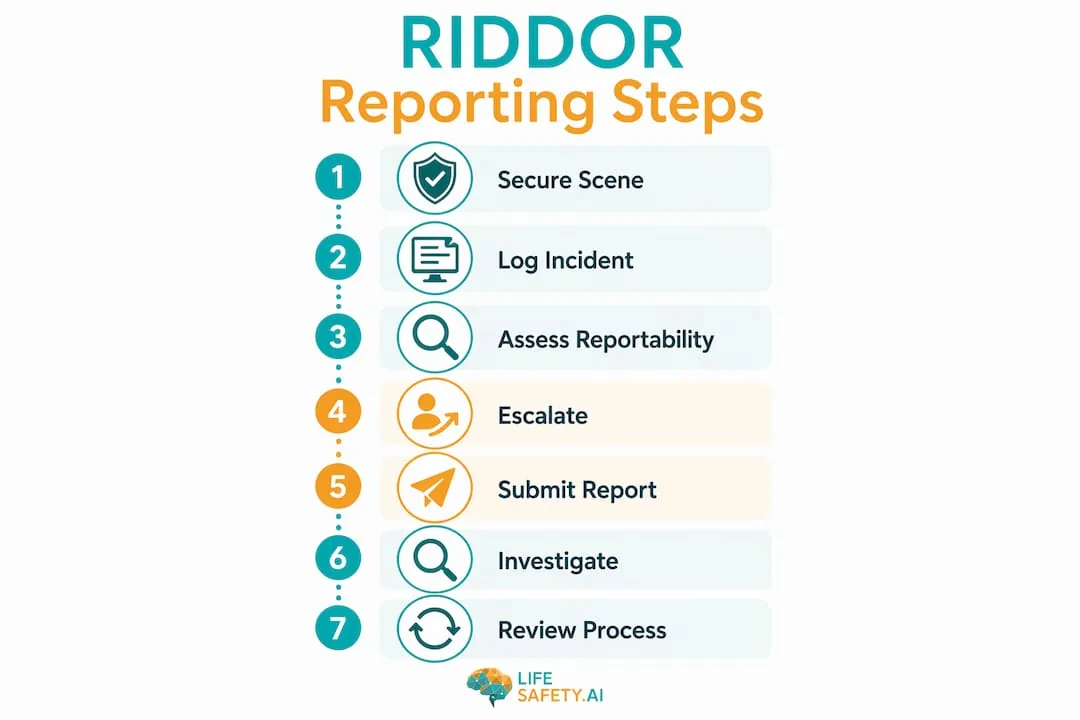
Most organisations that struggle with RIDDOR compliance do so not because they lack knowledge of the regulations, but because their internal processes are inconsistent. A structured workflow removes reliance on individual memory and reduces the risk of missed deadlines.
Step 1: Secure the scene and provide immediate care. The first priority after any incident is the safety and welfare of those involved. Preserve physical evidence where it is safe to do so.
Step 2: Log the incident internally within 24 hours. Record the date, time, location, people involved, nature of the injury or illness, and immediate circumstances. This internal log is separate from the RIDDOR report but feeds directly into it.
Step 3: Assess RIDDOR reportability. The responsible person reviews the incident against the classification criteria. Using HSE’s decision guidance tools is the recommended approach when classification is uncertain. Not every incident is reportable, and over-reporting can create unnecessary administrative burden.
Step 4: Escalate to the designated responsible person. In larger organisations, the duty holder may not be the person who first logs the incident. A clear escalation path, with named individuals and deputies, prevents reporting gaps.
Step 5: Submit to the HSE within the required timeframe. Use the online portal for most reports. Telephone for fatalities and the most serious injuries.
Step 6: Conduct a post-incident investigation. The investigation should identify root causes and contributing factors, not simply describe what happened. Findings feed directly into corrective actions.
Step 7: Review and update your process. Maintaining a RIDDOR decision log integrated with incident investigation workflows enables faster compliance and audit readiness. Review the log quarterly to identify patterns and training needs.
The internal process should be documented in your safety management system and reviewed annually or whenever there is a significant change in site operations, workforce composition, or regulatory guidance.
For higher-risk sectors such as construction and manufacturing, this workflow should align with wider legal duties under CDM 2015, contractor control arrangements, permit-to-work systems, and, where relevant, the governance expectations introduced by the Building Safety Act. Integrating RIDDOR decisions into digital incident management tools, corrective action tracking, and competency records can materially improve consistency. Platforms such as LifeSafety.ai can support this by centralising incident logs, assigning actions, and preserving an auditable trail for inspections and internal reviews.
What common mistakes do organisations make in RIDDOR reporting?
Common mistakes include confusing accident book recording with RIDDOR reporting, missing the over-7-day threshold, and delays in submission. These errors are preventable with the right training and process design. The following mistakes appear most frequently across construction, manufacturing, and facilities management environments:
- Treating the accident book as a RIDDOR report. Internal recording and statutory reporting are distinct obligations. An entry in the accident book satisfies neither the reporting deadline nor the legal submission requirement.
- Miscounting the over-7-day threshold. The day of the accident is excluded from the count, but weekends and bank holidays are included. A worker injured on a Thursday who cannot return until the following Friday has been incapacitated for eight days, triggering the reporting obligation.
- Delaying immediate reports for deaths and specified injuries. Some organisations wait until they have gathered full documentation before contacting the HSE. The regulations require notification without delay, with the written report to follow within 10 days.
- Misclassifying incidents. A fracture to a finger does not meet the specified injury threshold, but a fracture to the wrist does. Misclassification leads to either missed reports or unnecessary submissions, both of which create compliance risk.
- Failing to update reports when circumstances change. If an injury initially classified as over-7-day incapacitation later results in death, the report must be amended immediately.
- Neglecting record retention. Records must be kept for at least three years. Organisations that rely solely on paper-based systems frequently lose documentation during office moves or staff changes.
Another recurring issue is poor role clarity. Supervisors may assume the health and safety manager has reported an incident, while the health and safety manager assumes the site team is still gathering facts. Unless your procedure names a primary responsible person and a deputy, this gap can easily lead to a missed deadline.
There is also a tendency to focus only on injuries and overlook occupational diseases and dangerous occurrences. In manufacturing, exposure-related diagnoses may be reportable once confirmed by a doctor. In construction, structural failures, lifting incidents, and service strikes may trigger reporting even where no one is harmed. These categories are often under-reported because they sit outside the traditional “accident” mindset.
The most effective control measures are straightforward:
- Use a written decision tree for incident classification
- Train supervisors, managers, and administrators on reporting triggers
- Set automated reminders for 10-day and 15-day deadlines
- Require a second-person review for serious incidents before submission
- Audit retained records periodically to confirm completeness and accessibility
How should RIDDOR records be kept and audited?
RIDDOR requires duty holders to keep records of reportable incidents for at least three years, but in practice many organisations retain them for longer to support civil claims defence, trend analysis, insurer requests, and broader governance obligations. Good record-keeping is not simply about storing a copy of the submitted form. It means preserving the evidence that supports the classification decision and demonstrates that the report was made on time.
A robust RIDDOR file should normally include:
- A copy of the submitted HSE report or confirmation reference
- The internal incident report and accident book entry where applicable
- Witness statements and supervisor notes
- Photographs, CCTV stills, sketches, or scene records
- Medical confirmation relevant to classification, such as diagnosis or treatment details
- Investigation findings, root cause analysis, and corrective actions
- Evidence of communication with senior management, contractors, or clients where relevant
Auditing these records should form part of your wider health and safety assurance programme. A quarterly or biannual review can test whether incidents were classified correctly, reported within deadline, and followed by appropriate corrective action. This is especially important on multi-site estates, principal contractor arrangements, and complex occupied buildings where reporting responsibilities can become blurred.
Digital systems offer clear advantages over fragmented spreadsheets and paper files. Searchability, date stamping, access controls, and workflow history all help demonstrate compliance during an HSE inspection or internal governance review. If your organisation operates under ISO 45001 or similar management standards, RIDDOR records should also link to non-conformance, action tracking, and management review processes.
How do RIDDOR reporting duties connect with wider UK safety compliance?
RIDDOR does not operate in isolation. It sits within the broader framework of UK health and safety law, including the Health and Safety at Work etc. Act 1974, the Management of Health and Safety at Work Regulations 1999, and sector-specific duties such as CDM 2015 for construction. A reportable incident is often a signal that risk assessment, supervision, maintenance, training, or contractor management controls need review.
On construction projects, a RIDDOR event may trigger scrutiny of construction phase plans, site inductions, temporary works controls, lifting operations, and principal contractor coordination. In occupied higher-risk buildings, the Building Safety Act has increased expectations around governance, accountability, and evidence of control. While the Act does not replace RIDDOR, it reinforces the need for clear information management and competent oversight where building safety risks are present.
In manufacturing and engineering environments, reportable incidents often intersect with machinery safety, lockout-tagout equivalents, hazardous substances, maintenance regimes, and occupational health surveillance. A compliance officer should therefore treat every RIDDOR decision as both a legal reporting question and a management systems learning opportunity.
Practical integration points include:
- Linking RIDDOR reviews to risk assessment updates
- Checking whether contractor competence and supervision were adequate
- Reviewing whether training records support safe systems of work
- Escalating serious incidents into board or senior leadership reporting
- Tracking corrective actions to closure with evidence
This joined-up approach helps organisations move beyond minimum compliance and towards demonstrable risk reduction.
What should compliance officers do immediately after a potentially reportable incident?
The first few hours after a serious incident are critical. Decisions made at this stage affect legal compliance, evidence quality, and the organisation’s ability to learn from the event. Compliance officers should work from a predefined checklist rather than relying on memory.
- Confirm emergency response actions are complete. Ensure injured persons have received appropriate treatment and emergency services have been contacted where necessary.
- Secure the area. Prevent disturbance of the scene unless there is an ongoing risk that requires immediate intervention.
- Identify the duty holder. Confirm whether the employer, self-employed person, or premises controller is legally responsible for reporting.
- Start evidence capture immediately. Obtain photographs, witness details, equipment information, and initial factual accounts while memories are fresh.
- Assess whether immediate HSE notification is required. Fatalities, specified injuries, and dangerous occurrences may require action without delay.
- Open an internal investigation file. Record timelines, decisions, and actions taken from the outset.
- Notify internal stakeholders. This may include directors, project leads, HR, facilities, insurers, and client representatives depending on the context.
Where contractor interfaces are involved, establish early who controlled the work, who controlled the premises, and who is making the statutory report. Assumptions in this area are a common source of duplicated or missed submissions.
RIDDOR reporting guide final compliance checklist
For UK compliance officers, effective RIDDOR management comes down to disciplined execution: classify correctly, report on time, keep evidence, and learn from every event. The law is prescriptive, but compliance becomes much easier when responsibilities are clear and the process is embedded into day-to-day operations.
Use this final checklist to strengthen your arrangements:
- Define duty holders clearly for workers, contractors, visitors, and shared premises
- Train named responsible persons and appoint deputies for absence cover
- Use a documented decision process for deaths, specified injuries, diseases, dangerous occurrences, and over-7-day injuries
- Meet reporting deadlines of immediate notification, 10 days, or 15 days as applicable
- Keep records for at least three years with supporting evidence and investigation outputs
- Audit your system regularly to identify missed reports, weak classifications, or recurring causes
- Integrate RIDDOR into wider compliance management including CDM 2015, occupational health, contractor control, and Building Safety Act governance where relevant
If your organisation wants to improve consistency, reduce administrative friction, and maintain a stronger audit trail, centralising incident reporting and corrective action management in a dedicated platform can make a significant difference. LifeSafety.ai supports this approach by helping teams standardise workflows, evidence decisions, and maintain visibility across sites and portfolios.
Ultimately, RIDDOR compliance is not just about avoiding enforcement. It is about ensuring serious events are recognised, escalated, investigated, and used to prevent recurrence. That is the standard regulators expect, and it is the standard high-performing organisations should set for themselves.
Related Articles

Incident reporting software comparison: UK guide 2026
Discover our incident reporting software comparison for UK workplaces. Explore top options like Lifesafety, SafetyCulture, and more.

Safety management solutions for construction: UK SMS guide
Discover essential safety management solutions for construction sites in the UK. Learn how a mobile-first SMS can enhance safety and compliance.

Best Health and Safety Software for UK Workplaces: A Guide
Discover the best health and safety software for UK workplaces in 2026. Explore top picks like Lifesafety for compliance and efficiency!