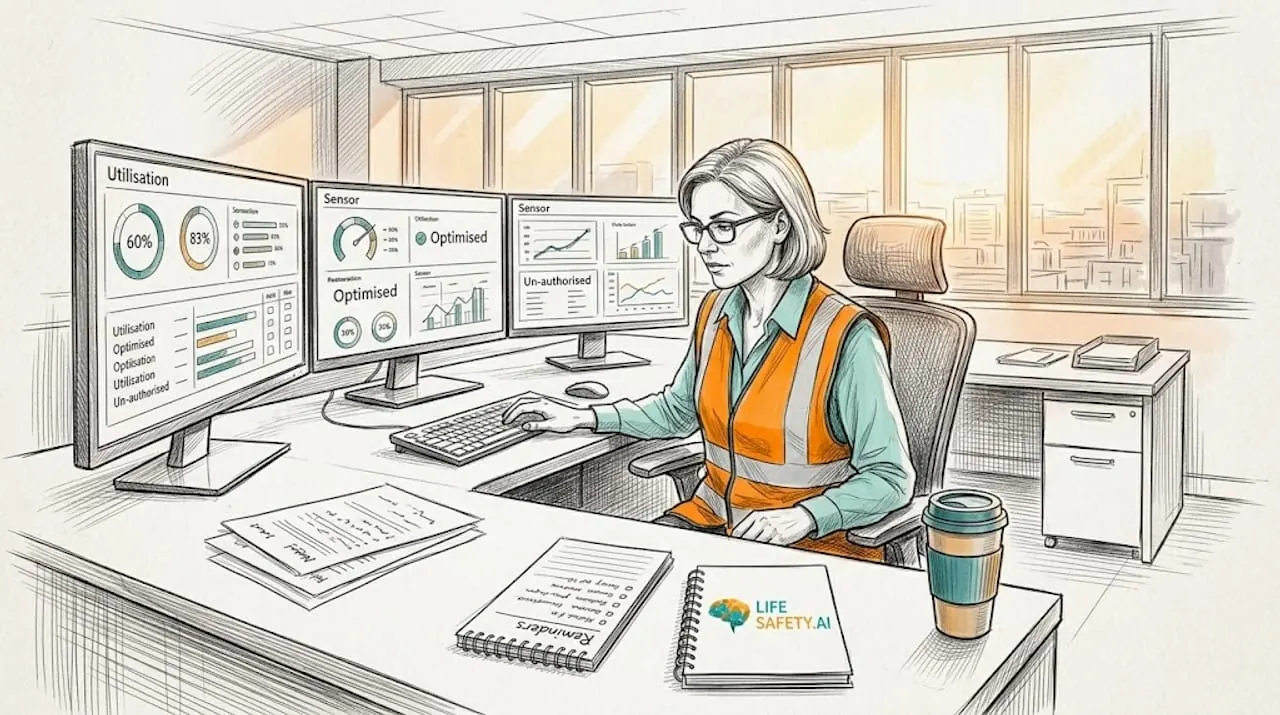
Real-Time Hazard Monitoring: Guide for Safety Professionals
Health & Safety Guidance
Real-time hazard monitoring: a guide for safety professionals
A practical guide to continuous hazard detection, sensor-led safety management, and faster incident prevention for UK construction, manufacturing, infrastructure, and high-risk workplaces.
TL;DR
- Real-time hazard monitoring involves continuous, automated data collection and analysis to detect threats before incidents occur.
- It relies on multimodal sensor fusion, AI analytics, and integrated frameworks that prioritise proactive safety management.
- Implementing these systems requires careful technology selection, organisational integration, and ongoing hazard identification to improve workplace safety effectively.
Hazard monitoring is not simply a matter of placing sensors on a wall and waiting for an alarm to sound. What is real-time hazard monitoring, precisely? It is the continuous, automated collection and analysis of environmental and operational data to detect threats the moment they emerge, before they become incidents. Many safety professionals still equate hazard monitoring with periodic inspections or end-of-shift reviews. That framing is outdated. The technologies now available, from AI-powered video analytics to multimodal sensor fusion, have shifted the entire discipline from reactive to genuinely predictive, and the implications for high-risk workplaces are significant.
In a UK context, that shift matters because employers remain under clear duties to identify foreseeable risks, implement suitable control measures, and review arrangements where conditions change. Whether the setting is a construction project under CDM 2015, a manufacturing facility reporting under RIDDOR, or a higher-risk building environment shaped by the Building Safety Act, the principle is the same: earlier visibility of emerging hazards supports better decisions, faster intervention, and stronger evidence of due diligence.
Key takeaways
| Point | Details |
|---|---|
| Real-time monitoring is proactive | Modern hazard monitoring systems detect anomalies before incidents occur, reducing reactive delays and supporting earlier intervention. |
| Multimodal fusion improves accuracy | Combining radar, vision, and wearable data produces more reliable hazard detection than any single sensor alone. |
| Frameworks must be people-centred | Technology only works when matched with clear communication, trained teams, and coordinated response plans. |
| Real-time outperforms traditional methods | Real-time systems offer higher coverage, faster alerts, and lower false alarm rates than periodic inspections. |
| Implementation requires careful selection | Choosing the right technology depends on your environment, hazard types, workforce needs, and existing safety workflows. |
How real-time hazard monitoring works: core technologies
Understanding the technologies behind real-time hazard monitoring systems gives safety professionals the context to make good procurement and deployment decisions. At its most basic level, the approach relies on a network of sensors capturing data continuously. But the sophistication lies in what happens to that data next.
The core sensing technologies currently in use include:
- Radar sensors: Detect movement, proximity, and physical intrusions in low-visibility conditions, including night and heavy rain.
- AI video analytics: Camera feeds processed by machine learning models to identify unsafe behaviours, unauthorised access, or structural anomalies in real time.
- Wearable devices: Track worker location, posture, heart rate, and environmental exposure, feeding data directly into central monitoring dashboards.
- Satellite and synthetic aperture radar (SAR) imagery: Enable remote infrastructure monitoring across vast sites, including 12,600 miles of railway track, without requiring on-site sensors at every point.
- Environmental sensors: Monitor air quality, gas concentrations, temperature, and noise levels continuously.
What truly distinguishes advanced hazard alert technology is multimodal fusion: the practice of combining outputs from multiple sensor types rather than relying on any one stream. A reliable system does not simply average sensor readings. Instead, it adapts sensor weighting dynamically based on environmental conditions, shifting reliance between radar and vision depending on illumination, weather, and signal quality. This is the difference between a system that degrades gracefully in fog and one that fails entirely.
AI and machine learning sit at the centre of how does real-time monitoring work in practice. Models trained on historical incident data can recognise patterns that precede hazardous events, issuing alerts with meaningful lead times. AI weather forecast models from NSF NCAR, for example, can predict severe hazards like tornadoes a full week in advance, outperforming traditional models in the three to seven day forecasting window.
Pro Tip: When evaluating hazard monitoring systems, ask vendors specifically how their platform handles sensor degradation. A system that fails silently under adverse conditions is more dangerous than one with no monitoring at all.
Frameworks for effective hazard monitoring and response
Technology without a supporting framework rarely delivers the safety outcomes organisations expect. The World Meteorological Organisation’s people-centred warning systems framework identifies four interdependent components that any credible hazard monitoring programme must address.
- Risk knowledge: Understand what hazards exist, where they are most likely to occur, and which populations or processes are most exposed.
- Detection and forecasting: Deploy sensors and analytical tools capable of identifying hazards as they develop, not after they have caused harm.
- Warning communication: Translate raw alerts into clear, role-specific instructions that reach the right people at the right time.
- Preparedness and response: Maintain trained teams and tested procedures so that when a warning is issued, the response is instinctive rather than improvised.
“Effective multi-hazard early warning systems must be people-centred and coordinated across multiple sectors and hazard types to achieve maximum efficiency.” — World Meteorological Organisation
The importance of hazard monitoring is only realised when all four elements function together. Many workplaces invest heavily in sensors but neglect warning communication, resulting in alerts that reach a control room but never translate into action on the ground.
Hazard identification must also be understood as a continuous process rather than a one-off activity. Workplaces change. Processes evolve, new equipment is introduced, and workforce composition shifts. A hazard identified during last year’s risk assessment may no longer be the primary concern, while new risks may have emerged entirely unnoticed. Proactive, ongoing identification using a combination of inspection data, worker reporting, and automated monitoring is what keeps a safety programme genuinely current.
Reducing operator workload is an equally important consideration. Real-time safety monitoring systems that generate excessive false alarms train operators to ignore warnings, a phenomenon well documented in industrial process safety. Selecting technologies with adaptive filtering and validated alert thresholds is not a luxury. It is a baseline requirement for any system intended to protect people.
For UK duty holders, these framework elements align closely with established legal expectations. Employers must provide suitable arrangements for planning, organisation, control, monitoring, and review. Principal contractors and principal designers under CDM 2015 must coordinate risk management across the project lifecycle. Where incidents do occur, robust monitoring records can also support internal investigation, corrective action, and where applicable, RIDDOR reporting.
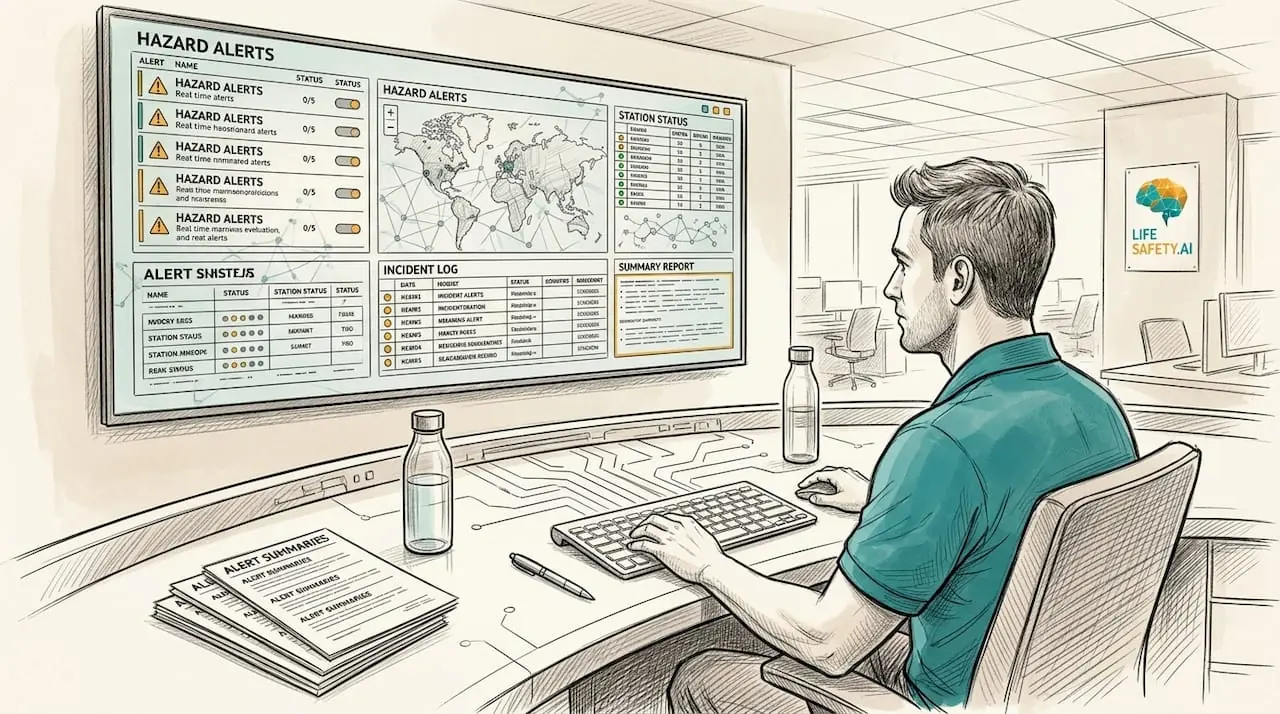
Real-time vs. traditional hazard detection: a direct comparison
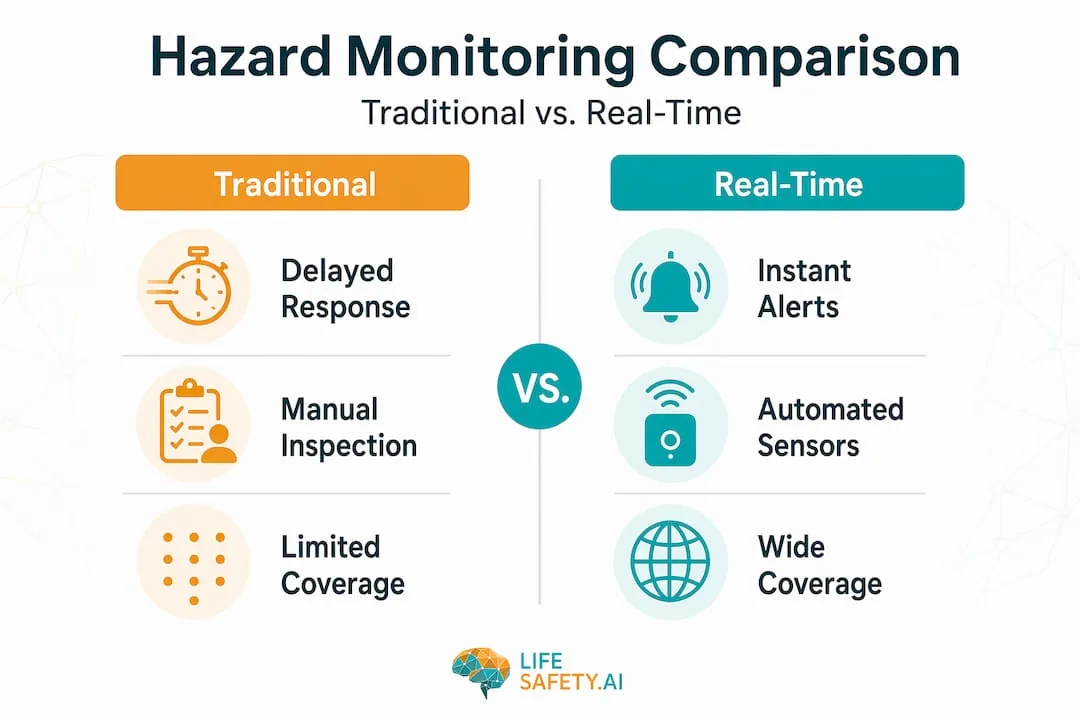
The case for real-time hazard monitoring becomes clearest when placed alongside the traditional alternative. Conventional hazard detection relies on scheduled inspections, periodic reviews, and reactive incident reporting. These approaches have their place, but they carry a fundamental flaw: the time lag between a hazard developing and a human noticing it.
This delay has a name. Traditional systems often suffer from “Hazard Awareness Delay”, the gap between when an anomaly begins and when it is identified. In electrical grids, for example, high-frequency real-time measurements can detect grid instability before a breaker trips, whereas conventional monitoring would only register the fault after the event.
| Feature | Traditional monitoring | Real-time monitoring |
|---|---|---|
| Detection timing | Post-incident or scheduled | Continuous, pre-incident |
| Coverage | Limited to inspection points | Comprehensive, sensor-wide |
| Alert speed | Hours to days | Seconds to minutes |
| False alarm management | Manual review required | Adaptive AI filtering |
| Operator workload | High, manual collation | Significantly reduced |
| Scalability | Labour-intensive | Automated and scalable |
The performance data from real-world deployments reinforces this picture. A radar-vision fusion system deployed in power transmission corridors reduced position prediction error by 43% and expanded detection coverage from 18% to 94% over six months, while cutting operator workload by 67%. The system identified 89 genuine threats with an average lead time of 17.8 seconds and maintained 99.4% uptime with only 3.2% false alarms.
Earthquake alert systems offer a similarly compelling illustration. Korea’s KMA network, expanded from 195 to 550 seismic stations, now issues warnings within 3 to 5 seconds of detecting strong seismic activity, reducing warning blind spots near epicentres by up to 75%.
For UK organisations, the practical lesson is straightforward: traditional inspections remain necessary, but they are no longer sufficient on their own in dynamic, high-risk environments. Real-time monitoring does not replace competent supervision, safe systems of work, or statutory inspection regimes. It strengthens them by reducing the gap between hazard emergence and management action.
Pro Tip: When comparing monitoring solutions, always request false alarm rate data alongside detection rates. A system with a 99% detection rate but a 30% false alarm rate will erode operator trust within weeks.
Deploying real-time monitoring in high-risk workplaces
For safety managers and construction professionals considering real-time safety monitoring, the implementation journey requires more than selecting the right hardware. Several practical factors determine whether a deployment succeeds or stalls.
The starting point is selecting technologies that match your specific hazard profile and environment. A construction site with heavy vehicle movements has different needs from a chemical processing plant monitoring gas release risks. Consider these key factors:
- Hazard type specificity: Match sensor capabilities to your primary risks. Gas detection sensors are irrelevant in environments where the primary hazard is structural instability.
- Integration with existing workflows: Systems that operate in isolation from your safety management platform generate data nobody acts on. Ensure your monitoring tools feed directly into your incident management and risk assessment processes.
- Mobile accessibility: Site managers and safety officers are rarely at a desk. Platforms that deliver alerts and dashboards to mobile devices keep response times low regardless of where staff are working.
- Training and stakeholder buy-in: Technology adoption fails when the people using it do not understand it or trust it. Structured training and clear communication of system capabilities, and limitations, are prerequisites for effective deployment. For construction teams, site safety preparation should incorporate monitoring system orientation as standard.
- Data privacy and regulatory compliance: UK workplaces must consider GDPR obligations when deploying wearables or video analytics that process personal data. Privacy impact assessments, clear lawful bases, retention controls, and transparent worker communication should be built into the rollout from the outset.
In practice, deployment should begin with a defined use case rather than a broad technology purchase. For example, a contractor may start by monitoring exclusion zones around lifting operations, plant-pedestrian interface risks, or confined space atmospheric conditions. A manufacturer may prioritise machine guarding breaches, heat stress, or gas detection in process areas. Starting with a narrow, high-value risk scenario makes it easier to validate performance, refine thresholds, and build confidence among supervisors and operatives.
It is also important to align deployment with UK compliance duties. Under CDM 2015, monitoring arrangements should support coordination, communication, and control of construction risks. Under RIDDOR, better event visibility can improve the quality and speed of incident investigation where a reportable event occurs. In occupied or higher-risk premises, the Building Safety Act increases the importance of reliable information management, accountability, and evidence that safety risks are being actively managed.
A sensible implementation plan will usually include:
- Baseline risk review: Confirm the hazards, affected persons, and operational scenarios where real-time monitoring will add measurable value.
- Pilot deployment: Test the system in a controlled area or process before scaling across the full site.
- Alert design: Define who receives alerts, what thresholds trigger escalation, and what actions are expected at each stage.
- Training and drills: Ensure supervisors, control room staff, and frontline teams know how to interpret and respond to alerts.
- Performance review: Measure false alarms, missed detections, response times, and user feedback, then refine the system.
- Governance and audit trail: Retain records that demonstrate monitoring, review, and corrective action for internal assurance and external scrutiny.
The organisations that gain the most from real-time monitoring are usually not those with the most sensors. They are the ones that integrate monitoring into daily operations, toolbox talks, permit controls, inspections, and management review. Technology should support the safety system, not sit beside it.
The future of real-time hazard monitoring
The future of real-time hazard monitoring is likely to be defined by greater integration, stronger predictive capability, and more context-aware decision support. The direction of travel is not simply more data. It is better interpretation of data, delivered in ways that help people act quickly and correctly.
Several developments are especially relevant for safety professionals:
- Edge analytics: Processing data closer to the sensor reduces latency and allows faster alerts even where connectivity is inconsistent.
- Digital twins: Live operational data can be mapped against virtual site or asset models, helping teams visualise where risk is developing and what controls are affected.
- Predictive maintenance integration: Hazard monitoring will increasingly overlap with asset health monitoring, identifying conditions that could lead to both safety incidents and operational failure.
- Context-aware alerts: Systems will become better at distinguishing between routine variation and genuine risk, reducing nuisance alarms and improving trust.
- Cross-platform safety intelligence: Monitoring data will feed directly into permits, inspections, incident logs, and corrective action workflows rather than remaining in standalone dashboards.
For UK industry, this evolution should be welcomed cautiously but positively. Advanced analytics can improve prevention, but they do not remove the need for competent judgement, consultation with workers, and proportionate control measures. HSE expectations remain grounded in practical risk management, not technology for its own sake.
There is also a governance dimension. As systems become more autonomous in how they classify and escalate risk, organisations will need clear accountability for configuration, oversight, and review. That is particularly important where monitoring outputs influence operational decisions, access control, or emergency response. The future is not hands-off safety. It is better-informed safety leadership.
My perspective: what real-time monitoring actually changes
What real-time monitoring actually changes is not just speed. It changes the quality of safety management. In many organisations, risk controls are documented well but observed inconsistently. Supervisors are stretched, conditions shift quickly, and near misses are often only understood after the fact. Real-time monitoring narrows that gap between work as imagined and work as done.
That matters because most serious incidents are not truly sudden. They are preceded by signals: a worker entering an exclusion zone, a rising gas concentration, a pattern of unsafe movement around plant, a temperature trend, a structural deviation, or repeated breaches of a permit condition. Traditional systems often capture these signals too late or not at all. Real-time systems make them visible while intervention is still possible.
The strongest use case is therefore not replacing people, but supporting them. Good safety professionals already know that prevention depends on timely information, clear communication, and disciplined follow-through. Real-time monitoring strengthens all three. It gives supervisors earlier warning, gives managers better evidence, and gives organisations a more realistic picture of operational risk.
Used well, it can also improve learning. Near misses, unsafe conditions, and recurring exposure patterns become easier to analyse when there is a reliable digital record. That supports trend review, targeted interventions, and more meaningful management conversations. In sectors where margins are tight and environments are fast-moving, that is a substantial advantage.
The caution, however, is important. Monitoring is only valuable if it leads to action. A dashboard full of alerts is not a safety improvement unless the organisation has the discipline to respond, review, and adapt. The real change comes when monitoring is embedded into the wider safety system: risk assessments, briefings, permits, inspections, investigations, and leadership oversight.
How Lifesafety supports real-time hazard monitoring
Lifesafety supports real-time hazard monitoring by helping organisations turn observations, alerts, and site-level risk information into coordinated action. While every workplace will have its own mix of sensors, systems, and operational constraints, the core challenge is usually the same: ensuring that critical information reaches the right people quickly and is recorded in a way that supports follow-up.
Within that context, a platform approach can add value by connecting monitoring outputs to day-to-day safety workflows such as:
- Incident and near-miss logging: Capture events quickly from mobile devices so that emerging patterns are not lost.
- Corrective action tracking: Assign actions, owners, and deadlines when a hazard alert requires intervention.
- Risk assessment review: Update assessments when monitoring data shows that exposure patterns or site conditions have changed.
- Audit-ready records: Maintain a clear trail of alerts, responses, and control improvements to support internal governance and external scrutiny.
- Mobile-first access: Enable site teams, supervisors, and managers to review and respond without waiting to return to a desktop system.
For UK construction and manufacturing organisations, this kind of integration is especially useful where compliance depends not only on identifying hazards, but on demonstrating that they were acted upon. That supports stronger evidence for HSE inspections, internal audits, contractor management, and post-incident review.
In practical terms, Lifesafety can help bridge the gap between detection and response. That is often where safety performance is won or lost. A sensor may identify a problem in seconds, but unless the issue is escalated, assigned, and closed out, the operational benefit is limited. Connecting those steps in one workflow is what turns monitoring into management.
FAQ
What is real-time hazard monitoring?
Real-time hazard monitoring is the continuous, automated collection and analysis of environmental or operational data to identify threats as they emerge. Instead of relying solely on scheduled inspections or retrospective reporting, it provides immediate visibility of unsafe conditions, behaviours, or exposures.
How does real-time hazard monitoring improve safety performance?
It improves safety performance by reducing the delay between hazard emergence and intervention. Faster detection can support earlier control measures, fewer missed warning signs, better incident prevention, and stronger evidence for management review and continuous improvement.
Does real-time monitoring replace inspections and risk assessments?
No. Real-time monitoring should complement, not replace, inspections, supervision, and formal risk assessment. It is most effective when integrated into an existing safety management system that includes competent oversight, safe systems of work, and regular review.
What technologies are commonly used?
Common technologies include radar sensors, AI video analytics, wearables, environmental sensors, and remote monitoring tools such as satellite or SAR imagery. The most effective systems often combine multiple sources through multimodal fusion.
What should UK employers consider before deployment?
UK employers should consider hazard relevance, integration with existing workflows, worker consultation, training, false alarm management, and data protection obligations. Where personal data is processed, GDPR compliance is essential. Deployment should also support wider duties under HSE guidance, CDM 2015 where applicable, and incident management arrangements including RIDDOR reporting.
What is the biggest implementation mistake?
A common mistake is treating monitoring as a standalone technology project. The biggest gains come when alerts are linked to clear escalation routes, trained responders, corrective actions, and management review. Without that operational integration, even accurate detection may not improve outcomes.
Final thought
Real-time hazard monitoring is best understood as an operational capability, not a gadget. Its value lies in helping organisations identify risk earlier, communicate more clearly, and respond more consistently. For safety professionals working under increasing scrutiny and complexity, that is not a marginal improvement. It is a meaningful step towards more resilient, evidence-led safety management.
Related Articles

Incident reporting software comparison: UK guide 2026
Discover our incident reporting software comparison for UK workplaces. Explore top options like Lifesafety, SafetyCulture, and more.

Safety management solutions for construction: UK SMS guide
Discover essential safety management solutions for construction sites in the UK. Learn how a mobile-first SMS can enhance safety and compliance.

Best Health and Safety Software for UK Workplaces: A Guide
Discover the best health and safety software for UK workplaces in 2026. Explore top picks like Lifesafety for compliance and efficiency!