
Permit to work procedure: a practical guide for H&S teams
Permit to work procedure: a practical guide for H&S teams
A practical guide to designing, issuing, monitoring, suspending, and closing out permits to work in line with HSE expectations, CDM 2015 duties, and robust site safety management.
TL;DR
- A permit to work procedure is a structured safety system that authorises high-risk hazardous tasks before work begins, ensuring risks are managed with defined controls.
- It requires comprehensive documentation, active monitoring, and disciplined management to maintain its effectiveness and prevent accidents or legal violations.
- Digital permit systems enhance oversight, accuracy, and auditability, supporting organisations in achieving safety compliance and operational integrity.
A permit to work procedure is a formal, structured system that authorises, manages, and controls hazardous work by defining the job scope, associated risks, required controls, timings, and individual responsibilities before a single tool is lifted. Grounded in the UK Health and Safety Executive’s HSG250 guidance, the system applies to high-risk activities including hot work, confined space entry, and electrical isolation. Without a functioning work permit system, organisations expose workers to uncontrolled hazards and expose themselves to enforcement action under the Health and Safety at Work etc. Act 1974. This guide walks you through every stage of the permit to work process, from form design to close-out, with practical tools and expert insight drawn from current UK standards.
What are the key components of an effective permit to work procedure?
A permit to work procedure functions as a live safety control, not a filing exercise. UK-style PTW systems must cover hazard identification, precautions, formal issue, suspension, and restart steps in line with HSE’s HSG250 guidance. That sequencing matters because each stage verifies the previous one, creating a chain of documented accountability that holds up under audit or investigation.
Every permit form must contain the following core elements to be legally and operationally credible:
- Permit identification: unique permit number, job title, location, date, and planned start and end times
- Personnel details: name and competence confirmation of the permit issuer, the permit receiver, and any supervising authority
- Hazard and risk summary: specific hazards identified for the task, cross-referenced to the relevant risk assessment and method statement
- Control measures: isolation status, personal protective equipment requirements, atmospheric testing results, and any fire prevention measures
- Authorisation signatures: formal sign-off from the issuer confirming controls are in place before work begins
- Suspension and restart controls: documented conditions under which work must stop and the steps required before resuming
- Close-out confirmation: signed declaration that work is complete, the site is restored, and all personnel are accounted for
Oracle Safety’s February 2026 guidance adds that well-designed forms include cross-referencing to related active permits, version control, emergency plan links, and a distribution list. This matters particularly on complex sites where simultaneous operations create overlapping hazards. A confined space permit, for example, should reference any hot work permit active in the same area.
Pro Tip: Keep the permit form itself to two sides of A4 maximum. If your form runs to six pages, workers will skim it. Brevity drives compliance.
What tools and steps does the permit to work workflow require?
A structured permit to work workflow follows seven sequential steps. Skipping or compressing any of them is where most permit failures originate.
- Request: The permit receiver submits a formal work request describing the task, location, personnel, and estimated duration.
- Hazard assessment: The permit issuer conducts or reviews a site-specific hazard assessment, referencing the hazard identification process and any existing risk assessments or method statements.
- Issue: The issuer completes the permit form, confirms all controls are in place, and signs the document. The permit is only valid from this point.
- Briefing: The permit receiver briefs all workers on the permit conditions, hazards, and emergency procedures before work starts. A toolbox talk at this stage is best practice.
- Monitoring: A designated person checks that controls remain effective throughout the work. Any new hazard or changed condition triggers a review.
- Suspension or restart: If conditions change, work stops and the permit is formally suspended. Restart requires a fresh check of all controls before the permit is reactivated.
- Close-out: The receiver confirms task completion, site restoration, and personnel clearance. The issuer countersigns and the permit is archived.
The following table shows the three most common permit types and their task-specific checklist requirements:
| Permit type | Key checklist items |
|---|---|
| Hot work | Fire extinguisher in place, flammable materials removed, fire watch confirmed, hot work area inspected post-completion |
| Confined space entry | Atmospheric testing completed, rescue plan confirmed, entry and standby personnel named, ventilation verified |
| Electrical isolation | Voltage absence verified, lock-off and tag-out applied, competent person confirmed, safe isolation checklist completed |
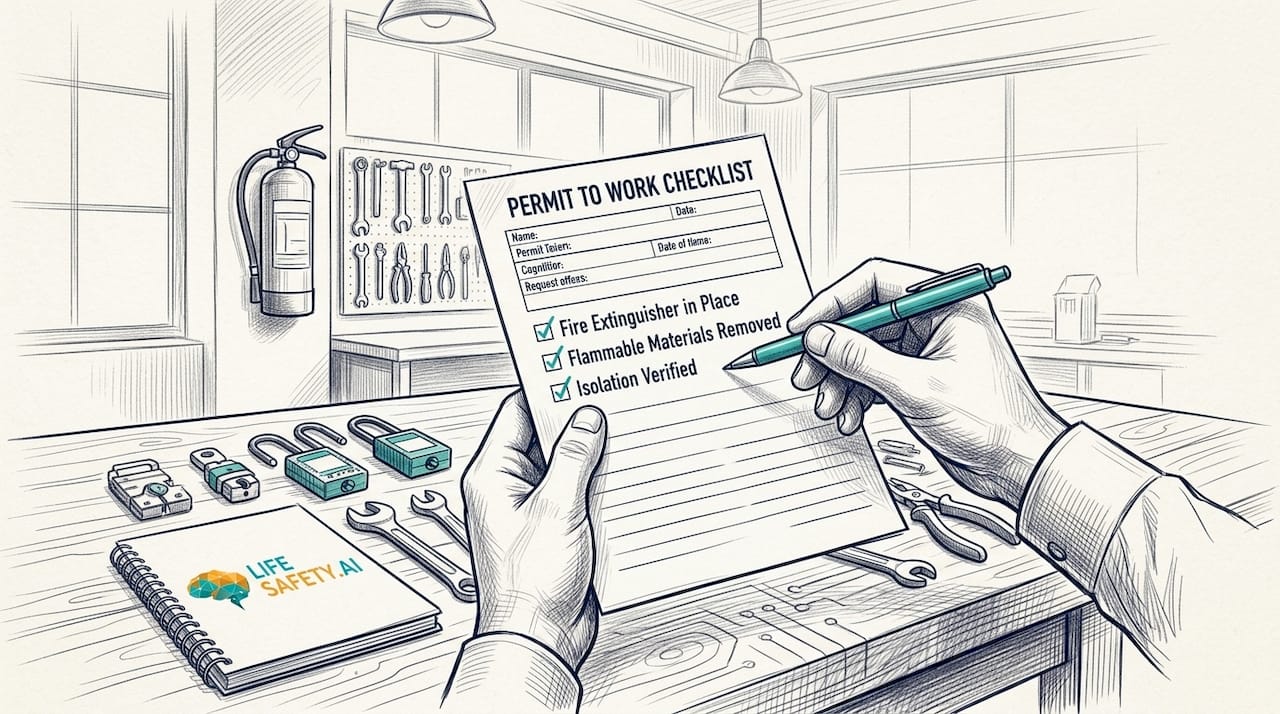
Safe isolation deserves particular attention. Electrical isolation in permit to work scenarios frequently fails because personnel mistake a switched-off status for a confirmed dead status. The Martindale Electric safe isolation procedure requires a qualified person to verify the absence of voltage using a compliant voltage indicator, apply a formal lock-off and tag-out, and document every step. Failing to prove safe isolation leads auditors and investigators to presume it was never done, which exposes your organisation to serious legal and safety risk.
Shift handover is the second most critical procedural moment. HSE guidance stresses formal handover involving face-to-face review, physical checks of isolations, and confirmation of all personnel on site. A written handover log is not sufficient on its own if the incoming supervisor has not physically verified the controls.
Pro Tip: Display the active permit at the work location throughout the job. If a worker cannot see the permit, they cannot verify they are working within its scope.
How do you monitor, suspend, and close out permits correctly?
Monitoring is the stage most organisations underinvest in. Issuing a permit correctly and then leaving workers unsupervised for six hours defeats the purpose of the work authorisation process entirely. A designated monitor, named on the permit, must conduct periodic checks and document any changes to site conditions, personnel, or task scope.
Permits must have set start and end times, and prolonged permits carry a specific risk: complacency. When workers operate under the same permit for days, the initial vigilance fades and controls are assumed rather than verified. Revalidation for any extension is not optional. It requires a fresh hazard check, updated signatures, and confirmation that all original controls remain effective.
Conditions requiring immediate suspension include:
- Unexpected change in atmospheric conditions, including ventilation failure in confined spaces
- Discovery of an unidentified hazard not covered by the original risk assessment
- Injury or near-miss event within the permit area
- Shift break on high-risk tasks where the incoming team has not been formally briefed
- Any change to the scope of work beyond what the permit originally authorised
The close-out phase carries its own risks. Common mistakes include signing off the permit before all tools are accounted for, failing to confirm that all workers have physically left the area, and neglecting to restore the site to a safe condition before the issuer countersigns. A well-designed PTW form includes a close-out checklist that forces the receiver to confirm each of these points in sequence before the permit is cancelled.
Archived permits must be retained as safety records. Under CDM 2015 and general HSE audit requirements, permit records demonstrate that your organisation applied systematic controls to hazardous work. Digital records are preferable because they are searchable, timestamped, and cannot be lost or altered.
For higher-risk environments, disciplined permit close-out also supports wider compliance management under the Building Safety Act where dutyholders need clear evidence of control, communication, and record integrity. If an incident becomes reportable under RIDDOR, a complete permit trail can become a critical part of demonstrating what controls were planned, who authorised the work, and whether site conditions changed before the event.
What are the most common pitfalls in permit to work implementation?
The most damaging mistake in any permit to work process is applying the system to every task regardless of risk level. PTW credibility depends on balancing comprehensiveness with operational simplicity, and over-permitting trains workers to treat the paperwork as a formality rather than a genuine control. HSE’s HSG250 guidance is explicit: permits should apply where a credible risk exists that cannot be managed by standard safe working procedures alone.
Beyond over-permitting, the following pitfalls consistently appear in incident investigations and HSE enforcement actions:
- Vague language on the form: Phrases like “take appropriate precautions” are unenforceable. Every control measure must be specific and verifiable.
- Competence not verified: Signing a permit for a worker whose qualifications have not been checked is a systemic failure. Competence records must be current and accessible at the point of issue.
- No cross-referencing of simultaneous permits: On busy sites, two permits operating in adjacent areas can create combined hazards that neither permit individually addresses. Cross-permit awareness is a design requirement, not an afterthought.
- Informal verbal handovers: Shift changes managed by a quick conversation rather than a documented, face-to-face review are a leading cause of permit-related incidents.
- Safe isolation assumed rather than proven: As Steve Dunning of Martindale Electric has noted, demonstrable safe isolation is a life-saving control. Training records alone do not prove isolation was performed correctly on the day.
“A permit to work system that workers trust is one that is clear, proportionate, and consistently enforced. The moment it becomes a box-ticking exercise, it stops protecting anyone.”
Technology addresses several of these pitfalls directly. Digital permit platforms automate version control, flag expired permits, prompt cross-referencing, and create auditable records without adding administrative burden to your team. For organisations managing permit to work documentation across multiple sites, digital systems are the only practical way to maintain consistent standards.
In practice, this is where connected safety platforms add value. A system such as LifeSafety.ai can support permit governance by linking permits to risk assessments, inspections, incident records, corrective actions, and training evidence. That makes it easier for H&S teams to demonstrate not just that a permit existed, but that the surrounding control environment was active and traceable.
Pro Tip: Run a quarterly permit audit. Pull five completed permits at random and check whether the controls listed were actually verifiable on the day. This single habit reveals more about your system’s health than any training course.
Key takeaways
A permit to work procedure is only effective when it functions as a live safety control at every stage, from hazard assessment through to documented close-out, with competence verified and controls physically confirmed rather than assumed.
| Point | Details |
|---|---|
| Structure every permit correctly | Include hazard identification, named personnel, control measures, and signed authorisation before work begins. |
| Safe isolation must be proven | Use a documented checklist such as the Martindale procedure to verify absence of voltage, not just switched-off status. |
| Manage the full permit life cycle | Monitor actively, suspend on changed conditions, revalidate extensions, and complete a formal close-out checklist. |
| Avoid over-permitting | Apply permits only where credible risk exists; unnecessary permits breed complacency and reduce system credibility. |
| Digitise your records | Digital permit systems provide timestamped, searchable audit trails that paper records cannot reliably deliver. |
Why disciplined PTW management is the difference between compliance and catastrophe
Disciplined permit to work management is not administrative overhead. It is one of the clearest indicators of whether an organisation genuinely controls high-risk work or merely documents it after the fact. Where permits are well designed, competently issued, actively monitored, and formally closed out, they create a visible chain of control that protects workers, supervisors, contractors, and dutyholders alike.
Where they are weak, the opposite happens. Hazards drift, isolations are assumed, handovers become informal, and site teams begin to rely on memory rather than verification. That is the point at which a permit system stops being a safeguard and starts becoming evidence of organisational failure. In serious incidents, investigators will look closely at whether the permit reflected the real task, whether controls were physically in place, whether supervision was adequate, and whether the work should have been suspended when conditions changed.
For UK construction, manufacturing, utilities, and facilities environments, this has direct legal and operational consequences. Weak permit control can contribute to breaches of the Health and Safety at Work etc. Act 1974, undermine compliance with CDM 2015, and expose gaps in contractor management, competence assurance, and emergency preparedness. If an event results in a specified injury, dangerous occurrence, or other reportable outcome, RIDDOR reporting obligations may follow quickly, and the quality of the permit record will matter.
The practical standard is straightforward: only issue permits for genuinely high-risk work, make the form clear enough to use properly, verify controls before work starts, monitor conditions while the task is live, and never treat suspension or revalidation as optional. If your teams can do that consistently, the permit system becomes a meaningful operational control rather than a paper shield.
Organisations looking to strengthen this area should focus on three priorities:
- Standardise the process so every site, shift, and contractor follows the same issue, briefing, monitoring, and close-out rules.
- Improve visibility by ensuring active permits, isolations, and simultaneous operations are easy for supervisors and workers to see and understand.
- Digitise evidence so records are timestamped, searchable, and linked to inspections, incidents, actions, and competence data.
That is where a modern safety platform can materially improve performance. With LifeSafety.ai, H&S teams can centralise permit records, connect them to risk controls, and maintain a stronger audit trail across multiple sites. For organisations under pressure to demonstrate compliance, reduce permit-related failures, and improve operational assurance, disciplined PTW management is not just best practice. It is the difference between controlled work and preventable harm.
Related Articles

Incident reporting software comparison: UK guide 2026
Discover our incident reporting software comparison for UK workplaces. Explore top options like Lifesafety, SafetyCulture, and more.

Safety management solutions for construction: UK SMS guide
Discover essential safety management solutions for construction sites in the UK. Learn how a mobile-first SMS can enhance safety and compliance.

Best health and safety software for UK workplaces: 2026 guide
Discover the best health and safety software for UK workplaces in 2026. Explore top picks like Lifesafety for compliance and efficiency!