
Master safety training management for UK compliance
Master safety training management for UK compliance
Running safety courses is not the same as managing safety training. Many construction and manufacturing organisations tick the attendance box, file the certificates, and assume compliance is secured. Yet 680,000 non-fatal injuries were recorded across UK workplaces in 2024/25, alongside 124 fatalities, with construction alone accounting for 35 deaths at 4.8 times the average industry rate. These numbers persist despite mandatory training regimes. The uncomfortable truth is that training delivery and training management are entirely different disciplines. This article breaks down what genuine safety training management looks like, why UK law demands it, and how you can build a system that genuinely reduces incidents rather than simply generating paperwork.
Table of Contents
- Defining safety training management and legal requirements
- How to identify training needs and select methodologies
- Assessing competence and validating training effectiveness
- Integrating safety training into your overall safety management system
- Why digital-first safety training management is becoming essential
- Connect your workforce and compliance with smart safety training management
- Frequently asked questions
Key Takeaways
| Point | Details |
|---|---|
| Systematic compliance | Managing safety training systematically is required for UK legal compliance and goes far beyond simple courses. |
| Risk-driven training | Effective safety training is always tailored to actual workplace risks and reviewed after any major change or incident. |
| Competence validation | Competence must be assessed and documented, blending skills, experience, and attitude—not just credentials. |
| Digital transformation | Digital training management platforms strengthen audit trails, automate oversight, and help prevent enforcement action. |
| Continuous improvement | Great safety training is repeatedly revised within broader safety systems for measurable, lasting results. |
Defining safety training management and legal requirements
Building on the high incident rates highlighted above, it is vital to understand precisely what safety training management entails and the legal reasons it matters.
Safety training management is the systematic process of ensuring workers receive adequate training, information, and supervision to achieve competence in performing tasks safely. It is not a single event. It is a continuous cycle that spans needs analysis, delivery, competence assessment, record-keeping, and review.
For construction and manufacturing executives, three pieces of legislation sit at the heart of this obligation:
- Health and Safety at Work Act 1974 (HSWA): Places a duty on employers to provide information, instruction, training, and supervision as necessary to ensure the health and safety of employees.
- Management of Health and Safety at Work Regulations 1999 (MHSWR), Regulation 13: Requires employers to provide adequate health and safety training on recruitment and when exposure to new or increased risks occurs.
- Provision and Use of Work Equipment Regulations 1998 (PUWER), Regulation 9: Specifically mandates training for all persons who use, supervise, or manage work equipment, a critical requirement in both sectors.
Both construction and manufacturing carry elevated risk profiles. Working at height, operating heavy plant, handling hazardous substances, and using complex machinery create hazard combinations that demand structured, documented competence management rather than ad hoc instruction.
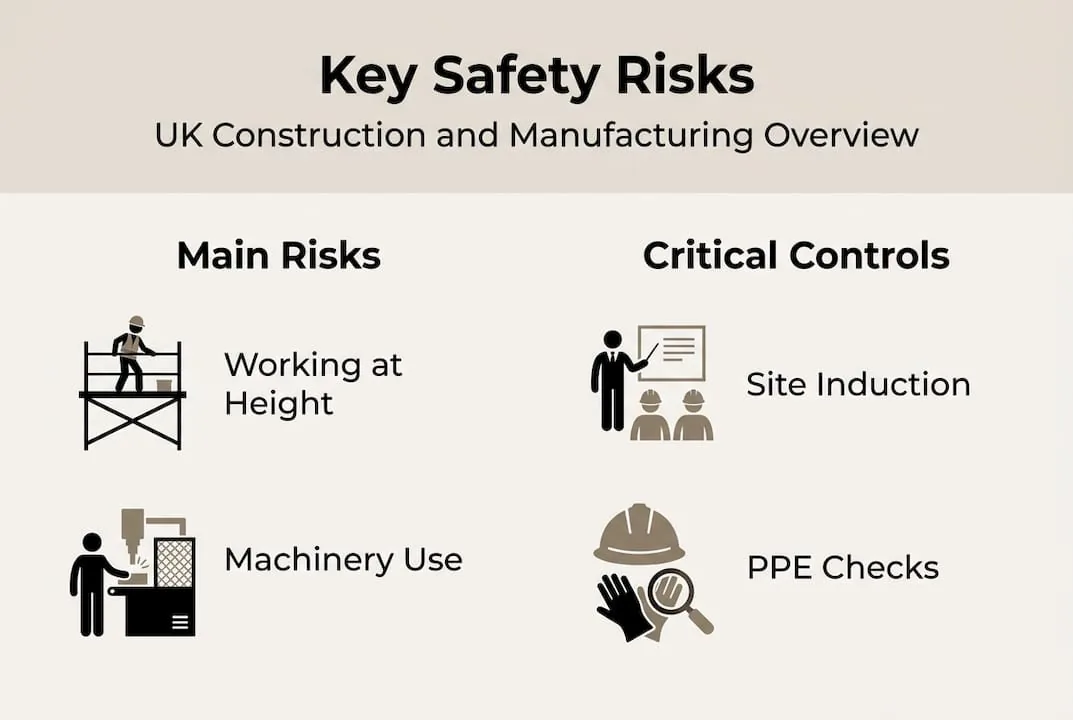
Record-keeping is not optional. If the HSE investigates an incident, your ability to produce dated training records, competency assessments, and refresher schedules is the difference between demonstrating due diligence and facing enforcement action. Integrating your safety modules with training records creates a single source of truth that auditors can verify quickly.
The core activities of effective safety training management include:
- Training needs assessment: Identifying gaps based on roles, risks, and regulatory requirements.
- Training delivery: Selecting methods appropriate to the hazard and the learner.
- Competence assessment: Verifying that training has produced genuine capability.
- Record-keeping: Maintaining auditable evidence of all activity.
- Review and renewal: Updating training when processes, equipment, or legislation change.
“Competence is not simply about holding a certificate. It is the demonstrated ability to perform a task safely, consistently, and in real working conditions.”
Organisations that treat fire safety compliance and other specialist areas as isolated modules, rather than integrated components of a broader training system, often find gaps emerge precisely where risks are highest. The same principle applies to RIDDOR reporting awareness, CDM 2015 duty-holder competence, and the stronger accountability expectations introduced by the Building Safety Act. Training management must connect these obligations rather than leaving them in separate administrative silos.
How to identify training needs and select methodologies
Now that we have defined the scope and regulatory requirements, let us look at exactly how training needs are identified and how you can select the most effective methods for your workplace.
Training needs must be tied directly to your dynamic risk assessments and method statements (RAMS). A generic annual refresher schedule is not sufficient. When a new piece of machinery arrives on the production floor, or when a construction site safety layout changes, training needs change with it. The HSE is explicit: risk-linked training analysis and varied delivery methods are expected, not optional extras.
Different hazard types call for different learning approaches. Here is a practical comparison:
| Training method | Best suited to | Risk level addressed |
|---|---|---|
| Classroom instruction | Legislation, theory, induction | Low to medium |
| On-the-job with supervision | Machinery operation, manual handling | Medium to high |
| E-learning modules | Refreshers, awareness, compliance updates | Low to medium |
| Toolbox talks | Site-specific hazards, daily briefings | Medium to high |
| External accredited courses | Specialist skills (e.g., IPAF, NEBOSH) | High |
To build a structured approach, follow these steps:
- Map every role in your organisation to its associated hazards.
- Cross-reference with your risk assessment module to identify mandatory training requirements.
- Select delivery methods proportionate to the risk level of each task.
- Schedule initial training, supervised practice, and competence sign-off as three distinct stages.
- Set automatic renewal triggers linked to equipment changes, incident data, or regulatory updates.
High-risk tasks deserve particular attention. Falls from height remain the leading cause of construction fatalities. Machinery-related incidents dominate manufacturing statistics. Manual handling injuries account for a significant proportion of non-fatal harm across both sectors. Your training programme must weight these areas accordingly, rather than applying equal effort across all topics.
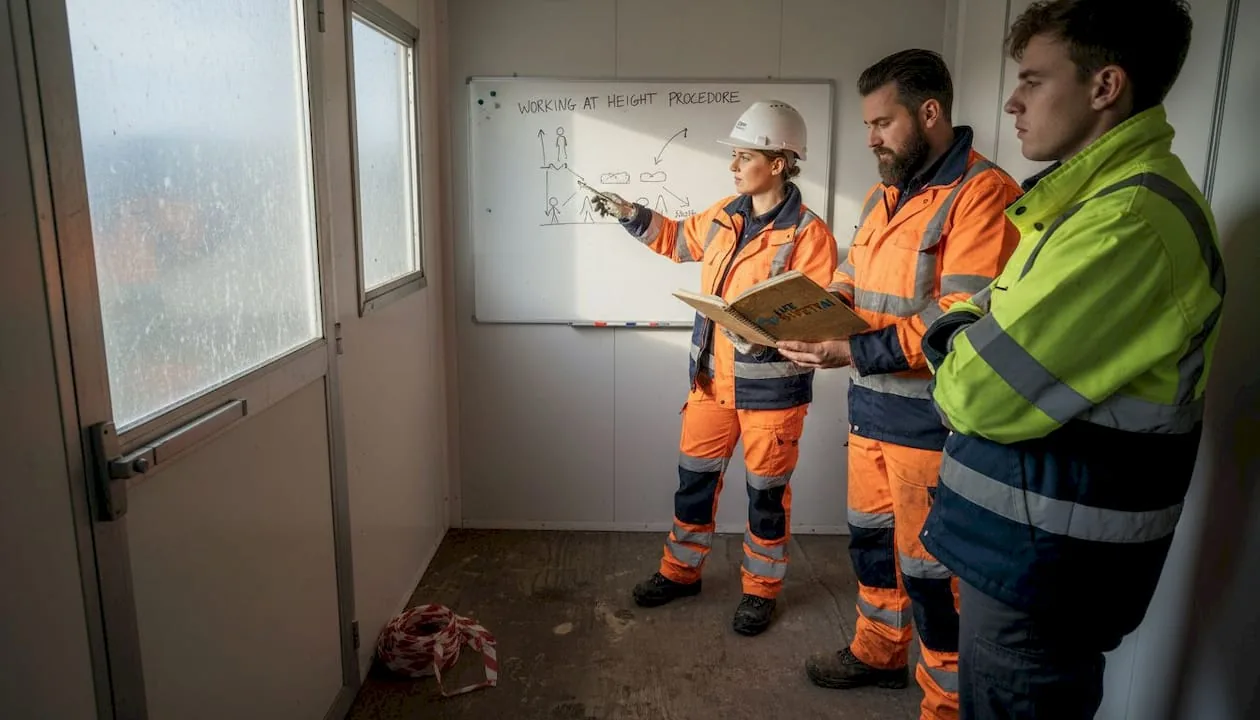
Site preparation and task sequencing also influence training priorities. Following site preparation best practices before work begins reduces the likelihood of workers encountering hazards they have not been trained to manage.
Pro Tip: Build a simple matrix that maps every job role to its required training, expiry dates, and preferred delivery method. Review it quarterly and after every significant incident or process change. This single document can transform your training needs analysis from reactive to genuinely proactive.
Assessing competence and validating training effectiveness
Once needs are identified and training delivered, organisations must verify that learning has produced genuine competence and compliance.
Competence is a blend of four elements: training, knowledge, experience, and attitude. A worker who has attended a manual handling course but consistently ignores safe lifting techniques is not competent, regardless of the certificate in their file. The HSE makes this clear: training must be proportionate to risks, must account for human factors such as fatigue and stress, and must be validated through real performance, not just attendance records.
Effective competence assessment methods include:
- Direct observation: A supervisor watches the worker perform the task under normal conditions.
- Written or verbal testing: Checks knowledge retention after formal training.
- Certificate verification: Confirms externally accredited qualifications are current and relevant.
- Performance review integration: Links safety competence to regular appraisal processes.
Here is how direct supervision compares with competence-based autonomous working:
| Factor | Direct supervision | Competence-based solo work |
|---|---|---|
| Risk level | High or unfamiliar tasks | Routine, assessed tasks |
| Evidence required | Supervisor sign-off logs | Competency matrix sign-off |
| Suitable for | New starters, contractors | Experienced, assessed workers |
| Review frequency | Ongoing until competent | Scheduled periodic review |
Contractors and temporary workers present a particular challenge. Many organisations assume that a contractor’s own induction covers all relevant hazards. It rarely does. Your site-specific risks, your equipment, and your emergency procedures require separate verification. Maintaining digital training records for every individual on site, including contractors, closes this gap and protects your organisation if an incident occurs.
Infrequent and emergency tasks are another edge case worth planning for. A worker trained in emergency isolation procedures two years ago, who has never needed to use them, may not retain that knowledge reliably. Scenario-based refreshers and simulation exercises address this directly.
Pro Tip: Use your incident trend data as a training effectiveness audit. If the same type of near-miss keeps appearing, it is a signal that training has not produced genuine competence in that area. Pair your competence assessment tools with incident analytics to spot these patterns early.
Integrating safety training into your overall safety management system
Assessing competence is only effective if it is part of a continual improvement cycle. Let us see how to integrate training management into your wider systems.
HSG65, the HSE’s established framework for managing health and safety, organises activity around a Plan, Do, Check, Act cycle. Safety training belongs in every stage of that loop, not just the “Do” phase. Planning identifies what training is needed and when. Doing delivers it. Checking validates competence and reviews outcomes. Acting updates the programme based on what checking reveals.
Here is how to embed training into each stage practically:
- Plan: Define training requirements for each role during risk assessment and before new projects or equipment are introduced.
- Do: Deliver training using methods matched to risk level, and record attendance, content, and assessor details immediately.
- Check: Conduct regular safety audits that include training records, competence observations, and contractor verification.
- Act: Revise training content, frequency, and delivery methods in response to audit findings, near-misses, incidents, enforcement notices, or organisational change.
This integration matters because training failures rarely sit alone. A poor induction may connect to weak supervision. Expired equipment training may sit alongside incomplete maintenance records. Repeated manual handling injuries may indicate both inadequate instruction and flawed task design. When training data is linked to audits, inspections, incident reports, and corrective actions, management can see the full picture rather than isolated symptoms.
For construction duty holders, this joined-up approach also supports CDM 2015 expectations around planning, coordination, and competence. For organisations managing occupied or higher-risk premises, the Building Safety Act raises the importance of clear accountability, evidence, and information management. Training records should therefore sit within the same governance structure as risk assessments, permit controls, contractor management, and emergency planning.
Do not overlook RIDDOR in this process. Reportable incidents should trigger a formal review of whether training content, supervision levels, or competence checks were sufficient. If a dangerous occurrence or specified injury reveals a gap, the corrective action should not stop at reporting. It should feed directly back into the training management cycle.
- Link training to incident investigations: Every investigation should ask whether competence, supervision, or refresher timing contributed.
- Align training with change management: New layouts, new substances, new contractors, and new equipment all require review.
- Include training in leadership reporting: Boards and senior managers should see overdue training, competence gaps, and high-risk roles.
- Use audit findings to prioritise refreshers: Focus effort where controls are weakest or behaviours are drifting.
Pro Tip: If your training records are stored separately from your audits, incidents, and risk assessments, you are making root-cause analysis harder than it needs to be. Bring them together in one management system so trends become visible before they become enforcement issues.
Why digital-first safety training management is becoming essential
Paper files and spreadsheets can work at very small scale, but they struggle once your workforce grows, your contractor base expands, or your compliance obligations become more complex. In construction and manufacturing, where workers move between sites, shifts, and tasks, manual systems create blind spots quickly.
A digital-first approach does not simply make administration easier. It materially improves compliance control. Automated reminders reduce the risk of expired certifications. Centralised records make it easier to prove competence during an HSE inspection. Role-based matrices help managers identify who is authorised for specific tasks. Mobile access allows supervisors to verify training status before work starts, not after an incident has occurred.
Digital systems are especially valuable where multiple regulations overlap. A single worker may need induction evidence, PUWER training, manual handling refreshers, COSHH awareness, emergency procedure instruction, and site-specific contractor controls. Managing that through disconnected folders is inefficient and risky. Managing it through a live platform creates visibility and accountability.
Key advantages of digital-first safety training management include:
- Automated expiry alerts: Prevents missed refresher deadlines for high-risk activities.
- Instant audit trails: Produces dated evidence for HSE inspections, client reviews, and internal audits.
- Role-based competence matrices: Shows exactly which workers are trained, assessed, and authorised.
- Contractor visibility: Helps verify third-party competence before site access is granted.
- Integrated analytics: Connects training status with incidents, near-misses, and corrective actions.
There is also a governance benefit. Senior leaders often receive lagging indicators such as injury totals or enforcement notices. Digital training dashboards provide leading indicators instead: overdue refreshers, incomplete inductions, unassessed new starters, and high-risk roles without current sign-off. That allows intervention before harm occurs.
For organisations facing scrutiny under the Building Safety Act, digital evidence management is increasingly important. The ability to show who was trained, when they were assessed, what information they received, and how competence was reviewed supports a stronger compliance position. The same is true when responding to client prequalification, principal contractor checks, or insurer requests.
Pro Tip: If you are still relying on spreadsheets, start by digitising your highest-risk training categories first: work at height, machinery, contractor induction, emergency response, and hazardous substances. That phased approach delivers quick compliance gains without overwhelming the team.
Connect your workforce and compliance with smart safety training management
Safety training management is not an administrative afterthought. It is a core control measure that underpins legal compliance, operational resilience, and workforce protection. When managed properly, it helps organisations move beyond attendance records and towards demonstrable competence.
The most effective systems share a few consistent traits. They are risk-led, not calendar-led. They assess competence, not just participation. They integrate with audits, incidents, and corrective actions rather than sitting in isolation. And increasingly, they rely on digital workflows to maintain visibility across employees, contractors, and multiple sites.
For UK construction and manufacturing organisations, that approach supports compliance with the HSWA, MHSWR, PUWER, RIDDOR, CDM 2015, and the wider competence expectations reinforced by the Building Safety Act. More importantly, it helps prevent real harm.
If you want to strengthen your approach, start with the basics:
- Review your current training matrix against actual site and operational risks.
- Check whether competence is being verified through observation and sign-off, not just certificates.
- Link training reviews to incidents, near-misses, audits, and management of change.
- Digitise records and refresher workflows for higher-risk roles and contractor populations.
- Report training gaps to leadership as a live compliance risk, not a back-office issue.
LifeSafety.ai helps organisations bring these elements together through connected modules for risk assessment, audits, training records, and compliance oversight. If your current process feels fragmented, now is the right time to build a system that gives managers confidence, workers clarity, and auditors evidence they can trust.
Frequently asked questions
What is the difference between safety training and safety training management?
Safety training is the delivery of instruction, such as an induction, toolbox talk, or accredited course. Safety training management is the wider system that identifies needs, assigns training, verifies competence, keeps records, schedules refreshers, and reviews effectiveness. UK compliance depends on the management system, not just the training event.
Which UK regulations require employers to manage safety training?
The main legal drivers include the Health and Safety at Work etc. Act 1974, the Management of Health and Safety at Work Regulations 1999, and PUWER 1998. Depending on your activities, duties may also arise under CDM 2015, COSHH, RIDDOR, and the Building Safety Act, particularly where competence and information management are critical.
How often should safety training be refreshed?
There is no universal interval for every topic. Refreshers should be based on risk level, manufacturer guidance, legal requirements, incident history, and changes to tasks or equipment. High-risk activities often need more frequent review, especially after near-misses, process changes, or prolonged periods without task exposure.
Is a certificate enough to prove competence?
No. A certificate may show that training was attended, but it does not by itself prove competence. Competence should also include practical observation, experience, site-specific understanding, and safe behaviour. This is particularly important for machinery, work at height, contractor activities, and emergency procedures.
Why are digital training records better than spreadsheets?
Digital systems improve visibility, reduce missed expiry dates, and create stronger audit trails. They also make it easier to link training with risk assessments, audits, incident investigations, and contractor controls. For organisations managing multiple sites or high-risk work, that can significantly reduce compliance gaps.
Should contractors be included in the same training management system as employees?
Yes. Contractors may bring their own qualifications, but they still need verification against your site-specific hazards, emergency arrangements, and equipment controls. Including them in the same training management system helps ensure consistent oversight and provides defensible evidence if the HSE investigates an incident.
Related Articles

Incident reporting software comparison: UK guide 2026
Discover our incident reporting software comparison for UK workplaces. Explore top options like Lifesafety, SafetyCulture, and more.

Safety management solutions for construction: UK SMS guide
Discover essential safety management solutions for construction sites in the UK. Learn how a mobile-first SMS can enhance safety and compliance.

Best Health and Safety Software for UK Workplaces: A Guide
Discover the best health and safety software for UK workplaces in 2026. Explore top picks like Lifesafety for compliance and efficiency!