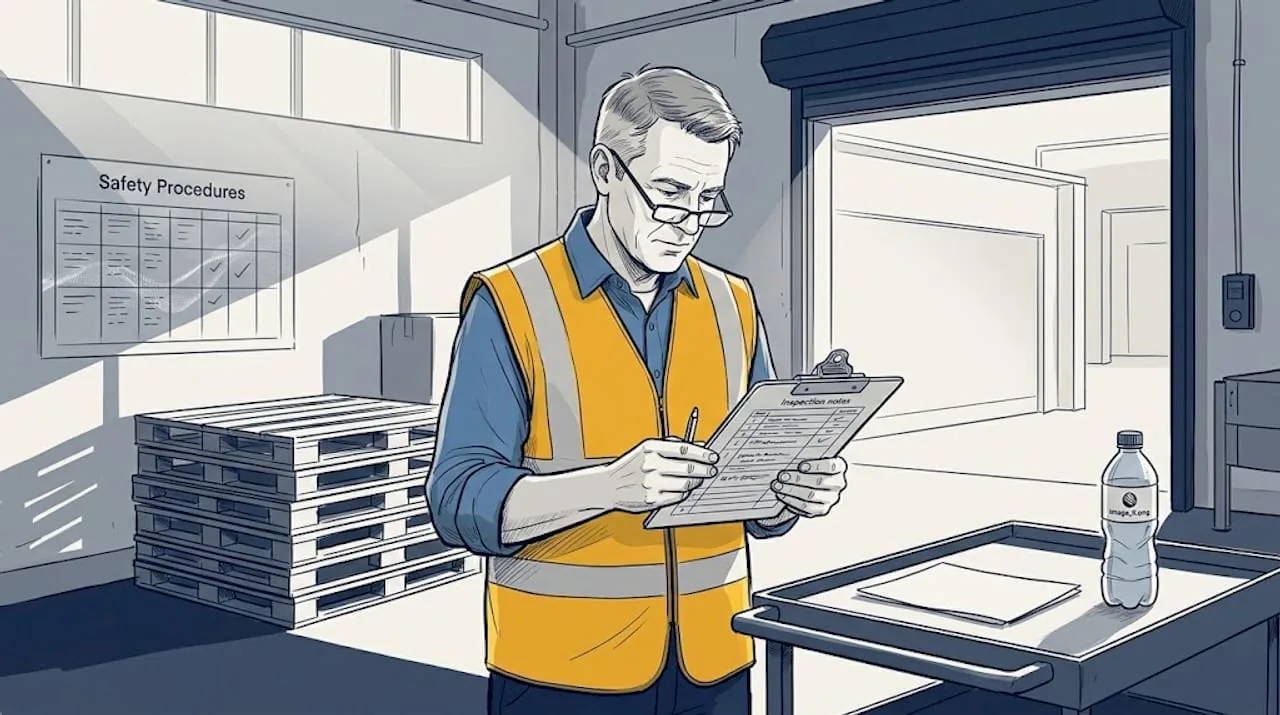
Improve risk assessments for safer UK workplaces
Improve risk assessments for safer UK workplaces
TL;DR:
- Risk assessments are legally required and must be suitable, sufficient, proportionate, and regularly updated.
- Effective assessments involve hazard identification, risk evaluation, worker consultation, and control implementation.
- Digital tools like LifeSafety.ai streamline risk management and support continuous site safety improvements.
Risk assessments sit at the heart of every serious health and safety programme in the UK. Get them right and you reduce injuries, protect your workforce, and stay on the right side of the law. Get them wrong and the consequences can be severe. Workplace fatalities remain a real concern, and inadequate risk assessments are frequently a contributing factor. In this article, we walk through what UK law actually requires, how the standard five-step process works, which hazards matter most in construction and manufacturing, and the practical strategies that separate genuinely effective assessments from box-ticking exercises.
Table of Contents
- What is a risk assessment and why does it matter?
- The standard 5-step risk assessment process
- Common hazards in construction and manufacturing risk assessments
- Essential strategies for effective and compliant risk assessments
- Our perspective: Why real-world risk assessment is simpler (and harder) than it looks
- How LifeSafety.ai helps you achieve risk assessment excellence
- Frequently asked questions
Key Takeaways
| Point | Details |
|---|---|
| Legal cornerstone | UK law requires risk assessments to be suitable and sufficient for your workplace. |
| 5-step methodology | Effective assessments follow the HSE’s structured process, using the hierarchy of controls. |
| Industry-specific hazards | Construction and manufacturing present unique, high-risk hazards demanding tailored solutions. |
| Dynamic practice | Regular reviews and updates are essential, especially after changes or new risks. |
| Practical simplicity | Real impact comes from engaging people and focusing on practical action over complex paperwork. |
What is a risk assessment and why does it matter?
A risk assessment is a structured process of identifying hazards in the workplace, evaluating the likelihood and severity of harm, and deciding what controls are needed to protect people. It is not optional. Under the Management of Health and Safety at Work Regulations 1999, every employer must carry out risk assessments that are suitable and sufficient. That phrase carries real legal weight.
The HSE definition of risk assessment makes clear that “suitable and sufficient” does not mean exhaustive paperwork for every minor task. It means the depth of the assessment must match the level of risk involved. A routine office task needs far less detail than working at height on a live construction site. The principle is proportionality, not bureaucracy.
So what does a legally sound risk assessment actually cover? The core elements include:
- Identifying hazards present in the workplace or arising from work activities
- Deciding who might be harmed and how, including employees, contractors, and visitors
- Evaluating the risks and determining whether existing controls are adequate
- Recording findings clearly, especially when five or more employees are involved
- Reviewing and updating the assessment whenever circumstances change
“A risk assessment is not about creating huge amounts of paperwork, but rather about identifying sensible measures to control the risks in your workplace.” — HSE
For health and safety professionals in construction and manufacturing, the challenge is not understanding the concept. It is embedding risk assessment processes into the daily rhythm of site operations, rather than treating them as a one-off compliance task.
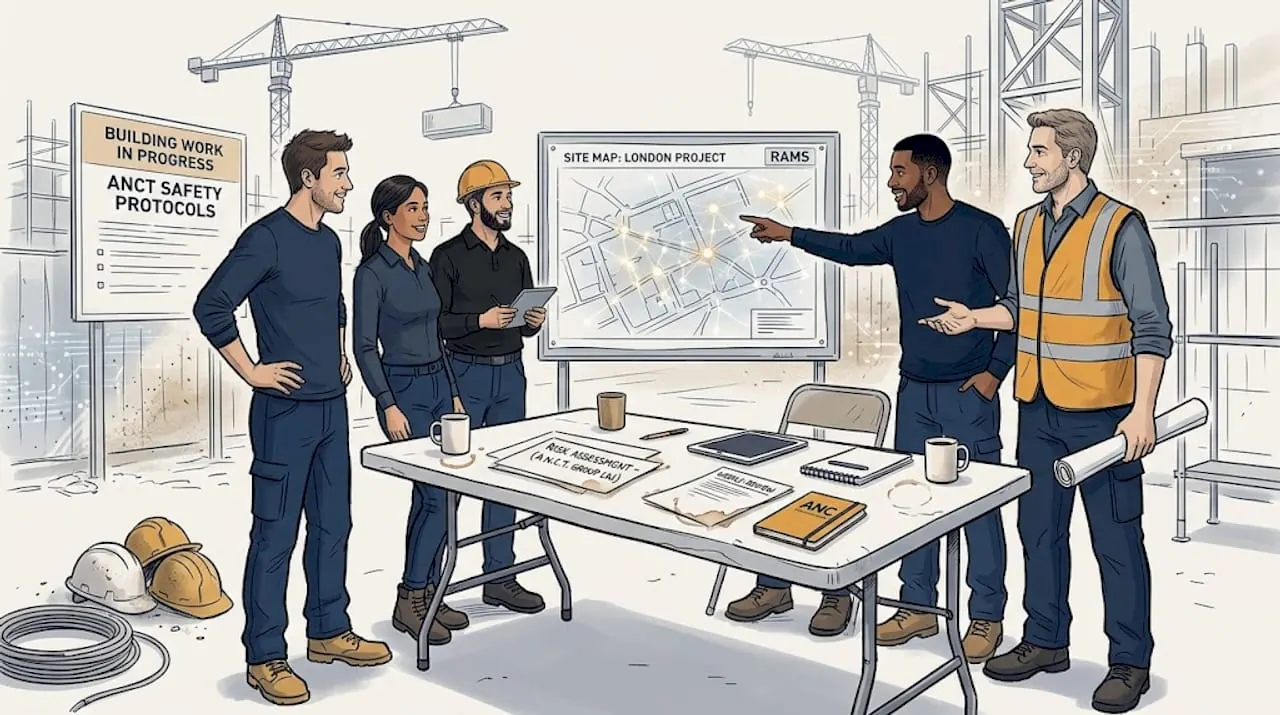
Pro Tip: When risk assessments are genuinely integrated into site culture, rather than completed in isolation by a single manager, both compliance rates and safety outcomes improve significantly. Involve your workers at every stage.
The standard 5-step risk assessment process
The HSE’s five-step methodology provides a clear and repeatable framework that works across industries. Here is how each step applies in practice:
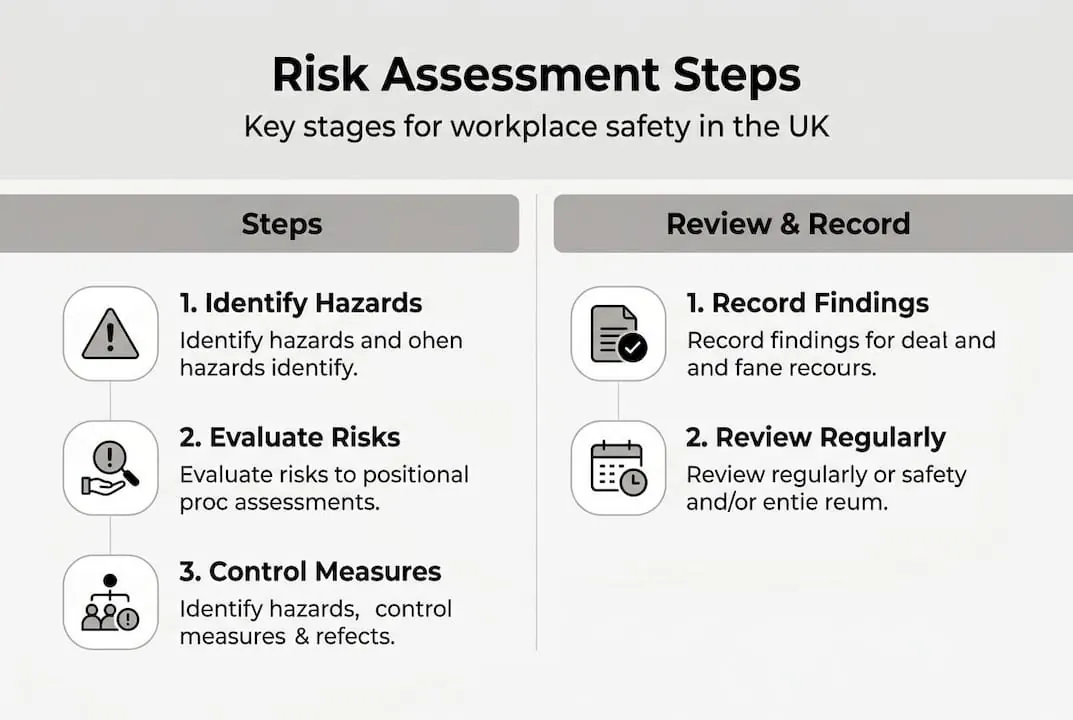
- Identify the hazards — Walk the site, consult workers, review accident records, and consider non-routine tasks. Hazards include anything with the potential to cause harm.
- Decide who might be harmed and how — Think beyond your direct employees. Contractors, agency workers, young workers, and members of the public may all be exposed.
- Evaluate the risks and decide on precautions — Use the hierarchy of controls to determine the most effective response to each hazard.
- Record your findings and implement them — Document what you found and what actions you took. This record is your evidence of compliance.
- Review your assessment and update if necessary — Assessments are living documents. Changes in personnel, equipment, or working methods all trigger a review.
The hierarchy of controls is central to step three. It ranks control measures from most to least effective:
| Control level | Approach | Example |
|---|---|---|
| Eliminate | Remove the hazard entirely | Redesign the process to avoid the risk |
| Substitute | Replace with something safer | Use a less hazardous chemical |
| Engineer | Physical barriers or guards | Machine guarding, edge protection |
| Administrative | Change how work is done | Safe systems of work, training |
| PPE | Personal protective equipment | Hard hats, gloves, eye protection |
Pro Tip: PPE should always be the last line of defence, not the first response. Prioritise elimination and engineering controls wherever possible. Over-reliance on PPE is one of the most common weaknesses we see in construction risk assessments. Review your site safety tips and creating method statements to reinforce this approach.
Common hazards in construction and manufacturing risk assessments
Knowing the framework is essential, but your assessment must reflect the specific hazards present on your site. In construction and manufacturing, certain categories consistently dominate risk profiles.
Key hazards across both sectors include working at height, machinery and moving parts, manual handling, harmful substances, workplace transport, and electricity. Each of these demands specific control measures and should feature prominently in any site-level risk assessment.
The scale of the problem is significant. Construction accounts for nearly 28% of all fatal workplace injuries in Great Britain, despite representing a much smaller share of the overall workforce. That disparity is not accidental. It reflects the density of serious hazards in construction environments and the consequences of inadequate risk management.
“Falls from height remain the single largest cause of fatal injuries to workers in the UK construction sector.”
For manufacturing, machinery-related injuries and exposure to hazardous substances are persistent concerns. The risks associated with manual handling risks are also significant, contributing to a high proportion of musculoskeletal injuries across both industries.
Here is a practical checklist of hazards to include in your assessment:
- Working at height: scaffolding, ladders, fragile roofs, leading edges
- Machinery: unguarded moving parts, maintenance activities, operator error
- Slips, trips, and falls: wet surfaces, poor housekeeping, uneven ground
- Hazardous substances: dusts, fumes, solvents, asbestos, COSHH-regulated materials
- Workplace transport: vehicle and pedestrian interaction, reversing, loading areas
- Electricity: overhead lines, buried cables, temporary supplies on site
- Manual handling: repetitive lifting, awkward postures, heavy or unstable loads
Addressing each of these categories systematically, rather than focusing only on the most obvious risks, is what separates a thorough assessment from a superficial one.
Essential strategies for effective and compliant risk assessments
Understanding hazards is the foundation. Applying consistent, dynamic strategies is what makes risk assessments genuinely effective rather than administratively complete.
Regular reviews and dynamic tracking are particularly important in construction, where site conditions change constantly. An assessment completed at project start may be wholly inadequate by week three if new contractors, equipment, or activities have been introduced. Build review triggers into your programme from the outset.
Non-routine tasks and vulnerable groups require specific attention. Young workers, new starters, and those returning from absence may lack the experience to recognise hazards that experienced workers take for granted. Visitors and contractors bring their own risk profiles. Your assessment must account for all of these groups explicitly.
Here are the strategies that consistently deliver results:
- Consult your workers at every stage. They know the hazards better than anyone. Their input improves accuracy and increases buy-in.
- Use structured templates to ensure consistency across sites and teams, but adapt them to reflect actual site conditions.
- Integrate COSHH assessments directly into your broader risk assessment process rather than treating them as separate documents.
- Conduct site-specific reviews after incidents, near misses, and significant changes to work activities.
- Assess chemical safety risks systematically, including exposure limits, substitution options, and emergency procedures.
- Use digital tools to track actions, assign responsibilities, and monitor completion rates in real time.
Pro Tip: Recording your assessments is a legal requirement for employers with five or more staff, but the real value is in using that data to benchmark progress. Track the number of open actions, time to close, and repeat hazard categories. That data tells you where your programme needs strengthening.
Our perspective: Why real-world risk assessment is simpler (and harder) than it looks
We have worked with health and safety professionals across construction and manufacturing, and the pattern we see most often is not a lack of knowledge. It is a disconnect between documentation and reality.
Many organisations produce detailed, well-formatted risk assessments that bear little resemblance to what actually happens on site. The paperwork is complete. The hazards are listed. The controls are noted. But nobody checked whether the controls were actually in place, and nobody asked the workers.
That is the harder part of risk assessment. The legal framework is relatively straightforward. The challenge is making sure the assessment reflects the real task, the real environment, and the real behaviour of the people doing the work. In sectors governed by CDM 2015, this matters even more because planning, coordination, and communication duties sit alongside the assessment itself.
In practice, the most effective risk assessments are often the simplest. They are clear, site-specific, and action-oriented. They avoid generic wording. They identify who owns each control. They are reviewed when conditions change. And they are visible to the people expected to follow them.
Where organisations struggle, the warning signs are usually familiar:
- Copied templates that do not reflect the actual task or environment
- Controls listed without verification that they are in place and effective
- No worker consultation during drafting or review
- Assessments not updated after changes, incidents, or near misses
- Poor linkage between risk assessments, method statements, permits, and training
- No action tracking for outstanding control measures
The simpler part is this: most workplaces do not need more complicated forms. They need better conversations, clearer ownership, and stronger follow-through. If your team can identify hazards, agree practical controls, and verify that those controls are working, you are already doing the most important part well.
This is also where wider UK compliance duties come into view. If an incident occurs because a known hazard was poorly assessed or unmanaged, the consequences may extend beyond internal audits. Depending on the event, there may be implications under RIDDOR reporting requirements, HSE enforcement action, and, in higher-risk built environments, scrutiny linked to the Building Safety Act and dutyholder accountability.
Good risk assessment is not about writing more. It is about seeing clearly, acting early, and checking that controls work in the real world.
How LifeSafety.ai helps you achieve risk assessment excellence
For many organisations, the biggest challenge is not knowing what a good risk assessment looks like. It is maintaining consistency, visibility, and accountability across multiple sites, teams, and contractors. That is where digital systems make a measurable difference.
LifeSafety.ai helps health and safety teams move from static documents to active risk management. Instead of assessments sitting in folders or being lost in email chains, teams can create, review, assign, and monitor actions in one place.
Key benefits include:
- Standardised digital assessments that improve consistency while remaining site-specific
- Action tracking so control measures are assigned, monitored, and closed out
- Real-time visibility across projects, contractors, and locations
- Integrated workflows linking risk assessments with method statements, inspections, and permits
- Audit-ready records that support HSE inspections, internal reviews, and evidence of compliance
- Continuous improvement data to identify recurring hazards, overdue actions, and weak control areas
For construction businesses, this supports stronger compliance with CDM 2015 planning and coordination duties. For manufacturing operations, it improves control over machinery, manual handling, COSHH, and maintenance-related risks. In both sectors, it helps ensure that risk assessments remain live, relevant, and usable.
If your current process depends on spreadsheets, disconnected templates, or paper forms, the administrative burden can quickly undermine quality. A digital platform reduces that friction and makes it easier to focus on what matters: identifying hazards early, implementing controls properly, and proving that your system works.
What better looks like
- Assessments completed before work starts, not after the fact
- Controls linked to named owners and realistic deadlines
- Reviews triggered by change, incident, near miss, or new contractor activity
- Evidence available for internal audits, client assurance, and regulator scrutiny
- One connected system for risk, action, and compliance management
Explore LifeSafety.ai risk assessment tools to strengthen compliance, improve workforce engagement, and build safer UK workplaces.
Frequently asked questions
Are risk assessments a legal requirement in the UK?
Yes. Under the Management of Health and Safety at Work Regulations 1999, employers must assess workplace risks and implement suitable control measures. If you employ five or more people, you must also record the significant findings.
What does “suitable and sufficient” mean?
It means the assessment must be proportionate to the level of risk, identify the significant hazards, consider who may be harmed, and set out sensible controls. It does not mean producing excessive paperwork for low-risk activities.
How often should a risk assessment be reviewed?
There is no fixed universal interval. Reviews should take place whenever there is a significant change, such as new equipment, altered working methods, new contractors, an incident, a near miss, or evidence that existing controls are no longer effective.
Who should be involved in a workplace risk assessment?
Managers and competent health and safety advisers should be involved, but so should the people doing the work. Worker consultation is essential because frontline teams often understand practical hazards and workarounds better than anyone else.
What are the most common risk assessment failures in construction and manufacturing?
The most common failures include generic templates, poor worker consultation, over-reliance on PPE, failure to review after change, and weak follow-up on actions. In construction, failures around work at height, temporary works, and contractor coordination are especially serious.
How do risk assessments relate to RIDDOR and CDM 2015?
Risk assessments help prevent incidents that may become reportable under RIDDOR. In construction, they also support compliance with CDM 2015 by informing planning, coordination, safe systems of work, and dutyholder decision-making throughout the project lifecycle.
Can digital tools improve risk assessment quality?
Yes. Digital tools improve consistency, action tracking, auditability, and visibility across sites. They also make it easier to review assessments, assign responsibilities, and demonstrate compliance to clients, auditors, and regulators.
Final thought
Better risk assessments do not start with better forms. They start with better observation, better consultation, and better follow-through. When assessments are practical, current, and embedded into daily operations, they become one of the strongest tools you have for preventing harm and meeting your legal duties.
If you want to strengthen your approach, standardise your process, and keep actions visible across your organisation, LifeSafety.ai can help you turn compliance into a safer way of working.
Related Articles

Workplace safety software for construction teams
Discover top-rated workplace safety software for construction. Improve incident tracking, compliance, and safety analytics with Lifesafety!

LifeguardAI.co.uk alternatives for UK safety managers: 2026
Discover top lifeguardai.co.uk alternatives for UK safety managers. Explore Lifesafety and other innovative solutions to enhance workplace safety.

Site audit recommendations: your 2026 action plan
Unlock the power of effective site audit recommendations. Follow our 2026 action plan to boost indexing, enhance content quality, and improve site speed.