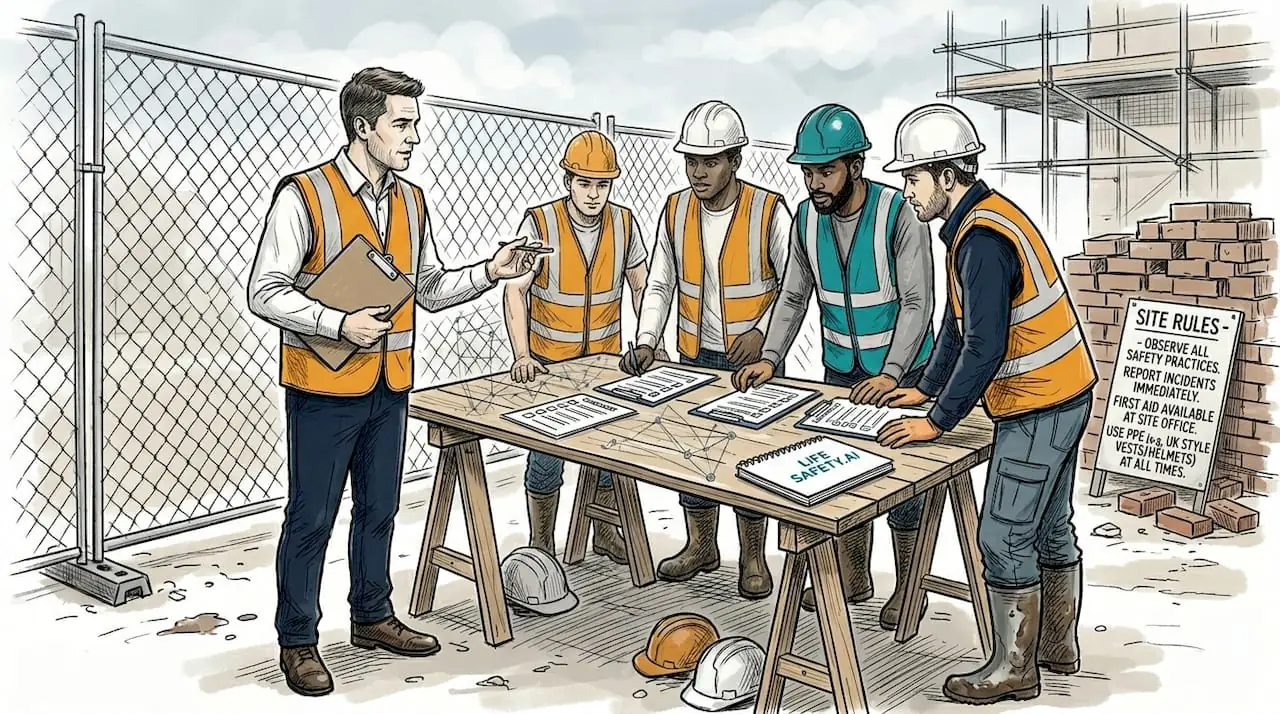
How to improve site safety: Practical steps for workplaces
How to improve site safety: Practical steps for workplaces
TL;DR:
- Construction and manufacturing sites face high risks such as falls, machinery contact, vehicle strikes, and hazardous substance exposure.
- Effective safety management depends on thorough planning, suitable and sufficient risk assessments, robust hazard controls, worker engagement, and disciplined review.
- Digital tools support monitoring, reporting, and compliance under frameworks such as RIDDOR, CDM 2015, COSHH, and the Building Safety Act, but they must reinforce, not replace, leadership and training.
Construction and manufacturing sites remain among the most hazardous workplaces in the UK. With over 8,000 enforcement notices issued to the construction sector in 2024 alone, the consequences of poor safety management are severe: injuries, fatalities, enforcement action, and reputational damage. The good news is that practical, evidence-based improvements are within reach for every compliance officer. This article walks you through the key risks, legal requirements, and actionable steps to strengthen site safety, from thorough planning and hazard controls to digital automation that transforms how your teams manage compliance day to day.
Table of Contents
- Understanding risks and legal requirements
- Preparation: Assessing and planning for safer sites
- Execution: Controlling hazards and engaging workers
- Verification and automation: Monitoring, reporting and digital tools
- A practical perspective: Building safety culture beyond technology
- Streamline site safety with LifeSafety.ai solutions
- Frequently asked questions
Key Takeaways
| Point | Details |
|---|---|
| Prioritise risk controls | Always use the HSE hierarchy of control to eliminate or guard hazards before relying on procedures or PPE. |
| Document and monitor | Thorough assessments, method statements, and digital reporting help ensure compliance and drive measurable safety improvements. |
| Engage and educate workers | Participation programmes, toolbox talks, and regular audits reduce accidents and strengthen a collaborative safety culture. |
| Leverage automation wisely | Digital tools automate compliance and reporting, but they must be matched by training, supervision, and leadership engagement. |
Understanding risks and legal requirements
Before you can improve site safety, you need a clear picture of what you are up against. Construction and manufacturing environments share several high-priority hazards that account for the majority of serious incidents each year.
Key site hazards include:
- Falls from height: 28% of construction fatalities in 2024/25
- Machinery contact and entanglement
- Vehicle and plant strikes in shared traffic zones
- COSHH exposures from dust, fumes, and chemicals
- Manual handling injuries and musculoskeletal disorders
Understanding these hazards is only the starting point. UK law sets clear expectations for how you manage them.
Regulatory frameworks you must comply with:
| Regulation | What it requires |
|---|---|
| CDM 2015 | Construction Phase Plans, Principal Designer and Principal Contractor duties, and coordinated risk management throughout the project lifecycle. |
| RIDDOR | Mandatory reporting of specified injuries, dangerous occurrences, occupational diseases, and fatalities. |
| COSHH Regulations | Assessment and control of hazardous substance exposures, including dust, fumes, vapours, and chemicals. |
| PUWER | Safe provision, maintenance, inspection, and use of work equipment. |
| Management of Health & Safety at Work Regulations | Suitable and sufficient risk assessments for all significant hazards and arrangements for planning, organisation, control, monitoring, and review. |
The HSE hierarchy of risk reduction is the gold standard for deciding how to control hazards. It prioritises elimination and substitution above all else, followed by engineering controls such as safe isolation and interlocks, then administrative procedures, and finally personal protective equipment. Relying on PPE alone is never acceptable as a primary control.
Your CDM compliance guidance obligations extend beyond paperwork. You must appoint competent duty holders, prepare and maintain a Construction Phase Plan, and ensure construction phase plan requirements are reviewed as the project evolves. Failure to meet these standards is precisely why enforcement rates remain high across UK construction safety regulations. A robust system is not optional; it is the foundation of every safe site.
Preparation: Assessing and planning for safer sites
With risks and legal duties clearly mapped, the next step is thorough preparation. Effective site safety begins long before anyone picks up a tool.
Steps for robust site safety planning:
- Conduct site-specific risk assessments for every significant hazard.
- Prepare method statements and RAMS that detail safe working procedures.
- Arrange site inductions covering emergency procedures, hazard zones, welfare arrangements, and reporting channels.
- Schedule regular toolbox talks to reinforce key safety topics.
- Implement permit-to-work procedures for high-risk activities such as hot works, confined space entry, and working at height.
- Establish a programme for regular site inspections and document findings.
- Review and update all documents when site conditions change.
HSE guidance is explicit: you must conduct detailed risk assessments, maintain method statements, carry out regular inspections, and track and report incidents including near-misses under RIDDOR where applicable. This is not a one-off exercise. Plans must be living documents.
Risk assessment and RAMS: what to include
| Document | Key elements |
|---|---|
| Risk assessment | Hazard identification, likelihood, severity, existing controls, further actions, responsible persons, and review dates. |
| Method statement | Step-by-step safe working procedure, equipment required, sequencing, responsible persons, and emergency arrangements. |
| COSHH assessment | Substance details, exposure routes, health effects, workplace exposure controls, PPE, and first-aid or spill response measures. |
One area where many sites fall short is documentation consistency. Using method statement templates that are standardised and version-controlled eliminates the risk of outdated documents circulating on site. Pair this with reliable incident reporting tools to ensure near-misses and incidents are captured and fed back into your risk assessment process.
Pro Tip: Automate your recordkeeping using a digital safety platform. When assessments, inductions, and permits are stored centrally and linked to the risk reduction hierarchy, compliance checks that once took hours can be completed in minutes.

Execution: Controlling hazards and engaging workers
Planning documents only deliver value when they are put into practice. Execution is where safety culture is either built or broken.
Applying hazard controls in practice:
- Eliminate hazards at the design stage wherever possible.
- Use safe isolation procedures before maintenance work begins.
- Install machinery interlocks and physical guarding on all relevant equipment.
- Enforce segregation of pedestrians and vehicles in shared zones.
- Use permit-to-work systems consistently for every high-risk task.
Worker engagement is equally critical. Toolbox talks and site briefings keep safety front of mind, but participation programmes go further. Labour inspections reduce injury risk by 25% and cut non-compliance by 32%, according to a recent meta-analysis. That is a compelling case for regular, structured engagement.
“Safety participation programmes and audits reduce accidents significantly. Monthly employee involvement, as seen at Michelin, drove measurable declines in workplace incidents.” HSE
Frontline workers often identify hazards that managers miss. Running monthly safety audit solutions that include worker input creates a feedback loop that continuously improves your controls. Real-time RAMS distribution means every worker has the current version of the method statement, not a printed copy from three weeks ago.
Worker engagement best practices:
- Involve workers in risk assessment reviews.
- Encourage near-miss reporting without fear of blame.
- Recognise and reward proactive safety behaviours.
- Use digital briefing tools to reach dispersed or multilingual teams.
Pro Tip: When rolling out automation in site safety, involve frontline teams early. Address knowledge gaps and resistance directly. Workers who understand why a system exists are far more likely to use it consistently.
Reviewing slip and trip reduction case studies from comparable industries can also surface practical ideas your team may not have considered.
Verification and automation: Monitoring, reporting and digital tools
Setting controls is only half the job. Verifying that they are working, and improving them over time, is where many organisations struggle.
Digital tools are transforming this part of the safety management cycle. Digital tools automate certifications, digital inductions, and real-time incident reporting, directly supporting the Building Safety Act’s golden thread principle of continuous, traceable documentation. This means every action, inspection, and incident is recorded and auditable.
Leading safety indicators to track:
| Indicator | Why it matters |
|---|---|
| Training completion rates | Predicts knowledge gaps before incidents occur. |
| Near-miss reporting frequency | Signals whether workers feel safe to report and whether weak signals are being captured. |
| Audit action close-out rates | Shows whether findings are acted upon promptly and effectively. |
| Permit-to-work compliance | Reflects discipline in high-risk task management. |
| Toolbox talk attendance | Measures engagement with safety communications and operational briefings. |
Tracking these leading indicators alongside lagging ones, such as injury rates and reportable events, gives you a far richer picture of site safety performance. Near-miss digital reporting platforms make it straightforward to capture and analyse this data in real time.
There is, however, an important nuance. Managers trust AI and automation for safety management far more than frontline workers do. Successful adoption depends on education, clear communication, and addressing deep-rooted paper-based habits. Technology alone does not fix culture.
Research on AI integration in safety monitoring reinforces this point: leading indicators must be empirically validated, not just assumed to be meaningful. Build your measurement framework carefully, and review it regularly with your safety team.
Exploring AI safety management insights can help you identify which indicators are most predictive for your specific site type and risk profile.
A practical perspective: Building safety culture beyond technology
Even the best digital system will underperform if the underlying culture is weak. Site safety improves most reliably when leaders treat compliance as an operational discipline rather than an administrative burden.
That means supervisors challenge unsafe acts consistently, managers review trends rather than just individual incidents, and directors ask whether controls are genuinely effective in practice. It also means workers are given the confidence to stop work, raise concerns, and report near-misses without fear of blame or retaliation.
What strong safety culture looks like on site:
- Visible leadership from managers and supervisors during inspections, briefings, and corrective actions.
- Clear accountability for closing out audit findings, permit breaches, and recurring hazards.
- Open reporting of unsafe conditions, near-misses, and lessons learned.
- Competence management so workers are trained, briefed, and authorised for the tasks they perform.
- Continuous review of RAMS, site logistics, and emergency arrangements as work evolves.
In UK construction and manufacturing, this cultural discipline is especially important because site conditions change quickly. A safe arrangement on Monday may be inadequate by Thursday if access routes, subcontractors, plant movements, or sequencing have changed. That is why monitoring and review are legal expectations under the Management Regulations, not optional extras.
Leaders should also be realistic about the limits of paperwork. A signed induction record does not prove understanding. A completed inspection form does not prove hazards were controlled. A closed action does not always mean the underlying risk has been reduced. The practical test is whether the site is safer in reality.
Common reasons safety systems fail despite good intentions:
- Risk assessments are copied forward without reflecting current site conditions.
- Method statements are too generic to guide real work activities.
- Permit systems exist on paper but are bypassed under production pressure.
- Near-miss reporting is discouraged by blame culture or slow follow-up.
- Audit findings are raised repeatedly because corrective actions are not embedded.
The practical answer is not more paperwork for its own sake. It is better-quality information, clearer ownership, and faster feedback loops. When workers see that reported issues lead to visible action, trust grows. When managers use data to remove barriers rather than assign blame, participation improves. That is how safety culture matures.
Streamline site safety with LifeSafety.ai solutions
If you are trying to improve site safety across multiple teams, contractors, or locations, consistency becomes one of the biggest challenges. LifeSafety.ai helps organisations standardise compliance processes while keeping them practical for day-to-day operations.
LifeSafety.ai can support your site safety programme through:
- CDM compliance tools for managing duty holder responsibilities and project documentation.
- Construction Phase Plan workflows that keep plans current and accessible.
- Method statement and RAMS management with version control and central access.
- Incident management for capturing accidents, near-misses, investigations, and corrective actions.
- Safety audit workflows that support inspections, findings, and action close-out.
- Near-miss reporting tools that strengthen leading indicator tracking and worker engagement.
Used properly, these tools help create the traceable, auditable record expected by regulators while reducing the administrative burden on site teams. They also support the golden thread approach by keeping critical safety information current, accessible, and linked across the project lifecycle.
For compliance officers, principal contractors, and operational leaders, the real value is not just digitisation. It is the ability to move from reactive paperwork to proactive control. That means faster updates to RAMS, clearer visibility of overdue actions, better evidence for audits, and stronger assurance that legal duties are being met in practice.
Ready to strengthen site safety?
LifeSafety.ai helps UK organisations manage site risk with practical tools for planning, reporting, auditing, and continuous improvement.
- Improve consistency across projects and contractors
- Support compliance with CDM 2015, RIDDOR, COSHH, and related HSE expectations
- Create a stronger evidence trail for inspections, investigations, and internal assurance
Frequently asked questions
What is the first step to improving site safety?
The first step is to carry out a suitable and sufficient risk assessment for the specific site and activities involved. Without a clear understanding of hazards, affected persons, and existing controls, it is impossible to prioritise effective action.
How often should risk assessments and RAMS be reviewed?
They should be reviewed whenever there is a significant change in site conditions, work methods, sequencing, personnel, equipment, or identified risk. They should also be reviewed after incidents, near-misses, or audit findings that suggest controls are no longer adequate.
Is PPE enough to control site hazards?
No. Under the HSE hierarchy of control, PPE is the last line of defence. Employers should first consider elimination, substitution, engineering controls, and administrative measures before relying on PPE.
What incidents must be reported under RIDDOR?
RIDDOR requires reporting of specified injuries, fatalities, dangerous occurrences, certain occupational diseases, and some over-seven-day incapacitations. Organisations should ensure supervisors know what is reportable and that reporting routes are clear and timely.
Why are near-miss reports so important?
Near-miss reports reveal weaknesses in controls before someone is harmed. They are one of the most useful leading indicators for identifying trends, improving risk assessments, and strengthening worker engagement.
How do digital tools help with Building Safety Act expectations?
Digital systems support the golden thread by keeping safety information accurate, accessible, and traceable. This helps organisations demonstrate that inspections, inductions, permits, incidents, and corrective actions are being managed in a structured and auditable way.
Can technology improve safety culture on its own?
No. Technology can improve visibility, speed, and consistency, but culture depends on leadership, competence, communication, and trust. Digital tools are most effective when they support a well-led safety system rather than attempt to replace it.
Related Articles

Incident reporting software comparison: UK guide 2026
Discover our incident reporting software comparison for UK workplaces. Explore top options like Lifesafety, SafetyCulture, and more.

Safety management solutions for construction: UK SMS guide
Discover essential safety management solutions for construction sites in the UK. Learn how a mobile-first SMS can enhance safety and compliance.

Best Health and Safety Software for UK Workplaces: A Guide
Discover the best health and safety software for UK workplaces in 2026. Explore top picks like Lifesafety for compliance and efficiency!