
How to conduct effective health and safety audits: A guide
How to conduct effective health and safety audits: A guide
TL;DR:
- Workplace incidents often result from overlooked safety gaps identified through audits.
- Proper preparation and systematic procedures are essential for effective health and safety audits.
- Engaging staff and focusing on real behaviours improve safety outcomes beyond mere compliance.
Workplace incidents do not happen by accident. In most cases, they are the result of gaps that a well-structured audit would have caught weeks or months earlier. Insufficient compliance remains a leading cause of workplace injuries and regulatory penalties across UK industries, from construction sites to manufacturing floors. This guide is designed to give health and safety officers a clear, practical framework for planning, conducting, and following up on audits that genuinely improve safety standards. We will walk you through every stage, from understanding your legal obligations to closing out corrective actions, so your organisation stays compliant and your workforce stays safe.
Table of Contents
- Understanding health and safety audits in the UK
- Preparation: What you need before you audit
- Step-by-step process for conducting the audit
- After the audit: Reporting, compliance, and follow-up
- Our perspective: What most health and safety audits miss
- How LifeSafety.ai can streamline your health and safety audits
- Frequently asked questions
Key Takeaways
| Point | Details |
|---|---|
| Audit basics | Know the distinction between audits, inspections, and risk assessments for full compliance. |
| Preparation matters | Detailed preparation and assembling the right team are crucial for audit success. |
| Follow clear steps | Structured, step-by-step processes help avoid missed issues and strengthen compliance. |
| Report and act | Timely reporting and corrective actions are legally required and improve safety culture. |
| Tools enhance results | Leveraging digital tools can streamline audits and ongoing compliance efforts. |
Understanding health and safety audits in the UK
A health and safety audit is a structured, systematic review of your organisation’s safety management systems, policies, and practices. It is not simply a walkthrough of the site. It is a thorough examination of whether your safety arrangements are working as intended and whether they meet the requirements set out by the Health and Safety Executive (HSE) and relevant UK legislation, including the Health and Safety at Work etc. Act 1974.
It is worth clarifying the difference between audits, inspections, and risk assessments, as these terms are often used interchangeably but mean different things. An inspection checks day-to-day conditions and activities. A risk assessment identifies hazards and evaluates their likelihood and impact. An audit, by contrast, looks at the broader system: are your policies documented, are your people trained, and are your procedures actually being followed?
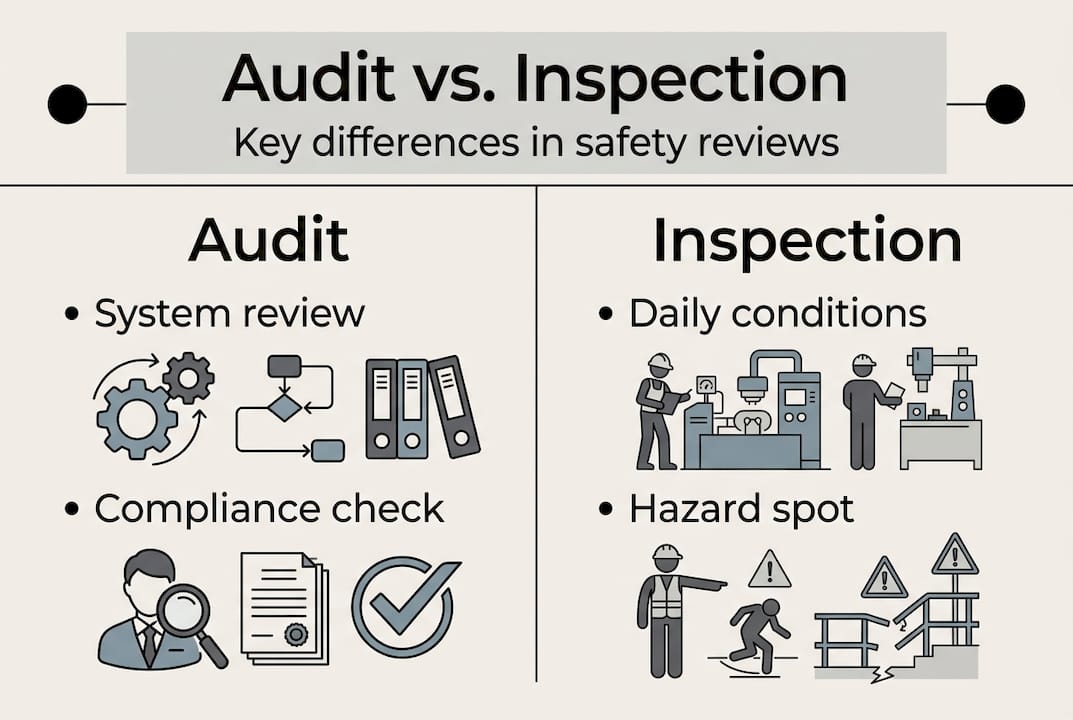
Understanding safety audit basics is the starting point for any officer who wants to move beyond reactive safety management. Audits support continuous improvement under HSE guidance, helping organisations identify weaknesses before they become incidents.
The key legal frameworks you need to be aware of include:
- The Health and Safety at Work etc. Act 1974, which sets out general duties for employers
- The Management of Health and Safety at Work Regulations 1999, which require documented risk assessments and management arrangements
- RIDDOR 2013 (Reporting of Injuries, Diseases and Dangerous Occurrences Regulations), which governs incident reporting
- CDM 2015, which applies specifically to construction projects and dutyholder responsibilities
- The Building Safety Act 2022, which strengthens accountability and competence expectations in higher-risk buildings
- UK HSE legal requirements that apply across sectors
A health and safety audit is not a one-off exercise. It is a vital part of a continuous cycle that keeps your workplace legally compliant and genuinely safer for everyone on site.
The benefits of a systematic audit approach are significant. You gain a clear picture of compliance gaps, you demonstrate due diligence to regulators, and you build a stronger safety culture across your teams. These are not abstract gains. They translate directly into fewer incidents, lower insurance costs, and greater confidence from clients, contractors, and principal dutyholders.
Preparation: What you need before you audit
Once you understand the basics, the next step is preparing everything needed to ensure a smooth audit. Preparation is not a formality. Proper preparation is the foundation of an effective audit, and skipping this stage is one of the most common reasons audits produce incomplete or misleading results.
Start by gathering the right documentation. You will need:
- Current health and safety policy and procedures
- Training records for all relevant personnel
- Previous audit and inspection reports
- Incident and near-miss logs
- Risk assessments for all significant activities
- Maintenance and equipment inspection records
- Emergency response plans
Assembling the right audit team is equally important. A strong team typically includes the health and safety officer, an operational manager familiar with the area being audited, and, where appropriate, an external specialist who brings an independent perspective. Involving workers directly affected by the processes being audited can also surface insights that management-level reviews miss.
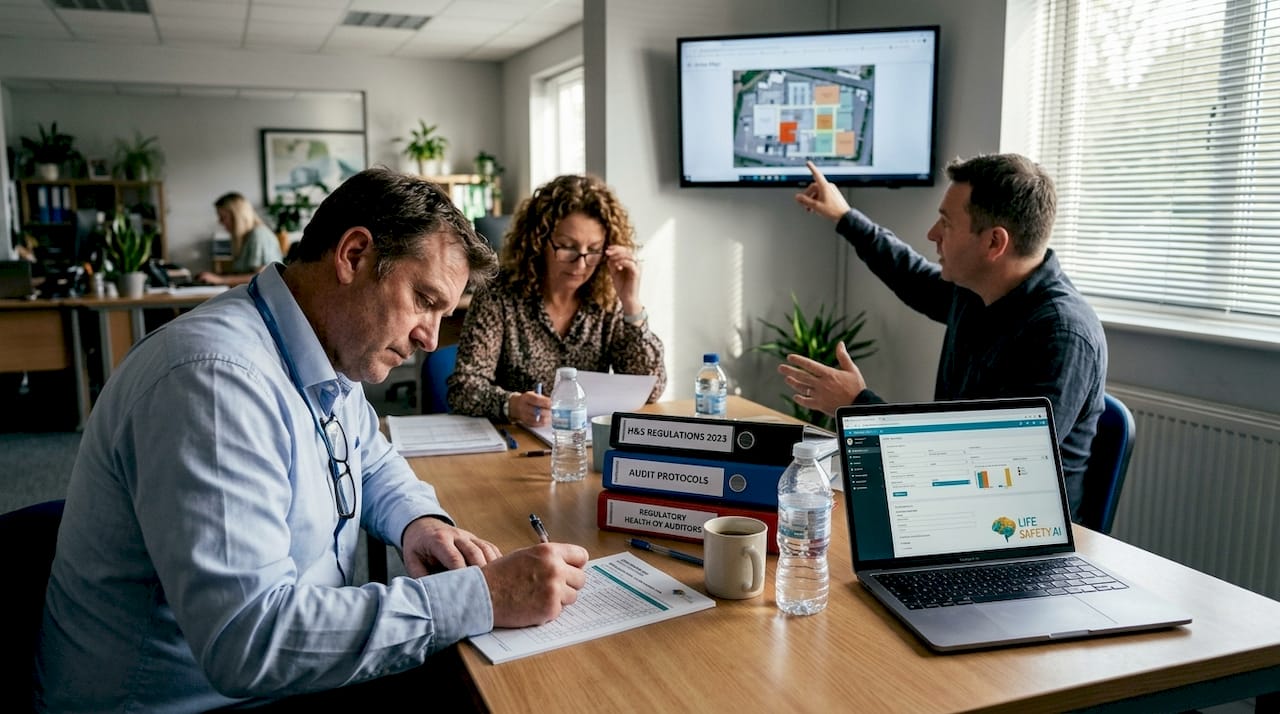
Pro Tip: Brief your audit team before the day. Assign specific areas of focus to each person so that nothing is duplicated and nothing is overlooked. A short pre-audit meeting of 30 minutes can save hours of confusion on the day itself.
Here is a quick overview of the essential tools and resources you should have ready:
| Tool | Purpose |
|---|---|
| Audit checklist | Ensures consistent coverage of all areas |
| Digital logging platform | Captures findings in real time |
| Previous audit reports | Provides benchmarks and tracks progress |
| Site maps or floor plans | Supports physical walkthrough planning |
| Interview question guide | Structures conversations with staff |
For those working in construction, reviewing construction safety tips before your audit can help you tailor your checklist to site-specific risks. Similarly, preparing for inspections shares useful overlapping principles that strengthen your overall readiness.
A common mistake at this stage is assuming last year’s checklist is still valid. Regulations change, your workforce changes, and your processes change. Always review and update your audit tools before each cycle.
Step-by-step process for conducting the audit
With your preparation complete, it is time to move into the audit itself, step by step. Following a clear sequence reduces missed issues and strengthens your regulatory defence if findings are ever challenged.
- Opening meeting: Gather the audit team and key site representatives. Confirm the scope, objectives, and schedule for the day. Set a professional but open tone so staff feel comfortable raising concerns.
- Physical walkthrough: Inspect the site systematically. Focus on machinery guarding, manual handling practices, fire escape routes, PPE usage, hazardous substance storage, and emergency equipment condition.
- Document review: Cross-reference what you observe on site with what your records say should be happening. Gaps between the two are often where the most significant findings emerge.
- Staff interviews: Speak with workers at various levels. Ask open questions about their understanding of procedures and whether they feel able to raise safety concerns. Their answers frequently reveal cultural issues that documents cannot capture.
- Closing meeting: Present preliminary findings to site management. Agree on timescales for corrective actions and confirm how the final report will be shared.
Critical areas to inspect include machinery and equipment, documented audits and records, emergency readiness, and training compliance. You can also explore specialised safety modules to extend your audit scope into specific risk areas.
Safety warning: Never conduct a physical walkthrough without appropriate PPE for the environment you are entering. Auditors are not exempt from site safety rules, and failing to follow them undermines the credibility of the entire process.
Pro Tip: Use a digital platform rather than paper checklists during the walkthrough. Real-time logging means findings are captured accurately, photographs can be attached instantly, and nothing is lost to illegible handwriting or misplaced sheets.
The HSE audit toolkit provides a useful reference for structuring your approach, particularly if you are auditing a new type of environment for the first time.
| Method | Manual tracking | Software-based tracking |
|---|---|---|
| Speed of recording | Slow, prone to errors | Fast, accurate, real-time |
| Evidence capture | Limited | Photos, notes, timestamps |
| Report generation | Hours of manual work | Automated, consistent |
| Audit trail | Paper-based, fragile | Cloud-stored, secure |
After the audit: Reporting, compliance, and follow-up
Completing the audit is not the end. Reporting and addressing findings are vital for compliance, and this is the stage where many organisations lose momentum. The audit report is your legal record of what was found and what was done about it.
Documenting findings and actions is a legal requirement under many HSE frameworks, and a well-structured report protects your organisation if a regulatory investigation ever takes place. Your report should include:
- Executive summary of overall compliance status
- Detailed findings for each area audited
- Non-conformities identified and their root causes
- Photographs and supporting evidence
- Recommended corrective actions with assigned owners and deadlines
- Reference to relevant legislation or standards
Prioritising corrective actions is critical. Not every finding carries the same risk. Use a simple risk rating such as high, medium, and low to determine which actions must be addressed immediately and which can be scheduled over weeks or months. High-priority findings should never wait for the next audit cycle.
Pro Tip: Assign each corrective action to a named individual with a specific deadline. Vague ownership leads to vague accountability. Follow up formally at agreed intervals, and document every update in your audit management system.
Maintaining audit records is not optional. Under UK law, records must be kept for a minimum period, and the HSE may request them during an incident investigation. Keeping records digitally ensures they are searchable, backed up, and accessible to the right people at any time.
For organisations with specific responsibilities around fire safety, reviewing fire safety compliance guidance alongside your audit findings ensures you are meeting all relevant obligations in that area. Ongoing compliance is not a single event. It is a continuous cycle of audit, action, review, and improvement.
Where findings relate to reportable incidents, dangerous occurrences, or systemic failings, ensure your escalation process aligns with RIDDOR thresholds and internal governance. In construction and higher-risk building environments, audit findings may also inform principal contractor reviews, competence assessments, and evidence needed under the Building Safety Act accountability framework.
Our perspective: What most health and safety audits miss
Reflecting on the process, it is clear that there is more to audits than ticking boxes. We have seen organisations produce immaculate audit reports that change almost nothing about how people actually behave on site. That is the gap most audits fail to bridge.
The uncomfortable truth is that compliance on paper and compliance in practice are two very different things. Workers can recite a procedure perfectly in an interview and ignore it completely the moment the auditor leaves. The strongest audit programmes recognise this and test for lived behaviour, not just documented intent.
That means looking beyond whether a policy exists and asking harder questions:
- Do supervisors consistently enforce the standard?
- Do workers understand why the control measure matters, not just what the rule says?
- Are production pressures undermining safe systems of work?
- Do contractors follow the same standards as direct employees?
- Are near-misses being reported honestly, or quietly normalised?
This is especially important in construction, manufacturing, and facilities environments where routine deviation can become culturally accepted. A missing guard, a blocked fire exit, or a shortcut around permit controls may be seen as normal until an injury, enforcement notice, or prosecution proves otherwise.
The best audits do not just ask whether the system exists. They test whether the system works under real operational pressure.
Another common weakness is failing to connect audit findings to wider business risk. Health and safety is not separate from operations, quality, insurance, procurement, or reputation. A poor audit result can indicate weaknesses in leadership, competence management, contractor control, and governance. In regulated sectors, that can quickly become a board-level issue.
In our view, effective audits should therefore combine three lenses:
- Legal compliance: Are you meeting HSE, RIDDOR, CDM 2015, and sector-specific duties?
- Operational reality: Are controls actually being followed on the ground?
- Continuous improvement: Are findings being used to strengthen culture, competence, and leadership over time?
When those three elements come together, audits stop being a paperwork exercise and become a practical management tool that prevents harm.
How LifeSafety.ai can streamline your health and safety audits
Even well-designed audit processes can become slow and inconsistent when they rely on spreadsheets, paper forms, and fragmented follow-up. That is where digital systems make a measurable difference. LifeSafety.ai helps organisations standardise audits, capture evidence in real time, and maintain a clear compliance trail across sites and teams.
Using LifeSafety.ai, health and safety teams can:
- Create structured digital audit templates tailored to construction, manufacturing, facilities, and higher-risk environments
- Record findings instantly with notes, photographs, timestamps, and location context
- Assign corrective actions to named owners with deadlines and status tracking
- Link audits to related inspections, incidents, permits, and site diary records
- Maintain a secure, searchable audit trail for internal review and external scrutiny
- Identify recurring trends across projects, contractors, or business units
For organisations managing multiple sites, this kind of visibility is especially valuable. It allows leadership teams to compare performance, spot repeated non-conformities, and intervene before local issues become systemic failures. That supports stronger governance and a more defensible position if the HSE, clients, insurers, or principal dutyholders request evidence.
Relevant LifeSafety.ai tools include:
- Safety Audits for structured audit workflows and evidence capture
- Safety Inspections for routine site checks and operational verification
- Site Diary for daily records that support audit findings and follow-up
- Specialised modules to extend oversight into permits, incidents, and compliance management
The real advantage is not just speed. It is consistency, traceability, and accountability. When audits are easier to complete and easier to follow up, they become more frequent, more reliable, and more useful to the business.
Frequently asked questions
How often should a health and safety audit be carried out?
The right frequency depends on your risk profile, industry, and regulatory exposure. Many organisations carry out formal audits annually, with targeted or themed audits more frequently. Higher-risk construction and manufacturing environments may require quarterly reviews or additional audits after incidents, major changes, or enforcement action.
What is the difference between an audit and an inspection?
An inspection focuses on current site conditions and behaviours. An audit examines the wider management system, including policies, competence, records, supervision, and whether controls are consistently implemented. Both are important, but they serve different purposes.
Who should be involved in a health and safety audit?
A typical audit team includes the health and safety lead, operational management, and where useful, an independent or specialist reviewer. Worker involvement is also valuable because frontline staff often identify practical issues that are not visible in documents alone.
Do audit findings need to be linked to legal requirements?
Yes. Good audit reports should reference the relevant legal duty, standard, or internal requirement wherever possible. This makes findings clearer, supports prioritisation, and strengthens your evidence base if the HSE or another regulator reviews your records.
Can digital tools improve audit quality?
Yes. Digital systems improve consistency, evidence capture, action tracking, and record retention. They also reduce administrative burden, making it easier to complete audits properly and follow through on corrective actions.
What should happen after an audit identifies a serious issue?
Serious findings should trigger immediate risk control measures, escalation to the appropriate manager, and formal action tracking. If the issue relates to an incident, dangerous occurrence, or legal reporting threshold, review whether RIDDOR notification or other statutory action is required without delay.
Related Articles

Incident reporting software comparison: UK guide 2026
Discover our incident reporting software comparison for UK workplaces. Explore top options like Lifesafety, SafetyCulture, and more.

Safety management solutions for construction: UK SMS guide
Discover essential safety management solutions for construction sites in the UK. Learn how a mobile-first SMS can enhance safety and compliance.

Best health and safety software for UK workplaces: 2026 guide
Discover the best health and safety software for UK workplaces in 2026. Explore top picks like Lifesafety for compliance and efficiency!