
BS standards explained: a guide for safety professionals
BS standards explained: a guide for safety professionals
British Standards shape how UK organisations demonstrate safe systems of work, evidence compliance, and defend decisions during audits, investigations, and enforcement action. For safety professionals working across construction, manufacturing, facilities, and the built environment, understanding how these standards operate is central to robust governance.
TL;DR
- British Standards are technical specifications issued by the British Standards Institution that establish safety and quality benchmarks across UK industries.
- While they are not laws in themselves, they are frequently cited in regulations and guidance, making adherence highly important for legal compliance, risk control, and defensible decision-making.
British Standards are formal technical specifications that define minimum requirements for safety, quality, and performance across UK industries. Produced under the authority of the British Standards Institution (BSI), they establish best-practice benchmarks accepted across sectors from construction to healthcare. For health and safety professionals and compliance officers, understanding BS standards is not optional. These specifications directly shape how audits are conducted, how risk assessments are written, and how liability is determined when things go wrong. This guide covers what BS standards are, how they are structured, and how to apply them effectively in your compliance work.
What are BS standards explained in plain terms?
A British Standard is a published document that sets out agreed specifications and procedures for a product, service, or system. The BSI, the UK’s national standards body, oversees their development and publication. Each standard carries a unique reference number, such as BS 7671 for electrical wiring regulations or BS 5306 for fire extinguishing systems.
The term “BS standards” is the common shorthand used by professionals. The formal industry term is simply “British Standards,” and both are used interchangeably across the sector. What matters is understanding that these documents are not marketing guidelines or aspirational targets. They represent the collective technical judgement of industry experts, regulators, and end users on what constitutes safe and effective practice.
British Standards underpin workplace safety by providing benchmarks for electrical installations, appliance safety, fire suppression, and protective equipment. That scope makes them indispensable for any compliance officer managing risk across a UK workplace. In practical terms, they often sit alongside HSE guidance, Approved Codes of Practice, and sector-specific duties under legislation such as the Health and Safety at Work etc. Act 1974, CDM 2015, and the Building Safety Act where building risk management and competence are under scrutiny.
How are British Standards developed and maintained?
Standards are developed by industry committees representing producers, users, and regulators, working together to produce guidance that is both technically sound and practically applicable. This consensus-based process is what gives British Standards their authority. No single organisation dictates the outcome. Instead, the standard reflects agreement across the people who design, use, and regulate the relevant systems.
The development process includes several key stages:
- Drafting: A technical committee prepares a draft standard based on current knowledge, incident data, and regulatory requirements.
- Public consultation: The draft is published for comment, allowing industry professionals to flag gaps or errors before finalisation.
- Publication: The finalised standard is published by BSI and assigned a reference number and date.
- Review: Standards are reviewed periodically, typically every five years, to reflect technological change or new regulatory requirements.
BS EN and BS ISO standards indicate that the UK has adopted harmonised European or international standards, promoting consistency across borders. This matters for compliance officers working with suppliers or contractors from outside the UK, as the same underlying specification applies in multiple jurisdictions.
Pro Tip: When a standard is revised, the year changes in its reference number. Always check you are working from the current version. Older standards such as BS 5518 have been replaced by European equivalents and no longer apply for compliance purposes.
What types of BS standards should safety professionals know?
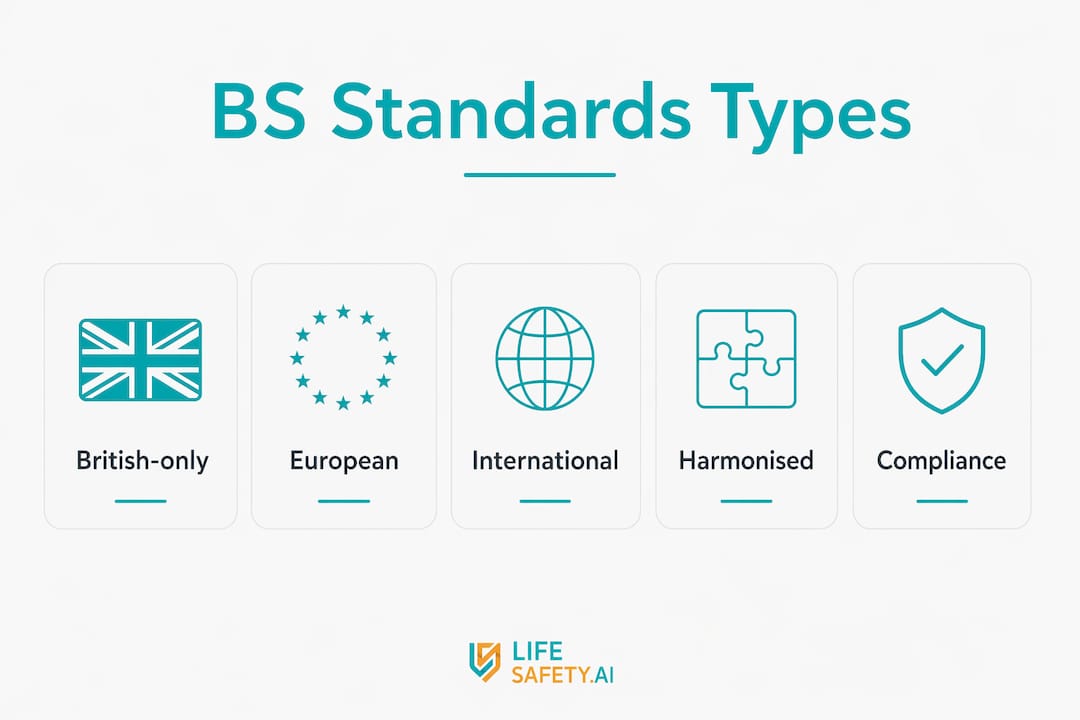
British Standards fall into three main categories, each with a distinct scope and application.
| Category | What it means | Example |
|---|---|---|
| BS | British-only standard | BS 7671 (Wiring Regulations) |
| BS EN | British adoption of a European standard | BS EN 60335 (appliance safety) |
| BS ISO | British adoption of an international standard | BS ISO 45001 (occupational health and safety) |
Compliance officers benefit from understanding these distinctions when navigating cross-border regulatory environments. A contractor working across the UK and EU, for example, needs to know which standards apply in each context and where they overlap.
Key electrical safety standards
BS 7671:2018, known as the IET Wiring Regulations, is the primary standard for electrical system design and installation in workplaces. It covers everything from cable sizing to earthing arrangements. Alongside it, BS 1363 governs UK 13A plugs and sockets, and BS EN 60335 sets safety requirements for household and commercial appliances. For professionals managing electrical safety across a site, these three standards form the core reference set.

Fire safety standards
The BS 5306 series covers fire extinguishing installations and their maintenance. BS 5306-0 addresses system selection, while BS 5306-3 specifies commissioning and maintenance requirements for portable extinguishers. Any compliance officer responsible for fire safety audits should be familiar with this series. Detailed guidance on applying these requirements in practice is available through LifeSafety.ai’s fire safety compliance resources.
Protective equipment and facilities management
Standards for personal protective equipment (PPE) fall largely under BS EN series, reflecting harmonisation with European product safety directives. Facilities managers also rely on standards covering water hygiene, ventilation, and access equipment. The breadth of applicable standards means that a structured approach to identifying which ones apply to your site is more effective than trying to read every document in full.
In higher-risk environments such as construction and manufacturing, this structured approach should be aligned with dutyholder responsibilities under CDM 2015, contractor control arrangements, and competence management. Where building occupation, refurbishment, or fire strategy is involved, standards should also be considered in the context of the Building Safety Act and the wider golden thread expectation for accurate, accessible safety information.
How do BS standards influence legal compliance and risk management?
BS standards are technically voluntary, but their citation in UK regulations makes them de facto mandatory in many contexts. The Electricity at Work Regulations 1989, for instance, references BS 7671 directly. Following that standard is therefore the accepted method of demonstrating compliance with the law. Departing from it requires a documented justification showing that an equivalent level of safety has been achieved by other means.
Non-compliance with a relevant British Standard does not automatically constitute a criminal offence, but it can be used as evidence of negligence in civil proceedings and insurance claims. In practice, this means that failing to follow BS 7671 during an electrical installation, or neglecting BS 5306-3 maintenance schedules for fire extinguishers, creates measurable legal and financial exposure for the organisation and the responsible individual.
The practical implications for compliance officers are significant:
- Safety audits: Standards define the criteria against which safety audits are measured. An auditor will check whether installations, equipment, and procedures meet the relevant standard.
- Risk assessments: A risk assessment that references applicable BS standards carries more weight in enforcement proceedings than one that does not.
- Incident investigations: When an incident occurs, investigators examine whether the relevant standard was followed. Departure from the standard shifts the burden of proof onto the organisation.
- Insurance: Insurers increasingly require evidence of standards compliance as a condition of cover, particularly for high-risk activities.
This is especially relevant where incidents may trigger RIDDOR reporting. If a dangerous occurrence, specified injury, or fire-related event is reportable, investigators will often examine whether recognised standards were embedded into the system of work. In construction, that may include whether design, temporary works, electrical installations, or fire precautions reflected accepted standards. In manufacturing, it may include guarding, maintenance, isolation, and equipment suitability.
Pro Tip: Keep a register of the BS standards that apply to your site, mapped to the specific regulations that reference them. This makes audit preparation faster and gives you a clear record of your compliance rationale.
Where can professionals access and use BS standards effectively?
Accessing British Standards is straightforward once you know the available channels. The cost of individual standards can be significant, but several routes reduce or eliminate that expense.
- BSI British Standards Online (BSOL): The BSI’s subscription platform provides access to the full catalogue of current standards. Organisational subscriptions are available and cost-effective for teams that reference standards regularly.
- University and public library memberships: Many university and public libraries provide free access to BSOL through institutional licences. If you are a member of a professional body or affiliated with a university, check whether this access is available to you before purchasing individual documents.
- Professional body resources: Bodies such as the Institution of Engineering and Technology (IET) and the Chartered Institution of Building Services Engineers (CIBSE) provide guidance documents and summaries that interpret key standards for their members.
- BSI Knowledge: BSI publishes handbooks and guidance documents that consolidate related standards into a single reference, which is often more practical than reading each standard individually.
Once you have access, integrate standards into your operational processes rather than treating them as reference documents to consult only during audits. Map each standard to the relevant risk area, assign ownership to a named individual, and set calendar reminders for review dates. Training records should confirm that relevant staff have been briefed on the standards that affect their work. This approach converts a document library into a live compliance framework.
For organisations managing multiple sites, contractors, or principal dutyholder arrangements, it is good practice to build standards into document control, procurement, permit-to-work, inspection schedules, and competence matrices. That way, compliance is not dependent on one person remembering a reference number; it becomes part of the management system.
Key takeaways
British Standards are the technical backbone of UK health and safety compliance, and understanding their structure, legal weight, and practical application is the most direct route to defensible, audit-ready safety management.
| Point | Details |
|---|---|
| BS standards are not laws | They are best-practice specifications, but citation in regulations makes them effectively mandatory in many contexts. |
| Three main categories exist | BS, BS EN, and BS ISO each reflect different scopes of harmonisation and apply in different regulatory environments. |
| Key standards to know | BS 7671, BS 5306, and BS EN 60335 are among the most frequently referenced in UK workplace safety audits. |
| Non-compliance creates liability | Departing from a relevant standard can be used as evidence of negligence in civil and insurance proceedings. |
| Free access is available | University and library memberships through BSOL can eliminate the cost of accessing individual standards. |
Why the legal status of BS standards still confuses experienced professionals
The question I hear most often from compliance officers is some version of: “Is this standard actually law, or can I choose not to follow it?” The honest answer is that the distinction matters far less than most people think, and focusing on it is often a distraction from the real work.
The more useful question is: “If something goes wrong on my site, will I be able to show that I followed recognised best practice?” British Standards are the primary mechanism for answering yes to that question. I have seen organisations spend considerable energy arguing that a particular standard does not strictly apply to their situation, only to find that an enforcement officer or a court takes a different view.
Post-Brexit harmonisation adds another layer of complexity. Some professionals assume that because a standard originated at European level, it is somehow less relevant in the UK. In practice, many BS EN standards remain deeply embedded in procurement specifications, product conformity expectations, and established safety management systems. The label may look technical, but the operational question remains simple: is this the recognised benchmark for safe practice in your activity?
This confusion is also reinforced by the way standards are used in different legal settings. In a criminal investigation led by the HSE, the regulator may focus on whether the employer reduced risk so far as is reasonably practicable. In a civil claim, the same facts may be examined through the lens of negligence and accepted industry practice. In an insurance dispute, the issue may become whether the insured complied with policy conditions or maintenance obligations. In all three scenarios, British Standards can become highly persuasive evidence.
For experienced professionals, the safest approach is not to debate whether a standard is “mandatory” in the abstract. It is to decide whether the standard is relevant, whether your organisation follows it, and if not, whether you have a documented, technically credible alternative that achieves at least the same level of control. That is the standard of thinking that stands up best under scrutiny.
Practical steps for applying BS standards in UK safety management
Turning standards into day-to-day compliance requires more than keeping PDFs in a shared drive. Safety leaders should build a repeatable process that links standards to hazards, legal duties, and operational controls.
- Create a standards register: List each relevant BS, BS EN, or BS ISO standard and identify where it applies across sites, assets, and activities.
- Map standards to legislation: Record links to the Health and Safety at Work etc. Act, Electricity at Work Regulations, Fire Safety Order, CDM 2015, RIDDOR, and any sector-specific duties.
- Assign ownership: Give each standard a responsible person, such as the facilities manager, electrical duty holder, fire safety lead, or project manager.
- Embed into documents: Reference standards in risk assessments, method statements, inspection forms, maintenance schedules, contractor briefs, and procurement specifications.
- Verify competence: Ensure staff and contractors understand the standards relevant to their tasks, and retain evidence through induction, toolbox talks, and formal training records.
- Review after change or incident: Revisit applicable standards after refurbishment, process change, equipment replacement, near misses, or reportable events.
This approach is particularly valuable in construction and manufacturing, where multiple contractors, changing work fronts, and complex plant interfaces can create gaps between written procedures and actual practice. A standard only helps if it is translated into controls people can follow and supervisors can verify.
Final thought
British Standards are not just technical publications for engineers and specialists. They are practical compliance tools that help organisations show what good looks like. For safety professionals, they provide a common language for design, maintenance, inspection, competence, and assurance.
If your organisation wants stronger audit readiness, clearer accountability, and better evidence for HSE scrutiny, insurer review, or internal governance, start by identifying the standards that matter most to your risk profile. Then make sure those standards are visible in the way work is planned, delivered, checked, and recorded.
In UK health and safety, defensibility often comes down to one question: can you show that your controls reflect recognised good practice? British Standards remain one of the strongest ways to answer that question with confidence.
Support compliance with LifeSafety.ai
LifeSafety.ai helps teams operationalise standards through structured risk assessments, auditable safety audits, reliable training records, and site-level oversight for electrical, fire, and contractor risk.
Related Articles

Incident reporting software comparison: UK guide 2026
Discover our incident reporting software comparison for UK workplaces. Explore top options like Lifesafety, SafetyCulture, and more.

Safety management solutions for construction: UK SMS guide
Discover essential safety management solutions for construction sites in the UK. Learn how a mobile-first SMS can enhance safety and compliance.

Best health and safety software for UK workplaces: 2026 guide
Discover the best health and safety software for UK workplaces in 2026. Explore top picks like Lifesafety for compliance and efficiency!